

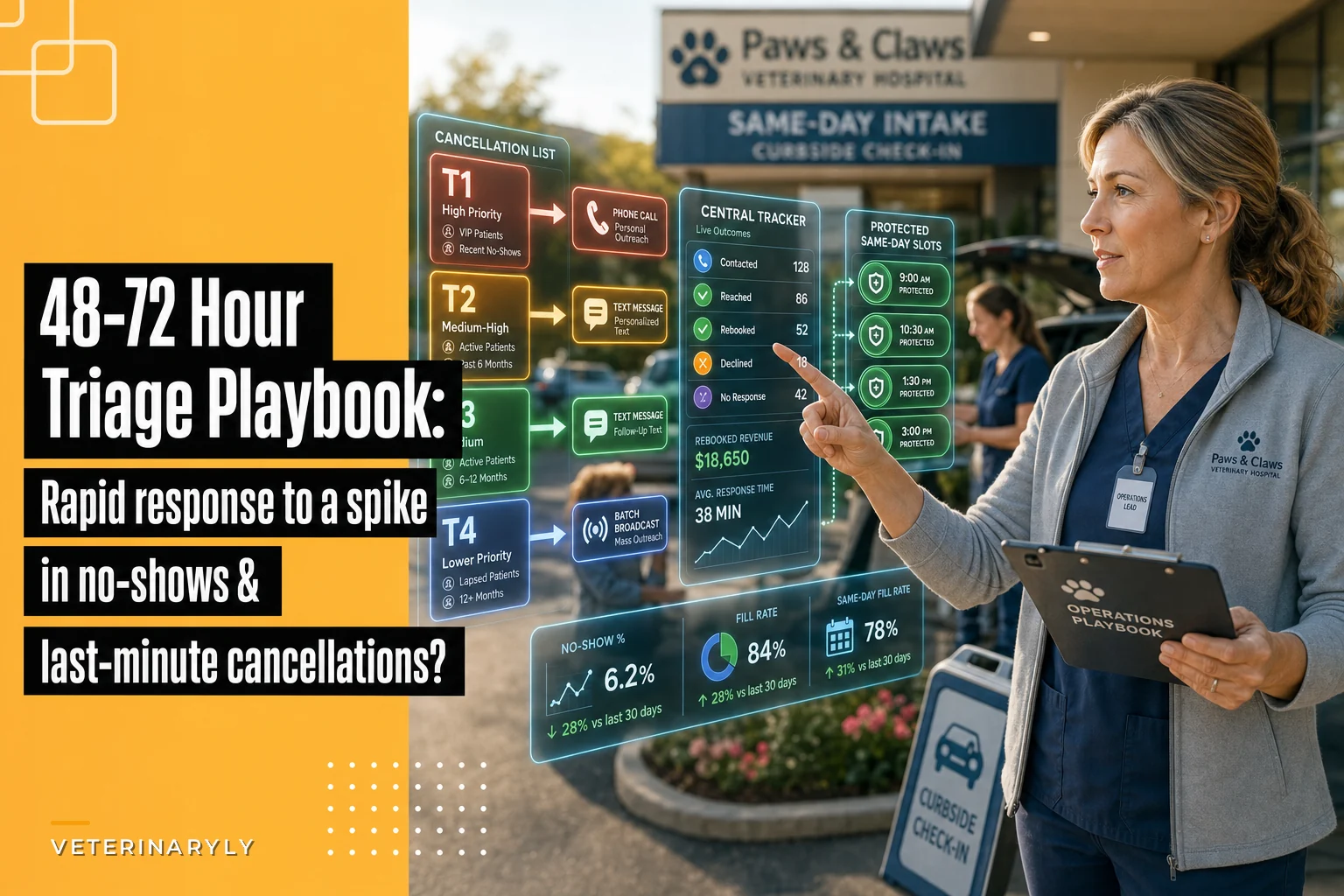

A normal clinic runs a no‑show rate somewhere in the 8–15% range depending on your client base, reminder system, and how much walk‑in work you take. When that number suddenly jumps to 25% or higher — over a weekend, a holiday week, flu season, bad weather, or for no obvious reason at all — you don't have time to sit around theorizing about why. You have exam rooms sitting empty, technicians standing around, and a revenue hole opening up in real time.
This is a clinic no‑show triage plan built for exactly that moment. Not a long‑term prevention strategy. Not a deposit‑policy overhaul. This is what you do in the next 48 to 72 hours to stop the bleeding, recover as much of the schedule as possible, and come out the other side stable enough to plan properly.
Everything here is meant to be executed by a small team — a practice manager, a lead CSR, and maybe a doctor who can approve schedule changes. Scripts are copy‑and‑paste. Timelines are aggressive on purpose.
First, know what you're actually dealing with
Before the checklist, one distinction that saves people from overreacting.
There's a difference between a spike and a shift. A spike is short and sharp — a bad three days, then it settles. A shift is a slow creep upward that's been happening for weeks and you only just noticed. This playbook is for spikes. If your no‑show rate has been climbing steadily for a month, aggressive rebooking won't fix the underlying problem and you'll just exhaust your team chasing it.
Quick test: pull your no‑show and cancellation numbers for the last 10 business days. If the last 2–3 days are dramatically worse than the 7 before them, you have a spike. Run the playbook.
Hours 0–12: Stabilize before you optimize
The instinct in the first few hours is to start frantically calling everyone who cancelled. Don't. This block is about containment — protecting the appointments you still have and reassigning idle capacity — not aggressive recovery.
Never miss a pet’s appointment again.
Veterinaryly helps you schedule, confirm, and manage every appointment and patient record effortlessly.
- Centralized appointment & patient management
- Automated client reminders
- Staff scheduling & task tracking
No credit card required
The 0–12 hour checklist
-
[ ] Pull the live picture
today's confirmed appointments, today's cancellations/no‑shows, and tomorrow's confirmed list.
-
[ ] Identify every unconfirmed appointment in the next 48 hours — these are your highest cancellation risk right now.
-
[ ] Send an immediate confirmation blast to those unconfirmed appointments (script below).
-
[ ] Build a same‑day fill list
recent cancellations, clients who wanted earlier slots, delayed recheck patients, and pending sick visits waiting on an opening.
-
[ ] Reassign idle staff — don't send techs home yet. Redeploy them to callbacks, unpaid‑balance outreach, and pharmacy refills.
-
[ ] Flag any revenue‑critical or medically urgent patients who cancelled (surgeries, sick pets, chronic‑disease rechecks) for priority callback in the next block.
-
[ ] Post a short internal note so the whole team knows the plan and stops improvising.
That last point matters more than it sounds. In real operations, the biggest early damage during a no‑show spike isn't the empty slots — it's five different staff members each doing their own uncoordinated version of "handling it." One person overbooks, another sends a client home, a third tells someone "we're slow, come whenever." You want one plan, communicated once.
Confirmation blast — text and voicemail
Text: > Hi [First Name], this is [Clinic] confirming [Pet]'s appointment on [Day] at [Time]. Reply C to confirm or R if you need to reschedule. We're holding this spot for you — thanks!
Voicemail: > Hi, this is [Name] from [Clinic] calling to confirm [Pet]'s visit on [Day] at [Time]. If that still works, no need to call back. If you need a different time, give us a ring at [Number] and we'll take care of it. Thanks!
The "reply R if you need to reschedule" line does something people underestimate: it gives the wobbly client an easy exit now, instead of them ghosting you at appointment time. A reschedule 24 hours out is a slot you can refill. A no‑show at 3pm is dead time.
Hours 12–48: Triage and rebook by priority, not by order
This is the core of the whole plan. Once the schedule is contained, you start recovering — but in a specific order. Most clinics rebook chronologically or randomly, calling whoever's list is on top. That's a mistake. You have limited calling hours and limited slots, so spend them on the patients who matter most, clinically and financially.
The priority tiers
| Tier | Who | Why they come first | Rebook target |
|---|---|---|---|
| 1 | Sick visits, post‑op rechecks, surgeries that cancelled | Medical risk + high revenue | Within 24–48 hrs |
| 2 | Chronic‑disease monitoring (diabetic, renal, cardiac rechecks) | Skipped monitoring = worse outcomes + lost recurring revenue | Within 3–5 days |
| 3 | Vaccine/wellness with an active reason to come (overdue, boarding soon, new pet) | Time‑sensitive, easy to lose | Within 1–2 weeks |
| 4 | Routine wellness, no urgency | Nice to recover, low priority | Backfill only |
Work the list top‑down. If you only get through Tier 1 and half of Tier 2 today, that's fine — you spent your hours where the money and the medicine are.
For your chronic patients specifically, this is where a spike quietly costs you the most. A diabetic recheck that slips is easy to let slide "until next month," and next month becomes never. Those are the patients tied to predictable, recurring revenue, and they're exactly the ones a chronic‑care follow‑up rhythm is meant to protect.
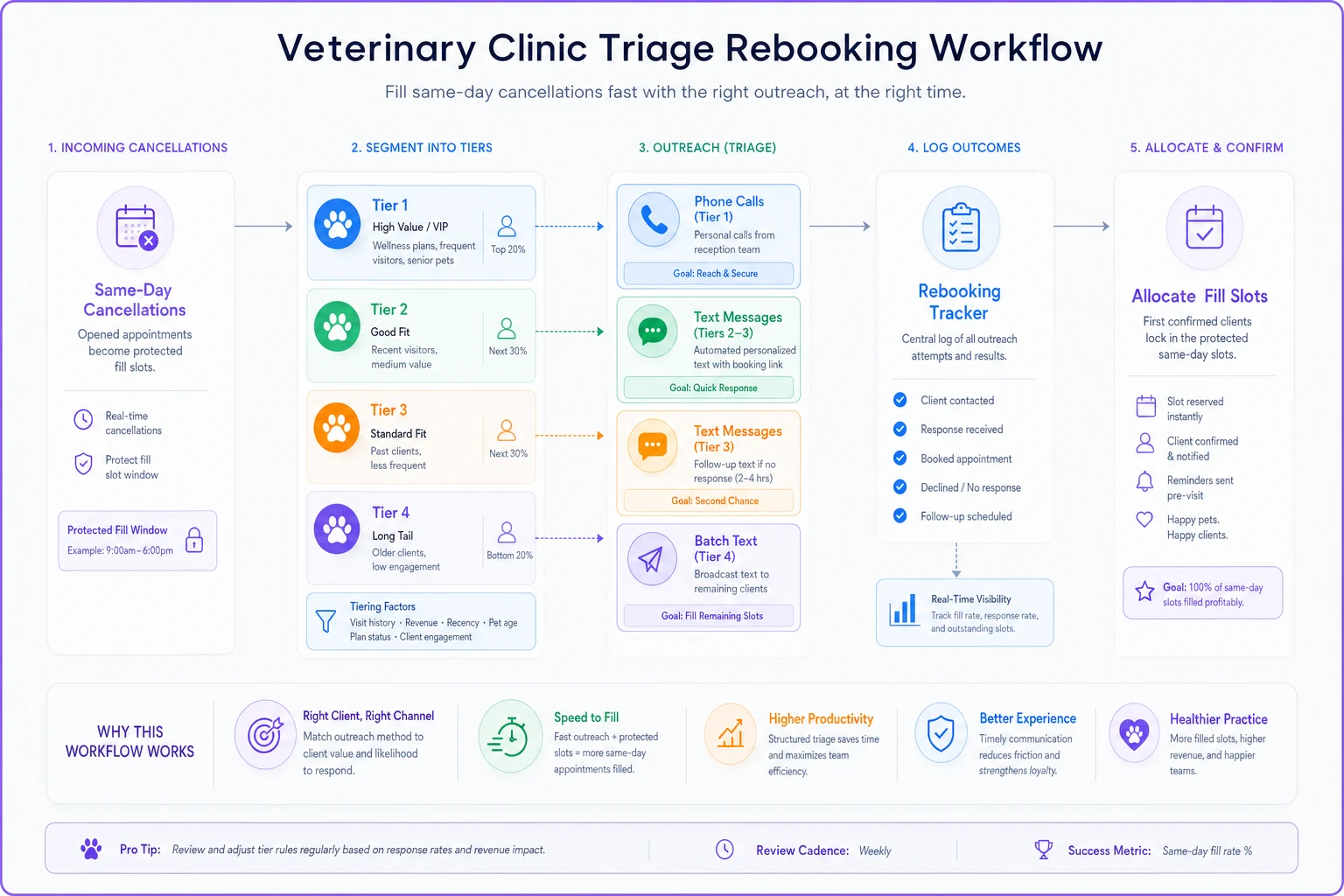
The triage rebooking process
-
Segment the cancellation/no‑show list into the four tiers above. A quick spreadsheet or a filtered view in your PMS works.
-
Call Tier 1 first, live, by phone. These are conversations, not texts. Offer the earliest slot you have, including any you just freed up.
-
Text Tier 2 and Tier 3 with a direct rebooking link or two specific time options. Two choices convert far better than "call us to reschedule."
-
Batch Tier 4 into a single evening text with an online booking link. No live calls.
-
Log every outcome — rebooked, declined, no answer — so nobody double‑calls and you can measure your contact rate later.
Use a simple visual to keep the rebooking workflow clear for whoever's on the phone.
Rebooking call script (Tier 1)
> Hi [First Name], it's [Name] at [Clinic]. I saw [Pet]'s [appointment/surgery/recheck] didn't happen as scheduled and I wanted to get [him/her] back in quickly — especially since it's a [recheck / sick visit / post‑op]. I actually have an opening [tomorrow at X] or [Thursday at Y]. Which works better for you?
No lecture about missing the appointment. In a spike, guilt‑tripping clients tanks your rebook rate. You want them back, not apologetic.
Rebooking text (Tier 2/3)
> Hi [First Name] — [Clinic] here. We'd like to get [Pet] back on the schedule for [his/her] [recheck/vaccines]. Two openings: [Day/Time] or [Day/Time]. Reply with your pick, or book anytime here: [link].
The auto‑message cadence
-
Hour 0
Confirmation or rebooking text (per tier)
-
Hour 24
Gentle reminder if no response — "Still holding a spot for [Pet], just reply to grab it"
-
Hour 44
Final nudge — "Last call on these times before we release them"
The "before we release them" framing works because it's true and it creates real urgency. A slot you're holding indefinitely has no pull.
Scheduling‑rule adjustments for the spike window
Strategic overbooking — carefully. During a spike, no‑show risk is elevated across the board, so a controlled amount of double‑booking on your highest‑risk slots (early morning, late afternoon, historically flaky clients) helps. But overbooking is a scalpel, not a hammer. Overbook the slots, not the doctors' capacity — if both clients show, you need a real plan for who sees them, or you just create a throughput jam.
Protected same‑day blocks. Keep two or three slots per doctor open specifically for same‑day sick visits and your fill list. When cancellations are running high, these blocks are what let you absorb walk‑ins and last‑minute rebooks without chaos.
Telehealth conversions. For recheck and follow‑up patients who are hard to get back in physically, offer a video recheck where clinically appropriate. A stable post‑op incision check or a medication follow‑up often doesn't need a room. This recovers revenue and keeps the medicine on track without consuming a physical slot.
When temporary overbooking makes sense — and when it doesn't
It makes sense when: your no‑show rate is genuinely elevated, you have data showing which slots are riskiest, and you have staff to handle the occasional double‑arrival gracefully.
It's a bad idea when: your team is already stretched thin, your rooms are the bottleneck (not your appointments), or you're overbooking blindly across the whole day. That doesn't recover revenue — it burns out your staff and produces long lobby waits, which causes the next wave of cancellations.
Who should not do this: single‑doctor practices with no flex capacity. If you're the only vet and both clients show, you've created a problem you can't solve. Stick to protected same‑day blocks and telehealth instead.
Overbook only the historically flaky slots and write a simple two‑person fallback plan for double arrivals so no one improvises under pressure.
If you're the only vet and both clients show, you've created a problem you can't solve. Stick to protected same‑day blocks and telehealth instead.
Short‑term cash‑flow tactics
A no‑show spike hits cash flow twice: the lost appointment revenue, and the ripple into your accounts receivable as balances go unpaid and rebooks slip. You can recover some of this in the same 48‑hour window without waiting on the schedule to fully recover.
-
Deposits/guarantees on rebooked high‑value slots. When you rebook a surgery or a longer procedure during the spike, take a card on file or a small deposit. Frame it as holding the spot: "Since we're getting you a priority slot, we take a $[X] deposit that goes straight toward the visit."
-
Targeted outreach on unpaid balances. This is a good use of your redeployed idle staff. Have techs or CSRs work through outstanding balances over 30 days with a friendly, non‑threatening call. Pairing a balance reminder with a rebooking offer ("we can also get [Pet] back in") converts surprisingly well.
-
Quick‑pay offers. A small, time‑boxed discount for settling an old balance this week can pull forward cash you'd otherwise chase for months. Keep it modest — this is about velocity, not deep discounting.
Cost pressure rarely comes from one direction. If your margins are already tight from things like rising supply and shipping costs, a no‑show spike compounds fast — which is why recovering revenue quickly matters more than it would in a fat month.
Unpaid‑balance call script
> Hi [First Name], it's [Name] at [Clinic]. Quick, friendly call — there's a balance of $[X] on your account, and I wanted to check in and make it easy to take care of. I can take it over the phone now, or send you a secure pay link. And while I have you, would you like me to get [Pet] back on the schedule?
Recommended staffing shifts for the spike window
Reactive staffing is where a lot of the money leaks during a no‑show spike. The panic move is sending techs home the second the schedule thins out. That's often the wrong call, because those same people are exactly who you need running recovery.
-
One CSR fully on rebooking — nothing else. Not front desk, not phones. Just working the priority list.
-
One tech/assistant on outbound — unpaid balances, refill outreach, confirmation follow‑ups.
-
Front desk stays normal‑staffed to handle inbound and same‑day fills without dropping calls.
-
Doctors flex to telehealth during freed‑up gaps rather than sitting idle.
If the spike is severe and you genuinely have to cut hours, cut from the back half of shifts and keep your recovery people through the productive calling window — mid‑morning and late afternoon, when clients actually answer.
Hours 48–72: Stabilize and measure
By now the acute phase is over. The last block is about locking in what you recovered and figuring out whether this was a blip or the start of a trend.
-
Reconcile the schedule. How many appointments did you recover? How many slots are still empty in the next week? Fill remaining gaps from your standby list.
-
Follow up on no‑responses. Anyone who never answered gets one final soft‑touch text with a booking link, then drops off the active list.
-
Confirm the next 72 hours aggressively. Run the confirmation blast again for all upcoming appointments — you don't want a second wave.
-
Debrief the team. Ten minutes. What worked, what jammed, which scripts converted.
-
Decide
spike or shift? If no‑shows are back to baseline, you're done. If they're still elevated, you need the longer prevention conversation — deposits, reminder‑system review, client segmentation.
The compact KPI dashboard
| Metric | What it tells you | Target during recovery | Reporting cadence |
|---|---|---|---|
| No‑show rate | Core problem severity | Back toward 8–12% | Daily |
| Fill rate | % of open slots recovered | 60–75% of gaps filled | Daily |
| Contact rate | % of outreach that reached a human | 50%+ | Daily |
| Same‑day utilization | How well protected blocks got used | 70%+ | Daily |
| Revenue recovered | $ from rebooked/filled slots | Trend upward | Daily |
| AR days impacted | Effect on receivables aging | No worsening | End of window |
The one people skip is contact rate, and it's the most diagnostic. If your no‑show recovery is failing, it's usually not because clients are saying no — it's because you're not reaching them at all. A low contact rate points to your calling window, your phone/text mix, or bad contact data. Not client behavior.
Where the right systems quietly earn their keep
Running this playbook manually is completely doable for one spike. What wears clinics down is doing it repeatedly — re‑segmenting lists by hand, chasing confirmations one text at a time, keeping track of who's been called and who hasn't.
This is where AI‑assisted scheduling and communication tools genuinely help, not as a gimmick but as a labor saver. Automated confirmation and reminder cadences run the hour‑0 / hour‑24 / hour‑44 sequence without a person driving each message. Systems that flag at‑risk unconfirmed appointments surface your highest‑risk slots before they collapse. Rebooking that logs every outcome automatically means you're not double‑calling clients or losing track of your contact rate mid‑spike.
The point isn't to replace the judgment calls — deciding which patients are Tier 1, when to overbook, when to convert to telehealth. Those stay human. The point is to take the repetitive, easy‑to‑drop mechanical work off your team's plate so they can spend their hours on the calls that actually recover revenue. A clinic that has this running in the background reacts to the next spike in minutes instead of scrambling for a day.
The takeaway
A sudden no‑show spike feels like an emergency because it is one — but it's a contained one, and it responds well to a fast, ordered response. Stabilize the schedule you still have before you chase what you lost. Rebook by clinical and financial priority, not by list order. Adjust your rules temporarily, protect your cash flow while you're at it, and measure enough to know whether you fought off a blip or need to plan for something bigger.
Keep this playbook somewhere your manager and lead CSR can grab it at 8am on a bad Monday. The clinics that get through spikes cleanly aren't the ones that never have them — they're the ones who don't have to invent a plan from scratch every time the schedule falls apart.
Keep this playbook somewhere your manager and lead CSR can grab it at 8am on a bad Monday. The clinics that get through spikes cleanly aren't the ones that never have them — they're the ones who don't have to invent a plan from scratch every time the schedule falls apart.
Ready to elevate your clinic’s efficiency?
Join 500+ veterinary clinics using Veterinaryly to save time, reduce administrative overhead, and improve patient care.