


Three months ago I walked through a four-location veterinary group that was hemorrhaging money on inventory. Not because they were overstocked. Because their Waterford location had 47 boxes of expired heartworm preventative while their Clarkston branch was turning away clients daily for the exact same medication.
The real kicker? Both managers thought they were doing great. Waterford was "prepared for seasonal demand" and Clarkston was "maintaining lean inventory." They were both following their own playbook.
Multi-location veterinary clinic operations fail when they run without clear governance. Every location develops its own way of doing things. Some centralize everything. Others let each site operate independently. Most end up somewhere in between—a messy hybrid that creates more problems than either extreme.
The hidden cost of "letting managers manage"
When veterinary groups expand to multiple locations, the default mode is usually letting each clinic manager run their site how they see fit. Makes sense on paper. They know their clients, their staff, their local market.
But operational independence comes with a brutal price tag. Take inventory transfers. Without standardized rules, you get situations where one clinic sits on excess stock while another loses revenue from stockouts. I tracked this at a six-location group last year—they were losing roughly $14,000 monthly just from mismatched inventory between sites. Not from poor purchasing. From poor coordination.
-
Pricing inconsistencies that confuse clients who visit multiple locations
-
Different appointment booking protocols that create capacity imbalances
-
Varied medical record standards that slow down inter-clinic referrals
-
Inconsistent staff training that makes covering shifts between locations nearly impossible
A three-location practice in Michigan discovered their decentralized approach meant techs couldn't float between clinics during staff shortages. Each location had developed different workflows for the same procedures. A blood draw that took 8 minutes at the main clinic took 15 minutes at their satellite location—not because of skill differences, but because of process differences.
Centralized vs local: the eternal tug-of-war
The centralization debate in multi-location veterinary operations usually swings between two extremes.
Never miss a pet’s appointment again.
Veterinaryly helps you schedule, confirm, and manage every appointment and patient record effortlessly.
- Centralized appointment & patient management
- Automated client reminders
- Staff scheduling & task tracking
No credit card required
Full centralization promises efficiency. One set of protocols. One pricing structure. One inventory system. Corporate groups love this because it scales cleanly. But it often fails in practice because veterinary medicine is inherently local. The clientele at your suburban location has different needs than your rural satellite clinic. The case mix varies. The competition differs. Even basic things like parking availability affect how you need to operate.
Full decentralization promises flexibility. Each location adapts to its market. Managers feel empowered. Staff can innovate. But this leads to chaos—plus it makes growth nearly impossible. Try adding a seventh location when your first six all operate differently. The onboarding alone becomes a nightmare.
Most groups need what I call "structured flexibility"—standardize what must be consistent, localize what needs adaptation.
What actually needs central control (and what doesn't)
Clear patterns emerge about what works best centralized versus localized.
Centralize these processes:
-
Medical protocols and quality standards need central governance. You can't have different standards of care between locations. When a client transfers their pet's care between your clinics, they expect consistency. This includes diagnostic protocols, treatment standards, and medical record requirements.
-
Inventory transfer rules must be standardized. Set clear triggers for when transfers happen, who approves them, and how quickly they execute. Without this, you get hoarding behavior at individual sites.
-
Pricing for common services should be consistent across locations. Different prices for the same vaccine at clinics 10 miles apart just frustrates clients and creates internal competition.
-
Staff training and certification requirements need central standards. A veterinary assistant should have the same core competencies whether they work at your downtown location or suburban clinic.
Keep these decisions local:
-
Appointment scheduling patterns can vary by location. Your high-volume vaccine clinic might do well with 15-minute slots while your specialty-referral location needs 45-minute blocks.
-
Marketing and community engagement works better with local control. The rescue group partnerships that work in one neighborhood might be irrelevant in another.
-
Staffing levels and mix should respond to local demand patterns. One location might need heavier weekend coverage while another sees their rush midweek.
The practical balance is to centralize safety and quality while leaving market-fit decisions to local teams.
Building transfer rules that actually work
Inventory transfers between locations represent the perfect microcosm of the governance challenge. Too many rules and nothing moves. Too few and you get chaos.
Transfer Workflow Process:
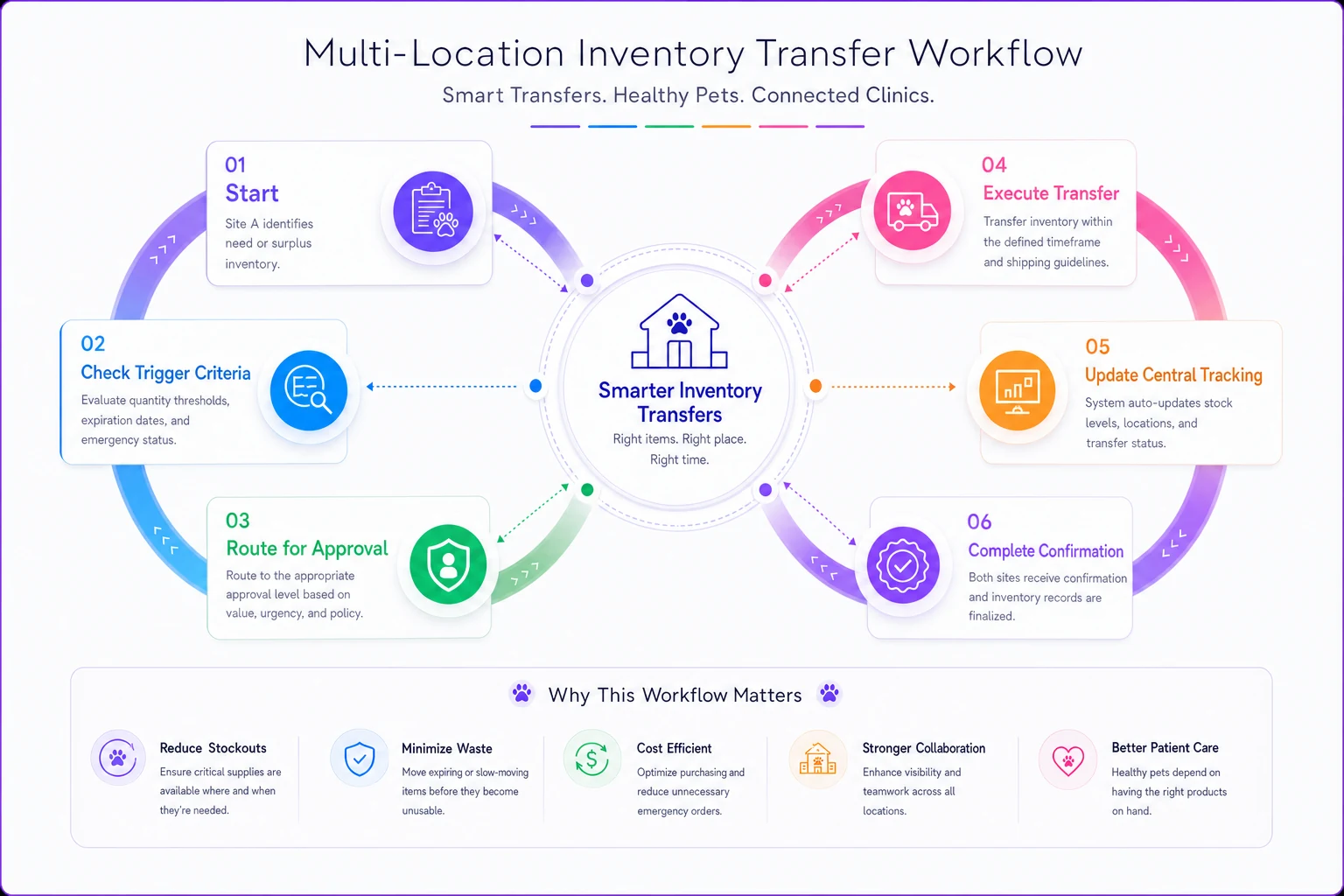
This decision tree maps the transfer triggers, approval levels, execution timeframe, and confirmation steps.
Automatic transfer triggers:
-
Any location below 2-week supply while another has 8+ weeks
-
Expired stock prevention when one site has <30 days to expiration
-
Emergency transfers for unexpected stockouts (same-day fulfillment)
Lead time standards:
-
Emergency transfers
complete within 4 hours
-
Standard transfers
next-day delivery
-
Bulk rebalancing
weekly scheduled runs
Approval hierarchy:
-
Under $500
automatic approval between sites
-
$500-2000
single manager approval
-
Over $2000
central operations approval
One five-location group implemented this exact framework and cut their inventory carrying costs by 22% while eliminating 90% of stockout situations. The key was making the rules clear enough that staff didn't need to think about edge cases.
The transport logistics matter too. Rotating responsibility for transfer runs between locations prevents any one site from bearing the burden. Using staff who already commute between locations for other reasons (like floating techs) reduces dedicated transfer trips.
The SOP alignment challenge nobody talks about
Even with clear governance rules, multi-location veterinary clinic operations fail when standard operating procedures don't align between sites. The worst situation is when you think procedures are standardized but they've quietly diverged over time.
This drift happens naturally. A lead tech at one location finds a slightly better way to prep surgical packs. Another clinic adjusts their lab processing sequence to work around their specific equipment layout. Small changes compound until your "standard" procedures aren't standard at all.
The fix isn't more documentation. It's active alignment through rotating audits and cross-training. Every quarter, have managers spend a day working at another location following that site's actual workflows. The disconnects become immediately obvious.
A two-location practice discovered their intake process had diverged so much that new client appointments took 18 minutes at one site and 31 minutes at the other. Same forms. Same systems. Completely different execution. They thought they had a performance problem. They had an alignment problem.
Creating checklists that enforce consistency without crushing flexibility
Checklists become the practical enforcement mechanism for governance in multi-site operations. Most clinics create checklists that are either too rigid (causing workarounds) or too vague (allowing interpretation).
The most effective approach uses what I call "outcome-based checklisting." Instead of dictating every micro-step, you define the required outcomes and let locations determine their specific path.
For example, a surgical prep checklist might require:
-
Patient identity verified against schedule
-
Surgical site marked and confirmed
-
Anesthesia plan documented
-
Equipment sterility confirmed
-
Timeout completed with full team
How each location accomplishes these outcomes can vary based on their layout, equipment, and team preferences. But the critical safety elements remain consistent.
One three-location group transformed their discharge process this way. Instead of forcing identical scripts, they created outcome requirements:
-
Medication instructions demonstrated
-
Follow-up appointment scheduled or declined
-
Warning signs reviewed
-
Written instructions provided
-
Contact for questions confirmed
Discharge consistency improved dramatically while letting each team maintain their conversational style. Client callbacks about medication questions dropped by 60% across all locations.
Technology coordination without central IT nightmares
Multi-location veterinary clinic operations often struggle with technology governance. Each site wants tools that fit their workflow. But supporting different systems becomes impossible as you scale.
The practical solution is standardizing your core platform while allowing approved add-ons for local needs. Your practice management system, pharmacy inventory, and diagnostic equipment interfaces need to be identical. But that specialty orthopedic location might need additional surgical planning software that your vaccine clinics don't touch.
| Technology Category | Standardization Level | Local Flexibility |
|---|---|---|
| Practice Management System | Required | Interface customization only |
| Inventory Management | Required | Local par level adjustments |
| Diagnostic Equipment | Required for core tools | Specialty additions allowed |
| Payment Processing | Required | Local payment plan options |
| Communication Tools | Required platform | Local marketing content |
Modern operational software can adapt to local patterns while maintaining central data standards. Your inventory management rules stay consistent, but the interface adjusts to how each location actually works.
The coordination benefits compound when these systems handle the routine governance tasks automatically. Transfer requests route based on your rules. Inventory levels balance across locations without manual checking. Price updates cascade immediately. SOPs stay synchronized with automatic version control.
Pilot standard platform rollouts at two locations first to surface integration issues before full deployment.
The technology conversation often misses the human element. The best systems reduce the friction of following governance rules. When transferring inventory between sites takes twelve clicks and three approvals, people find workarounds. When it's a two-click process with smart defaults, compliance becomes natural.
A real transformation: from chaos to coordination
A four-location group in Arizona went from complete operational chaos to smooth multi-site coordination in about six months.
Their starting point was brutal. Each location had different appointment types, inventory schedules, pricing beyond basic services, staff schedules, and even different ways of answering the phone.
They started by identifying their true pain points through data. Inventory transfers were taking 3-4 days when sites ran out of common medications. Clients complained about pricing inconsistencies. Staff couldn't cover shifts at other locations without extensive shadowing.
The transformation focused on three phases:
Phase 1: Critical standardization (months 1-2) They unified medical protocols, base pricing, and inventory transfer rules. Nothing fancy—just getting everyone on the same playbook for the essentials.
Phase 2: Process alignment (months 3-4) Cross-training initiatives identified where procedures had diverged. They created outcome-based checklists for key workflows. Managers started monthly rotation days at other sites.
Phase 3: Technology enablement (months 5-6) They implemented centralized inventory management with automated transfer triggers. Standardized their phone scripts and appointment types. Built dashboards showing real-time capacity across all locations.
The results hit both revenue and operations. Inventory costs dropped by roughly $8,000 monthly through better distribution. Staff started covering between locations smoothly, eliminating overtime during absences. The biggest win was client satisfaction—complaints about service inconsistency virtually disappeared.
The governance model that actually scales
The governance model that works for two locations breaks at four. What works at four fails at eight. The key is building a framework that evolves with growth rather than requiring complete overhauls.
Start with these core principles:
-
Standardize for safety and quality. Medical care, controlled substances, and safety protocols must be universal. No exceptions.
-
Coordinate for efficiency. Inventory, pricing, and basic workflows should align enough to enable resource sharing.
-
Localize for market fit. Hours, marketing, community partnerships, and demand-based staffing should respond to local needs.
-
Document for clarity. Every decision about what's centralized versus local needs clear documentation accessible to all locations.
-
Audit for drift. Quarterly process audits catch when standardized procedures start diverging before they become problems.
-
Enable through technology. Manual governance through policies and meetings fails at scale. Systems must enforce rules automatically.
The multi-location veterinary clinic operations that thrive long-term build this balance into their DNA from the start. They don't wait until they have six locations in chaos to start thinking about governance. They establish the framework with location number two and refine it with each addition.
Moving forward: your governance reality check
If you're running multiple veterinary locations, the governance question isn't whether to centralize or decentralize. It's about finding the right balance for your specific operations, markets, and growth stage.
Start by auditing your current state. Where are the friction points between locations? What problems keep recurring? Where do clients experience inconsistency? Where do staff struggle when covering other sites?
Then build your governance model around fixing those specific issues, not some theoretical ideal. Perfect standardization that nobody follows is worse than imperfect coordination that actually works.
The practices that succeed at multi-site operations don't get paralyzed by the governance challenge. They pick a direction, implement clear rules, and adjust based on results. They use technology to reduce the burden of coordination. They recognize that governance isn't about control—it's about creating a framework where multiple locations can thrive together instead of despite each other.
Your inventory doesn't need to expire in one location while another turns away sales. Your staff should be able to cover shifts without complete retraining. Your clients deserve consistent care regardless of which door they walk through. The right governance model makes all of this possible without crushing the local adaptation that makes each location successful.
The question isn't whether you need governance for multi-location veterinary clinic operations. It's whether you'll design it intentionally or let it evolve through expensive mistakes.
The practices that succeed at multi-site operations don't get paralyzed by the governance challenge. They pick a direction, implement clear rules, and adjust based on results.
Ready to elevate your clinic’s efficiency?
Join 500+ veterinary clinics using Veterinaryly to save time, reduce administrative overhead, and improve patient care.