

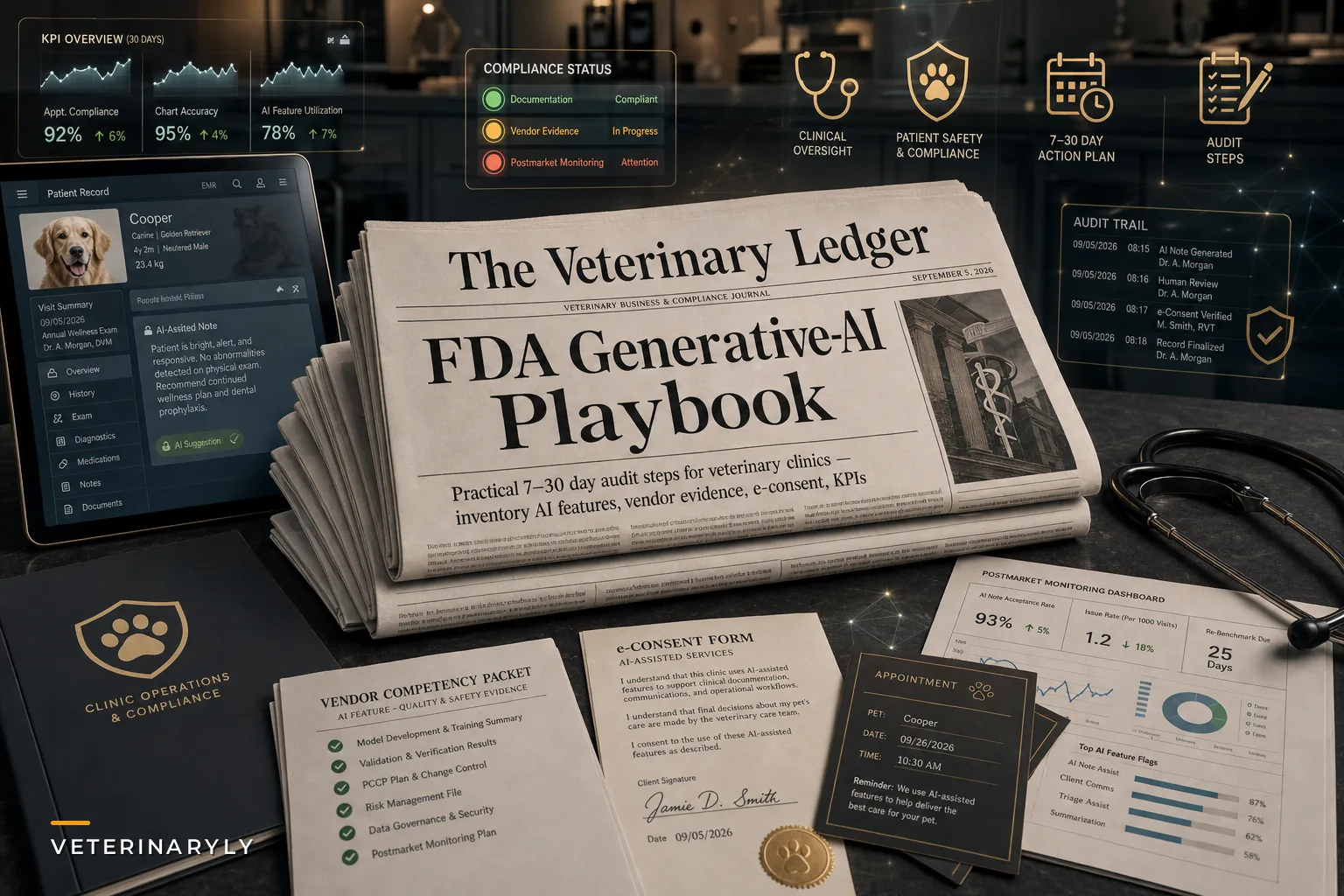

On August 18, 2026, the FDA's device center and Digital Health Center of Excellence released a discussion paper asking the public how it should regulate generative-AI-enabled medical devices. The FDA announcement covers risk frameworks, competency-based evaluation, postmarket monitoring, and change control for systems where the output isn't fixed — where the model generates something new every time.
Before anyone panics: this is human-side regulation, and vet clinics aren't the direct target. The FDA's device authority covers human medical devices. But if you think this doesn't touch you, you're missing where the pressure actually comes from. Your practice-management vendor sells to human clinics too, or wants to. Your malpractice carrier reads the same headlines. Your clients Google this stuff. And the documentation, validation, and change-control expectations the FDA is sketching out tend to become the de facto standard everyone's software gets measured against — whether or not there's a regulation forcing it.
The smart move isn't to wait for someone to tell you what to do. Treat this paper as a preview of the questions you'll eventually have to answer, and get your house in order while it's still cheap.
The gap this exposes: most clinics can't inventory their own AI features
When these tools rolled into practice-management software over the last couple of years, most of them arrived as features, not as decisions. Nobody sat down and said "we are now deploying a clinical decision-support system." Someone clicked "enable smart summaries" because it saved the techs ten minutes on discharge notes. The teletriage add-on came bundled in a plan upgrade. The appointment chatbot got switched on during onboarding and mostly forgotten.
-
Auto-generated SOAP note drafts and history summaries
-
Discharge instruction and home-care text handed to clients
-
Teletriage or symptom-checker chat that suggests urgency levels
-
Drafted client messages, reminders, and "why we recommend X" explanations
-
Coding or estimate suggestions that quietly shape what gets charged
-
Phone-line transcription and callback summarization
Each of those is a spot where a plausible-sounding but wrong output can land in a medical record or a client's inbox.
The generative part is what makes it risky — a rules-based reminder either fires or it doesn't, but a model that writes can invent a dosage, soften a red-flag symptom, or produce a discharge note that doesn't match what the vet actually said.
Why "it sounds right" is the dangerous failure mode
A lab machine that breaks tends to break loudly. A generative tool fails quietly and confidently. That's the shift clinic leaders haven't fully internalized.
Never miss a pet’s appointment again.
Veterinaryly helps you schedule, confirm, and manage every appointment and patient record effortlessly.
- Centralized appointment & patient management
- Automated client reminders
- Staff scheduling & task tracking
No credit card required
A typical example looks like this. A tech uses the summary feature to draft a discharge note for a post-op spay. The model pulls "monitor incision site, restrict activity for 10–14 days" — fine — but also confidently adds a line about resuming normal feeding immediately, when the vet's plan was a bland diet for 48 hours. Nobody caught it because the note read like a normal note. The client followed it. Now you've got a preventable GI upset, an annoyed client, and a record that doesn't reflect the actual clinical plan.
Nothing "broke." No error message. That's exactly what the FDA's interest in postmarket monitoring is getting at — with generative systems, the interesting failures don't show up in a crash log. They show up as a slow accumulation of small, plausible mistakes that only surface when someone gets hurt or a record gets audited. An analysis from law firm Arnold & Porter noted that the agency is leaning toward continuous, lifecycle-style oversight rather than a one-time approval — because the model's behavior can drift as it gets updated. That framing matters for clinics because it shifts the question from "did we validate it once" to "how do we know it's still performing fine this month."
A five-step audit any clinic can run this quarter
You don't need a compliance department to do this. You need an afternoon, a spreadsheet, and someone willing to click into every corner of your software.
-
Inventory every AI-touched output. Go screen by screen. For each feature, write down: what it generates, where that output goes (record? client? invoice?), and who reviews it before it's final. If the answer to "who reviews it" is "nobody," flag it immediately.
-
Classify by risk, not by convenience. Sort each feature into three buckets: cosmetic (internal drafts a human always edits), material (client-facing guidance, urgency triage), and clinical-record (anything that becomes part of the permanent medical note). Material and clinical-record items are where your attention goes.
-
Demand competency evidence from the vendor. Ask them, in writing, how the feature was validated for veterinary use specifically, what its known failure modes are, and how they'll notify you when the underlying model changes. Vague answers are an answer.
-
Set a human-in-the-loop rule for every material and clinical-record output. No generated dosage, urgency level, or discharge instruction leaves the building without a named person signing off. Write it down as an SOP, not a norm.
-
Define what you'll monitor after go-live. Pick two or three signals — corrected-note rate, client callbacks about confusing instructions, triage overrides by the vet — and actually look at them monthly.
Running through these five steps won't make your clinic bulletproof, but it will give you a defensible paper trail showing you thought about this deliberately rather than just leaving features on their default settings.
This workflow visualizes the audit steps so you can run them in an afternoon.
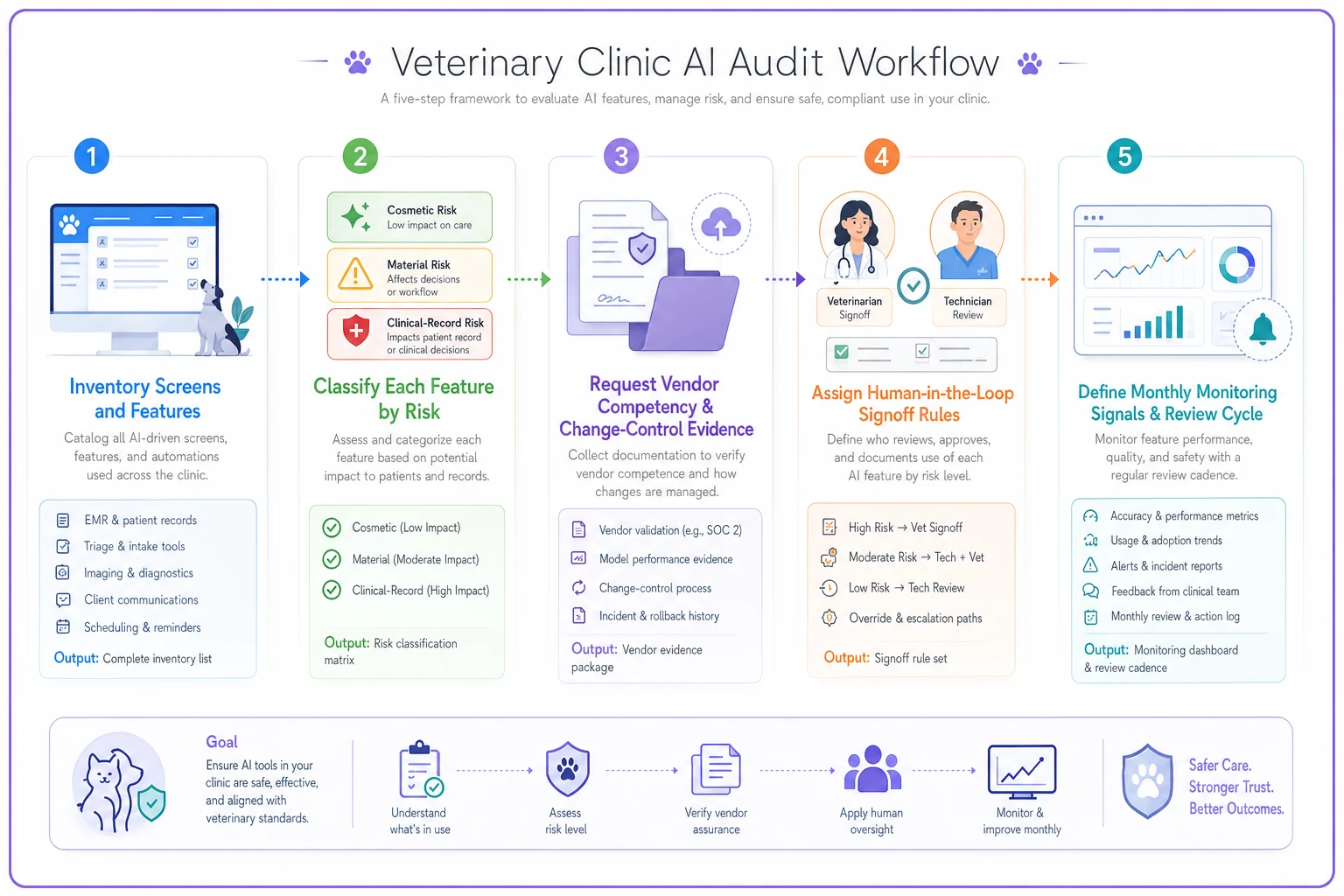
Running the visualized steps alongside the checklist makes it easier to assign owners and close the gaps you find.
Vendor questions that separate serious tools from wrappers
A lot of "AI features" in practice software are thin wrappers over a general model with no veterinary tuning and no change notification. The FDA's change-control framing gives you a useful lens here: if the vendor can't tell you when the model behind your feature changes, you have no way to know your original validation still holds.
| Question you ask | Weak answer (walk carefully) | Defensible answer |
|---|---|---|
| How was this validated for veterinary cases? | "It uses a leading AI model." | Documented testing on vet-specific scenarios with error rates |
| What happens when you update the model? | "Updates are seamless and automatic." | Advance notice, changelog, option to test before rollout |
| Can we see an audit trail of AI-generated content? | "Everything's saved in the record." | Clear flagging of what was AI-drafted vs. human-authored |
| Who's liable if a generated instruction is wrong? | Silence or "the vet reviews everything." | Contract language addressing shared responsibility |
| How do we turn a feature off? | "You can't, it's built in." | Feature-level controls per user role |
That last row matters more than people think. If you can't disable a feature that's misbehaving, you've handed operational control of your medical records to someone outside your building.
Where this ties into records you can actually defend
Every one of these AI outputs eventually lands in the same place: the medical record. That's where the compliance exposure gets real, because a record that mixes machine-drafted and human-authored content with no way to tell them apart is a record you can't defend in a board complaint or a lawsuit.
This is why the AI question is really a records-governance question wearing a new costume. If you already run a disciplined process for how notes are created, reviewed, locked, and retained, layering AI oversight on top is straightforward. If you don't, the AI just accelerates the mess. The same principles covered in our piece on data governance for veterinary medical records apply directly here — versioning, authorship tracking, and audit-ready trails are exactly what let you answer "who wrote this and did a licensed professional approve it" months after the fact.
A practical rule worth adopting: every AI-drafted entry gets a visible marker until a human finalizes it, and the record stores both the original draft and the edited final. That way, if a client's home-care instructions are ever questioned, you can show what was generated, what was changed, and who signed off. It sounds like extra process until you actually need it.
When leaning on these tools makes sense — and when it doesn't
When it makes sense: using generative drafts for internal, always-reviewed work. A summary feature that gives a tech a starting point for a note the vet then edits and signs is a genuine time-saver with a human backstop. Same with drafting routine client reminders that staff proof before sending. The tool speeds the boring part; the human owns the decision.
When it's a bad idea: letting a model send clinical guidance to a client with no review, or letting a triage chatbot assign urgency without a clear, tested escalation threshold and a fast path to a human. Anything touching a dosage, a red-flag symptom, or a "you can wait until morning" judgment call needs a person in the loop, full stop.
Who should slow down entirely: single-doctor practices and clinics without any note-review workflow. If you don't already have a habit of a second set of eyes on records, adding a confident text generator into that gap doesn't save labor — it manufactures liability faster than you can catch it. Build the review discipline first, then layer the tool on top of it.
A short real scenario
A three-vet small-animal clinic turned on auto-drafted discharge instructions to cut charting time. It worked — techs saved a real chunk of time per visit, easily an hour or two across a busy day. But over roughly two months they logged around a dozen client callbacks where the home-care instructions didn't match the vet's actual plan: wrong recheck timing, feeding guidance that contradicted the treatment, one medication interval that was just plain off.
Nobody had set a review step. The fix wasn't ripping the feature out — it was adding one: the vet or lead tech has to approve the draft before it prints or sends, and any AI-drafted note stays flagged in the record until that happens. Callbacks dropped sharply over the following weeks, and they kept most of the time savings because editing a decent draft is still faster than writing from scratch.
The lesson wasn't "AI bad." It was that an unreviewed generated output is an unfinished output, and treating it any other way is just optimism with a paper trail problem attached.
The move to make now
The FDA paper isn't a rule yet, and for veterinary clinics it may never be a direct one. But it's a clear signal of where things are heading: validation, documentation, monitoring, and change control are becoming the baseline expectation for any tool that generates clinical or client-facing content. Clinics that inventory their AI features, establish human-review rules, and keep records showing who authored and approved what will be in a defensible position no matter how the standards eventually land.
The ones treating "smart" features as invisible conveniences are quietly building an audit problem they can't see yet. Spend the afternoon. Build the list. Decide, deliberately, which outputs a human must own — because the tools aren't going to draw that line for you, and eventually someone is going to ask you where you drew it.
The ones treating "smart" features as invisible conveniences are quietly building an audit problem they can't see yet. Spend the afternoon. Build the list. Decide, deliberately, which outputs a human must own — because the tools aren't going to draw that line for you, and eventually someone is going to ask you where you drew it.
Ready to elevate your clinic’s efficiency?
Join 500+ veterinary clinics using Veterinaryly to save time, reduce administrative overhead, and improve patient care.