


Three weeks ago, a clinic in Denver discovered they'd been sending blood samples to their reference lab with the wrong patient IDs for six days straight. The mix-up started when a tech grabbed the wrong label sheet during a hectic Monday morning. By the time the lab flagged the inconsistency, they had 42 samples that couldn't be matched to patients, $3,400 worth of tests that needed re-running, and a stack of angry client calls about missing results.
This wasn't some rookie mistake or system failure. The clinic had been operating for twelve years. Their staff was experienced. They had protocols. What they didn't have was a veterinary lab sample workflow that could survive real-world pressure.
Every clinic owner thinks their sample handling is fine until something like this happens. You send out dozens of samples weekly, most come back with results, clients get their answers. The system appears to work. But underneath that apparent functionality, there's usually a mess of handwritten logs, verbal handoffs, sticky notes with special instructions, and staff members who each have their own way of doing things.
Why sample workflows break exactly when you need them most
Most clinics build their lab processes backwards. They start with whatever the lab requires, add some basic logging, then patch problems as they appear. A lost sample leads to a new rule about double-checking labels. A delayed result creates another step for following up. Before long, you've got a Frankenstein process held together by individual staff habits and unwritten exceptions.
Monday mornings when you're juggling emergency cases with routine bloodwork. End-of-day rushes when the courier arrives in fifteen minutes and three different techs are prepping samples. These moments expose every weakness in your workflow.
A tech draws blood for a senior screening panel but the request form says chemistry only. Nobody catches it because the tech who drew it isn't the one packaging it. The sample goes out, results come back incomplete, and now you need the owner to bring Fluffy back for another draw. That's a lost appointment slot, an unhappy client, and stressed staff.
Consider the chain-of-custody nightmare. Sample gets drawn at 9 AM, sits on the counter until noon, gets refrigerated by someone who doesn't note the time gap, then shipped at 4 PM. The lab rejects it for improper handling. You eat the cost, explain to the client why they need to come back, and probably comp the retest.
Result routing chaos follows a similar pattern. CBC comes back critical but sits in the general inbox for six hours because nobody designated who monitors what. The on-call vet finally sees it at 9 PM, calls the owner who's already panicking because they haven't heard anything, and now you're doing damage control instead of medicine.
The compound effect of sample errors on your practice
A single mislabeled sample seems minor until you calculate the actual impact.
Never miss a pet’s appointment again.
Veterinaryly helps you schedule, confirm, and manage every appointment and patient record effortlessly.
- Centralized appointment & patient management
- Automated client reminders
- Staff scheduling & task tracking
No credit card required
One mislabeled sample cascade:
-
Original test cost
$165
-
Retest cost (usually comped)
$165
-
Second appointment slot
30 minutes of capacity
-
Staff time for client communication
45 minutes
-
Veterinarian review time for both results
20 minutes
-
Administrative time for documentation
15 minutes
Total direct cost: around $380 plus the lost revenue from that appointment slot. If you're averaging $180 per appointment, you're looking at $560 in total impact from one labeling error.
The average clinic has 3-4 sample-related errors monthly. That's roughly $2,000 in direct losses, not counting reputation damage or client switching costs. Over a year, you're burning $24,000 on preventable sample handling mistakes.
Your team starts losing confidence. They double and triple-check everything, which slows down the entire workflow. The tech who made the original error becomes overly cautious, taking twice as long for routine draws. Other staff members develop their own "safety" steps that aren't documented anywhere. Soon you've got five different versions of the process running simultaneously, none of them talking to each other.
Building a sample workflow that actually works under pressure
The clinics that run smooth lab operations don't have more skilled staff or better labs. They have workflows that assume things will go wrong and build in corrections before problems cascade.
Start with your labeling system. Every label needs three elements printed clearly: patient ID, test ordered, and collection timestamp. Not handwritten, not abbreviated, printed. This means generating labels from your practice management system at the time of collection, not pre-printing sheets that can get mixed up.
Generate labels from your practice management system at the time of collection to avoid pre-printed label mix-ups.
Most clinics resist this because it seems slower. "We'll just grab a pre-made label and write the details." That's exactly when errors happen. The two seconds you save becomes twenty minutes of cleanup later.
Your chain-of-custody documentation should follow the sample, not live in a separate log. Simple custody cards that attach to each sample container:
| Step | Time | Initials | Storage |
|---|---|---|---|
| Collected | 9:15 AM | RT | Counter |
| Processed | 9:45 AM | KL | Refrigerated |
| Packaged | 3:30 PM | RT | Cooler |
| Shipped | 4:00 PM | JM | Courier |
This takes maybe 30 seconds per handoff but eliminates the "who had this last?" confusion that derails sample investigations.
Building verification points that don't add busy work is key. When a tech prints a label, the system should verify the patient ID matches the appointment. When someone processes a sample, they scan the label to confirm it matches the custody card. These micro-checks prevent macro disasters.
Below is a simple visual of the sample workflow.
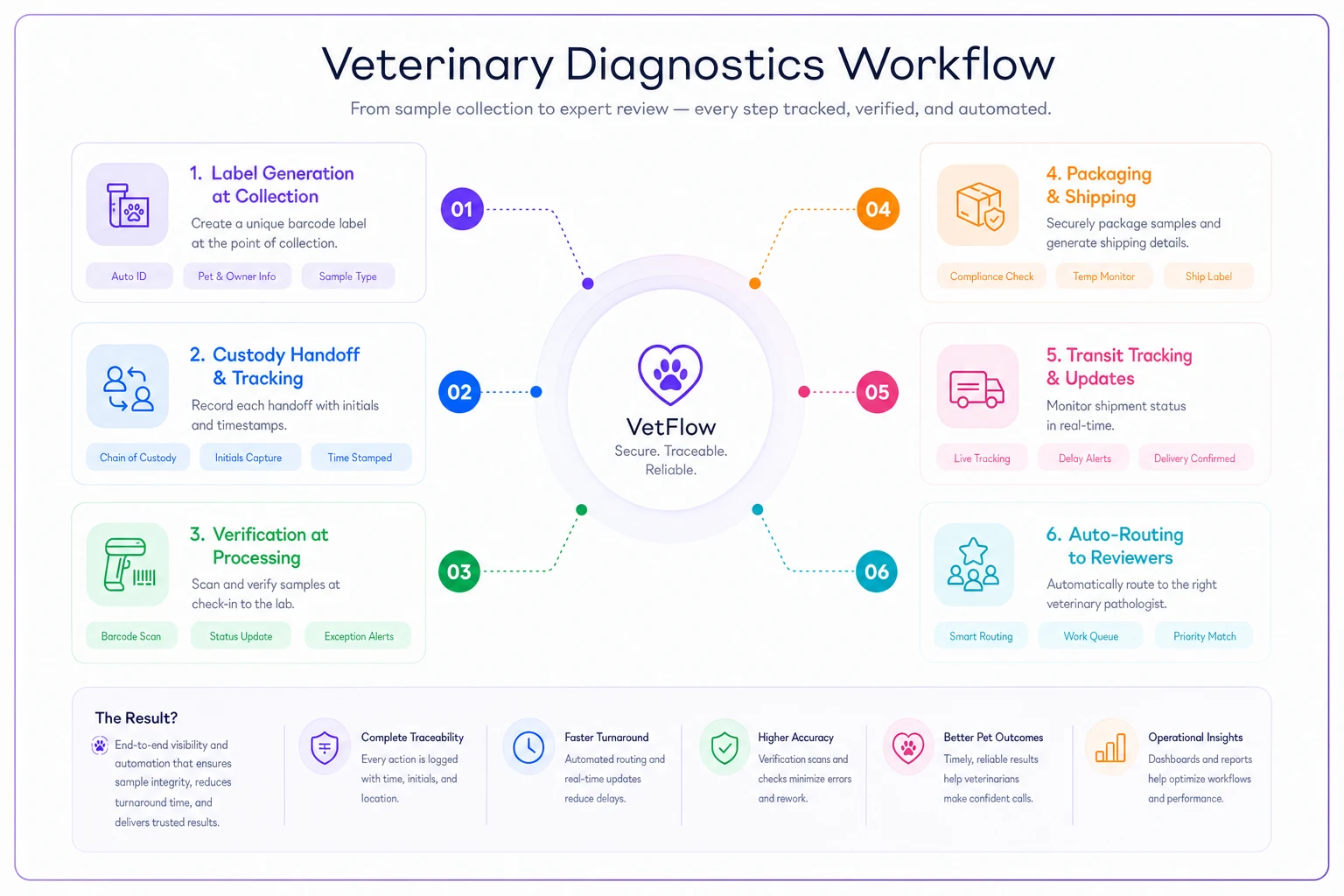
These micro-checks prevent macro disasters.
Setting SLAs that match reality, not wishful thinking
Service Level Agreements for lab work usually fail because clinics set them based on ideal conditions. "Results within 24 hours" sounds good until you realize that means someone needs to check for results every few hours, including weekends.
Sample Collection to Processing:
-
Routine
within 2 hours
-
Stat
within 30 minutes
-
End-of-day
before courier cutoff
Result Review to Client Contact:
-
Critical values
within 1 hour of receipt
-
Abnormal non-critical
same business day
-
Normal results
within 24 business hours
Notice these aren't aggressive targets. They're what you can consistently deliver even during busy periods. Better to set expectations you can meet than constantly apologize for delays.
Building triggers into your system matters here. Critical results should automatically flag multiple people. If the primary reviewer doesn't acknowledge within 30 minutes, it escalates. This isn't about not trusting staff; it's about recognizing that people get pulled into emergencies and things slip through cracks.
Automated routing that removes decision fatigue
By 2 PM on a typical day, your staff has made hundreds of small decisions. Every additional choice increases the chance of error. Manual result routing fails because it requires someone to read, interpret, and decide where each result goes, over and over.
Effective routing happens automatically based on pre-set rules:
-
Chemistry panels
→ Dr. Smith (primary) → Dr. Jones (backup)
-
CBC with critical values
→ On-call vet + Medical director
-
Routine heartworm tests
→ Tech supervisor for initial review
-
Cytology results
→ Whoever ordered + Medical director
The beauty of automated routing is consistency. Results don't sit in limbo because someone wasn't sure who should review them. They don't get lost in email. They follow the same path every time.
A practice in Austin implemented rule-based routing last spring. Before, they averaged 4-5 hours between result receipt and initial review. After three months with automated routing, that dropped to under 90 minutes. Zero critical results went unreviewed for more than 2 hours, compared to their previous average of one "missed" critical per month.
Most staff initially worried automated routing would create too much rigidity. What about special cases? What if Dr. Martinez specifically wanted to see Mrs. Johnson's lab work? Good routing systems let you override the default for specific cases while maintaining the safety net for everything else.
Quality checks that catch errors before they become problems
QA in most clinics means catching mistakes after they happen. Real quality assurance prevents errors from leaving your building.
Pre-shipment checklist that actually gets used:
-
Sample Verification (takes 45 seconds per sample) - Label matches request form - Container appropriate for test type - Sample volume adequate - Temperature requirements met - Special handling noted
-
Documentation Check - Custody card completed - Time gaps explained - Storage conditions recorded - Courier log updated
-
Final Packaging Review - Samples secured properly - Ice packs if required - Requisition forms included - Shipping labels correct
The resistance to QA usually comes from time pressure. "The courier is here, we need to get these out." But one rejected sample costs more time than checking ten samples properly. A practice in Phoenix tracked this: their 5-minute end-of-day QA process prevented an average of 3 sample rejections weekly. At 30 minutes to resolve each rejection, they saved 90 minutes by investing 25 minutes in prevention.
Quality checks work best when they're built into the natural workflow. Don't add a separate QA step at the end - embed verification into each handoff point. When someone moves a sample from processing to storage, they verify storage requirements. When packaging for shipment, they confirm container types.
When your workflow needs more than manual fixes
Manual processes work until they don't. Once you're sending out more than 20-30 samples weekly, the human coordination burden becomes unsustainable. Someone forgets to check the custody card. Labels get swapped despite double-checking. Results sit unreviewed because the designated person called in sick and nobody updated the routing.
This is where operational software becomes valuable - not as a fancy addition but as infrastructure that maintains consistency when humans get overwhelmed. Modern platforms can generate labels with embedded tracking codes, automatically log custody transfers, route results based on test type and values, and flag process violations before samples ship.
The real value isn't the technology itself but the standardization it enables. When every sample follows the same digital workflow, variations stand out immediately. When routing happens automatically, nothing gets lost in transition. When QA checks are built into the process, they can't be skipped during rush periods.
A clinic network in Colorado implemented end-to-end digital sample tracking across their four locations. Their error rate dropped from around 3% to 0.4% in six months. Their staff stress around lab work basically disappeared. No more panic about lost samples, no more confusion about result ownership, no more scrambling to piece together what happens when something goes wrong.
The software also provided something they hadn't expected: data. They could see which test types had the highest error rates, which times of day produced the most mistakes, which staff members needed additional training. Problems that were invisible in manual systems became obvious with proper tracking.
Making the transition without disrupting operations
The biggest mistake clinics make when upgrading their veterinary lab sample workflow is trying to change everything at once. Monday morning, new process, everyone figure it out. That's a recipe for chaos.
Start with labeling. Get that consistent and error-free before touching anything else. Once labels are reliable, add custody tracking. When that's smooth, implement automated routing. Build your workflow layer by layer, letting each component stabilize before adding the next.
Train in pairs, not groups. Have your best tech work with one other person until they're comfortable, then those two train the next pair. This creates natural backup coverage and prevents the "I thought someone else knew how to do this" situations that derail new processes.
Track sample rejection rates, result turnaround times, and client complaints about lab work. If those numbers aren't improving after each change, something's wrong with the implementation, not the concept. Expect pushback. Change is uncomfortable, especially when people feel like their current methods work fine. But "fine" isn't the standard you should accept for something as critical as lab work. One catastrophic error can cost more than a year's worth of process improvements.
The real ROI of fixing your sample workflow
Beyond the obvious cost savings from fewer errors and retests, a solid lab workflow changes your clinic's entire operation rhythm. Staff stop dreading lab-heavy days. Veterinarians trust that critical results will reach them. Clients get their results when promised.
When your team isn't constantly firefighting lab problems, they can focus on patient care. When results arrive predictably, you can schedule follow-up appointments confidently. When clients trust your lab handling, they're more likely to approve comprehensive diagnostics.
A practice in Portland transformed their lab operations eighteen months ago. They calculated the total impact: $31,000 saved in error-related costs, 180 hours of staff time recovered, client satisfaction scores up 22%, and diagnostic revenue increased by 15% because veterinarians felt confident recommending more comprehensive panels.
The indirect benefits might be even more valuable. Reduced staff burnout. Fewer client complaints. More time for actual veterinary medicine instead of administrative cleanup. Better diagnostic confidence because you trust your lab workflow.
Your veterinary lab sample workflow might seem like a back-office concern, but it directly impacts your clinical quality, team morale, and bottom line. Every sample that flows smoothly from collection to result strengthens client trust. Every error erodes it.
The clinics thriving despite increasing operational complexity aren't the ones with perfect staff or unlimited resources. They're the ones that recognized sample handling is too important to leave to chance, too complex for memory-based protocols, and too costly to keep patching with bandaid solutions.
Ready to elevate your clinic’s efficiency?
Join 500+ veterinary clinics using Veterinaryly to save time, reduce administrative overhead, and improve patient care.