

Your lead tech just trained a new hire on catheter placement. Three weeks later, that same new hire is showing another team member a completely different technique they "figured out." Meanwhile, your associate vet is drawing blood using a restraint method that contradicts what you taught at the last staff meeting.
This isn't a training problem. It's what happens when veterinary SOPs clinical workflows exist only in people's heads instead of documented systems.
The real damage shows up in ways most clinics never connect back to process failures. A cat gets stressed during a routine blood draw because two techs used different restraint approaches. A pre-surgical prep takes 35 minutes instead of 15 because nobody follows the same sequence. Your inventory is constantly off because three people count controlled drugs three different ways.
After helping veterinary practices build operational systems for years, I see this pattern constantly. Clinics that struggle with quality control, staff retention, and profitability almost always rely on tribal knowledge instead of standardized processes.
Why veterinary medicine resists standardization (and pays for it)
Veterinary practices face a unique challenge with SOPs. Unlike human hospitals where procedures are rigidly standardized, veterinary clinics deal with multiple species, vastly different patient sizes, and a culture that prizes individual clinical judgment.
A 5-pound chihuahua and a 150-pound mastiff both need IV catheters, but the approach differs dramatically. This variability becomes an excuse to avoid standardization altogether. "Every case is different" becomes the mantra that prevents consistency from taking root.
But here's what happens in practices without standardized workflows: that variability becomes chaos. Your experienced tech handles the mastiff beautifully using techniques they've developed over 10 years. Your new grad vet, lacking that institutional knowledge, struggles for 20 minutes and ends up with a stressed patient and bruised confidence.
The resistance goes deeper than clinical variation. Many veterinarians view SOPs as corporate intrusions on their medical autonomy. They didn't spend eight years in school to follow checklists. This mindset creates a two-tier problem: doctors resist implementing protocols, and when protocols do exist, they're ignored because "the doctor knows better."
Staff turnover amplifies these issues exponentially. The average veterinary practice loses 30-40% of their technical staff annually. Every time an experienced tech leaves, they take their accumulated knowledge with them. Without documented processes, you're essentially restarting from zero with each new hire.
The compound effect of process drift
Process drift in veterinary clinics follows a predictable pattern. It starts small — maybe someone discovers a "better" way to prep surgical packs. They share it with one colleague during a slow afternoon. That colleague modifies it slightly based on their preference. Within three months, you have four different prep methods across your team.
Never miss a pet’s appointment again.
Veterinaryly helps you schedule, confirm, and manage every appointment and patient record effortlessly.
- Centralized appointment & patient management
- Automated client reminders
- Staff scheduling & task tracking
No credit card required
This drift creates invisible friction throughout your practice. Surgery starts get delayed because instruments aren't where the surgeon expects them. Inventory runs out because different prep methods use different quantities of supplies. New hires get conflicting instructions from different trainers, leading to confusion and mistakes.
Each variation in process adds 2-3 minutes here, wastes a few supplies there. Across hundreds of procedures monthly, these small inefficiencies can easily cost $40,000-60,000 annually in lost productivity and waste. But because the losses are distributed across dozens of small process failures, they never appear as a line item you can address.
Quality of care suffers in less obvious ways too. When restraint techniques vary by handler, patients experience inconsistent stress levels. When monitoring protocols differ by tech, subtle changes in patient status get missed. These aren't dramatic medical errors — they're small degradations in care quality that accumulate over time.
The real killer is what happens during critical moments. An emergency arrives, and your team needs to work seamlessly. But without standardized protocols, everyone defaults to their individual training. The result is confusion, delays, and sometimes tragic outcomes that could have been prevented with clear, practiced procedures.
Building your SOP foundation without overwhelming your team
The biggest mistake clinics make when implementing SOPs is trying to document everything at once. You end up with a 200-page manual that nobody reads and everyone ignores. Start with the processes that create the most friction in your daily operations.
Begin by mapping your five highest-frequency procedures. These might include:
-
New patient intake
-
Routine blood draws
-
Vaccination appointments
-
Dental cleanings
-
End-of-day closeout
For each procedure, gather your most experienced staff and document the current best practice. Don't aim for perfection — aim for consistency. A good-enough process that everyone follows beats a perfect process that exists only on paper.
Shadow and Document Spend one week observing how different team members perform the same procedure. Note variations, not to criticize, but to understand why people deviate. Often, these variations reveal either training gaps or legitimate improvements that should be incorporated.
Collaborative Refinement Bring your observations to a team meeting. Present the variations you've noticed and facilitate a discussion about the best approach. When people participate in creating the standard, they're far more likely to follow it.
Start with the single procedure that causes the most daily delays to build quick momentum.
Visual Documentation Veterinary teams are visual learners. Instead of text-heavy documents, create visual guides with photos or simple diagrams. A one-page visual guide for catheter placement will get referenced daily. A five-page written procedure will gather dust.
Graduated Implementation Don't flip a switch and expect perfect compliance. Implement new SOPs gradually, starting with one procedure per week. This gives teams time to adjust and provides opportunity for refinement based on real-world application.
Here's a simple visual to think through the mapping-and-implementation workflow.
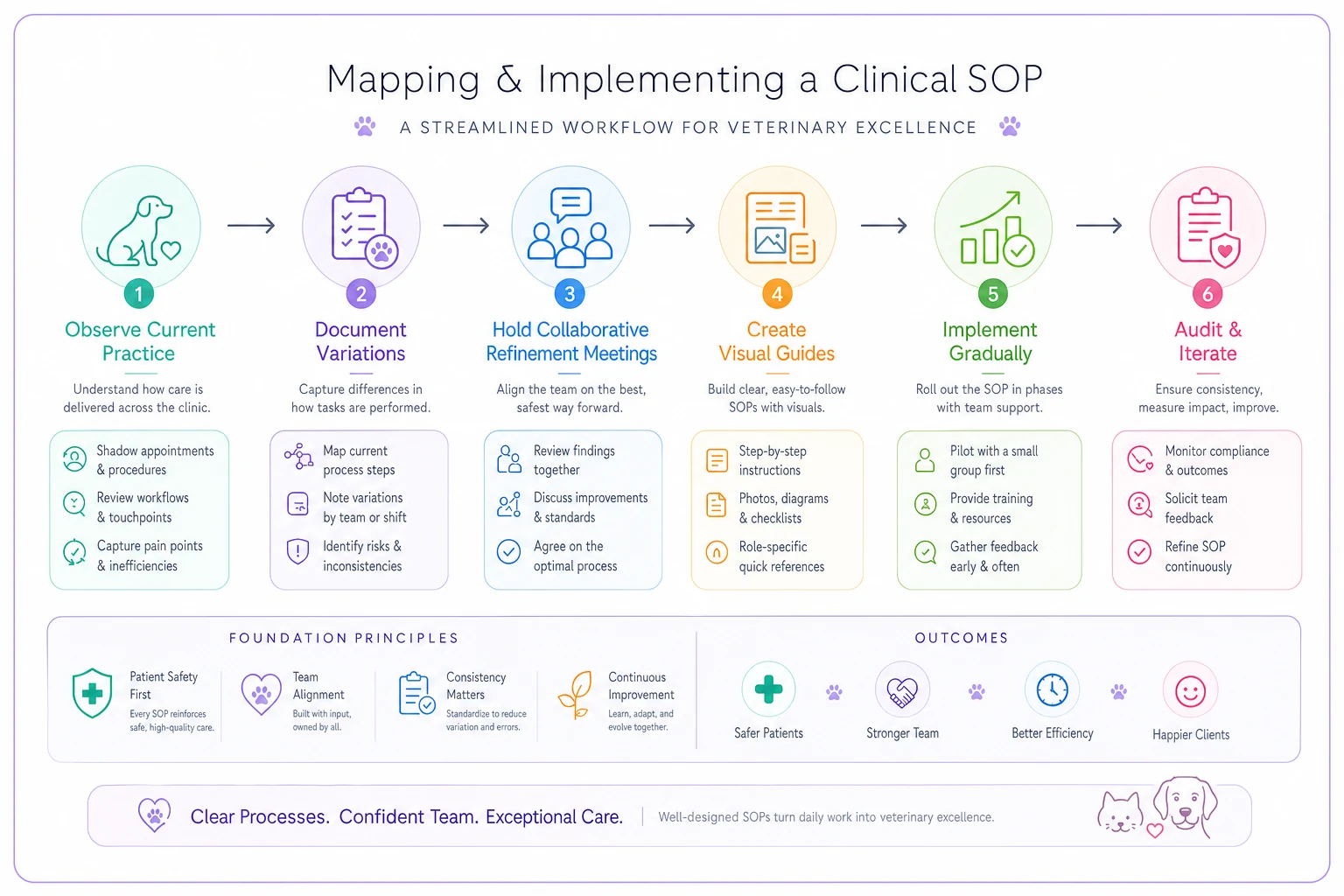
Keep the visual simple and focused on the sequence so teams can follow it during busy shifts.
Creating audit systems that actually drive improvement
Most veterinary clinics treat audits like dental cleanings — something you know you should do but keep postponing. The few that do conduct audits often use them punitively, creating resentment rather than improvement.
Effective auditing requires a different approach. Instead of looking for violations, frame audits as consistency checks. You're not catching people doing things wrong; you're ensuring everyone has the tools and training to succeed.
Design your audit scorecards around observable behaviors, not subjective judgments. For example, instead of "properly restrains patient," use specific criteria:
-
Positions patient according to documented technique
-
Maintains control throughout procedure
-
Adjusts technique appropriately for patient size
-
Communicates with handler throughout
This specificity removes ambiguity and makes feedback constructive rather than personal.
Your audit frequency should match the criticality of the process. Controlled drug protocols might need weekly spot-checks. Routine cleaning protocols might only need monthly review. The key is consistency — irregular auditing sends the message that standards only matter sometimes.
Build peer auditing into your system. Having techs audit each other creates shared ownership of standards and removes the hierarchical tension of management oversight. Rotate audit responsibilities monthly so everyone experiences both sides of the process.
Connect audit results to positive outcomes, not just corrections. When compliance improves, celebrate it. When someone consistently exceeds standards, recognize it publicly. This shifts the narrative from "we're checking up on you" to "we're all maintaining excellence together."
The maintenance routine that prevents process decay
Even the best SOPs decay without active maintenance. What worked perfectly six months ago might be inefficient today due to new equipment, staff changes, or evolved best practices. Building a maintenance routine into your SOP system prevents this decay.
Schedule quarterly SOP reviews, but make them efficient. Instead of reviewing every procedure, focus on the ones generating the most questions or variations. If multiple people are asking about the same process, that's your signal it needs updating.
Create a simple feedback mechanism for process improvements. Maybe it's a suggestion box, a dedicated Slack channel, or a standing agenda item in team meetings. When someone discovers a better technique, you want to capture and evaluate it quickly, not lose it to informal adoption.
Monthly Quick Checks
-
Are people following the critical SOPs?
-
What questions keep coming up?
-
Which processes are generating confusion?
Quarterly Deep Dives
-
Pick 2-3 SOPs for thorough review
-
Gather team feedback on what's working and what isn't
-
Update documentation based on real-world experience
Annual Overhauls
-
Review your entire SOP library
-
Retire outdated procedures
-
Identify gaps where new SOPs are needed
-
Ensure documentation matches current equipment and supplies
Track your "process deviation rate" — how often team members need to deviate from SOPs to handle real situations. If deviation rates exceed 20% for any process, that SOP needs immediate revision. High deviation rates indicate your standards don't match reality, which trains people to ignore all standards.
Making SOPs stick: The training framework that works
The traditional approach to SOP training — hand someone a binder and say "read this" — fails spectacularly in veterinary settings. Your team needs hands-on, contextual training that connects procedures to real outcomes.
Start with the "why" before the "how." When introducing a new SOP, explain the problem it solves. Maybe your catheter placement SOP reduces patient stress and decreases failed placement attempts. When people understand the purpose, compliance improves dramatically.
Use a three-phase training approach that accommodates different learning styles:
Phase 1: Demonstrate The trainer performs the procedure while narrating each step. This isn't just about showing the mechanical steps — it's about explaining the reasoning behind each decision.
Phase 2: Guided Practice The learner performs the procedure with the trainer providing real-time coaching. This phase might need multiple repetitions depending on procedure complexity.
Phase 3: Observed Independence The learner performs the procedure solo while the trainer observes silently, providing feedback only after completion.
Document training completion, but go beyond simple checkboxes. Record who trained whom, when, and any specific challenges or modifications needed. This creates accountability and helps identify training gaps when problems arise later.
Build SOP training into your regular workflows rather than treating it as a separate activity. Monday morning huddles can include a five-minute SOP refresh. Slow afternoons become opportunities for peer training. This integration makes training sustainable rather than burdensome.
Technology integration without overwhelming your workflow
Many clinics resist SOP implementation because they envision massive paper binders that nobody will reference during busy periods. Modern operational software changes this dynamic entirely, making SOPs accessible at the point of care.
The transformation happens when SOPs become integrated into daily workflows rather than separate references. A system where pulling up a patient automatically displays relevant protocols based on the scheduled procedure. Your tech doesn't need to remember which restraint technique to use for a fractious cat — the system prompts them with visual guides at the moment they need them.
AI-powered platforms can track which SOPs get accessed, identifying the ones that truly guide daily operations versus those that exist only for compliance. This usage data helps you focus maintenance efforts on the procedures that matter most.
More sophisticated systems can identify when procedures deviate from standards in real-time. If blood draw times suddenly increase by 40%, the system flags it for review. This shifts management from reactive firefighting to proactive optimization.
Technology should enhance your SOPs, not replace human judgment. The best systems provide guidance while allowing professional discretion. They track variations to identify patterns, not to enforce rigid compliance.
The integration should feel invisible to your team. If accessing an SOP requires three clicks and a password, it won't get used during a busy surgery schedule. The technology needs to surface information naturally within existing workflows, making the right way also the easy way.
Measuring impact: The metrics that matter
Most clinics never measure the impact of their SOP implementation, missing crucial feedback about what's working. But tracking the right metrics transforms SOPs from theoretical guidelines into powerful operational tools.
Start with process consistency metrics. Track how often the same procedure produces similar outcomes. If vaccine appointments take anywhere from 10 to 30 minutes, you have a consistency problem. When properly implemented SOPs bring that range down to 12-15 minutes, you've gained predictability that improves scheduling and client satisfaction.
Monitor training time for new hires. Before SOPs, getting a new tech fully functional might take 8-12 weeks of shadowing various people. With good SOPs, that timeline can drop to 4-6 weeks with more consistent results. This reduces the strain on your existing team while improving productivity.
Track error rates and near-misses. Without SOPs, these incidents often go unreported or get blamed on individuals. With clear standards, you can identify systemic issues. Maybe your medication dispensing errors drop by 60% after implementing a double-check protocol.
Some metrics to track:
| Metric |
|---|
| Procedure time consistency (standard deviation) |
| Training time to competency |
| Error and near-miss rates |
| Client complaint patterns |
| Staff confidence scores |
| Process deviation frequency |
Don't overlook qualitative improvements. Staff stress decreases when they have clear guidance. Client satisfaction improves when every visit follows predictable patterns. These "soft" metrics often drive the financial improvements that justify your SOP investment.
The realistic timeline for implementation
Clinics often fail at SOP implementation because they expect immediate transformation. Building a functional SOP system takes 6-12 months for a typical small animal practice, and that's perfectly normal.
Month 1-2: Foundation mapping. You're identifying critical processes and documenting current practices. Expect resistance and confusion as people realize how differently everyone operates.
Month 3-4: Collaborative refinement. Your team debates and agrees on best practices. This phase feels slow but builds crucial buy-in for later adoption.
Month 5-6: Gradual rollout. You're implementing 1-2 SOPs weekly, allowing time for adjustment and refinement. Compliance will be spotty as old habits die hard.
Month 7-9: Reinforcement and auditing. Regular audits identify gaps, and focused training addresses them. You'll start seeing consistency improvements, though not perfection.
Month 10-12: Optimization and expansion. Core SOPs are working well, and you're adding more complex procedures. The team begins suggesting improvements proactively.
This timeline assumes you're dedicating 3-5 hours weekly to the effort. Trying to compress it leads to superficial implementation that falls apart under pressure. Better to build slowly and sustainably than to rush and fail.
Your next seven days
Transforming your clinic's operations through SOPs doesn't require a massive initiative. It starts with small, focused actions that build momentum.
This week, pick one procedure that causes daily friction. Maybe it's your appointment scheduling process, or perhaps how controlled drugs get logged. Shadow three different team members performing this procedure. Document what you observe without judgment.
By Friday, convene a 30-minute meeting with those team members. Share your observations and facilitate a discussion about the ideal approach. You're not imposing a solution — you're building consensus around best practice.
Next week, create a simple one-page visual guide for that procedure. Photos from your phone and clear bullet points work fine. Post it where the procedure happens and ask everyone to follow it for one week.
The week after, gather feedback. What worked? What didn't? Refine the SOP based on real-world application. You've just created your first living SOP that your team actually owns.
This incremental approach beats grand plans that never launch. Each successful SOP builds confidence and momentum for the next one. Within three months, you'll have a core set of SOPs that measurably improve your operations.
The goal isn't perfect documentation of every possible procedure. It's creating enough consistency that your team can deliver excellent care reliably, regardless of who's working that day. Standards don't limit good medicine — they create the foundation that makes exceptional medicine possible at scale.
The goal isn't perfect documentation of every possible procedure. It's creating enough consistency that your team can deliver excellent care reliably, regardless of who's working that day. Standards don't limit good medicine — they create the foundation that makes exceptional medicine possible at scale.
Ready to elevate your clinic’s efficiency?
Join 500+ veterinary clinics using Veterinaryly to save time, reduce administrative overhead, and improve patient care.