

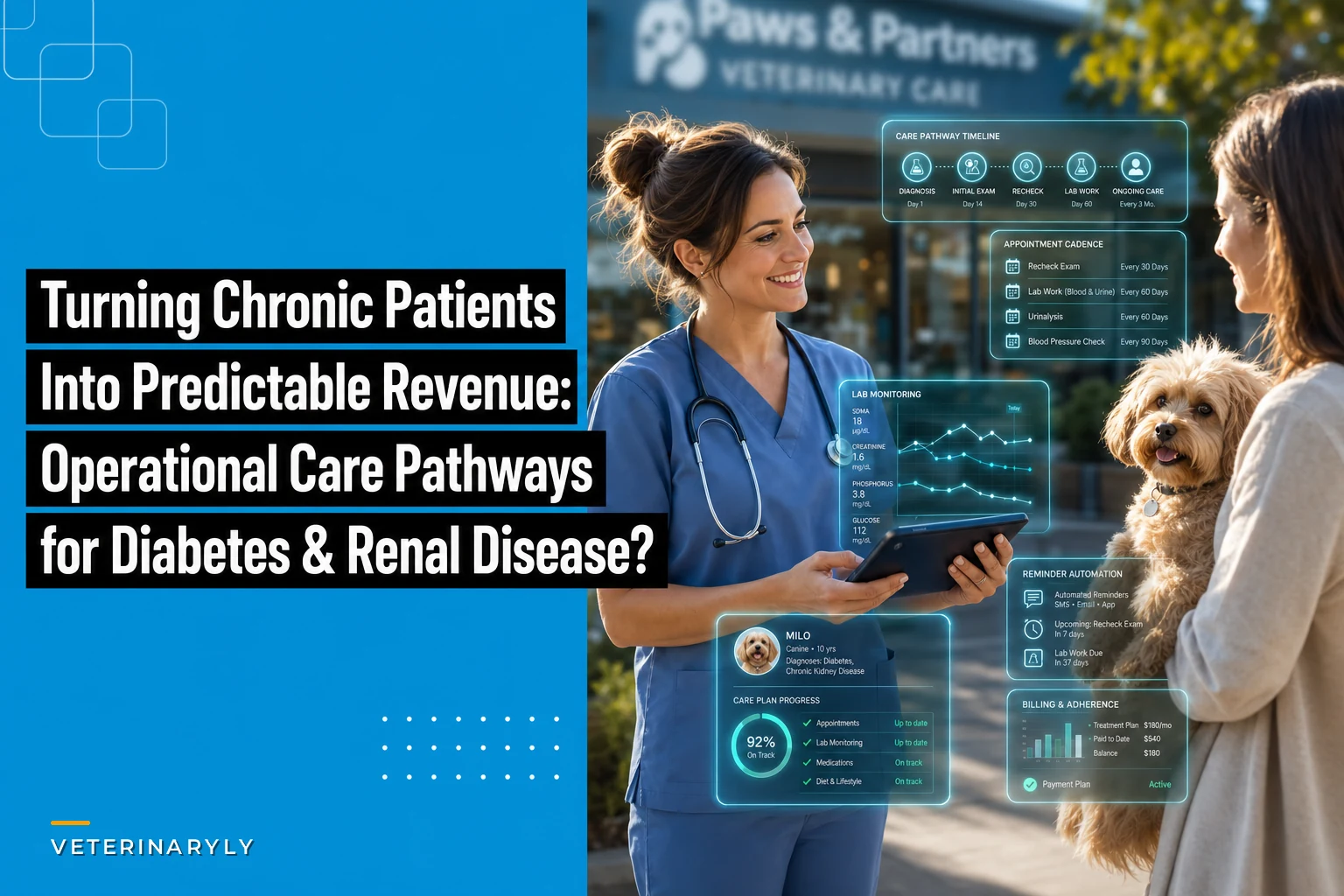

Last winter, I walked through revenue reports with a clinic owner in suburban Denver. She had 43 diabetic cats and 31 dogs with chronic kidney disease. Good patient base for a mid-sized practice. But their chronic care revenue was hitting maybe 35-40% of what it should have been. Not because the pets weren't getting treated — but because everything ran on memory, reminder notes stuck to monitors, and hoping someone would remember to call Mrs. Rodriguez about Max's overdue glucose curve.
When you actually run the numbers, it gets pretty depressing. A properly managed diabetic cat should bring in $7,500-11,000 yearly between monitoring visits, labs, insulin, prescription food, and managing complications. Kidney cases run similar. This practice was sitting on around $550,000 in potential annual revenue from chronic cases alone. They were probably capturing $220,000 of it.
The problem wasn't clinical knowledge. These vets absolutely knew what diabetic cats needed — quarterly fructosamine tests, bi-annual panels, regular weight monitoring, diet management. The issue was purely operational. No systematic way to make sure every patient hit every checkpoint on schedule. No way to catch when someone missed their three-month follow-up. No automatic triggers for the next phase of care.
The Hidden Economics of Chronic Disease Management
Most practices treat chronic cases like regular appointments that happen to repeat sometimes. That's backwards thinking. Chronic disease management is subscription revenue wearing a medical coat. Each diagnosed patient represents predictable income that should continue for years — but only if you actually build the systems to capture it.
Consider diabetic monitoring. Standard protocol involves initial stabilization (usually 2-3 visits in the first month), monthly checks for three months, then quarterly monitoring forever. Add annual complications screening — eye exams, blood pressure, urinalysis for UTIs. That's 7-9 visits per year once stable, plus ongoing prescription revenue.
Most clinics handle this by telling owners to "come back in three months" and crossing their fingers that everyone remembers. No automated reminders tied to specific conditions. No tracking of who's overdue. No escalation when someone disappears for half a year then shows up in DKA.
The vet gets frustrated seeing preventable complications. The owner feels terrible about "forgetting" appointments. The practice loses thousands in revenue that should have been predictable. A structured operational pathway fixes this mess by creating systematic touchpoints that feel like premium care while reducing everyone's workload.
Why Manual Tracking Creates Revenue Leakage
The typical chronic case workflow goes something like this: diagnosis happens, treatment starts, vet mentions follow-up schedule, maybe someone enters a reminder for three months out. Then real life happens. The reminder gets buried under emergency appointments. Three months becomes four becomes five. Client figures no news means good news. Six months later, the cat shows up in crisis.
Never miss a pet’s appointment again.
Veterinaryly helps you schedule, confirm, and manage every appointment and patient record effortlessly.
- Centralized appointment & patient management
- Automated client reminders
- Staff scheduling & task tracking
No credit card required
I've pulled appointment data from clinics managing chronic cases, and the pattern is consistent — roughly 30-35% of chronic patients completely disappear within six months of diagnosis. Another 40% get sporadic care, missing about half their recommended checkups. Only 25% or so actually receive the full monitoring protocol they need.
This isn't really about client compliance. It's system failure. When you depend on manual processes to manage complex, long-term care plans, stuff falls through cracks constantly. Staff turnover means knowledge walks out the door. Busy periods mean follow-ups get pushed aside. Different team members have different approaches to reminder calls.
The financial damage compounds over time. A diabetic cat getting quarterly monitoring stays stable longer, needs fewer emergency interventions, and generates steady revenue for 3-4 years typically. One getting spotty care often crashes within 18 months, either dying or getting euthanized after an expensive crisis that burns client trust. You lose current revenue plus years of future revenue.
Building Disease-Specific Pathway Templates
Standardized pathways fix this by creating predetermined schedules for each condition. Not generic "chronic disease" protocols — specific, detailed roadmaps for diabetes, kidney disease, hyperthyroidism, and other common long-term conditions.
A diabetes pathway template might include:
-
Week 0-2 - Day 1: Diagnosis, initial labs (CBC, chemistry, urinalysis, fructosamine) - Day 3: Start insulin, dispensing appointment - Day 7: First curve or spot check - Day 14: Adjustment consultation
-
Month 1-3 - Month 1: Full curve, fructosamine - Month 2: Spot glucose, weight check - Month 3: Curve, fructosamine, owner education review
-
Ongoing stable management - Every 3 months: Fructosamine, weight, physical exam - Every 6 months: Full lab panel, blood pressure - Annually: Comprehensive panel with T4, urinalysis, culture if needed
-
Automated triggers - Reminder sent 2 weeks before each appointment - Follow-up call if appointment not scheduled within 1 week - Alert to vet if patient overdue by more than 30 days - Automatic prescription renewal reminders at 25 days
This isn't just a clinical protocol — it's an operational framework. Every touchpoint has a specific trigger, owner communication template, and revenue expectation. Nothing depends on someone remembering. The pathway runs itself.
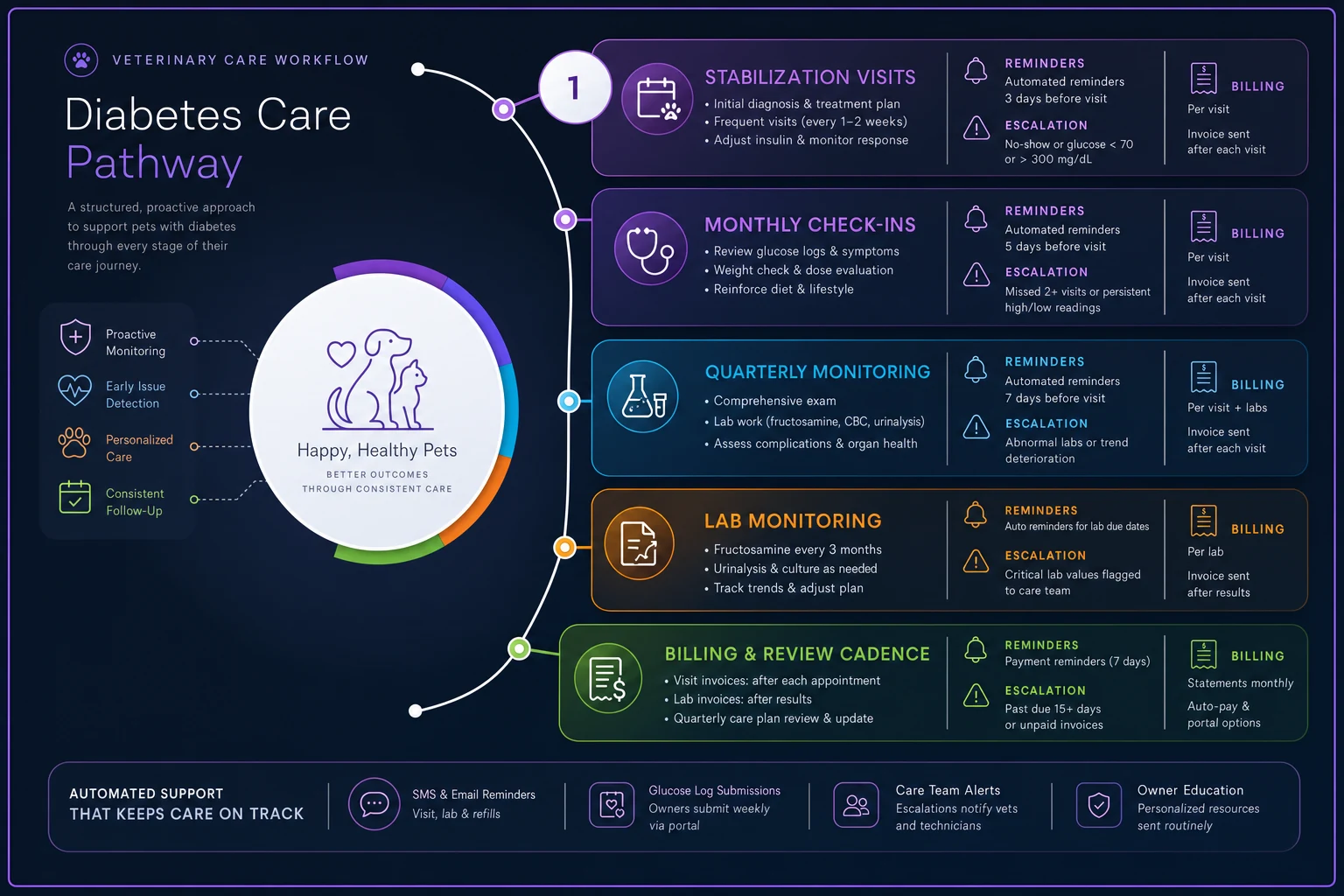
This visual summarizes the pathway's scheduled touchpoints and automated triggers.
The Psychology of Proactive Communication
Clients don't skip appointments on purpose. They forget, get overwhelmed, or figure their pet seems "fine" so monitoring can wait. Proactive, condition-specific communication completely changes this dynamic.
Instead of generic "time for Fluffy's checkup" reminders, send this: "It's been 3 months since Fluffy's last diabetes monitoring. Consistent glucose control prevents complications like cataracts and neuropathy. We have appointments available Tuesday or Thursday this week for her fructosamine test and weight check."
This works because it's specific (diabetes monitoring, not generic checkup), educational (mentions complications), and actionable (specific appointment slots). It frames the visit as preventing problems rather than checking boxes.
Timing matters. Two weeks gives enough lead time without being so far out that clients forget again. The follow-up at one week catches people who meant to call back but got distracted. The 30-day overdue alert prevents patients from vanishing entirely.
Some practices worry about seeming pushy. Clients actually appreciate the structure. Managing a diabetic pet feels overwhelming. Having a clinic proactively guide them through the process feels like premium care, not harassment. Their compliance improves because you've removed the mental burden of tracking what needs to happen when.
Appointment Cadence That Maximizes Compliance and Revenue
Traditional scheduling books one appointment at a time, hoping clients remember to schedule the next one. This creates unnecessary friction at every step. Smart pathways pre-schedule the entire year.
During the stabilization visit, book the next four quarterly appointments. Yes, some will need rescheduling. But having appointments already on the calendar creates commitment. It's easier to move an existing appointment than remember to create one from scratch.
Quick monitoring visits (15 minutes): Fructosamine draw, weight check, brief exam. Price these affordably — $65-85. The goal is reducing barriers to consistent monitoring.
Comprehensive rechecks (30 minutes): Full exam, lab work, medication adjustments, owner education. Price at standard consultation rates plus labs.
Annual intensive review (45 minutes): Complete workup including complications screening, dietary review, quality of life assessment. Premium pricing justified by comprehensive nature.
This tiered structure serves multiple purposes. Quick visits keep clients coming regularly without major cost burden. Comprehensive rechecks generate solid revenue while providing necessary medical oversight. Annual reviews catch developing complications before they become emergencies.
Consider bundling services. A "Diabetes Management Package" might include quarterly monitoring visits, all fructosamine tests, and 10% off insulin for $X annually. Clients get predictable costs, you get guaranteed revenue, and compliance improves because everything's prepaid.
Laboratory Monitoring Without the Chaos
Lab scheduling for chronic patients usually happens randomly. Someone might remember to run a fructosamine. Maybe not. Results get filed somewhere. Follow-up happens if someone notices something abnormal. This reactive approach misses trends and wastes opportunities.
Build lab schedules directly into pathway templates:
| Test | Frequency | Purpose | Action Thresholds |
|---|---|---|---|
| Fructosamine | Every 3 months | Glucose control | >400: Increase insulin. >500: Urgent recheck |
| Chemistry panel | Every 6 months | Organ function | Creatinine increase >0.5: Investigate |
| Urinalysis | Every 6 months | UTI screening | Bacteria/WBC: Culture & treat |
| Blood pressure | Every 6 months | Complication monitoring | >160: Start medication |
| T4 (cats) | Annually | Concurrent disease | >4.0: Investigate hyperthyroidism |
Make this systematic, not memory-dependent. When a diabetic patient checks in, the system should automatically flag which labs are due based on last testing date. Results should trigger specific actions — not just get filed away.
Example: Fructosamine comes back at 450 (elevated but not critical). System automatically generates client communication about increasing insulin dose, schedules a two-week follow-up call, and alerts the vet if no response within three days. No one has to remember to follow up — it happens automatically.
Billing Cadence That Reduces Sticker Shock
Nothing kills chronic disease management faster than surprise $400 bills. Clients need predictable costs to maintain compliance long-term. Most clinics handle billing reactively — charging whatever services happen that day, creating unpredictable expenses that stress clients and tank compliance.
Consider wellness plan-style billing for chronic conditions. Spread annual costs across monthly payments. A diabetes management plan might run $120-140 monthly, covering:
-
All monitoring appointments
-
Fructosamine testing
-
Annual complication screening
-
10% discount on insulin and supplies
-
Priority scheduling for concerns
This transforms chronic care from unpredictable expense spikes into manageable monthly costs. Clients can budget properly. You get predictable revenue. Compliance improves because services are prepaid.
Even without formal plans, reduce billing friction. Send estimates before appointments. Offer payment plans for larger workups. Allow pre-payment for upcoming services. Remove financial surprises that cause clients to delay or skip care.
The Adherence Tracking Most Clinics Miss
Most practices track whether appointments happened. Almost none track whether treatment protocols are actually being followed at home. This creates massive blind spots in chronic disease management.
Real adherence tracking monitors:
-
Prescription refill timing (is insulin lasting as long as it should?)
-
Home monitoring frequency (are they checking glucose as recommended?)
-
Dietary compliance (are they buying prescription food consistently?)
-
Administration technique (during rechecks, can they demonstrate proper injection?)
This data reveals what's really happening between visits. If insulin refills are stretching longer than they should, the client might be under-dosing or skipping doses. If prescription food purchases stopped, diet non-compliance might explain poor control.
Build these checkpoints into pathways. During appointment scheduling calls, ask about current insulin supply. Track prescription food purchases through your system or distributor reports. Include technique review in every monitoring visit. This isn't micromanaging — it's identifying problems before they become crises.
When you spot non-adherence, address it systematically. Don't lecture. Investigate why. Cost concerns? Offer payment plans. Injection anxiety? Provide additional training. Schedule conflicts? Suggest alternative monitoring approaches. The pathway should include response protocols for common adherence obstacles.
Technology Infrastructure That Actually Works
The operational complexity of managing dozens or hundreds of chronic patients exceeds what manual systems can handle. You need technology infrastructure, but not the bloated "enterprise solutions" that take months to implement and require constant IT support.
Modern operational platforms designed for veterinary clinics can automate most pathway management. The system tracks where each patient sits in their journey, triggers communications at appropriate intervals, flags overdue cases, and generates reports showing pathway performance.
The technology should be invisible to your team. They shouldn't have to learn complex new workflows or remember to check another system. Good operational software integrates with your existing practice management system, automatically pulling patient data and pushing back appointment bookings.
Look for platforms that let you build custom pathways for different conditions, not one-size-fits-all templates. Your diabetes pathway differs from kidney disease differs from hyperthyroidism. The system should accommodate this complexity while keeping the interface simple for staff.
The automation handles repetitive tasks — sending reminders, flagging overdue patients, generating follow-up tasks. This frees your team to focus on actual patient care and client relationships rather than administrative tracking.
Measuring Success Beyond Just Revenue
Revenue is obvious, but effective veterinary chronic care pathways impact multiple practice performance dimensions. Track these indicators:
Clinical outcomes: Average time to stabilization, complication rates, average disease duration before euthanasia. Better pathway adherence should improve all these.
Client satisfaction: Survey scores, referral rates, online reviews mentioning chronic disease management. Structured pathways typically improve client experience significantly.
Team efficiency: Time spent on appointment scheduling, reminder calls, following up on overdue patients. Automation should cut this by 60-70%.
Revenue metrics: Revenue per chronic patient, lifetime value, pathway completion rates. Expect 40-60% improvement in the first year.
Compliance rates: Percentage completing quarterly visits, lab work adherence, prescription compliance. Target 75%+ for well-designed pathways.
A clinic I worked with recently shared their nine-month results. Diabetic cat revenue up 51%. Average time between diagnosis and first crisis extended from around 7 months to 16 months. Client satisfaction scores for chronic disease management jumped from 3.1 to 4.5 out of 5. Staff spent about 5 fewer hours weekly on chronic disease administration.
These improvements compound. Better clinical outcomes mean clients trust your protocols more. Higher satisfaction drives referrals of other chronic cases. Improved efficiency lets you manage more cases without adding staff. The pathway pays for itself within months, then generates ongoing returns for years.
Common Pitfalls That Destroy Pathway Performance
Over-complexity from the start: Launching with twelve different disease pathways, each with dozens of touchpoints. Start with one or two common conditions. Perfect those before expanding.
Rigid adherence to protocols: Mrs. Thompson can't afford quarterly visits but could do bi-annual. Work with her rather than letting her drop out entirely. Pathways should guide, not dictate.
Forgetting the human element: Automation handles scheduling and reminders, but someone still needs conversations about quality of life, cost concerns, and treatment goals. Don't let efficiency eliminate empathy.
Weak onboarding: Dumping a diabetic diagnosis on an overwhelmed owner then expecting perfect compliance. Spend extra time initially explaining the pathway, setting expectations, addressing concerns.
Ignoring workflow integration: Creating beautiful pathways that don't mesh with how your clinic actually operates. If your team does callbacks at 4 PM, don't schedule them for 10 AM.
Not training the entire team: Reception doesn't understand why chronic appointments differ from regular visits. Techs don't know the pathway triggers. Vets freelance their own protocols. Everyone must understand and follow the system.
The Competitive Advantage of Systematic Chronic Care
Within a couple years, clinics with strong veterinary chronic care pathways will dominate chronic disease referrals in their markets. General practitioners who can demonstrably manage complex cases long-term will capture cases that previously went to specialists. The operational infrastructure becomes a competitive advantage.
Practices implementing structured pathways consistently report becoming known as "the diabetes place" or "where you go for kidney cats." Specialists start referring stable cases back because they trust the monitoring will actually happen. Other clinics refer complex cases they can't manage systematically.
The market dynamics make sense. Pet owners with chronic cases desperately want predictability — clinical, operational, and financial. A clinic that can offer all three while delivering superior outcomes naturally attracts these high-value, long-term clients.
Insurance companies are starting to notice too. Some now offer preferred rates for clinics with documented chronic disease pathways because outcomes are better and costs more predictable. This trend will accelerate as pet insurance penetration increases.
Starting Your Pathway Implementation
Pick one condition. Diabetes in cats or chronic kidney disease in dogs — something common enough to matter but focused enough to manage properly. Build a complete pathway including:
-
Detailed appointment schedule for year one
-
Lab monitoring calendar with specific tests
-
Communication templates for each touchpoint
-
Billing structure that smooths costs
-
Adherence tracking checkpoints
-
Clear escalation triggers
Run a pilot with 10-12 patients. Track everything. Refine based on what actually happens versus what you planned. Only after proving the model works should you expand to other conditions.
Get buy-in by showing the math. If you have 18 diabetic patients averaging $4,200 annually under current management, improving to $7,500 through better pathways means $59,400 additional revenue. That funds the technology, training, and time investment several times over.
Train progressively. Start with one champion who deeply understands the pathway. Have them train others individually rather than group sessions where details get lost. Role-play common scenarios. Make sure everyone can explain why each touchpoint matters and how it connects to better outcomes for both patients and the practice.
Ready to elevate your clinic’s efficiency?
Join 500+ veterinary clinics using Veterinaryly to save time, reduce administrative overhead, and improve patient care.