


Version date: June 2025 · Planned review date: June 2026
This is a working education asset — not a product manual and not a set of industry staffing standards. It pulls together what the published veterinary workforce research actually says, separates that from an author-created operational method, and gives you printable worksheets you can take into your own practice this week. Read the scope and disclosure sections before applying anything here to real staffing decisions.
Executive summary: what "capacity-based staffing" actually decides
Most practices don't schedule to capacity. They schedule to history — "this is how we've always built Tuesdays" — and then absorb the overflow through unpaid lunch breaks, late record-writing, and whoever is willing to stay. Capacity-based staffing is a management approach that tries to match available labor hours to total measured demand, not just booked appointments, so coverage decisions get made before the day falls apart rather than during it.
-
How much real work (appointment and non-appointment) lands on each role in a given week?
-
Where does that work pile up into observable bottlenecks?
-
Which tasks have no backup coverage when one person is out?
-
If we change one thing, how will we know whether it helped?
Done properly, the framework informs decisions like whether to add a technician shift or a CSR shift first, whether your doctors are losing produced hours to callbacks that a credentialed technician could own, and whether your "short-staffed" feeling is actually a staffing problem or a workflow-routing problem.
What it does not do is tell you the "correct" number of staff per doctor. No source in this brief establishes a validated universal veterinary staffing ratio, and this package does not prescribe one. Any numbers you see below that aren't tied to a named citation are explicitly labeled as local inputs you set yourself.
Scope and limitations
This is a practice-management framework, and the distinction matters for how you're allowed to use it.
Never miss a pet’s appointment again.
Veterinaryly helps you schedule, confirm, and manage every appointment and patient record effortlessly.
- Centralized appointment & patient management
- Automated client reminders
- Staff scheduling & task tracking
No credit card required
-
It is not a clinical staffing standard. Decisions about how many credentialed technicians must be present for anesthesia, surgery, or treatment supervision are governed by your clinical judgment and your jurisdiction's veterinary practice act — not by this document.
-
It is not legal, employment-law, or wage-and-hour guidance. Scheduling changes, on-call pay, and overtime rules carry legal obligations that vary by jurisdiction. Confirm those separately.
-
It is not a benchmark. Where this brief cites workforce research, those findings describe populations and settings — they are not thresholds you should import directly into your clinic.
-
It does not replace professional judgment or practice-specific financial analysis. Every output here is meant to inform a conversation, not end one.
Adapt everything to your own caseload, service mix, staffing model, jurisdiction, and clinical responsibilities.
Evidence review: what the published sources actually support
The honest state of the literature: there is strong, credible evidence that the veterinary workforce is under real strain, that demand for care has grown, and that turnover and workload are meaningful operational risks. There is much weaker public evidence for any specific, validated staffing ratio you could apply across practices. Those two facts are why a capacity-based method is more defensible than a capacity number.
Workforce strain and burnout are documented, not anecdotal. The AVMA and the Merck Animal Health Veterinary Wellbeing Study have repeatedly documented elevated psychological distress and burnout risk in the profession, with wellbeing linked to workload and practice conditions.¹ ² This supports the rationale for workload mapping — but it describes individuals, not the right number of shifts.
Demand for veterinary services rose sharply and then fluctuated. Industry analyses including AVMA economic reporting and Mars/AAHA-adjacent commentary documented a surge in visits and spending through the early 2020s followed by softening visit volumes.³ The operational takeaway isn't a number — it's that demand is volatile, which is exactly why fixed historical schedules misfire.
Access-to-care and workforce-supply questions are contested. Reports such as the Mars Veterinary Health "Tackling the Veterinary Professional Shortage" analysis and subsequent academic commentary disagree on whether there is a true long-term headcount shortage or a distribution and efficiency problem.⁴ For a practice manager, that debate is actually useful: it means squeezing more produced capacity out of existing staff through better role design is at least as important as hiring.
Turnover carries real, if practice-specific, cost. General human-capital research (SHRM) documents that replacement costs are substantial across industries.⁵ This is not veterinary-specific, and you should treat it as directional context, not a veterinary benchmark.
Labor-market context is public and current. The U.S. Bureau of Labor Statistics publishes employment and outlook data for veterinarians and veterinary technologists/technicians, including above-average projected growth for technician roles.⁶ That's a supply-side signal, not a staffing prescription.
No source above gives you a validated doctors-to-technicians ratio, a float-pool percentage, or a no-show threshold. So this package does not present any.
Source table
| # | Source | Date | Type | Population / setting | Finding used here | Limitation for your practice |
|---|---|---|---|---|---|---|
| 1 | AVMA workforce & wellbeing reporting | 2022–2024 (ongoing) | Professional association report | U.S. veterinary professionals | Documents workforce strain and wellbeing risk | Describes populations, not staffing levels; self-reported |
| 2 | Merck Animal Health Veterinary Wellbeing Study | 2018, 2021, 2023 editions | Industry-sponsored survey | U.S. veterinarians & staff | Links wellbeing to workload/conditions | Sponsored; survey-based; not a staffing standard |
| 3 | AVMA economic / industry visit-and-spend reporting | 2021–2024 | Association economic analysis | U.S. companion-animal practices | Demand surged then softened; volatility | Aggregate trends; your local demand may differ |
| 4 | Mars Veterinary Health, "Tackling the Veterinary Professional Shortage" | 2022 | Industry white paper | U.S. veterinary labor market | Shortage framed as supply + efficiency | Sponsored; contested conclusions |
| 5 | SHRM human-capital / turnover-cost research | 2016–2022 | Cross-industry HR research | General U.S. workforce | Turnover replacement cost is substantial | Not veterinary-specific; directional only |
| 6 | U.S. Bureau of Labor Statistics, Occupational Outlook | 2023–2024 | Government labor data | U.S. vet & vet tech occupations | Employment levels & projected growth | National aggregate; not practice-level guidance |
Full citations with links are in the References section.
The Veterinaryly capacity method (author-created framework)
> Clearly labeled as an author framework. Everything in this section is a structured operational method created by the author. It is not drawn from the sources above, and none of its steps are validated benchmarks. It's a way to organize decisions — the numbers come from your practice.
The method has four moves: map the work, find the pinch, document who covers what, then test one change. Most practices skip straight to "we need to hire," which is move four without moves one through three.
Prioritize resolving tasks marked with an escalation gap before adding headcount; they're single points of failure.
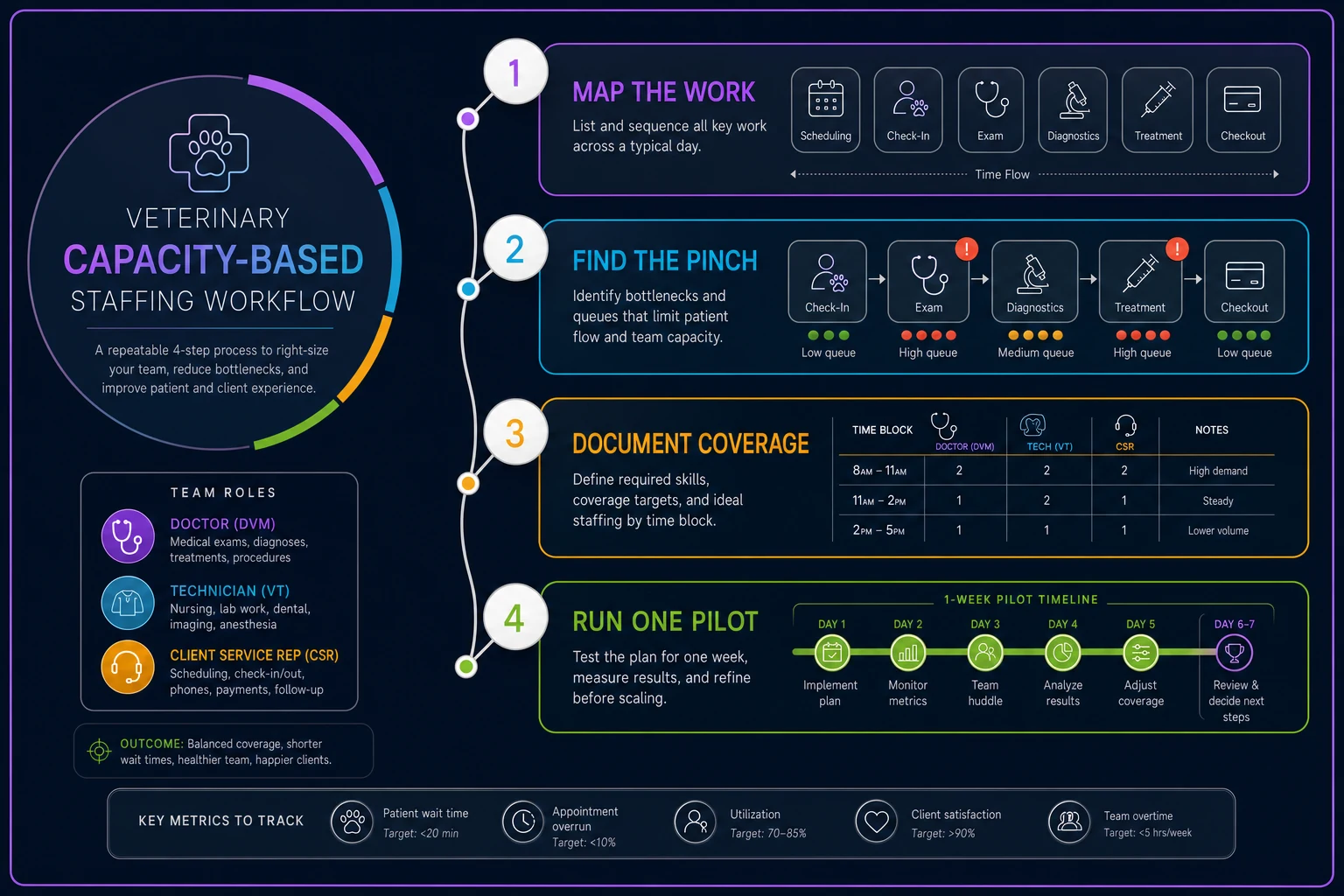
Move 1 — Workload mapping (appointment and non-appointment demand)
The biggest blind spot in most scheduling conversations is that scheduling software shows appointments and nothing else. But the appointment is often less than half of what actually consumes a role's day. If you only staff to the appointment grid, you're structurally understaffed by design — and nobody wrote it down anywhere.
-
Appointment demand — scheduled exams, surgeries, procedures, recheck slots.
-
Phone and message demand — inbound calls, voicemails, portal messages, text threads.
-
Pharmacy / refill demand — approval requests, authorization callbacks, home-delivery handling.
-
Diagnostic follow-up — lab result review, result callbacks, imaging follow-through.
-
Client communication — discharge calls, estimate follow-ups, reminder outreach.
-
Handoffs — doctor-to-tech, tech-to-CSR, shift-change transfers.
-
Urgent / unscheduled work — walk-ins, same-day squeeze-ins, in-hospital emergencies.
-
Administrative work — record completion, insurance/claims, inventory, callbacks logging.
The point isn't perfect precision. It's to make the invisible work visible so it stops being absorbed silently by whoever cares the most — and burns out first.
Move 2 — Capacity diagnostic (local measures, not universal thresholds)
Don't go looking for a magic number. Go looking for observable bottlenecks using measures you can actually collect:
-
Time from inbound call to answered or returned (does it balloon at predictable hours?)
-
Refill requests sitting unprocessed past your own internal target
-
Records not closed within your own stated window
-
Doctors doing work a credentialed technician could own
-
The recurring "who's covering the phones" scramble at lunch
A bottleneck is anything where work reliably queues at the same point. You're not comparing yourself to the industry. You're comparing your practice to its own stated expectations.
Move 3 — Role-based coverage design
This is where fragility hides. Map, for each critical task: who owns it, who backs it up, what the handoff depends on, and where there's an escalation gap — a task with exactly one person who can do it. Single-coverage tasks are your real scheduling risk. One call-out and the whole day degrades.
Move 4 — Run one pilot, not five
Change one thing. Measure before and after against your baseline. Set a fixed review date and decide whether to continue, revise, or stop.
Illustrative teaching scenario (hypothetical — not real results)
> This is a constructed teaching example. The practice, the numbers, and the outcome are invented to show how the method flows. Nothing here is a reported result, a benchmark, or a Veterinaryly customer. Treat every figure as a local input placeholder, not a finding.
Picture a two-site companion-animal group — call it Maple & Harbor Veterinary — with roughly 55 staff across both sites. The managers "know" Harbor is short-staffed because it feels chaotic every afternoon.
Workload mapping (Move 1) over one week shows that at Harbor, refill approvals and lab-result callbacks are landing mostly on doctors between roughly 2–5 p.m. — the same window as their heaviest appointment block. The capacity diagnostic (Move 2) shows callbacks queuing past the practice's own four-hour internal target almost every afternoon.
Coverage mapping (Move 3) surfaces the real problem: refill triage is single-coverage. Only one credentialed technician is trained on it, and she's in appointments all afternoon.
So the pilot (Move 4) isn't "hire a doctor." It's: cross-train a second technician on refill triage and shift that work off doctors during the 2–5 window, for four weeks, reviewed on a set date. The hypothetical baseline is refill turnaround averaging around 6–7 hours; the team sets a target to pull that under their four-hour internal goal and to recover doctor time for appointments.
Whether it worked gets decided on the review date against the baseline — not assumed in advance. That's the whole discipline: the scenario is designed to show the process, not to promise a result.
CE Session Abstract (conference-ready)
> Note on CE status: This session is designed as practical practice-management education. It is not currently RACE-approved, VHMA-approved, CVPM-eligible, or accredited by any body, and it has not been accepted by any conference. Any CE representation would require written confirmation from the relevant approver and event organizer.
Session title: Staff to the Work, Not the Grid: A Capacity-Based Method for Veterinary Scheduling and Coverage
Format: 60-minute interactive workshop (also deliverable in 45 minutes)
Intended audience: Veterinary practice managers, practice owners, multi-location operations leaders, and team leads responsible for scheduling, staffing, and service capacity. No prior analytics experience required; participants should bring general familiarity with their own practice's scheduling.
Session description: Most veterinary schedules are built from history and patched in real time. This workshop teaches a vendor-neutral, four-move method for matching labor to total demand — including the non-appointment work that quietly consumes a team's day. Attendees will complete a live workload map, learn to spot bottlenecks using locally collected measures rather than borrowed industry numbers, document role-based coverage dependencies to expose single-coverage risks, and design one controlled staffing or workflow pilot they can run in a single scheduling cycle. The session is explicit about what the published workforce evidence does and does not support, and it does not prescribe universal staffing ratios. Participants leave with three printable worksheets and a facilitator handout.
Measurable learning objectives. By the end of the session, participants will be able to:
-
Complete a workload map for at least one role, distinguishing appointment demand from at least three categories of non-appointment demand.
-
Identify at least two observable bottlenecks in their own operation using locally collected measures rather than universal thresholds.
-
Document role-based coverage dependencies for at least three critical tasks, including primary coverage, backup coverage, and escalation gaps.
-
Define a one-cycle pilot with a baseline measure, an intervention, a review date, and explicit continue/revise/stop criteria.
Timed agenda (60 minutes):
| Time | Segment |
|---|---|
| 0:00–0:05 | Framing: why history-based schedules misfire; what the evidence does/doesn't say |
| 0:05–0:12 | Evidence review (workforce strain, demand volatility, the ratio gap) |
| 0:12–0:27 | Hands-on: workload mapping — appointment vs. non-appointment demand |
| 0:27–0:37 | Hands-on: capacity diagnostic — finding local bottlenecks |
| 0:37–0:48 | Hands-on: role-based coverage & escalation-gap mapping |
| 0:48–0:56 | Hands-on: design one one-cycle pilot with stop/revise criteria |
| 0:56–1:00 | Disclosure, limitations, Q&A, take-home tools |
(45-minute version compresses the evidence review to 4 minutes and shortens each hands-on block by roughly 2 minutes.)
Three attendee takeaways:
-
A completed workload map and coverage template for at least one role, started live in the room.
-
A written one-cycle pilot plan with baseline and decision criteria.
-
A clear-eyed understanding of why no validated universal veterinary staffing ratio is being prescribed — and how to make defensible local decisions instead.
Participants leave with the worksheets and facilitator handout described below.
Downloadable artifacts (reproduced in full below — no login or purchase required)
These are printable as-is. Copy them into a spreadsheet or print them. Nothing here requires any software.
1) Capacity & Workload-Mapping Worksheet
| Role | Demand category | Time period | Workflow stage | Est. volume (local input) | Est. time per unit (local input) | Who currently absorbs it |
|---|---|---|---|---|---|---|
| Doctor | Appointment | Exam/treatment | ||||
| Doctor | Diagnostic follow-up | Result review/callback | ||||
| Technician | Pharmacy/refill | Triage/approval | ||||
| Technician | Handoffs | Shift change | ||||
| CSR | Phone/message | Inbound/return | ||||
| CSR | Client communication | Discharge/estimate | ||||
| Assistant | Admin | Record/inventory | ||||
| Management | Urgent/unscheduled | Squeeze-in coordination |
All volume and time figures are local inputs. No cell is a benchmark.
2) Role-Based Coverage Template
| Critical task | Primary owner | Backup owner | Handoff depends on | Escalation gap? (Y/N) | Risk if primary absent |
|---|---|---|---|---|---|
> Any row where Backup owner is blank or Escalation gap = Y is a single-coverage risk. Prioritize those before adding headcount elsewhere.
3) Pilot-Measurement Worksheet
-
Pilot name
-
One change being tested (only one)
-
Baseline measure (and how/when collected)
-
Target (local, not a benchmark)
-
Start date Review date (fixed):
-
Service measures tracked
-
Labor measures tracked
-
Decision at review ☐ Continue ☐ Revise ☐ Stop
-
Reasoning for decision
4) One-Page Facilitator Handout
Workshop steps: (1) Map the work → (2) Find the pinch → (3) Document coverage → (4) Test one change. Three non-appointment demand categories to always check: phone/message, pharmacy/refill, diagnostic follow-up. Source limitations in one line: The evidence supports why to map workload; it does not supply validated staffing ratios — set your own local targets. Disclosure line to read aloud: "This framework was developed by Veterinaryly, a practice-management software company. You can apply every step today with a spreadsheet and no software purchase."
When this framework makes sense — and when it doesn't
It makes sense when:
-
You feel short-staffed but can't say which role or which hour.
-
Doctors are absorbing refill and callback work during produced appointment time.
-
One person's absence predictably wrecks the day (single-coverage risk).
-
You're about to hire and want to confirm the bottleneck is really headcount.
It's a bad idea when:
-
You're using it to justify a staffing cut you've already decided on. Mapping is a diagnostic, not a cost-cutting cover story.
-
You treat the hypothetical scenario numbers as real targets. They're placeholders.
-
You try to change five things at once — you'll never know what moved the needle.
Who should not run this alone: Anyone trying to use workload data to make clinical supervision or legal staffing-compliance calls. Those decisions belong with your veterinarians and your jurisdiction's rules, full stop.
Disclosure and neutrality statement
Commercial interest. This package was produced by Veterinaryly, a company that sells veterinary practice-management and scheduling software. Veterinaryly has a commercial interest in practices improving how they manage capacity. That interest is disclosed openly here.
Neutrality. The four-move method, every worksheet, and the entire workshop can be completed with a spreadsheet and printed templates. No part of this session, and none of the downloadable tools, requires purchasing, trialing, or logging into Veterinaryly or any other product. Where software can reduce the manual effort of workload mapping and coverage tracking — by centralizing demand data that's otherwise scattered across phones, the PIMS, and sticky notes — that's an optional efficiency, not a requirement of the method.
Presenter roles. See bios below. Any independent co-presenter or reviewer involved in a future delivery of this session would participate specifically to keep it educational and vendor-neutral, and their role would be disclosed in full.
Presenters and review status (stated honestly)
Lead author (Veterinaryly). The lead author is a member of the Veterinaryly practice-operations content team, writing from operational practice-management and workflow-analysis experience across companion-animal practices. Veterinaryly's commercial role is disclosed above.
Independent co-presenter / reviewer — status. A defensible CE submission for this session requires an independent, credentialed co-presenter or reviewer: a licensed veterinarian, a credentialed veterinary practice manager (e.g., CVPM), or a multi-site veterinary operations leader with firsthand staffing experience, whose role is to confirm the session is educational and balanced rather than a product demonstration.
As of this version date, no such independent review has been completed, and no co-presenter has been confirmed. We will not claim otherwise. Before this package is submitted anywhere as a finished proposal, that independent practitioner will be engaged, will review the workflow examples and role descriptions for realism, will approve their own biography and any quoted expertise in writing, and will be named here with full disclosure. Until that happens, this document stands as a transparent working proposal — not a reviewed or accepted session.
Event / CE status. This session has not been submitted to, accepted by, or endorsed by any conference, and it carries no CE accreditation. Any speaker submission will be framed as an inquiry until a specific event confirms its submission route, deadline, session length, vendor-speaker eligibility, and conflict-of-interest requirements for the applicable cycle.
References and evidence notes
Citations are provided for verification. Readers should consult the current version of each source, as editions and figures are updated.
-
American Veterinary Medical Association (AVMA) — workforce and wellbeing reporting and economic resources. Professional association. See avma.org (workforce and economics sections). Limitation: describes populations and trends, not staffing prescriptions.
-
Merck Animal Health Veterinary Wellbeing Study (2018; 2021; 2023 editions), conducted with AVMA collaboration. Industry-sponsored survey of U.S. veterinarians and staff. Limitation: sponsored, self-reported; not a staffing standard.
-
AVMA economic / industry visit-and-spend analyses (2021–2024). Association economic reporting on companion-animal demand trends. Limitation: aggregate national trends; local demand varies.
-
Mars Veterinary Health, "Tackling the Veterinary Professional Shortage" (2022). Industry white paper on the U.S. veterinary labor market. Limitation: sponsored; conclusions contested in subsequent commentary.
-
Society for Human Resource Management (SHRM) — human-capital and turnover-cost research (2016–2022). Cross-industry HR research. Limitation: not veterinary-specific; use only as directional context.
-
U.S. Bureau of Labor Statistics, Occupational Outlook Handbook — Veterinarians; Veterinary Technologists and Technicians (2023–2024). Government labor data. Limitation: national aggregates; not practice-level guidance.
Evidence note on benchmarks: None of the sources above establishes a validated universal veterinary staffing ratio, workload threshold, float-pool percentage, no-show target, or labor-cost benchmark. This package deliberately prescribes none. Every numeric figure in the author framework, worksheets, and teaching scenario is either a local input you set yourself or a clearly labeled hypothetical.
How to use this document
Start with the workload-mapping worksheet for your single most stressed role. Spend one representative week filling it in honestly — including the invisible work. Then run the coverage template to find your single-coverage risks. Pick one pilot. Set a review date. Decide against your own baseline. That's the whole discipline: make the work visible, find where it queues, see who's a single point of failure, and test one change at a time. The evidence tells you why this matters. Your own practice tells you what to do about it.
Ready to elevate your clinic’s efficiency?
Join 500+ veterinary clinics using Veterinaryly to save time, reduce administrative overhead, and improve patient care.