



Author: Compiled by the Veterinaryly operations editorial team, drawing on veterinary practice-operations and workforce-onboarding experience.
Published: June 2024 · Last reviewed: June 2024 · Version: 1.0
Change log: v1.0 — Initial public release of the framework, role matrices, 30/60/90-day worksheet, decision tree, and check-in logs.
Start here: what this is, and what it is not
Most practices already agree onboarding should run one to three months, cover role-specific training, SOP review, technology training, mentorship, assessments, milestones, and feedback. That part isn't the problem. Practice-management guidance has been saying this for years.
The gap is quieter and more expensive: a new hire finishes "onboarding," starts working independently, and nobody can point to the moment someone confirmed they were ready. The calendar said 90 days, so the training tags got pulled off the schedule. That's it. That's the whole decision.
This toolkit exists to fill that specific hole. It's a competency and readiness sign-off supplement, not a replacement for your onboarding program. A basic onboarding checklist answers "Did we cover this topic?" A competency sign-off answers something harder: "Has this person demonstrated this task, been observed doing it, and been cleared — by a named person, on a date — to do it without supervision?"
Those are different questions. The first is about content delivery. The second is about verified capability. If your current onboarding documents only answer the first one, this is the layer that's missing.
One thing up front, plainly stated: everything below is an adaptable operational framework created by Veterinaryly. It is not a validated standard, not legal advice, not medical-direction advice, and not a substitute for your own SOPs or your state's rules. Every clinical-task example is a practice-adaptable example that requires local SOP, medical-director, credentialing, and jurisdictional review before you use it. More on that in the governance section — which you should actually read before touching the matrices.
Why elapsed time is the wrong readiness signal
Here's a failure pattern that shows up constantly, across clinics of very different sizes.
Never miss a pet’s appointment again.
Veterinaryly helps you schedule, confirm, and manage every appointment and patient record effortlessly.
- Centralized appointment & patient management
- Automated client reminders
- Staff scheduling & task tracking
No credit card required
A veterinary assistant is hired in March. They shadow for two weeks, they're pleasant, they pick things up fast. By week five the schedule is slammed, someone calls out, and the assistant gets pulled to restrain a fractious cat for a blood draw — solo — because "they've been here over a month." Nobody ever watched them do a solo restraint on a difficult patient and confirmed the technique was safe. The month passed, so the assumption filled the gap.
This is the core design principle behind the whole toolkit, and it's worth saying directly: time-in-role is not competence. Structured onboarding works when it's tied to observable demonstration and supervised progression, not a countdown. The calendar is a planning tool. It is not evidence.
-
The confident-but-unready hire gets cleared early because they seem fine, and the first real failure happens unsupervised.
-
The quiet-but-competent hire stays over-supervised for months because nobody formally signed off, wasting mentor hours and frustrating a good employee.
-
The uneven hire — strong on client-facing tasks, shaky on clinical ones — gets cleared as a whole instead of task-by-task, so a real gap gets buried under an overall "seems ready."
That last one is the most common and the most dangerous. Readiness is not one switch. It's dozens of small ones, and they don't all flip at the same time.
Scope and governance (read this before the matrices)
This is the section people skip and then regret. The competency matrices are the easy part. Deciding who is allowed to sign off on what is the part that actually protects your practice.
Who may sign off
| Competency type | Example items | Who can typically sign off | When medical-director approval is required |
|---|---|---|---|
| Administrative / client-service | Check-in workflow, phone triage script, payment handling, appointment booking rules | Lead receptionist, practice manager, or designated trainer | Not usually — unless the task touches clinical scheduling rules or triage decisions |
| Workflow / support | Room turnover, inventory pulls, restraint for routine patients, kennel and biosecurity protocols | Lead technician, practice manager, or credentialed technician mentor | When a task overlaps clinical judgment or patient-safety thresholds your practice defines |
| Clinical-task readiness | Any task involving patient care, sample collection, medication handling, anesthesia support, or delegated medical acts | Only per your SOPs and subject to medical-director / veterinarian oversight | Always defer to local SOPs, credentialing rules, delegation limits, and state practice-act requirements |
The row that matters most is the bottom one. This toolkit does not tell you what any staff member is permitted to do. Permitted duties, required supervision levels, and delegation limits for veterinary assistants, credentialed veterinary technicians, and veterinarians are not the same across the board, and they vary by state and by your own practice policy. Treat every clinical row in the matrices as a placeholder you must validate against your practice act, your credentialing requirements, and your medical director's judgment before a single sign-off happens.
Aligning tasks to your SOPs
-
Map each competency line to your actual written SOP.
-
If no SOP exists for a task, that's a finding — either write one or remove the competency.
-
Where a task involves clinical judgment or delegated medical acts, route it through your medical director before it becomes a sign-off item.
A note on terminology
The U.S. veterinary field uses "veterinary technician," "veterinary technologist," "veterinary assistant," and credentialed titles (CVT/LVT/RVT depending on state) that are not interchangeable. Some are legally protected titles tied to credentialing; some are not. This toolkit uses "veterinary assistant or veterinary technician" as a combined pathway only because staffing structures vary so widely — you must split, relabel, and re-scope that pathway to match the actual credentialed roles and permitted duties in your practice and state. For authoritative role and credentialing framing, consult your state veterinary medical board.
A note on confidentiality
Veterinary records confidentiality is governed by state law and professional/ethical obligations, not a single federal framework. (HIPAA does not generally govern veterinary medical records.) Where the client-service pathway touches records handling and client privacy, align it to your state's requirements and your own privacy policy rather than assuming a specific federal standard applies.
The 30/60/90-day planning worksheet
This is Veterinaryly's adaptable planning framework. Copy it, change the timelines, change the decision points — it's a starting structure, not a rule.
The core idea: each phase ends with an explicit decision, and the only permitted decisions are the four below. "It's been 90 days" is not one of them.
-
✅ Completed — competency demonstrated and signed off
-
🔄 Continue supervised practice — progressing, not yet independent
-
⚠️ Remediate — specific gap identified, remediation plan attached
-
⏸️ Defer pending local approval — task requires medical-director / credentialing / jurisdictional sign-off not yet obtained
Phase structure (adaptable)
| Phase | Typical focus | Manager/mentor review point | Decision required |
|---|---|---|---|
| Days 0–30 (Orientation) | Practice tour, systems access, SOP review, technology training, shadowing, low-risk supervised tasks | End-of-week check-ins + Day 30 review | Confirm orientation complete before supervised practice expands |
| Days 31–60 (Supervised practice) | Performing role tasks under defined supervision; competency observations begin in earnest | Weekly + Day 60 review | Mark each competency Completed / Continue / Remediate / Defer |
| Days 61–90 (Conditional independence) | Reduced supervision on signed-off tasks only; remaining items stay supervised | Day 90 review + readiness decision tree | Independent-duty approval only for competencies with completed sign-offs |
Critical rule built into the worksheet: independent-duty approval is granted per competency, never per person by date. A hire can be independent on check-in workflows at Day 45 and still supervised on restraint at Day 90. That's normal. That's the tool working correctly.
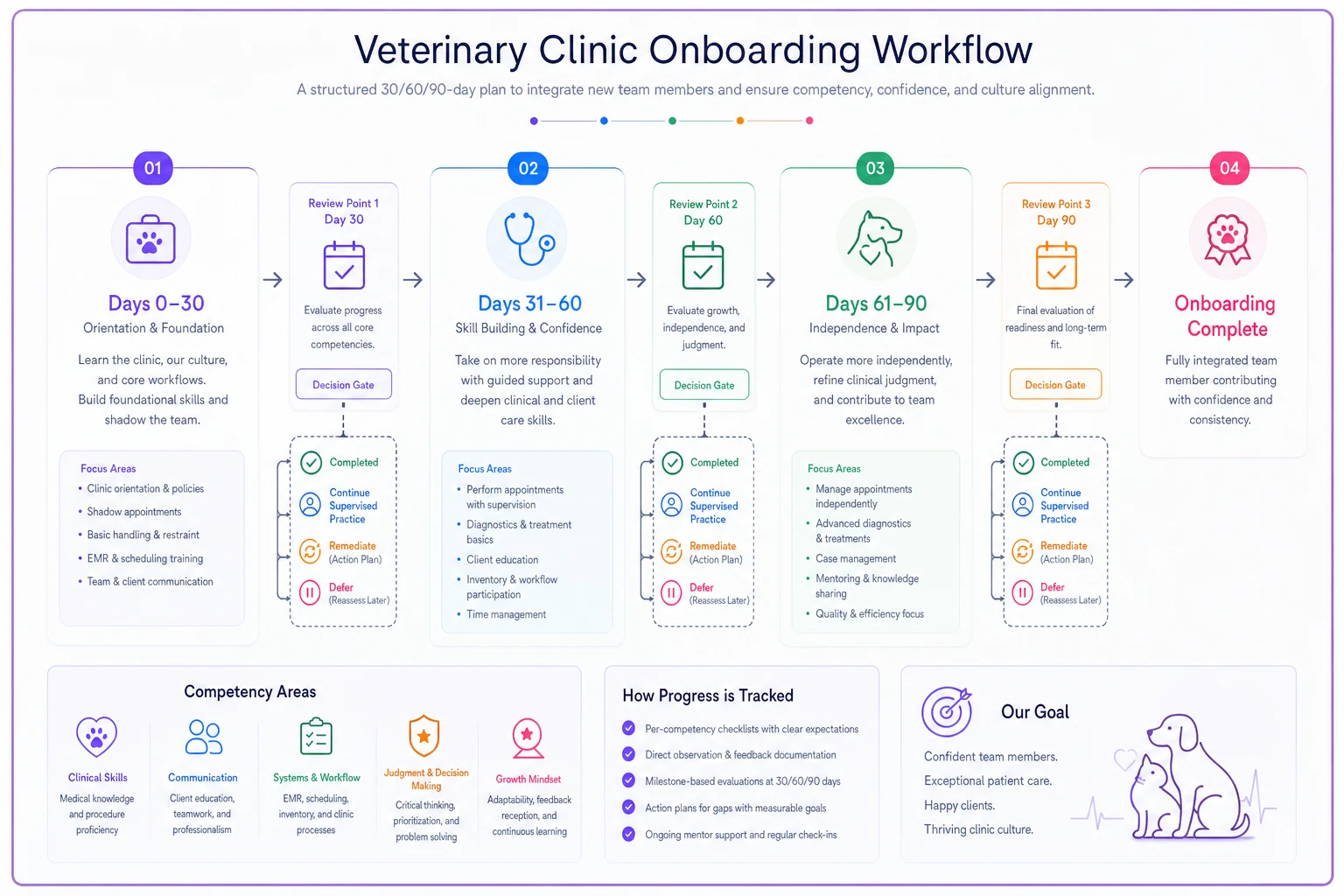
Use this visual to map who reviews each phase and where decisions are recorded.
The core idea remains: independent-duty approval is tied to completed sign-offs, not elapsed time.
Role-based competency matrices
Below are the three pathways. Every row uses the same field structure so your documentation stays consistent across roles.
Standard field set for every competency row (use this exact structure in your workbook):
-
Competency / task description (observable — "demonstrates," "performs," "responds," not "understands")
-
Prerequisite training or SOP reference (your local SOP number/link)
-
Required supervision level (Direct / Indirect / Independent — per your SOP)
-
Date observed
-
Assessor name
-
Trainee acknowledgement (initials/signature)
-
Remediation action (if not yet met)
-
Re-assessment date
A reminder that applies to all three matrices: these are adaptable examples. Clinical rows especially must be validated against local SOPs, credentialing rules, delegation limits, and your state practice act before use.
Pathway 1 — Receptionist / Client-Service (15+ observable items)
-
Performs full client and patient check-in per SOP without prompting
-
Navigates the practice management system to book, reschedule, and cancel per scheduling rules
-
Follows the phone-triage script and escalates clinical questions rather than answering them
-
Collects payment, applies deposits, and reconciles a drawer per financial SOP
-
Verifies client contact and patient records accurately at every touchpoint
-
Handles an upset or grieving client using the practice's communication standard
-
Explains estimates and payment options within scope, without giving medical advice
-
Manages the appointment schedule during a surge (double-books, work-ins) per SOP
-
Processes prescription refill requests and routes them correctly for approval
-
Follows confidentiality and records-release rules per practice policy and state law
-
Executes the recall/reminder workflow accurately
-
Handles inbound emergencies per the triage-escalation SOP (recognizes and routes, does not diagnose)
-
Documents client communications in the record per standard
-
Manages check-out, discharge paperwork handoff, and follow-up scheduling
-
Operates all front-desk technology (phones, payment terminal, scanning, messaging) independently
-
Follows opening/closing procedures and cash-handling controls
Pathway 2 — Veterinary Assistant or Veterinary Technician (15+ observable items)
Split this pathway by credential and re-scope every clinical row to your state and SOPs before use. Assistant and credentialed-technician permitted duties are not identical.
-
Follows biosecurity, PPE, and hand-hygiene protocols consistently
-
Performs safe patient handling and restraint for routine patients (species/temperament appropriate)
-
Demonstrates restraint for fractious or high-risk patients only under the supervision level your SOP defines
-
Prepares exam and treatment rooms and manages turnover per SOP
-
Obtains and records accurate patient history and vitals within role scope
-
Sets up and maintains equipment per manufacturer and practice SOP
-
Handles, labels, and routes laboratory samples per SOP (adaptable example — validate scope)
-
Assists with diagnostic imaging positioning per safety SOP
-
Prepares and handles medications within permitted scope and supervision level (adaptable example — validate against delegation limits and controlled-substance rules)
-
Supports anesthesia/monitoring tasks only at the scope your SOP and credentialing permit (adaptable example — validate)
-
Performs venipuncture / sample collection only if within permitted duties and signed-off (adaptable example — validate)
-
Follows controlled-substance handling and documentation per practice SOP and applicable rules
-
Documents in the medical record accurately, completely, and on time
-
Follows cleaning, sterilization, and instrument-processing SOPs
-
Communicates patient status and concerns to the supervising veterinarian appropriately
-
Follows emergency/crash protocols in their defined support role
-
Manages inventory pulls and expiration checks per SOP
Every item marked adaptable example is a placeholder. Do not treat any of them as permitted duties until your medical director and credentialing/jurisdictional review confirm them.
Pathway 3 — Newly Hired Veterinarian (15+ readiness items)
This pathway is deliberately not a clinical competency exam. A licensed veterinarian's clinical competence is established through licensure and credentialing. What onboarding actually needs to confirm is practice-integration readiness — how this veterinarian works within your systems, your team, and your protocols. Frame it that way, and have your medical director review it.
-
Completes systems/technology access and can document a full visit in the PIMS independently
-
Understands and follows practice controlled-substance policy and DEA/record obligations as they apply locally
-
Locates and applies practice clinical SOPs, formularies, and standing orders
-
Understands the practice's delegation and supervision expectations for support staff
-
Follows the practice's client-communication and estimate/consent workflow
-
Understands referral, emergency-transfer, and after-hours protocols
-
Uses the lab and imaging ordering/result-routing workflow correctly
-
Follows the medical-record documentation and sign-off standard within required timeframes
-
Understands the practice's appointment structure, scheduling expectations, and capacity norms
-
Knows the escalation path for clinical questions during the mentorship period
-
Understands biosecurity, controlled-drug, and safety protocols specific to the practice
-
Participates in the defined mentorship/case-review cadence
-
Understands billing/coding workflow to the extent required for accurate charge capture
-
Follows the practice's consent and liability-documentation workflow
-
Understands emergency and crash-cart roles and locations
-
Demonstrates comfort with the practice's team-communication and handoff norms
Notice what's not on this list: "demonstrates surgical competence," "diagnoses correctly," and similar. Those belong to licensure and clinical judgment, not to an onboarding sign-off sheet. The onboarding question for a new veterinarian is "Can this licensed professional operate safely and effectively inside our specific system?" — and your medical director defines that bar.
Mentor and supervisor check-in guide
Documentation without conversation is just paperwork. The sign-off matrices are the record; the check-ins are the coaching that makes the record honest.
Weekly check-ins (especially in the first 30 days): short, 10–15 minutes, built around four questions:
-
What did you do independently this week that felt solid?
-
What did you do that you're still unsure about?
-
What slowed you down or confused you?
-
What do you need from me before next week?
That fourth question surfaces missing SOPs and unclear workflows faster than any survey. New hires see your process gaps with fresh eyes — for about the first month, before they stop noticing. That window is a genuine operational asset most practices waste.
Structured 30/60/90 reviews: longer, tied directly to the competency matrix. Walk the matrix line by line. For each item: Completed, Continue, Remediate, or Defer. Attach a remediation plan to anything not met — not a vague "needs more practice," but a specific action and a re-assessment date.
Mentor / supervisor weekly check-in and remediation log (copy this)
| Field | Entry |
|---|---|
| New hire name / role | |
| Week # / date | |
| Wins (independent tasks) | |
| Tasks still supervised | |
| Gaps / confusion raised | |
| SOP or resource issues surfaced | |
| Remediation actions assigned | |
| Re-assessment date | |
| Mentor name / signature |
Copy this log into your training records and attach remediation plans when required.
The readiness decision tree
This is the heart of the toolkit — the part that prevents the "calendar said 90 days" failure. It's Veterinaryly's adaptable framework; the point is the logic, not the exact wording.
The tree separates readiness into three layers, because they clear differently and by different people:
Layer 1 — Administrative readiness
Can they operate systems, follow front-desk/support workflows, and handle non-clinical responsibilities independently? → If yes: sign off those specific competencies for independence. → If no: route to supervised practice or remediation. Do not clear.
Layer 2 — Workflow readiness
Can they perform their role's operational tasks correctly within your process, with the required supervision level met? → If yes: sign off those specific competencies. → If no: supervised practice or remediation. Do not clear.
Layer 3 — Clinical-task readiness
Does the person perform delegated clinical tasks safely, within permitted scope? → This layer does NOT clear on observation alone. It clears only when: (a) the task is within permitted duties per your state practice act and credentialing rules, (b) the task maps to a local SOP, (c) medical-director/supervising-veterinarian requirements are met, and (d) the observed sign-off is complete. → If any of those are unmet: the task stays supervised or goes to remediation. Never automatic clearance. Never clearance by elapsed time.
The single non-negotiable rule the tree enforces: elapsed time alone never grants independent clearance, and clinical-task clearance always defers to local SOPs, medical-direction requirements, credentialing rules, and applicable jurisdictional requirements.
Final sign-off record (fillable)
| Competency | Layer (Admin/Workflow/Clinical) | SOP ref | Supervision level met? | Assessor | Date | Trainee ack. | Independent-duty approved? (Y/N) | If N: remediation + re-assess date |
|---|---|---|---|---|---|---|---|---|
Use this record as the authoritative last step for any independent-duty approval.
New-hire feedback loop template
The check-in guide captures what mentors see. This captures what the new hire sees — and it's arguably more valuable, because they experience your onboarding as a customer of it.
Give every new hire a standing, low-friction way to flag four things, without needing to raise them face-to-face in a busy hallway:
-
Unclear workflows — "I don't understand how X is supposed to hand off to Y"
-
Missing training — "I was expected to do X but never trained on it"
-
Unsafe conditions — anything they perceive as a safety risk (patient, staff, or self)
-
Resource gaps — missing SOPs, broken equipment, no access to a system they need
New-hire feedback log (copy this):
| Date | Category (workflow / training / safety / resource) | What happened | Suggested fix (optional) | Reviewed by | Action taken | Closed date |
|---|---|---|---|---|---|---|
Two rules make this actually work: safety items get reviewed immediately, not at the next check-in, and every submitted item gets a visible response. A feedback form that vanishes into silence trains people to stop using it within two weeks.
A realistic scenario
A three-doctor small-animal practice — roughly 30 staff, somewhere around 340–380 visits a week — kept losing veterinary assistants in the first four months. Onboarding looked thorough: a solid checklist, a two-week shadow period, a friendly team.
When they actually mapped it, the problem wasn't the checklist. It was that "trained" and "cleared to work alone" were the same event — the checklist getting completed. New hires got pushed to solo tasks the moment the list was done, hit something they'd never actually been observed doing, felt exposed, and either made avoidable errors or quietly started job-hunting.
They added exactly one layer: per-competency sign-offs plus a Day 30/60/90 review that could only end in Completed, Continue, Remediate, or Defer. Nothing else changed — same trainers, same checklist, same shadow period.
The shift wasn't a dramatic metric. It was that mentors could finally see which specific tasks a new hire hadn't been cleared on, and stopped assigning them solo prematurely. New hires reported feeling less thrown-in. A couple of near-misses got caught at the "continue supervised" stage instead of on the floor. That's the honest outcome: not a turnover statistic, but fewer people being asked to work independently on things nobody had confirmed they could do. (This is an illustrative operational scenario, not a measured study — we're not claiming a validated turnover or error reduction, because we haven't run a controlled pilot to prove one.)
How to implement this without creating busywork
The fastest way to kill a competency system is to roll it out across every role at once and drown your leads in paperwork. Don't do that. Pilot it.
-
Pick one role — ideally receptionist/client-service, because it's the lowest-risk pathway to learn the mechanics on.
-
Compare it to your existing onboarding docs. Lay your current checklist next to the matrix. Delete duplicates. Keep only what adds the readiness layer your checklist doesn't already have. The goal is to supplement, not to make people fill out two documents that say the same thing.
-
Assign clear ownership. One person owns the toolkit's upkeep (usually the practice manager or training lead). Sign-off authority is assigned per the governance table. Ambiguity here is where these programs quietly die.
-
Run it with 2–3 new hires before expanding to other roles.
-
Retain the records per your practice's document-retention policy. These are training and personnel records — store and secure them accordingly.
-
Review the tool itself every 6–12 months, and whenever an SOP, credentialing rule, or state requirement changes. A competency matrix that references a retired SOP is worse than none.
When this actually makes sense
-
You already run structured onboarding but can't prove readiness consistently.
-
Different trainers clear people to different (unwritten) standards.
-
You've had a new hire pushed to independent work before they were ready.
When this is a bad idea (as-is)
-
You have no written SOPs yet. Fix that first — a competency without an SOP has nothing to reference.
-
You try to deploy all three pathways across the whole team in one week.
-
You treat the matrices as permitted-duty lists instead of adapting every clinical row to your state and SOPs.
Who should NOT use the clinical rows unmodified
Anyone who hasn't had a medical director and, where relevant, credentialing/legal review confirm that each clinical task is within permitted scope for that role in that state. The clinical examples are starting points, full stop.
Start with the lowest-risk pathway and keep sign-off fields concise to avoid adding administrative burden.
The aim is to add a small, verifiable layer of evidence to your existing onboarding, not to create duplicate or excessive paperwork.
Independence, sources, reviewers, and limitations
Independence and limitations statement
This toolkit is educational, vendor-neutral, and free to use. It requires no account, no purchase, no software login, and no lead capture. It is not legal advice, not medical-direction advice, and not a validated or endorsed standard. It is not a substitute for your practice's SOPs or for jurisdiction-specific requirements. The 30/60/90-day progression, the readiness decision tree, the competency matrices, and all template fields are Veterinaryly's adaptable operational framework — starting structures you are expected to modify. Every clinical-task example requires local SOP, medical-director, credentialing, and jurisdictional review before use. Permitted duties and supervision requirements differ by role and by state and are not established by this document.
On expert review — stated honestly
-
a veterinary practice-management professional (implementation workflow, manager responsibilities, check-in cadence, documentation approach),
-
a credentialed veterinary technician educator or technician leader (technician/assistant pathway terminology, supervision framing, competency-observation fields), and
-
a practicing veterinarian or medical director (new-veterinarian pathway and all clinical-task framing, to ensure nothing implies unauthorized delegation).
We will not name reviewers we have not actually engaged. As of version 1.0, this asset is published as an author-created framework pending completion of that named, credentialed review; reviewer names, credentials, affiliations, and specific review scope will be added to this section in the version history when review is complete, and only then. If you're reading a version whose reviewer table below is empty, treat this as an un-reviewed draft framework and apply your own qualified review before institutional use.
| Reviewer name | Credentials | Role / affiliation | What they reviewed | Review date |
|---|---|---|---|---|
| (pending — to be completed only when review actually occurs) |
External references (general design principles only)
-
Your state veterinary medical board / practice act — the authoritative source for permitted duties, delegation limits, supervision requirements, and credentialing in your jurisdiction.
Note: general adult-learning and competency-assessment principles referenced above (observable demonstration over elapsed time, structured feedback, supervised progression) reflect widely published training-design concepts; readers making formal claims should cite primary sources directly rather than relying on this overview.
Veterinaryly's own framework (clearly separated from the above)
The following are author-created and adaptable, not external standards: the 30/60/90-day phase structure and permitted phase outcomes; the three-layer readiness decision tree; the per-competency field set; all role competency matrices; and all check-in, remediation, feedback, and final sign-off templates.
A closing note on why the sign-off matters
The reason this layer is worth the effort isn't paperwork — it's that "we assumed they were ready" is a sentence no practice manager wants to say after something goes wrong. A dated, named, task-specific sign-off replaces an assumption with a decision. That's the whole point. Adapt it, argue with it, cut half of it if half is all you need — just don't let elapsed time keep making the readiness call for you.
Version 1.0 · Published June 2024 · Next scheduled review: within 12 months or upon relevant SOP, credentialing, or regulatory change. This document is freely reproducible and adaptable for individual practice use.
Ready to elevate your clinic’s efficiency?
Join 500+ veterinary clinics using Veterinaryly to save time, reduce administrative overhead, and improve patient care.