



A veterinary clinic owner in Phoenix spent $8,000 on custom analytics software last year. Beautiful dashboards, real-time updates, 47 different metrics tracking everything from average transaction value to parking lot utilization. Six months later, they were hemorrhaging $22,000 monthly and couldn't figure out why.
The problem wasn't lack of data. It was drowning in the wrong data while missing the three numbers that actually mattered for their specific situation.
This scenario plays out constantly across veterinary practices. Clinics track what's easy to measure instead of what drives decisions. They monitor vanity metrics while operational problems compound in the background. They build dashboards designed for a 15-doctor hospital when they're running a 2-vet practice. Then wonder why all that tracking doesn't translate to better performance.
The veterinary clinic KPIs that matter aren't universal. What a solo practitioner needs to watch differs fundamentally from what a multi-location group tracks. A general practice has different pressure points than an emergency clinic. Yet most clinics copy metrics from industry articles or software defaults without considering their actual operational reality.
Why most practices measure the wrong things
Walk into most veterinary clinics and you'll find someone tracking appointment numbers religiously. Makes sense on the surface—more appointments should mean more revenue. Except when those appointments are 15-minute vaccine visits averaging $65 while the surgery schedule sits half empty, losing potential $800-1200 procedures daily.
The disconnect happens because clinics inherit their metrics instead of designing them. They track what their practice management software displays by default. They monitor what some consultant recommended five years ago. They measure what sounds important in industry magazines.
Different clinic types have completely different operational realities, but most follow the same KPI playbook:
Solo practitioner clinics obsess over total revenue when they should watch capacity utilization. When you're the only vet, every minute matters more than every dollar. A packed schedule of low-value appointments prevents you from taking higher-margin cases.
Two to three vet practices track individual doctor productivity when they should monitor workflow handoffs. The real bottleneck isn't how fast each vet works—it's the 20 minutes lost between discharge and room turnover because nobody owns that transition.
Emergency clinics measure wait times when they should track decision delays. Clients will wait three hours if they know what's happening. They'll leave after 45 minutes if nobody communicates. Time isn't the problem—information flow is.
Specialty practices count referral numbers when they should measure referral quality. Getting 200 referrals monthly means nothing if 60% are inappropriate cases that waste consultation slots. One orthopedic surgeon discovered he was losing $14,000 monthly seeing cases his referring vets should have handled.
Most clinics treat KPIs like a checklist rather than a decision system. They collect numbers without connecting them to actions. They build reports without establishing thresholds. They review data without creating response protocols.
Building KPI systems that actually work
A 4-vet general practice in Denver restructured their entire metric system around one realization: 80% of their problems stemmed from three operational failures that traditional KPIs completely missed.
Never miss a pet’s appointment again.
Veterinaryly helps you schedule, confirm, and manage every appointment and patient record effortlessly.
- Centralized appointment & patient management
- Automated client reminders
- Staff scheduling & task tracking
No credit card required
Instead of tracking 30+ metrics equally, they built a hierarchy:
Tier 1: Daily Decision Drivers (checked every 2-4 hours)
-
Surgery schedule fill rate for next 48 hours
-
Same-day appointment availability by hour
-
Current day revenue pace vs. target
These weren't just numbers on a screen. Each metric had specific thresholds and required actions. Surgery fill below 70% for tomorrow triggered immediate callback attempts to surgery waitlist. Same-day availability dropping below 20% activated overflow protocols. Revenue pace falling 15% behind target prompted spot-checking appointment types.
Tier 2: Weekly Workflow Indicators (reviewed Monday and Thursday)
-
Room utilization patterns by day/time
-
Discharge time by procedure type
-
Lab result turnaround impact on revisits
Tier 3: Monthly Strategic Measures (analyzed first Tuesday monthly)
-
Client lifetime value by acquisition source
-
Service mix trends by provider
-
Capacity lost to no-shows and late cancellations
The magic wasn't the metrics themselves—it was matching measurement frequency to decision frequency. Daily operations need daily numbers. Weekly scheduling needs weekly patterns. Monthly strategy needs monthly trends.
Set review cadences to match how quickly decisions need to be made—daily for operations, weekly for staffing, monthly for strategy.
Most clinics get this backwards. They check monthly metrics daily (pointless noise) and daily metrics monthly (missed opportunities). They treat all KPIs as equally important when operational reality demands hierarchy.
Decision rules that trigger real action
Numbers without decision rules are just decoration. A practice manager watching average transaction value creep from $180 to $175 to $170 over three months might note the trend and move on. But what's the actual trigger for action? When does watching become doing?
Small animal practices that successfully reverse negative trends don't just monitor—they pre-decide their responses:
| Metric | Green Zone | Yellow Trigger | Red Trigger | Yellow Action | Red Action |
|---|---|---|---|---|---|
| Daily Revenue | 90-110% of target | 80-89% of target | Below 80% | Review appointment mix, call no-shows | Add same-day availability, promote services |
| Surgery Schedule | 75-95% full | 60-74% full | Below 60% | Contact waitlist, review pricing | Emergency outreach to recent surgical consults |
| New Client Share | 18-25% monthly | 12-17% monthly | Below 12% | Audit client experience | Launch retention campaign + acquisition push |
| Average Invoice | $165-200 | $150-164 | Below $150 | Staff training on recommendations | Review service pricing and bundling |
The numbers aren't magic—they're specific to this clinic's cost structure and market position. A rural practice might thrive at $140 average tickets. An urban specialty center might panic below $400. The framework matters more than the figures.
Yellow triggers prompt investigation and adjustment. Red triggers demand immediate intervention. Without these pre-determined thresholds, managers waste energy constantly wondering if a number is "bad enough" to act on.
Emergency clinics operate differently
An emergency clinic tracking the same KPIs as a general practice is like a restaurant monitoring metrics meant for a grocery store. The operational dynamics are completely different.
Emergency and urgent care facilities should structure their veterinary clinic KPIs around flow and decision speed:
Primary Flow Metrics:
-
Triage to doctor time (not door to door)
-
Critical decision communication lag
-
Admission conversion rate for borderline cases
A 24-hour emergency hospital discovered they were losing $48,000 monthly not from slow service but from inconsistent triage standards. Different technicians had different thresholds for "urgent," creating unpredictable wait times that frustrated everyone. They didn't need to be faster—they needed to be more consistent.
Their solution wasn't tracking average wait time but measuring variance. A consistent 90-minute wait (with clear communication) retained more clients than unpredictable 30-120 minute windows.
Critical Decision Rules:
-
When triage variance exceeds 25%
- Immediate triage protocol review - Shadow observation next three shifts - Standardization training within 72 hours
-
When admission conversion drops below 35%
- Review last 20 declined admissions - Identify pattern in declinations - Adjust financial communication process
-
When communication lag exceeds 20 minutes
- Deploy floater to update waiting clients - Implement 15-minute update rounds - Review staffing model for communication gaps
They built their KPI system around reducing uncertainty, not reducing time.
Multi-site complexity requires different approaches
Running three clinics isn't three times harder than running one—it's exponentially more complex because problems compound across locations while solutions remain isolated.
A group with four general practices learned this after implementing identical KPI dashboards across all locations. The metrics showed Location A performing beautifully while Location C struggled. They spent months trying to replicate Location A's "success" at Location C.
Location A was in an affluent suburb with high dental compliance. Location C served a rural community prioritizing emergency care. Location A's high average transaction value came from preventive services Location C's market wouldn't support. Meanwhile, Location C excelled at livestock and large animal calls that Location A couldn't provide.
Effective multi-site KPI structures acknowledge operational differences:
Core Universal Metrics (all locations track identically):
-
Staff utilization rate
-
Client complaint resolution time
-
Controlled substance compliance
-
Safety incident frequency
Location-Specific Metrics (tailored to market):
-
Service mix targets based on demographics
-
Pricing thresholds based on competition
-
Staffing ratios based on case complexity
-
Marketing ROI based on acquisition costs
Performance Indices (relative to location baseline):
-
Growth rate vs. own previous year
-
Efficiency improvement vs. own baseline
-
Client satisfaction vs. own history
-
Profitability vs. own targets
This approach stops the destructive practice of comparing dissimilar operations while maintaining accountability and improvement focus.
Integration problems that break most systems
Even well-designed KPI systems fail when they exist in isolation. A practice manager checking six different systems to compile daily numbers won't maintain the habit. A veterinarian logging into three platforms to review performance won't engage consistently.
Fragmented metrics create fragmented responses. When appointment data lives in one system, financial data in another, and inventory data in a third, nobody connects the dots. You see symptoms without causes, effects without triggers.
A specialty surgical practice streamlined from 11 different tracking tools to 3 integrated systems. Instead of jumping between practice management software, inventory management, manual spreadsheets, separate financial reporting, staff scheduling platforms, paper equipment logs, email referral tracking, standalone CRMs, analytics tools, CE tracking, and controlled substance systems—they created an integrated workflow.
The reduction meant they could actually use their KPIs for decisions instead of spending hours collecting them. Their threshold triggers became actionable because the data was accessible when decisions needed to be made.
Building momentum with cascade protocols
The best KPI systems don't just flag problems—they create momentum toward solutions through cascade protocols. When a metric hits a threshold, it triggers a series of predetermined micro-actions that compound into meaningful change.
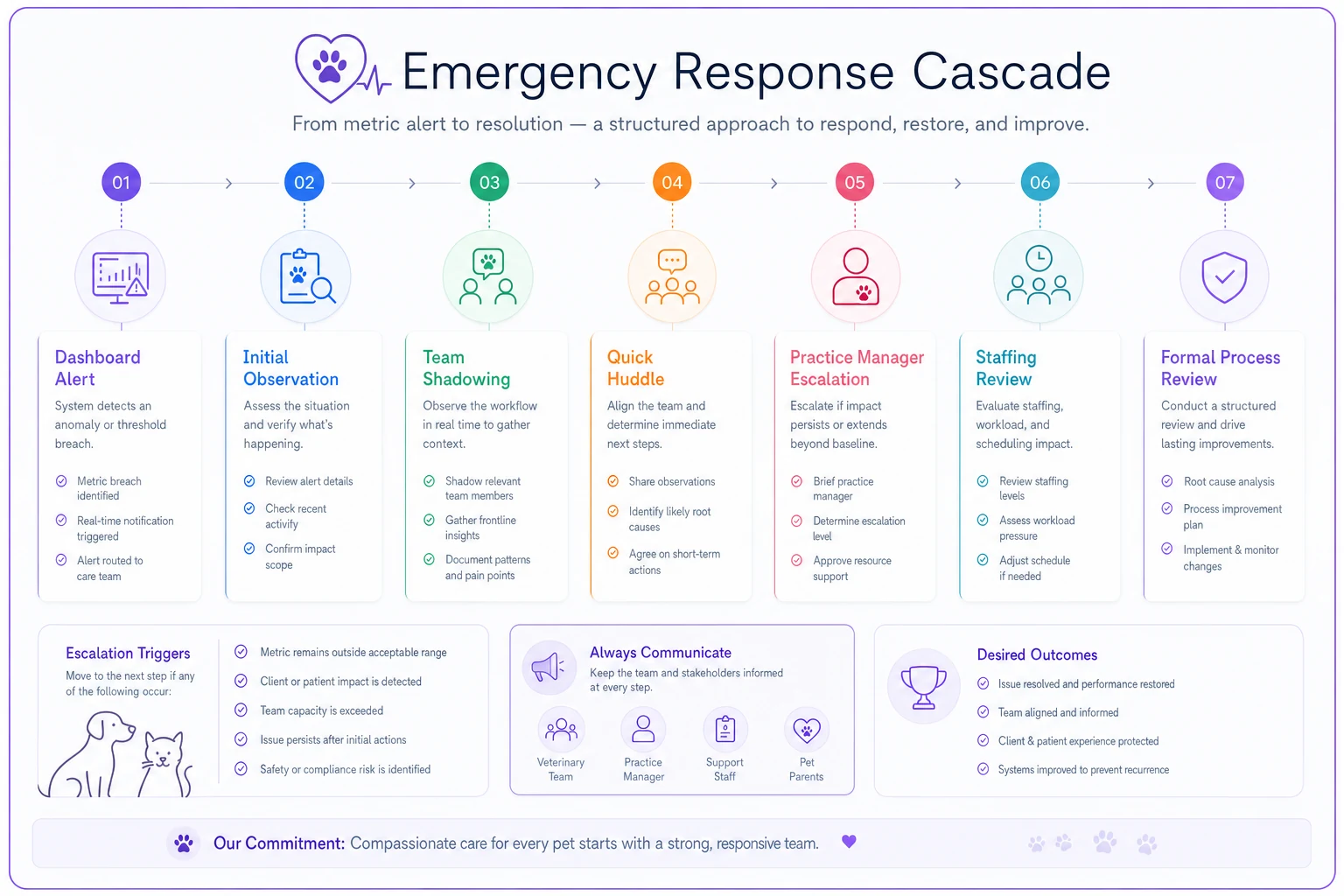
This workflow shows how an alert progresses through predefined steps until resolved.
A mixed animal practice in Colorado developed this cascade approach after realizing their traditional monthly reviews weren't driving improvement:
When room turnover exceeds 20 minutes average (checked daily at 2 PM):
Appointment Efficiency Cascade:
-
Day 1
Charge nurse observes and documents friction points
-
Day 2
Team lead shadows discharge process, identifies bottleneck
-
Day 3
Quick huddle to adjust workflow, implement same day
-
Day 4
Measure again, if still over 20 minutes, elevate to practice manager
-
Day 5
Practice manager reviews staffing model for that time slot
-
Day 7
Formal process review if problem persists
This cascade ensures problems get progressively more attention without requiring immediate escalation for every variance. Small issues get small fixes. Persistent problems get systematic solutions.
The cascade protocol prevents two common failures: overreaction to normal variance and underreaction to genuine problems. By building graduated responses, clinics avoid both management fatigue and operational drift.
The key insight from successful cascade implementations is timing matters more than perfection. A mediocre solution implemented immediately often outperforms a perfect solution that takes weeks to deploy.
Where AI automation changes everything
This is where AI-powered operational software fundamentally changes what's possible for veterinary clinics. Instead of manually checking thresholds, calculating variances, and triggering cascades, AI automation handles the mechanical parts while humans focus on decisions and improvements.
Modern operational platforms with AI automation can monitor dozens of metrics simultaneously, detect patterns humans would miss, and trigger appropriate responses based on complex rule sets. They transform KPI management from a time-consuming chore to an automated operational asset.
The key isn't replacing human judgment but augmenting it. AI agents excel at continuous monitoring, pattern recognition, and consistent rule application. Humans excel at understanding context, making exceptions, and driving change. The combination creates management systems that actually work in daily practice.
For clinics struggling with fragmented systems and manual tracking, AI-assisted platforms offer a path to integrated operations without massive technology overhauls. They connect existing systems, automate data collection, and surface insights that drive better decisions.
Finding your sustainable measurement rhythm
One pattern emerges consistently: the clinics that sustain improvement don't try to track everything perfectly. They track a few things consistently and act on what they learn.
A two-doctor practice in Oregon runs one of the most effective KPI systems around. They track exactly seven metrics, review them at three different intervals, and maintain predetermined responses for every threshold. Their entire dashboard fits on one screen. Their decision rules fit on one page. Their cascade protocols are memorized by the entire team.
This simplicity isn't laziness—it's sophistication. They've identified the metrics that actually drive their specific operation, eliminated everything else, and built habits around consistent monitoring and response. They don't need 50 KPIs because they thoroughly understand and act on their seven.
The sustainability comes from matching measurement complexity to management capacity. A solo practitioner can't maintain a 30-metric dashboard. A 10-vet hospital can't function with only three KPIs.
Making metrics drive actual improvement
The gap between tracking and improving isn't technology—it's commitment to response. Clinics that successfully use veterinary clinic KPIs to drive performance share three characteristics:
They measure what they'll act on. Every metric has a purpose and a potential response. They don't track anything "just in case" or "because we should." If a number won't change behavior, they don't waste time collecting it.
They distribute ownership clearly. Each KPI belongs to someone specific who has both the authority and accountability to improve it. The practice manager might own financial metrics. The lead technician owns efficiency metrics. The medical director owns quality metrics. Without ownership, metrics become nobody's problem.
They celebrate movement, not just achievement. When average invoice improves from $152 to $158, they acknowledge the progress even though the target is $175. When no-show rates drop from 15% to 12%, they recognize the improvement while pushing toward 8%. This momentum focus maintains engagement even during slow improvement periods.
Building a decision system that scales
Your KPI system should evolve with your practice, but the decision framework can remain constant. Whether you're tracking 5 metrics or 50, whether you're a solo practice or a multi-site group, the core structure holds:
-
Define your critical few metrics based on actual operational pressure points
-
Set clear thresholds that trigger specific actions
-
Build cascade protocols that create progressive response
-
Review at intervals that match decision frequency
-
Distribute ownership to people who can drive change
-
Integrate data sources to reduce collection friction
-
Automate monitoring where possible to maintain consistency
The clinics thriving financially aren't the ones with the most sophisticated analytics. They're the ones that connect measurement to management, data to decisions, metrics to movement. They use their veterinary clinic KPIs as an operational tool, not a reporting obligation.
The path forward isn't adding more metrics or buying better dashboards. It's understanding which numbers actually matter for your specific situation, building systems that surface those numbers when needed, and maintaining the discipline to act on what you learn.
Everything else is just expensive decoration.
Everything else is just expensive decoration.
Ready to elevate your clinic’s efficiency?
Join 500+ veterinary clinics using Veterinaryly to save time, reduce administrative overhead, and improve patient care.