


A no‑show spike almost never looks like a slow leak. It looks like a Monday where four morning wellness slots vanish before 9 a.m., two surgery consults cancel by text, and your afternoon suddenly has gaps you can't fill fast enough to matter. By Wednesday you're staring at a day sheet that's 30% air, and payroll doesn't care that half your bookings evaporated.
This is a three‑day problem that needs a three‑day response — not a "let's revisit our reminder policy next quarter" project. The goal is narrow: stabilize cash flow and fill the schedule within 48–72 hours, then buy yourself time to fix root causes later. Everything below is built to be executed by an existing team, using tools you already have.
Hour 0–6: Triage the backlog before you touch the phones
The instinct when the schedule cracks is to start calling people and scrambling to get anyone in. Don't. You'll burn goodwill and staff hours on low‑value slots while the profitable ones stay empty.
Start by pulling every cancellation and no‑show from the last 48–72 hours plus every open slot for the next three days. Then sort them into a rough risk‑and‑value grid. You're answering two questions per slot: how much revenue does this represent, and how medically time‑sensitive is it.
| Slot type | Revenue weight | Medical urgency | First‑wave priority |
|---|---|---|---|
| Post‑op recheck, sick pet follow‑up | Medium | High | Call first — clinical risk |
| Dental, mass removal, surgery consult | High | Medium | Call first — revenue |
| Diagnostics (bloodwork rechecks, imaging) | High | Medium | Second wave |
| Wellness / vaccine visits | Low–Medium | Low | Backfill from waitlist |
| Nail trims, minor tech appointments | Low | Low | Fill only if convenient |
The pattern across busy clinics: front desk instinctively works the easy calls first — nail trims, vaccine reschedules — because those clients say yes quickly. Meanwhile the $900 dental that canceled sits untouched until it's too late to rebook that week. Flip that order deliberately. High‑value and high‑urgency slots get your best staff and first attention.
One more thing during this window: separate true no‑shows from broken communication. A surprising share of "cancellations" during a spike are clients who thought they rescheduled, replied to a reminder nobody read, or called a number that went to voicemail. Pull those out — they're often the easiest to recover because the client still wants the appointment.
Hour 6–24: Temporary scheduling rules that actually hold the line
You can't run your normal booking rules during a spike. They assume a stable no‑show rate, and that assumption just broke. Put temporary rules in place and tell the whole team they expire in a set number of days — that framing matters, because staff resist permanent changes but accept short emergency measures.
Never miss a pet’s appointment again.
Veterinaryly helps you schedule, confirm, and manage every appointment and patient record effortlessly.
- Centralized appointment & patient management
- Automated client reminders
- Staff scheduling & task tracking
No credit card required
-
Controlled overbooking on low‑commitment slots only. Double‑book wellness and vaccine visits at a ratio that matches your current spike rate. If you're suddenly seeing 25% no‑shows on wellness, book roughly one extra low‑risk appointment per two at‑risk slots. Never overbook surgery, sedation, or long consults — a double surgical booking that both show up is a safety problem, not just an inconvenience.
-
Compress the confirmation window. Move from "we confirm the day before" to same‑morning confirmation for the next three days. A slot confirmed at 7:30 a.m. is far less likely to no‑show at 10 a.m.
-
Hold two "flex" slots per doctor per day. Leave them intentionally open to absorb same‑day recovery bookings and urgent recheck reschedules. Empty‑looking on paper, but they're what let you say "yes, come in at 2" when a client finally calls back.
-
Shorten the reschedule ladder. Normally you might offer three date options. During a spike, offer the two soonest slots only. Choice paralysis kills recovery bookings.
Overbook narrowly and deliberately, and never overbook surgery or long consults.
The mistake clinics make here is quietly overbooking everything out of panic. Then Tuesday all your gamble‑bookings show up at once, your lobby is packed, wait times blow out, and you've converted a no‑show problem into a throughput and client‑experience problem. Overbook narrowly and deliberately.
Hour 6–48: Outreach that fills slots without sounding desperate
Targeted outreach is where most of the schedule actually gets rebuilt. The rule: match the channel to the value of the slot. Phone for high‑value and clinical, SMS for quick reschedules, email only as a low‑effort net.
Phone — for high‑value and medically urgent slots
Keep it warm and specific. You're not begging, you're offering a spot that just opened.
> "Hi [Client], this is [Name] at [Clinic]. We had a scheduling opening come up this week and I thought of [Pet] — I know we'd talked about getting that dental scheduled. I've got a spot Thursday morning or Friday afternoon. Would either of those work?"
For clinical follow‑ups that no‑showed:
> "Hi [Client], [Name] from [Clinic]. Dr. [X] wanted to make sure [Pet] gets that recheck after last week — it's important we don't push it too far out. I can get you in tomorrow at 11 or Wednesday at 3. Which is easier?"
Notice the second script leads with medical reasoning, not scheduling convenience. That changes the client's frame from "optional errand" to "my vet is concerned."
SMS — for wellness, vaccines, and quick rebooks
> "[Clinic] here — a spot opened up for [Pet] this week. Want it? Reply YES and we'll grab it, or call us at [number]."
> "[Pet]'s appointment slot is available earlier than expected — [Day] at [Time]. Reply YES to confirm within 2 hours or it goes to the next family."
That two‑hour urgency line matters. Open‑ended SMS offers sit unanswered; a soft deadline roughly doubles same‑day reply rates.
Email — the wide net for the whole gap
> "We've had some schedule changes this week and freed up several appointment times. If you've been meaning to get [Pet] in, reply or call — we can likely get you in within a day or two."
Don't over‑engineer the email. It's the cheapest channel and the lowest converter. It exists to catch the handful of people who were already thinking about calling.
Hour 12–72: Short‑term billing and revenue moves
Filling slots is half the job. The other half is protecting cash flow while you do it, because a schedule that fills back up in three weeks doesn't help you make payroll on Friday.
-
Front‑load deposits on high‑value rebookings. For surgeries and dentals you're rebooking this week, take a modest deposit — often $50–$100 — at booking. It's not primarily about the money; a client who's paid something shows up. No‑show rates on deposit‑held surgical slots drop sharply.
-
Convert canceled procedures into diagnostics you can bill sooner. If a dental canceled but the pre‑anesthetic bloodwork was already planned, offer to run it now so the surgery day is shorter and the revenue isn't fully deferred.
-
Chase the near‑complete invoices. During a revenue dip, unbilled or partially billed visits from the past week are the fastest cash you have. Have someone spend an hour closing out open invoices and sending payment links. This is often faster money than any new booking.
-
Delay discretionary spend for the week. Pause non‑urgent supply reorders and any deferrable outgoing costs until the schedule stabilizes. If you've already done work to tighten supply and shipping costs — which is worth doing regardless — you can lean on that here; the operational steps in Preparing Your Clinic for the July USPS Price Changes are a solid reference for trimming outgoing costs without disrupting care.
The revenue move most clinics miss: they focus entirely on new bookings and ignore the money already sitting in unclosed invoices and unbilled add‑ons. During a three‑day cash crunch, collecting what you're already owed is usually faster than earning something new.
Staffing: reassign roles for 72 hours, don't add hours
You don't fix a no‑show spike by adding staff. You fix it by temporarily reassigning who does what, because the work shifts from seeing patients to filling the schedule and closing invoices.
-
One front‑desk person becomes the dedicated recovery caller. Pull them off walk‑in and phone duty entirely. Their only job is working the priority slot list with the scripts above. Split calls this way and you'll get far more done than everyone squeezing rebooking calls between other tasks.
-
A technician takes same‑morning confirmations. Fifteen minutes each morning texting or calling that day's bookings to confirm. This is the single highest‑leverage staff hour of the day during a spike.
-
Reduce doctor hours on the emptiest day, not across the board. If Wednesday is 40% open and unlikely to recover, it's better to send one doctor home early or flip them to catch‑up records than to spread thin coverage across three half‑empty days. Protect payroll where the schedule genuinely won't fill.
-
Someone owns billing cleanup. One person, one hour a day, closing open invoices and sending payment links.
The failure pattern here is asking your whole team to "help with rebooking calls when they get a chance." That means nobody owns it, and the priority list gets worked in random order by whoever's least busy. Assign one owner per task, even if it's just for three days.
The three‑day stabilization dashboard
You can't manage a spike you can't see. Set up a dashboard so simple that anyone can update it — a whiteboard or a shared sheet works fine. Update it twice a day, morning and end of shift.
-
Fill rate — booked slots ÷ total available slots, next 3 days
-
Recovery bookings — how many canceled/no‑show slots you've rebooked
-
Same‑day confirmation rate — % of today's appointments confirmed by morning
-
Repeat no‑show rate — are the rebookings actually showing up?
-
Deposits collected — dollar value held on this week's high‑value bookings
-
Open invoices closed — count and dollar value collected from backlog
If fill rate is climbing but repeat no‑show rate is also climbing, you're rebooking the wrong people — tighten confirmations and lean on deposits. If fill rate is stuck despite heavy calling, your outreach is hitting the wrong slots or the wrong channel — recheck your priority grid.
Most reminder and scheduling systems can pull these numbers automatically. If yours flags at‑risk appointments or auto‑fills from a waitlist, use it — that's exactly the kind of grunt work worth automating so your recovery caller spends time on actual conversations, not hunting through the calendar. But don't let a tooling gap stop you. A whiteboard updated twice a day beats a perfect dashboard you set up next week.
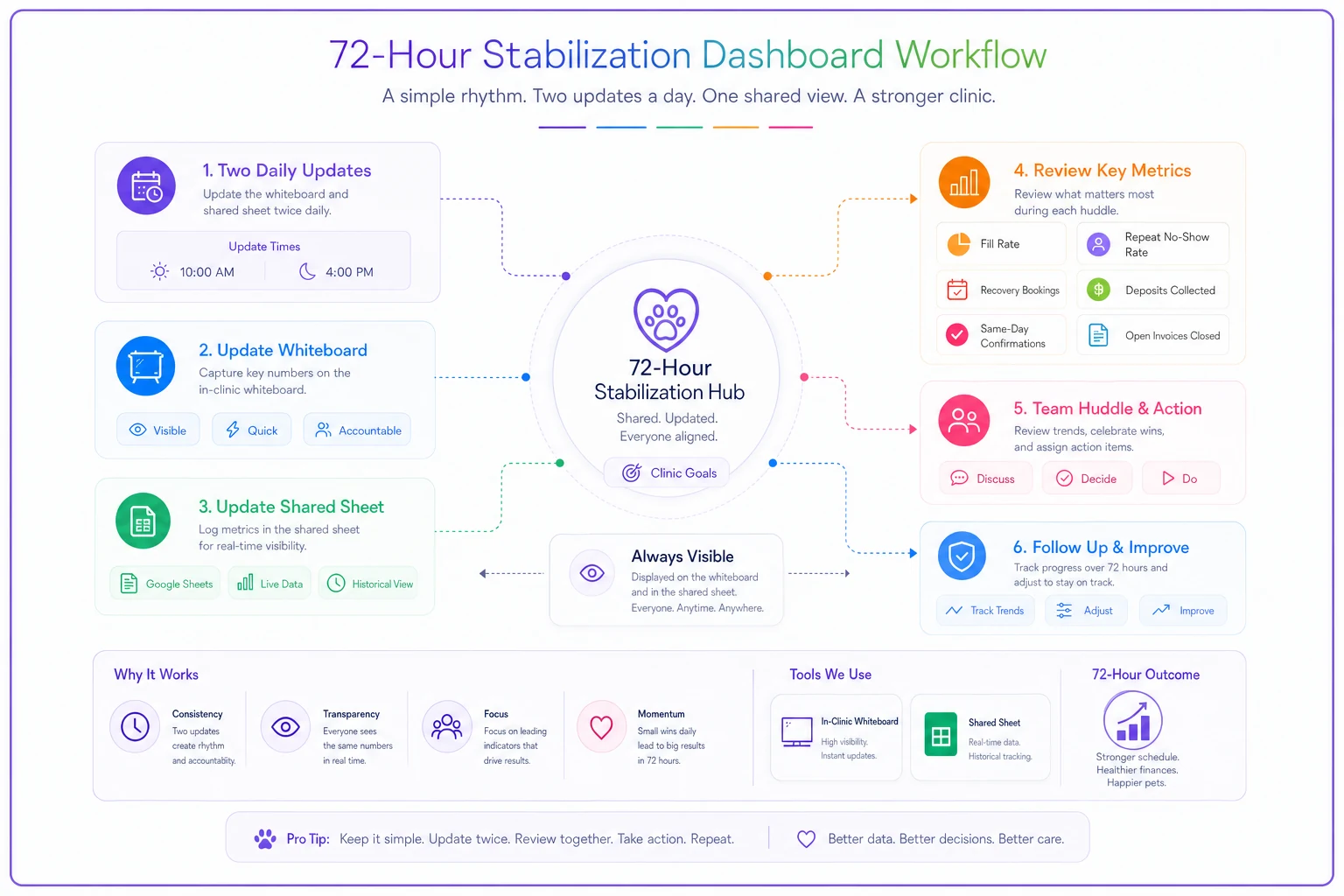
Here's a simple visual to keep the team aligned.
Real scenario: a two‑doctor small‑animal clinic
A two‑doctor practice hit a rough stretch — a local event weekend combined with a stomach bug going around — and saw no‑shows jump from their usual 6–7% to about 22% over four days. Roughly 30 slots evaporated, and Wednesday's day sheet was close to a third empty.
They ran a version of this playbook. Front desk pulled the slot list and worked high‑value and clinical calls first. One tech took over morning confirmations. They collected $75 deposits on the three dentals they rebooked and sent an SMS blast to the recent‑cancellation list with a two‑hour reply window.
By day three, they'd recovered somewhere around 18 of the 30 lost slots, closed out about $2k in open invoices sitting from the prior week, and cut same‑day no‑shows roughly in half thanks to morning confirmations. Not a perfect recovery — a handful of low‑value slots stayed empty and they sent a doctor home early one afternoon. But cash flow held, and they didn't panic‑hire or slash prices to fill chairs.
When this playbook makes sense — and when it doesn't
Use it when the spike is sudden and looks temporary: a bug going around, a weather event, a local disruption, or a communication glitch that torched a few days of confirmations. Short, sharp shocks are exactly what a 72‑hour response is built for.
Don't lean on it when your no‑show rate has been climbing steadily for months. That's not a spike — that's a structural problem in your reminder system, booking policies, or client mix, and no amount of emergency calling fixes it. If you find yourself running this playbook every couple of weeks, the emergency response is your problem. Stop firefighting and fix the underlying scheduling and confirmation workflow.
And skip the aggressive overbooking entirely if you're a single‑doctor practice with tight room capacity. The downside of everyone showing up at once is worse for you than the empty slots.
The point
A no‑show spike feels like chaos, but it responds well to a narrow, ordered plan: triage by value and urgency first, put temporary rules in place, work the phones in the right order, protect the cash you can, and watch a handful of numbers twice a day. Do that for 72 hours and most clinics stabilize before the spike does real damage. The clinics that handle these well aren't the ones with the fanciest software — they're the ones who don't waste the first six hours panicking. Sort the backlog, assign owners, start dialing the right slots. The schedule fills back up faster than you'd expect when the effort goes where the value is.
Ready to elevate your clinic’s efficiency?
Join 500+ veterinary clinics using Veterinaryly to save time, reduce administrative overhead, and improve patient care.