

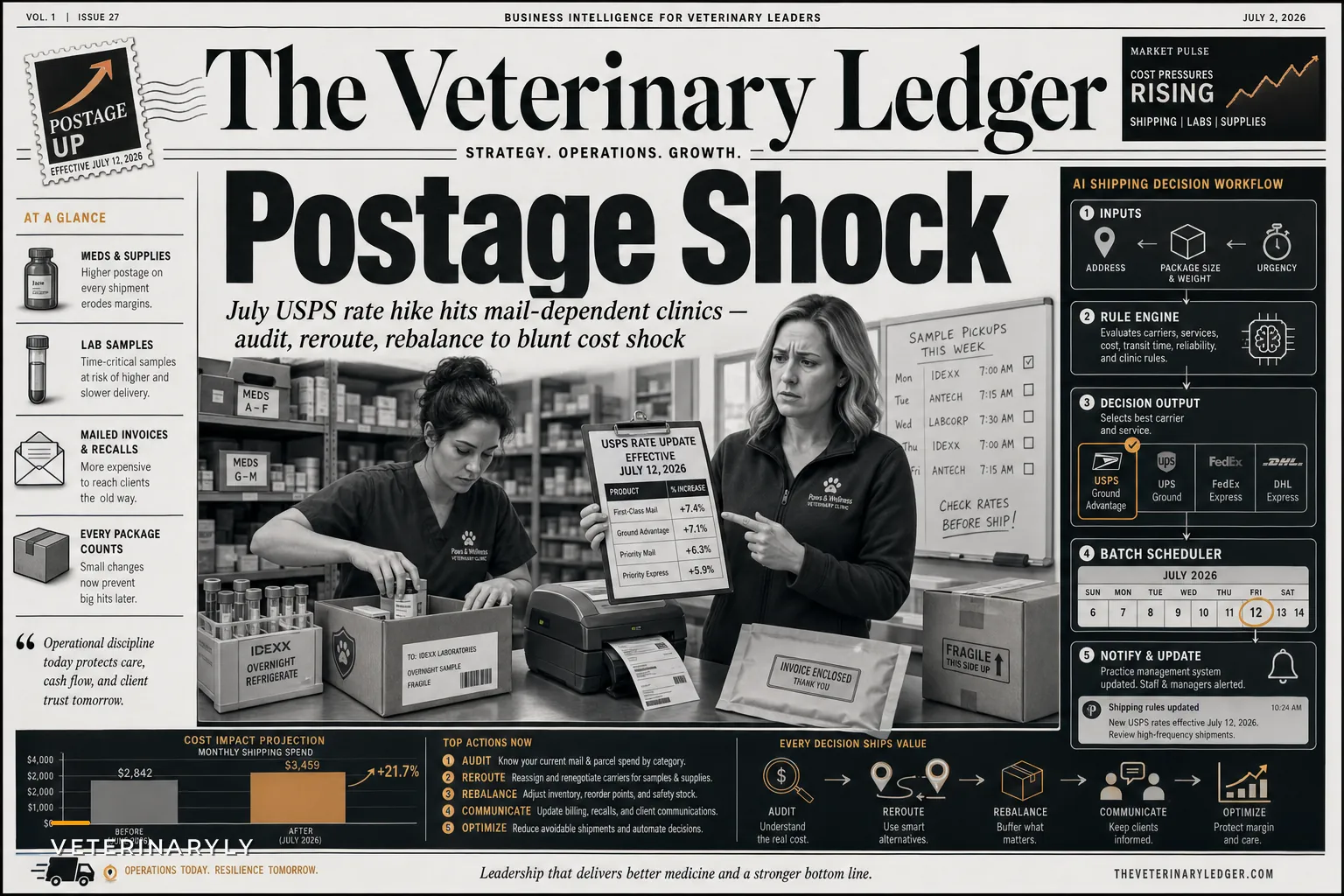

Last week, USPS quietly dropped their July 2026 price changes, and if you're shipping medications, lab samples, or even client reminders, you're looking at another round of increases hitting mid-July. The changes run from basic Forever stamps jumping a few more cents to Priority Mail packages climbing by percentages that'll make your quarterly shipping budget look optimistic.
What makes this round different is the timing. Unlike previous increases where clinics could absorb the hit or pass it through, this one lands when most practices are already squeezed on margins. Between supplier price adjustments earlier this year and the pressure to stay competitive on service pricing, there isn't much room left to absorb anything.
I spent yesterday afternoon going through numbers with a clinic manager in Denver who ships about 120 medication packages monthly. She pulled up shipping expenses from last July versus this March — already up 18% before the new rates even kick in. When we mapped July's changes against her current volume, she's looking at another $400–500 monthly just in shipping. That's before factoring in lab sample shipments to their reference lab or the monthly statement mailings they still do for older clients.
Why veterinary clinics feel shipping increases differently
Most businesses deal with shipping as a straightforward line item. Order supplies, ship products, move on. Veterinary clinics operate in a different situation entirely — shipping touches almost everything. Incoming supplies, outgoing lab samples, medication fulfillment, client communications, vaccine reminder mailers. It adds up fast.
The operational complexity shows up in places you wouldn't expect. Take lab samples. You can't just swap carriers when USPS raises rates because your reference lab has specific pickup schedules and handling requirements. That histopath sample needs to reach the lab within a defined window, packaged exactly right, chain of custody intact. When shipping costs go up, you're largely stuck.
Medication shipping has its own version of this problem. Some clinics built entire chronic care programs around shipping monthly medications directly to clients — made perfect sense when flat-rate boxes were cheaper and clients loved the convenience. A clinic in Phoenix showed me their numbers recently. They ship roughly 85 chronic medication packages monthly, mostly thyroid and cardiac meds. Each per-package cost increase seems small until you multiply it across their volume. Suddenly they're absorbing $300–400 monthly they hadn't planned for.
The deeper issue is how disconnected these costs are from actual pricing decisions. When you set the price for a thyroid medication refill six months ago, nobody was thinking about July shipping rates. Your practice management system doesn't automatically adjust shipping fees when carriers change their prices. So every package shipped after July 12th potentially loses money if you haven't updated your fee structure.
The compound effect that actually kills margins
What damages clinic profitability isn't the shipping cost itself — it's the cascade of small operational decisions that follow. When shipping costs spike, staff start batching shipments to save money, which delays medication delivery and frustrates clients. The front desk starts debating whether to ship that single prescription or ask the client to pick it up, creating inconsistent service experiences. Your inventory manager starts ordering supplies in larger quantities to cut shipping frequency, which ties up more cash in stock.
Never miss a pet’s appointment again.
Veterinaryly helps you schedule, confirm, and manage every appointment and patient record effortlessly.
- Centralized appointment & patient management
- Automated client reminders
- Staff scheduling & task tracking
No credit card required
Each adjustment makes sense on its own. Together, they create friction that costs significantly more than the original price increase.
A practice in Atlanta learned this the hard way last year. To offset rising shipping costs, they introduced a minimum order value for shipped medications — seemed reasonable. But chronic care clients who previously ordered monthly started skipping refills or just picking up medications instead. The practice lost the predictable revenue stream they'd spent months building, and medication compliance dropped because clients kept forgetting to come in.
The shipping "savings"? Maybe $200 monthly. The lost revenue from disrupted chronic care? Closer to $2,000 monthly once you account for missed refills and the compliance visits that didn't happen.
Building shipping resilience into your operations
The clinics that handle shipping volatility best treat it as an operational system, not just a cost center. They've built processes that flex when rates change without disrupting client service or piling onto staff.
Start with visibility. Most clinics genuinely don't know what they spend on shipping because it's scattered across multiple accounts and expense categories — the UPS account for supplies, the USPS account for lab samples, stamps for client mailings. Nobody's looking at the total picture.
Pull three months of shipping expenses across all carriers and break them out:
-
Incoming supplies (medical, pharmaceutical, office)
-
Outgoing lab samples (reference lab, cytology, histopath)
-
Client medications (chronic refills, compounds, special orders)
-
Client communications (statements, reminders, marketing)
-
Other (equipment returns, documents, etc.)
Run a separate export for postage and account-level fees to catch small recurring charges often hidden in vendor invoices.
This breakdown immediately shows you where rate increases hit hardest and where you have room to adjust.
The carrier arbitrage opportunity most clinics miss
Something worth knowing — while USPS raises rates on Priority Mail, they're keeping Media Mail relatively flat. While FedEx increases ground shipping, their express saver rates in certain zones barely moved. The carriers assume you're locked into your shipping patterns, but veterinary clinics have more flexibility than they usually take advantage of.
Lab samples are the obvious starting point. Yes, your reference lab probably prefers USPS Priority Mail, but have you actually asked about alternatives? A clinic in Tampa negotiated with their lab to accept FedEx Ground for non-urgent samples, saving around $12 per shipment. They still use Priority Mail for stats and time-sensitive samples, but routine bloodwork goes ground. Annual savings worked out to roughly $3,600.
Medication shipping offers even more options. Instead of defaulting to whatever's easiest, map out your actual shipping patterns:
| Shipping Type | Current Carrier | Monthly Volume | Cost per Package | Alternative Option | Potential Savings |
|---|---|---|---|---|---|
| Local medications (<10 miles) | USPS Priority | 45 packages | $8.50 | Clinic courier/tech | $5.00 |
| Regional medications (10-50 miles) | USPS Priority | 30 packages | $9.75 | UPS Ground | $7.25 |
| Chronic refills (any distance) | USPS Flat Rate | 40 packages | $9.45 | Client pickup incentive | $9.45 (full savings) |
| Compound medications | FedEx Overnight | 8 packages | $28.00 | FedEx Express Saver | $19.00 |
This isn't about switching everything to the cheapest option. It's about matching shipping methods to what the service actually requires.
Rethinking client communication in a higher-cost environment
Physical mail for client communications feels outdated, but plenty of clinics still send paper statements, appointment reminders, and vaccine notices. With stamp prices climbing again, it's worth running the actual numbers.
A typical clinic sends something like:
-
200 monthly statements
-
150 appointment reminders
-
300 vaccine reminders
-
100 miscellaneous notices
At current rates, that's around $400 monthly in postage alone, not counting paper, envelopes, or staff time. After July, closer to $425–430. Seems small until you realize that's over $5,000 annually for something most clients would prefer to receive digitally anyway.
The conversion doesn't need to be all-or-nothing. Start with clients who already engage digitally — those using your online pharmacy or patient portal. Offer a small incentive to switch to email communications, maybe a discount on their next visit or a free nail trim.
A clinic in Sacramento took this gradual approach and found something unexpected. Their older clients — the ones staff assumed would resist going digital — actually had among the highest conversion rates once someone at the clinic personally helped them set up email preferences during a visit. The resistance wasn't about technology. It was just that nobody had walked them through it. Once someone did, most of them switched without much pushback.
Operationalizing shipping decisions with AI assistance
The complexity of shipping decisions — multiple carriers, different service levels, varying urgency — makes this exactly the kind of problem where AI-powered operational software starts to deliver real value. Not the hyped version where automation magically solves everything, but practical tools that handle repetitive decision-making so your staff doesn't have to.
Think about what happens when someone needs to ship a medication. They check the address, estimate the package size, maybe compare two carriers if they're being thorough, then pick whatever seems reasonable. That decision process, repeated dozens of times a week, probably consumes more staff time than most clinic managers realize.
Modern operational platforms can automate these decisions based on rules you define. Package under one pound going within ten miles? System selects the cheapest ground option. Lab sample marked urgent? Defaults to Priority Mail with tracking. Chronic medication refill for a wellness program client? Triggers the weekly batch process automatically.
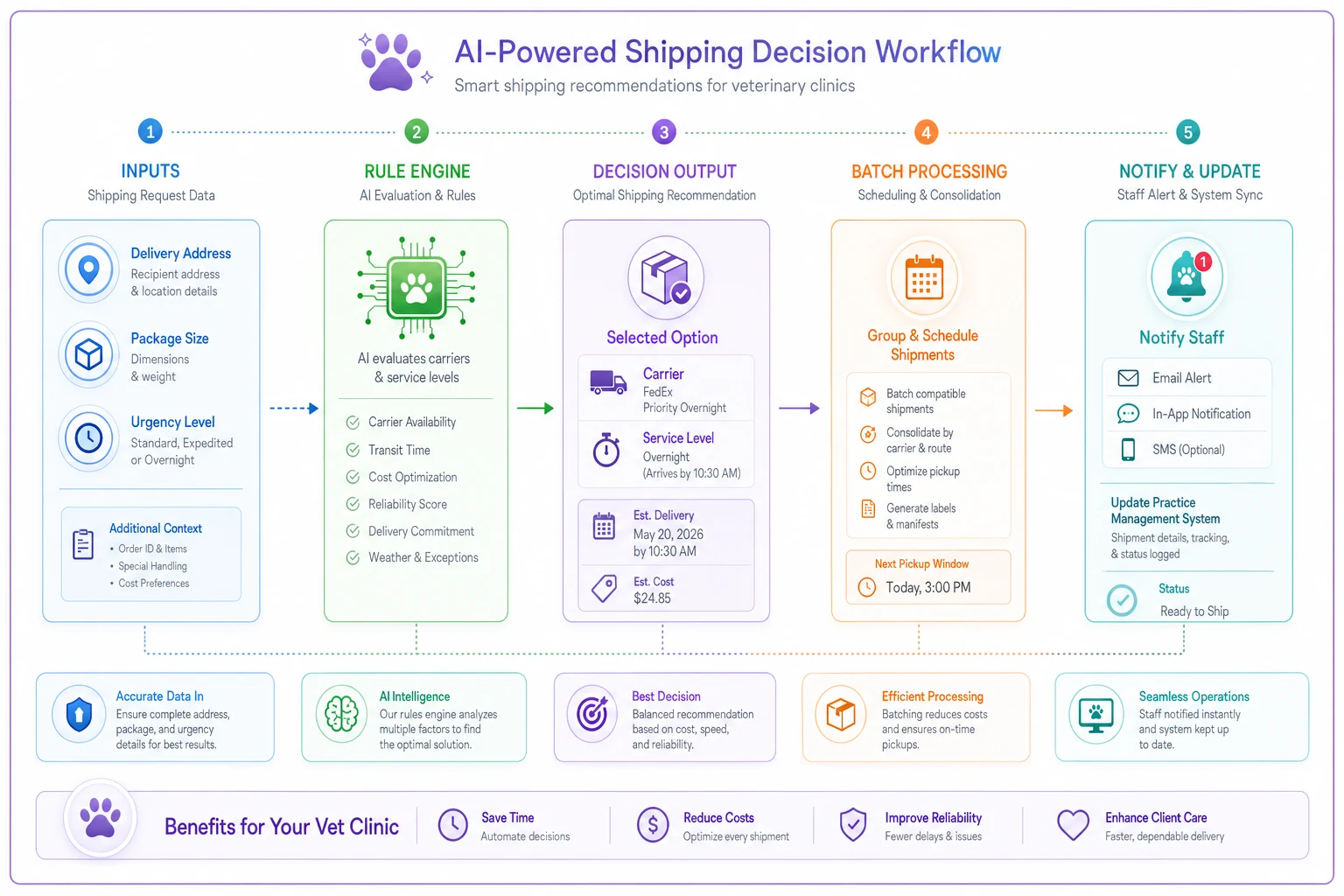
This diagram shows the decision flow from input to carrier selection and batch scheduling.
The automation isn't replacing judgment — it's standardizing routine decisions so your team can focus on the exceptions. When rates change, you update the rules once instead of retraining everyone on new price thresholds.
Creating sustainable shipping policies
The biggest mistake clinics make when shipping costs change is getting reactive. Rates go up, panic sets in, new rules get made without thinking through downstream effects. Then six months later you're dealing with unintended consequences while another round of increases is already in the pipeline.
Sustainable policies start with clear principles, not rigid rules:
-
Ship medications when it serves medical compliance, not just convenience
-
Shipping costs should be transparent to clients, not buried in medication markup
-
Staff should have clear guidelines but flexibility for genuinely unusual situations
From those principles, you build specific frameworks:
Medication Shipping Tiers:
-
Urgent/Critical
Ships same day regardless of cost (insulin, seizure meds, etc.)
-
Chronic Management
Ships weekly in batches, flat fee to client
-
Convenience
Client pays actual shipping plus handling
Lab Sample Guidelines:
-
Stats and critical samples
Fastest available method
-
Routine samples
Standard ground unless lab requirements dictate otherwise
-
Batch non-urgent samples when possible (monthly derm cultures, etc.)
Client Communication:
-
Default to digital for clients with email on file
-
Paper only for compliance-required notices
-
Monthly batch printing for non-urgent paper communications
These aren't rigid rules — they're decision frameworks that help staff make consistent choices while still leaving room for exceptions.
The sample routing problem that compounds shipping costs
Lab sample shipping deserves separate attention because it's where operational inefficiency multiplies costs fast. Most clinics treat each sample independently — draw blood, package it, ship it. But reference labs typically accept batch shipments, and proper sample routing and labeling systems can meaningfully reduce shipping frequency without sacrificing result turnaround.
The key is understanding which samples need to go out immediately versus which ones can wait for the day's batch. CBC/chemistry on a stable patient coming in for annual vaccines can wait for the 4 PM pickup. Cytology on a suspicious mass might need the noon express run.
A clinic in Portland restructured their entire sample workflow around this logic. They created three collection windows:
-
Morning samples (collected 8 AM – 11 AM)
Ship at noon for next-day results
-
Afternoon samples (collected 11 AM – 3 PM)
Ship at 4 PM for standard turnaround
-
Late samples (collected after 3 PM)
Hold for next morning's batch unless urgent
That simple time-based system cut their daily lab shipments from five or six packages down to two or three, saving roughly $30 daily in shipping costs alone. More importantly, it reduced sample handling errors because staff weren't constantly rushing to package individual samples throughout the day.
Protecting margins without alienating clients
The obvious reaction to increased shipping costs is to pass them directly to clients. New rates come out, you add a few dollars to the shipping fee, problem solved. Except clients notice — especially clients who are already sensitive about the cost of veterinary care.
The smarter move is bundling shipping into value propositions clients already accept. Instead of charging $9.95 to ship a chronic medication, build shipping into a monthly management program that includes the medication, shipping, and quarterly monitoring. Clients see consistent monthly value. They're not watching a variable shipping line item fluctuate every few months.
A practice in Austin restructured their chronic medication program this way. Previously, clients paid medication cost plus shipping each month, with prices varying based on what changed. They switched to flat monthly plans:
-
Thyroid Management Program
$45/month including medication and shipping
-
Cardiac Support Program
$75/month including medications and shipping
-
Diabetes Management Program
$95/month including insulin and shipping
The programs ran slightly above the à la carte price, but clients enrolled because they valued the predictability. Enrollment grew by about 40% over six months, and the practice could absorb shipping fluctuations without constantly adjusting prices and fielding confused phone calls.
Moving from reactive to strategic
Most clinics won't feel the full impact of July's USPS rate increases until they review Q3 expenses and start wondering why operational costs jumped. By then, it's too late to adjust strategically — you're playing catch-up with hasty policy changes and last-minute price adjustments.
The practices that handle shipping volatility well treat it as an operational challenge worth planning around, not just an unavoidable cost. They understand their shipping patterns, maintain flexible carrier relationships, and have built systems that can adapt without disrupting client service.
This isn't about finding the cheapest shipping option for everything. It's about understanding the true cost of your shipping decisions — not just the postage, but the staff time, the client experience, the inventory implications, and the downstream revenue effects.
July's rate increases are a reminder that operational efficiency isn't about perfection. It's about building systems that can absorb changes without breaking. Whether through better process design, strategic automation, or simply better visibility into actual costs, the clinics that prepare now will barely notice when the new rates hit.
The ones that don't will be scrambling to understand why Q3 margins disappeared — probably right around the time the next round of increases for early 2027 gets announced.
Your shipping costs will go up. That part's not negotiable. Whether those increases disrupt your operations or become a minor line item adjustment in a well-designed system is entirely up to the decisions you make in the next couple of weeks.
Your shipping costs will go up. That part's not negotiable. Whether those increases disrupt your operations or become a minor line item adjustment in a well-designed system is entirely up to the decisions you make in the next couple of weeks.
Ready to elevate your clinic’s efficiency?
Join 500+ veterinary clinics using Veterinaryly to save time, reduce administrative overhead, and improve patient care.