



When a clinic's no-show rate jumps from its usual 7–9% to something like 18–22% over a few days, the damage isn't just empty rooms. It's the pile of displaced patients, the recheck appointments that quietly fell off, the diabetic cat whose glucose curve got pushed a week, and the front desk slowly drowning in a callback list nobody has time to work.
The instinct is to deal with it once things calm down. That's the mistake. The backlog compounds. Every day you don't triage it, the list of patients who needed to be seen yesterday gets longer, and the revenue you could have recovered walks out the door with clients who rebooked somewhere else.
This is a time-boxed plan. You can start it inside the next hour and have measurable stabilization by hour 72. Not a strategy document — something you actually execute.
First, size the problem (do this in the first 90 minutes)
You can't triage what you haven't measured. Before anyone starts dialing, one person — ideally the practice manager or lead CSR — needs to pull a quick snapshot. Not a polished report. A whiteboard works fine.
Rapid assessment checklist:
-
How many appointments no-showed or cancelled in the last 48–72 hours? Get the raw count.
-
Of those, how many haven't been rebooked yet?
-
How many open slots exist over the next 3 days, by provider?
-
Which of the dropped appointments were clinically time-sensitive — rechecks, post-op, chronic disease monitoring, medication-dependent visits?
-
What's your actual team capacity today and tomorrow — who's on, who could pick up a half-shift?
-
How many of the no-show clients have a card on file or an unpaid balance?
The goal is one number for your backlog and one number for your available capacity over the window. If you've got 60 unrebooked appointments and realistic room for 35 over three days, you're not just rescheduling — you're triaging, and some things will convert to virtual or get pushed with a safety net.
One pattern worth flagging: clinics almost always underestimate how many dropped appointments were clinically significant. The front desk sees "annual vaccine, no-show" and "post-surgical recheck, cancelled" as two line items in the same list. They are not the same line item. That's the whole reason for the next step.
The patient-prioritization matrix
Not every missed appointment deserves the same urgency. Working down the callback list in chronological order is how a post-op incision check ends up behind four nail trims.
Never miss a pet’s appointment again.
Veterinaryly helps you schedule, confirm, and manage every appointment and patient record effortlessly.
- Centralized appointment & patient management
- Automated client reminders
- Staff scheduling & task tracking
No credit card required
Sort every unrebooked appointment into one of these tiers. For a list of 50–60 patients, this takes one person maybe 30–40 minutes.
| Tier | Criteria | Examples | Target action window |
|---|---|---|---|
| 1 – Clinically urgent | Medical risk if delayed beyond 24–48h | Post-op rechecks, suspected infections, uncontrolled diabetics/renal cases, medication titration, jaundice/anorexia follow-ups | Contact within 2 hours; seen or virtually assessed within 48h |
| 2 – Time-sensitive but stable | Delay is tolerable short-term but shouldn't slip a week | Chronic disease monitoring due, pre-anesthetic bloodwork, dermatology rechecks, dental with active signs | Contact same day; booked within 72h |
| 3 – Routine | No clinical harm from a short delay | Wellness exams, annual vaccines, nail trims, elective dental cleanings | Contact within 72h; book into open future slots |
| 4 – Convertible | Can be handled remotely | Behavior follow-ups, medication refill checks, stable chronic rechecks with recent diagnostics | Offer virtual within 48h |
Tier 4 is your pressure-release valve. Every appointment you shift to a virtual visit frees a physical slot for a Tier 1 or 2 patient. In practice, somewhere between 15–25% of missed recheck appointments can be safely handled virtually — which is often the difference between clearing the urgent list and not.
Who sorts the list? A technician or the lead vet should do a fast pass on Tiers 1 and 2. That's a clinical call, not a reception task. Tiers 3 and 4 can be sorted by front desk once you've written down simple rules for them.
The 48–72 hour action timeline
Assign a name to every block before you start. Ambiguity about who owns what is what kills these efforts by hour 6.
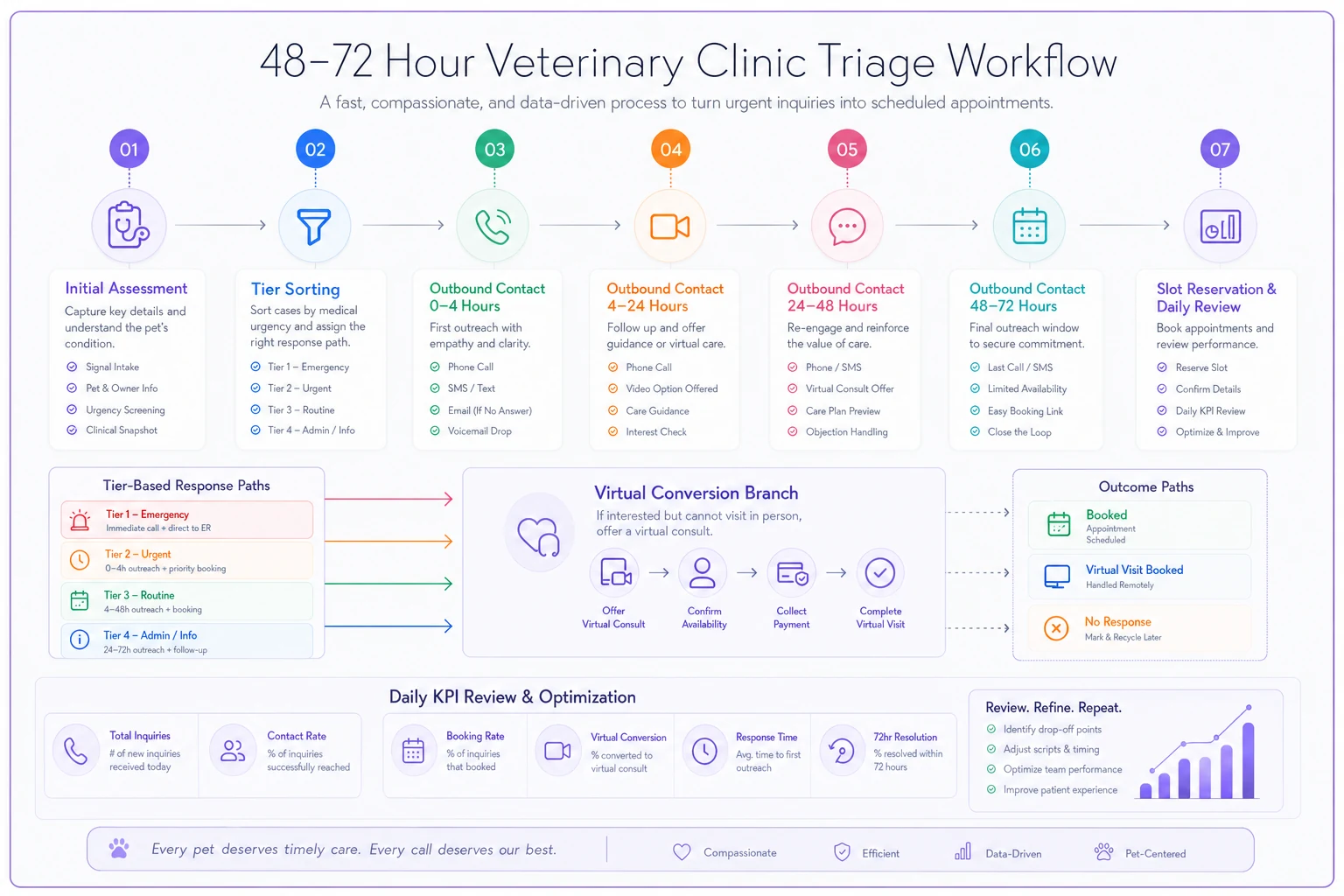
This diagram shows the workflow for the 48–72 hour action timeline.
Hours 0–4: Triage and launch
-
Manager pulls the backlog and capacity snapshot (the 90-minute step above).
-
Lead vet or senior tech sorts the list into the four tiers.
-
Front desk starts outbound contact on Tier 1 immediately — phone first, no exceptions.
-
Manager blocks a handful of same-day and next-day slots reserved specifically for Tier 1 conversions.
Hours 4–24: Work the list down
-
Continue Tier 1 phone outreach until every patient is contacted or has a message and SMS out.
-
Begin Tier 2 outreach — phone for anyone reachable, SMS/email for the rest.
-
Start converting Tier 4 patients to virtual slots.
-
Pull one extra person onto phones if the list isn't moving. A 90-minute phone blitz with two people clears more than one person grinding all day.
Hours 24–48: Fill and confirm
-
Push Tier 3 outreach via SMS and email batch — these don't need phone calls.
-
Confirm every booking made in the first 24 hours with a reminder. Re-confirmation cuts the second round of no-shows, which is a real risk when you're rebooking already-flaky appointments.
-
Fill remaining open slots from your recall list.
Hours 48–72: Stabilize and review
-
Final sweep of anyone uncontacted. Offer one last reschedule or virtual option.
-
Review the KPI dashboard (below). Adjust the next day's scheduling rules based on what fill rate is telling you.
Staffing note: The highest-leverage move in the first 24 hours is pulling someone off their normal duties and putting them on the phones. A tech who normally rooms patients but has a light afternoon is worth more on outbound calls during a backlog than running routine appointments. Don't be precious about job titles during triage.
Scheduling rule changes for the window
Your normal scheduling template is built for a normal week. During a backlog, a few temporary changes make a real difference. These are short-term — revert them once the no-show rate is back under control.
Same-day slot reservation. Hold roughly 2–3 slots per provider per day open specifically for Tier 1 and 2 patients you're pulling from the backlog. Counterintuitive, but those slots fill within hours and prevent urgent patients from hearing "next Thursday."
Targeted double-booking — carefully. This is not a license to overbook the whole schedule. Double-book only appointment types with a genuinely high no-show probability: patients with a prior no-show history, same-day routine requests, unconfirmed appointments past the reminder window. Pairing a likely-no-show nail trim with a quick tech appointment recovers capacity without torpedoing your flow. Overbook the wrong type — two 40-minute workups — and you've just created a waiting-room disaster.
Shorter visit templates. Create a trimmed "focused recheck" template for the duration — 15 minutes instead of 20–30 — for single-issue follow-ups. Post-op suture checks, ear rechecks, weight checks for a chronic case. Shaving five minutes off twenty appointments reclaims close to two hours of provider time per day.
When this is a bad idea: don't apply aggressive double-booking if you're already short-staffed on techs. Overbooking only works if you have floor capacity to actually move patients through. If you're down two techs, shorter templates and same-day reservations are safer.
Outreach scripts that actually convert
The tone matters more than most people realize. A backlog callback that sounds like an apology-and-reschedule gets "let me check and call you back" — which never comes. A callback that leads with the clinical reason and offers an easy yes converts.
Phone (Tier 1 & 2)
> "Hi [Name], this is [Clinic]. Dr. [X] wanted [Pet] seen this week because of [the recheck / the medication adjustment / the post-op check]. I've got an opening tomorrow at 10:40 or 2:15 — which works better? If getting in is tough, we can also do a quick video check so Dr. [X] can take a look."
No "sorry you missed your appointment." Lead with the pet's health, offer two specific times, not "when are you free." Specific times convert — open-ended questions stall.
SMS (Tier 2 & 3)
> "[Clinic]: [Pet] is due for a recheck. Reply with a time that works and we'll get you booked: Tue AM / Wed PM / Thu AM. Prefer a video visit? Reply VIDEO."
Email (Tier 3 batch)
Short subject line — "[Pet]'s visit — quick reschedule." One sentence explaining why, one clear booking link or number. Nobody reads a paragraph.
Convert-to-virtual
> "Since [Pet] is stable and we've got recent bloodwork, Dr. [X] is comfortable doing this one as a video visit. We can get that done today — want me to send the link?"
Reschedule + pre-pay
For clients who've already no-showed once, a small deposit at booking dramatically improves the odds they actually show. Frame it plainly, not punitively:
> "To hold the spot we take a [$20–30] deposit that goes straight toward the visit. Can I put that on the card we have on file?"
Clients who've no-showed once are two to three times more likely to do it again on the rebooking. A deposit on the second booking isn't really about the money — it's about securing commitment. People who put money down show up.
Short-term revenue tactics to stabilize cash flow
Clearing the backlog and recovering revenue are the same job done well.
-
Fill slots from a focused recall list. Pull patients overdue for something billable — dentals, senior panels, chronic rechecks — and offer them the slots freed by no-shows. You're converting dead air into revenue.
-
Pre-pay on re-bookings for repeat no-show clients, as above.
-
Temporary cancellation-fee messaging. You don't have to actually charge a fee to benefit from mentioning the policy. A reminder line — "cancellations within 24 hours may be subject to a fee" — measurably reduces last-minute drops. If you don't already have a policy, this window is a reasonable time to introduce it in reminder language.
-
Convert virtual visits into billable touchpoints. A video recheck is still a service. Charge for it accordingly — this isn't a free courtesy.
On the economics: if your average invoice runs somewhere around $120–180 and you're recovering even 20–25 of the ~60 displaced appointments inside 72 hours, that's roughly $3k–$4k back on the books in a window where most clinics just eat the loss. The recall-list fills add on top of that.
Supply and shipping costs ripple into these same margin conversations — if you've been tracking how external cost shocks affect clinic economics, the same discipline applies here, much like the operational steps we covered in preparing your clinic for the July USPS price changes. Protecting margin during a disruption is the same muscle whether the disruption is shipping rates or a no-show spike.
A short KPI dashboard to run overnight
You don't need analytics software for this. A shared spreadsheet updated twice a day is enough to know whether the plan is working or whether you need more people on the phones.
| Metric | How to measure | Target in the window |
|---|---|---|
| No-show rate | No-shows ÷ booked, daily | Trending back toward baseline (under ~10%) by day 3 |
| Fill rate | Filled slots ÷ available slots | 80%+ |
| Time-to-contact | Hours from no-show to first outreach | Tier 1 under 2h; all tiers under 24h |
| % high-risk seen within 48h | Tier 1 seen (in-person or virtual) ÷ total Tier 1 | 90%+ |
| Revenue recovered | Billed value of rebooked/virtual visits from the backlog | Track cumulatively |
At the end of each day, look at two numbers — time-to-contact and fill rate. If time-to-contact is slipping, you have a staffing problem on the phones; fix it first thing the next morning by reassigning someone. If fill rate is low despite good contact times, your offer isn't landing — adjust the scripts, lean harder on virtual conversions, or open more same-day slots. Make one change, not five. You want to know what actually moved the needle.
A real scenario
A three-doctor small-animal practice hit a rough stretch — a local event weekend, bad weather, and a payroll week all collided, and their no-show rate spiked to around 20% over four days. About 55 appointments dropped, close to half of them unrebooked by Monday morning. Buried in that list: two post-op rechecks and several chronic-disease monitoring visits that had quietly slipped.
They ran a version of this plan. Tuesday morning the manager sorted the list into tiers in under an hour. A tech got pulled onto phones for the morning and worked Tiers 1 and 2. Over three days they contacted all 55 clients, rebooked around 30, converted 6 recheck patients to video visits, and filled 9 of the remaining open slots from an overdue-dental recall list.
Every Tier 1 patient was seen or virtually assessed within 48 hours — including both post-op cases. Recovered revenue landed somewhere in the $3,500–$4,500 range across the window, most of which would have otherwise been a clean loss. Just as important, the backlog didn't roll into the following week, which is where these things usually turn from a bad few days into a bad month.
Where tools quietly earn their keep
None of this requires software — a whiteboard and a spreadsheet get you through 72 hours. But the clinics that recover fastest tend to be the ones whose practice management system can pull the no-show list, batch the SMS and email outreach, and flag which clients have a card on file without someone manually cross-referencing three screens. When outreach is handled automatically and the dashboard numbers populate themselves, the practice manager spends the window making decisions instead of assembling data. That's the real value — not replacing the plan, just removing the friction that slows everything down when every hour counts.
The point isn't the technology. A sudden no-show spike is survivable and recoverable if you treat the first 72 hours as triage rather than cleanup. Sort by clinical risk, contact fast, convert what you can to virtual, put a deposit on the flaky rebookings, and watch two numbers overnight. Do that, and the week that could have cost you a month's worth of recheck revenue becomes a bad few days you already handled.
The point isn't the technology. A sudden no-show spike is survivable and recoverable if you treat the first 72 hours as triage rather than cleanup. Sort by clinical risk, contact fast, convert what you can to virtual, put a deposit on the flaky rebookings, and watch two numbers overnight. Do that, and the week that could have cost you a month's worth of recheck revenue becomes a bad few days you already handled.
Ready to elevate your clinic’s efficiency?
Join 500+ veterinary clinics using Veterinaryly to save time, reduce administrative overhead, and improve patient care.