
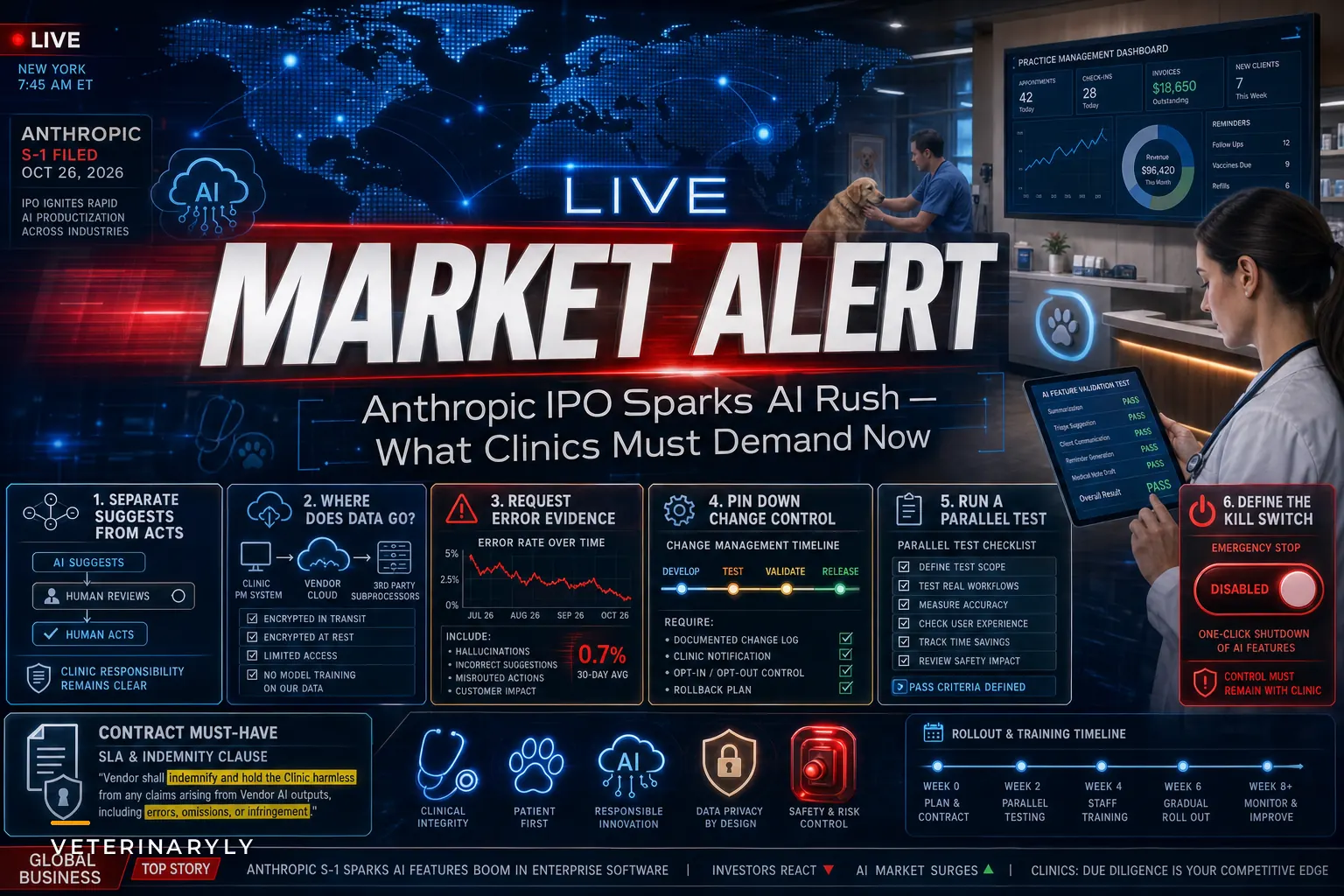

When Anthropic filed its S-1 with the SEC on October 26, 2026, most clinic owners probably didn't notice. A frontier AI lab going public doesn't feel like it has much to do with running a four-exam-room practice in a strip mall. But it does — just not in the way the headlines suggest.
An IPO of that size, covered in detail by CNBC's live coverage, signals that generative AI is moving from "experimental" to "monetized at scale." When the money gets serious, every SaaS vendor serving veterinary clinics — your practice-management system, your scheduling add-on, your billing platform — gets pressure to ship AI features fast. Over the next 12 to 18 months, expect a flood of "now with AI" announcements, upsell emails, and renewal conversations that suddenly include a triage bot or an automated coding assistant you didn't ask for.
That's the real operational event here. Not the IPO itself, but the vendor behavior it accelerates. And most clinics have no structured way to evaluate what they're being sold.
The problem isn't AI. It's that nobody's doing vendor due diligence for clinics on AI features.
When a vendor adds a new scheduling rule or a billing report, you can usually test it in a week and see whether it works. When a vendor adds an AI feature — say, a model that drafts SOAP notes or auto-suggests billing codes from a visit — you often can't tell whether it's working until something goes wrong three months later.
That's the trap. AI features fail quietly. A scheduling bug throws an error. A bad AI suggestion just produces a plausible-looking wrong answer that a busy tech accepts at 4:45pm on a Friday.
Most clinics are running procurement for AI features the same way they'd buy a label printer. The questions they ask are about price, support hours, and whether it integrates with their current system. The questions they should be asking — about model validation, data handling, change control, and liability — almost never come up until a contract renewal or, worse, an incident.
AI vendor due diligence for clinics is really just procurement discipline applied to a category where the risks are harder to see. The good news is that the discipline itself isn't complicated. It's mostly a matter of asking better questions before you sign, not after.
What vendors will push vs. what you actually need to verify
The gap between the sales pitch and the operational reality tends to look like this:
Never miss a pet’s appointment again.
Veterinaryly helps you schedule, confirm, and manage every appointment and patient record effortlessly.
- Centralized appointment & patient management
- Automated client reminders
- Staff scheduling & task tracking
No credit card required
| What the vendor emphasizes | What you actually need to verify |
|---|---|
| "AI-powered triage saves front-desk time" | How are urgent cases flagged, and what's the documented false-negative rate? |
| "Automatic note generation" | Who reviews and signs off? Is the AI draft clearly marked vs. clinician-edited text in the record? |
| "Smart billing code suggestions" | Does it ever auto-apply codes, or only suggest? What's the audit trail when a code is wrong? |
| "Seamless integration with your PMS" | Does your patient data leave your system to reach a third-party model? Where does it go, and is it retained? |
| "Always improving — updates roll out automatically" | Can AI features change silently without your approval? Can you opt out of a model update? |
| "Enterprise-grade security" | What specifically happens if the vendor is acquired, loses funding, or the underlying model provider changes terms? |
That last row matters more than most people expect right now. A wave of AI commercialization also means a wave of startups scaling fast, some of which won't survive. If your triage or documentation workflow depends on a vendor built on top of a model provider, you've got two layers of continuity risk, not one.
The underlying issue: AI features change workflows faster than clinics can govern them
This is the part that doesn't show up in a demo. When an AI feature changes how work gets done, it quietly reshapes who's responsible for what.
A realistic example: a mid-size clinic turns on an AI documentation assistant that drafts visit notes from the exam. The pitch is that it saves each doctor 20–30 minutes a day. Sounds great. But within a few weeks, a pattern shows up — the AI drafts are so clean and confident-looking that the associates stop carefully reviewing them. One note carries forward a medication dosage from a template that didn't match the actual visit. Nobody catches it because the note reads perfectly.
That's not a software bug. That's a governance gap. The clinic adopted a tool that changed the documentation workflow without updating the review step that the old workflow depended on.
This is exactly the territory the FDA has been circling. If you want a deeper, structured framework for auditing and validating these features before they touch your records, the practical playbook built around the FDA's generative-AI paper walks through the validation and control steps in detail. The short version: an AI feature isn't "done" when it works in a demo. It's done when you've defined who checks its output, how errors get caught, and what happens when it's wrong.
A due-diligence process you can actually run before signing
You don't need a compliance department for this. You need a repeatable set of steps and the discipline to not skip them because the sales rep is friendly and the discount expires Friday.
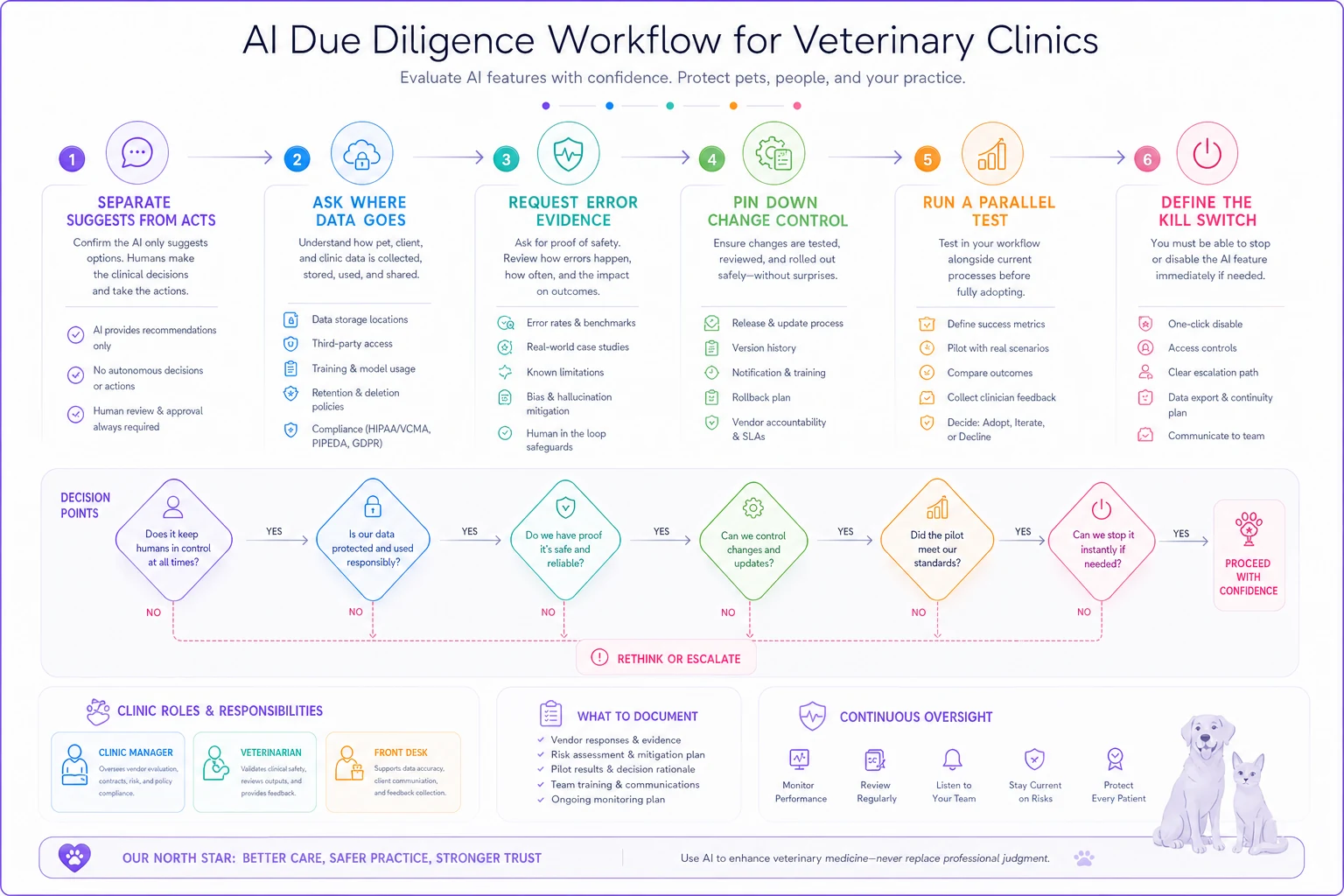
Here's a simple workflow you can follow when evaluating an AI feature.
-
Separate "suggests" from "acts." For every AI feature, write down whether it only suggests (a human makes the final call) or whether it can take an action on its own — apply a code, send a client message, reschedule an appointment. Anything that acts autonomously gets a much higher bar.
-
Ask where the data goes. Specifically
does patient or client data leave the vendor's system to reach a third-party AI model? If yes, get the retention and training policy in writing. "Your data is never used to train models" should be a contract clause, not a sentence on a webpage.
-
Request error evidence, not accuracy claims. Any vendor can say "95% accurate." Ask instead: show me examples of where it gets things wrong, and what the workflow does when that happens. A vendor who can't describe failure modes hasn't tested their own product honestly.
-
Pin down change control. Can the vendor push a model update that changes behavior without telling you? Negotiate advance notice and the right to review or delay AI feature changes. This is standard in the procurement and vendor contract governance work clinics already do for other systems — it just needs to extend to AI.
-
Run a parallel test. Before AI output goes live in records or billing, run it alongside your normal process for 2–4 weeks and compare. If the AI-suggested billing codes diverge from your staff's codes on 1 in 8 visits, you need to know before those codes hit claims.
-
Define the kill switch. Who can turn the feature off, how fast, and what's the fallback workflow?
If the honest answer is "we'd be stuck," the feature isn't ready for your clinic.
A short real scenario
A three-doctor small-animal practice adopted an AI billing assistant that suggested procedure codes from the visit notes. The front desk was told it would reduce missed charges. For the first month it seemed fine — invoices went out faster.
Then the practice manager ran a reconciliation and found the tool had been under-suggesting codes for recheck exams, quietly defaulting them to a lower-cost code. The leak was small per visit, maybe $8–$15 each, but across roughly 280–300 relevant visits a month it added up to somewhere in the range of $3k–$4k in monthly undercharging. Nobody noticed because every individual invoice looked reasonable.
What fixed it wasn't dropping the tool. It was adding a weekly reconciliation step comparing AI-suggested codes against a sample of actual visits — the parallel-test discipline from step 5, applied continuously. Once the clinic treated the AI as a suggestion engine that needed a check rather than an authority, the tool became genuinely useful.
The feature wasn't bad. The missing governance step was.
When demanding more from vendors makes sense — and when you're overdoing it
Not every AI feature needs the full treatment. Calibrate to the risk.
Full due diligence makes sense when the feature:
-
touches the medical record or billing
-
can take an action without human review
-
sends data to a third-party model
-
is sold by a newly funded startup whose continuity you can't easily assess
You can keep it light when the feature:
-
only reorganizes information you already have
-
is purely internal (like summarizing your own appointment history for your eyes)
-
has an obvious human checkpoint built into the existing workflow
-
can be turned off instantly with zero operational disruption
Who should slow down entirely: single-location clinics with no one clearly owning data governance. If nobody in the building can answer "where does our client data go," that's the gap to close before adding any AI feature that touches patient information. Adding AI on top of unclear data governance just multiplies exposure you can't see.
A pre-signing checklist
Before you agree to any AI feature in a scheduling, triage, records, or billing system, confirm you have written answers to:
-
- [ ] Does this feature suggest, or does it act on its own?
-
- [ ] Does our data leave the vendor's environment to reach an AI model?
-
- [ ] Is our data ever used to train the vendor's or a third party's models?
-
- [ ] What are the known failure modes, and what happens operationally when it's wrong?
-
- [ ] Can the vendor change AI behavior without our approval or notice?
-
- [ ] Who on our team reviews AI output before it becomes final?
-
- [ ] How fast can we turn it off, and what's the fallback?
-
- [ ] What happens to our setup if the vendor is acquired or shuts down?
If a vendor bristles at these questions, that tells you something useful. The good ones will have answers ready, because serious buyers have started asking.
Where this leaves clinics
The Anthropic filing isn't a reason to rush into AI or to avoid it. It's a signal that sales pressure is about to intensify, and the clinics who come out ahead will be the ones treating AI features like any other high-stakes vendor decision — real questions, written answers, and a review step that catches quiet failures.
The mistake isn't adopting AI. It's adopting it the way you'd adopt a new fax line: plug it in, trust it, move on. AI features earn their place in a clinic the same way a new associate does — through a defined scope, a clear reporting line, and someone checking the work until it's proven. Keep that standard, and most of the risk in this coming wave manages itself.
Ready to elevate your clinic’s efficiency?
Join 500+ veterinary clinics using Veterinaryly to save time, reduce administrative overhead, and improve patient care.