

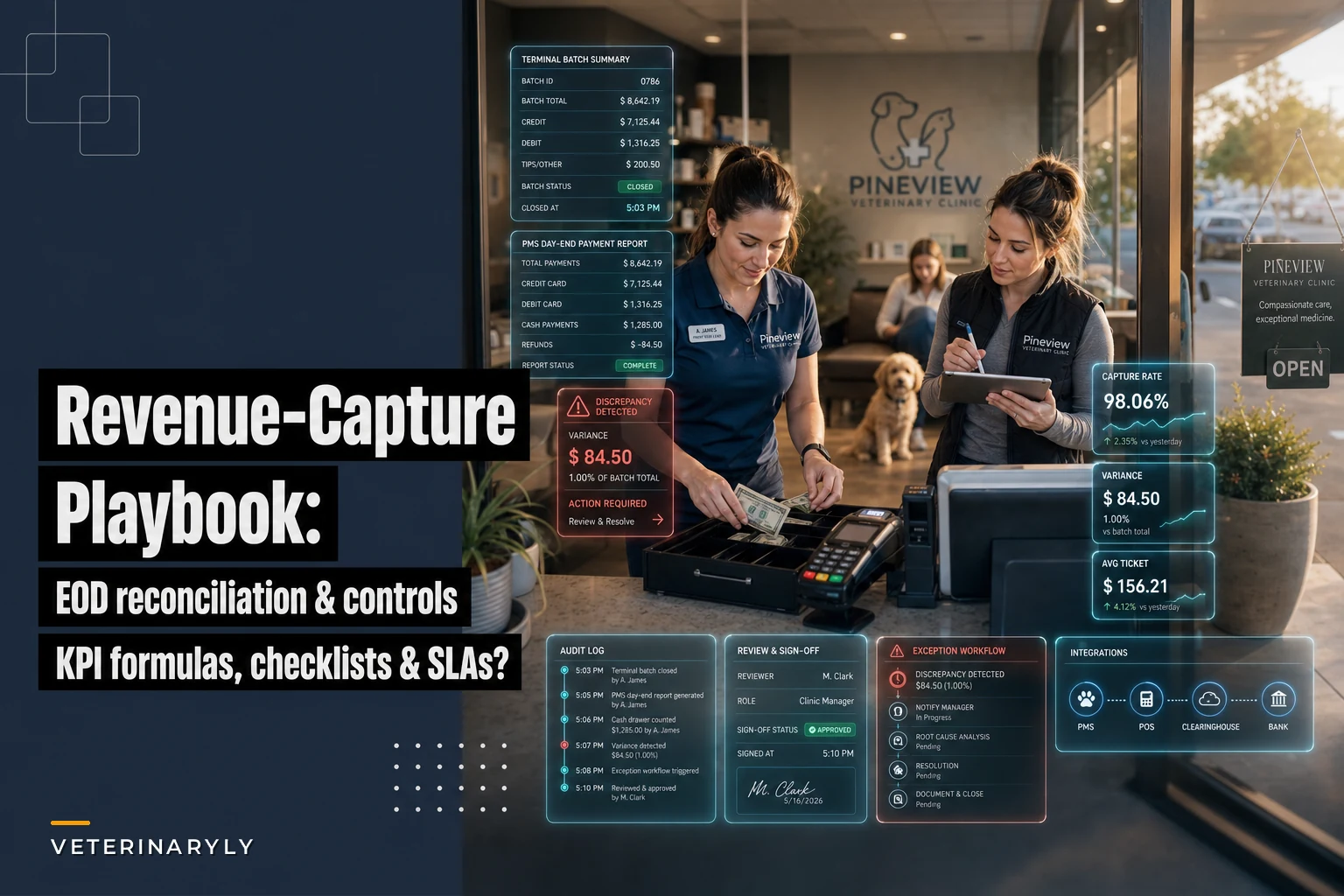

Most clinics obsess over the back half of the revenue cycle — claims, write-offs, aging buckets. But a huge chunk of lost money never gets that far. It leaks in the first ten minutes of a visit and again in the last five, at the front desk and the payment terminal. A tech adds an injection to the chart but nobody touches the invoice. A client gets quoted $220, declines two line items, pays $160, and those declined services just disappear without a trace. End of day, the terminal batch reads $8,940 and the PMS says $9,310 — and the front desk shrugs and goes home.
This playbook covers only that window: pre-visit through point of sale. If you want the full claims-and-aging side, that's covered separately in the veterinary revenue-cycle system with dashboards, SLAs and staffing rules. Here we stay narrow and tactical — the exact KPIs, reconciliation steps, scripts, and escalation triggers.
Where the money actually leaks (and why it's invisible)
The front-desk/POS leak is sneaky because nothing breaks. The day runs fine. Clients leave happy. The deposit clears. The problem is the deposit is quietly 3–6% smaller than it should have been, and because nobody reconciles at the charge level, there's no alarm.
-
Uncaptured charges — services performed, documented clinically, never added to the invoice. Vaccines, nail trims, ear cytology, take-home meds grabbed off the shelf.
-
Partial-pay drift — client declines part of an estimate, the invoice gets edited down, and the decline is never actually recorded. You can't follow up on something you didn't log.
-
Terminal/PMS mismatch — payments taken on the card terminal that don't tie back to a specific invoice, or tips and adjustments applied at the terminal with no PMS counterpart.
-
Chargemaster/bundle errors — a wellness bundle still priced at last year's rate, a "free" recheck that was supposed to be charged after day 14, a manual discount that became permanent because nobody changed it back.
The reason it stays hidden: the people who could catch it are the same people who created it, and there's no independent check between "charge entered" and "money banked." Fix that independence problem and most of the leak surfaces within two weeks.
The KPI set — exact numerators and denominators
Vague KPIs are worse than none. "Capture rate" means nothing unless everyone computes it the same way. Here's the tight set. Pull these daily unless noted.
Never miss a pet’s appointment again.
Veterinaryly helps you schedule, confirm, and manage every appointment and patient record effortlessly.
- Centralized appointment & patient management
- Automated client reminders
- Staff scheduling & task tracking
No credit card required
| KPI | Numerator | Denominator | Cadence | Target |
|---|---|---|---|---|
| Charge Capture Rate | Line items on invoice | Billable services in clinical note (sampled) | Daily sample of 15–20 visits | ≥ 98% |
| Estimate→Invoice Variance | Invoiced total | Accepted estimate total | Per visit, rolled up daily | within ±5% |
| Terminal-to-PMS Reconciliation Gap | Terminal batch total | PMS payments posted (same day) | Daily, every terminal | $0 |
| Declined-Service Logging Rate | Declines recorded with reason code | Estimated declines (sampled call-backs) | Weekly | ≥ 90% |
| Late-Charge Rate | Charges added after visit close | Total charges | Weekly | < 2% |
| Unapplied-Payment Count | Payments not tied to an invoice | — (raw count) | Daily | 0 |
A few notes that matter more than the table itself:
Charge Capture Rate needs sampling, not a full audit. Nobody can reconcile every note against every invoice daily. Pull a random 15–20 visits — mix the busy techs with the quieter ones, mix morning and afternoon. If your sample capture rate drops below 96%, expand the sample the next day. A consistent 98%+ on a genuinely random sample is something you can trust.
If your sample capture rate drops below 96%, expand the sample the next day.
Estimate→Invoice Variance only works if declines are logged. A client declining $60 of a $240 estimate and paying $180 is a legitimate variance, not a leak — but only if you recorded the decline. An unexplained variance is the signal. A documented decline is a follow-up opportunity.
Reconciliation Gap should be literally zero. Not "close." Any non-zero gap is either a mis-posted payment, a tip discrepancy, or a payment taken with no matching invoice. A $12 gap you ignore today is how a $400 gap three weeks from now becomes impossible to untangle.
End-of-day reconciliation — the procedure, with role separation
This is the heart of the playbook. The single biggest control improvement for most clinics isn't software — it's making sure the person who took the money isn't the only person who confirms the money.
Here's the end-of-day sequence. A disciplined team should get through it in around 12–18 minutes.
-
Front desk closes the terminal batch and prints or exports the batch summary — card total, transaction count, any tips or adjustments.
-
Front desk runs the PMS day-end payment report — total payments posted, broken out by type (card, cash, check, external financing).
-
Compare card total vs. terminal batch. These must match to the penny. If not, stop and find the specific transaction before anyone leaves.
-
Count the cash drawer against the PMS cash total. Record any over/short.
-
A second person — not the one who closed the batch — reviews and signs off. This is non-negotiable. In small clinics it's the practice manager or lead tech; in a two-person front desk, they check each other.
-
Log the result in a dated reconciliation record
card match (Y/N), cash over/short, unapplied payments, who closed, who reviewed.
-
Any gap over the threshold (say $10) triggers the exception workflow before it ages overnight.
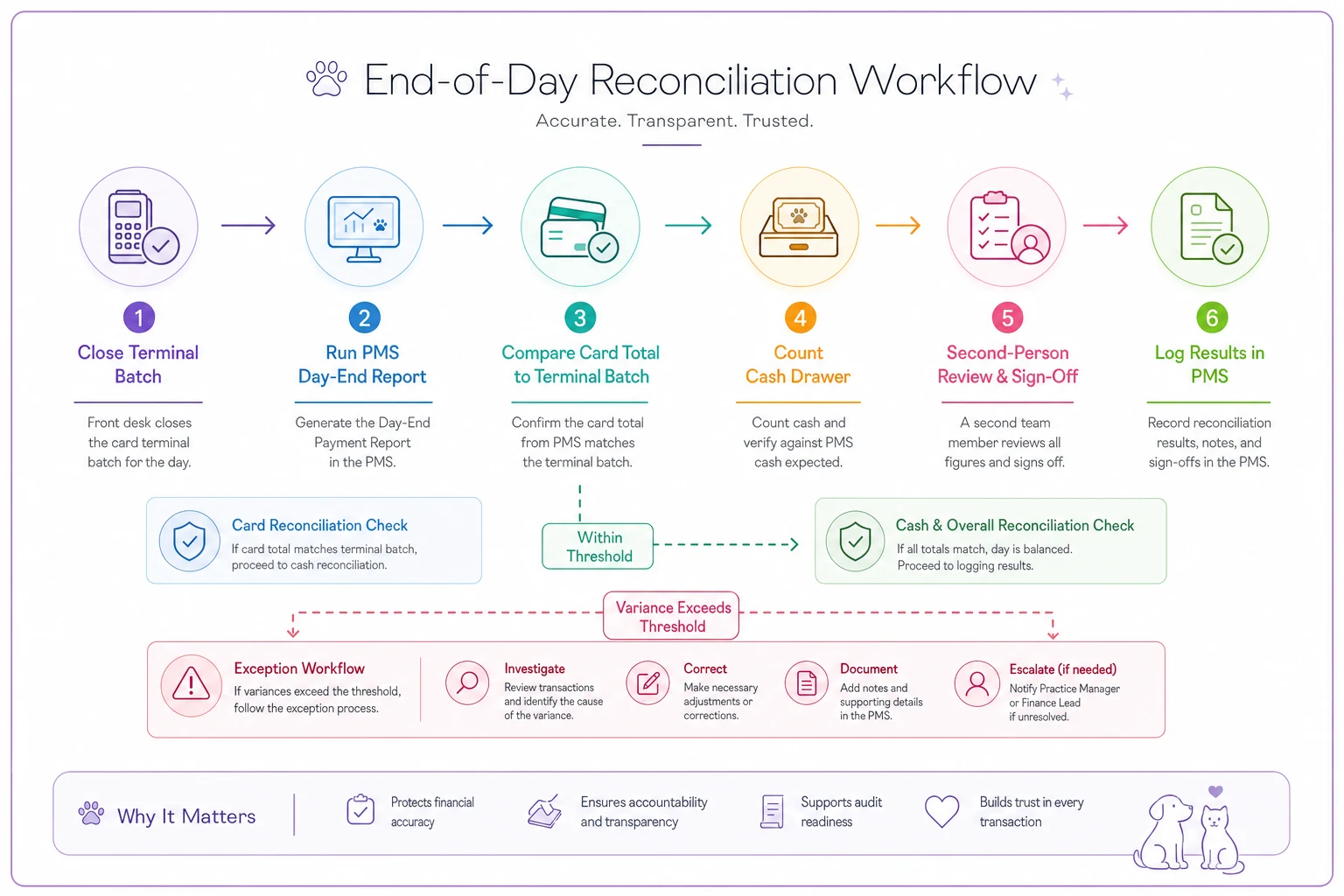
The audit log is what makes this real. You want a standing record that answers, for any given day: who closed the batch, who reviewed it, what the gap was, how exceptions were resolved. When a discrepancy surfaces three weeks later, a reconciliation log with names and timestamps turns a two-hour forensic hunt into a five-minute lookup.
Many practice-management platforms can enforce this kind of structure — timestamped day-end reports, payment-to-invoice matching, a review step that can't be skipped. Where that exists, lean on it. The point isn't the tool; it's that the two-person check and the dated log happen every single day, not just when someone remembers.
Bundling and chargemaster change controls
Pricing errors in bundles are a slow bleed. A wellness package priced $18 under cost, applied to 40 visits a month, is roughly $8,000–$9,000 a year gone — and nobody notices because each individual invoice looks fine.
-
No price or bundle change goes live without a second approver. One person proposes, one approves. Document the old price, new price, effective date, and reason.
-
Temporary discounts get an expiry date. The most common chargemaster leak is a "promo" or "staff rate" that was supposed to last a month and is still active two years later.
-
Quarterly bundle audit. Pull every active bundle, sum the component retail prices, compare to the bundle price, confirm the intended margin still holds. Lab and vaccine costs drift; bundles don't update themselves.
-
Lock the override. Front-desk price overrides should require a reason code and, above a dollar threshold, manager approval. An override with no reason is a hole.
The pattern worth remembering: chargemaster leaks aren't caused by bad intentions. They're caused by nobody owning the change back. Someone drops a price for a legitimate reason, and the "un-drop" never gets scheduled.
Estimate and consent scripts by risk tier
The front desk sets the tone for whether money gets captured. Clear estimates reduce both leakage and the awkward checkout argument. Tier your scripts by the dollar size and surprise-risk of the visit.
Low tier (routine, under ~$150 — wellness, vaccines, nail trim):
> "Today's visit comes to about $120 — that's the exam, the vaccines, and the fecal. Want me to add the nail trim while he's here? That's another $18."
Mid tier (~$150–$600 — dentals, diagnostics, minor procedures):
> "Here's your estimate — the low end is $340 if everything's straightforward, the high end is $510 if we need the extra extractions and the pre-anesthetic panel. I'll have the team call you before we go past the number you approve. Which parts would you like us to go ahead with today?"
High tier (over ~$600 — surgery, hospitalization, emergency):
> "This estimate runs $820 to $1,150. We'll need a deposit of $400 today to proceed, and we'll call you if the treatment plan changes before we cross your approved ceiling. Here's the consent form — initial next to each item you're approving."
Per-item initialing isn't just liability protection; it's your decline log. Anything not initialed is a documented decline you can follow up on next week.
Exception workflow for uncaptured and late charges
Late charges — services added after the visit closes — are where capture goes to die. The longer a charge sits uncaptured, the lower the odds you ever collect it, because the client's gone and nobody wants to make the "you owe us another $40" call.
-
Tech flags a missed charge the moment it's noticed — shelf med grabbed, extra service performed.
-
Front desk attempts same-day capture. If the client is still in the building or being checked out, it's a normal add-on.
-
If the client has left, route to a dated late-charge queue with: service, amount, visit date, reason it was missed.
-
Manager reviews the queue daily. Decide per item
bill the client, write it off, or absorb it — and record the decision. A logged write-off is data. A write-off that just happens is a leak.
-
Track the late-charge rate weekly. If one tech or one shift generates most of them, that's a training or workflow issue, not a billing issue.
The point here: your goal isn't zero write-offs. It's zero silent write-offs. Every uncaptured charge should be a conscious decision someone signed, not something that quietly evaporated.
Integration mapping — making the systems agree
System mismatches are where reconciliation lives or dies. Map the data flow explicitly so everyone knows what should tie to what:
-
PMS → POS terminal the invoice total should push to the terminal. Integrated terminals do this automatically; standalone terminals require manual entry, which is where typos and unapplied payments start.
-
POS terminal → PMS the payment, with transaction ID, should post back against the specific invoice.
-
POS → bank the terminal batch should match the next-day bank deposit. Know whether your processor nets out fees or sends gross deposits — those behave differently.
-
PMS → clearinghouse for any insured or wellness-plan billing, confirm charges flowed through.
The two reconciliation points that catch the most: terminal batch = bank deposit (daily) and PMS payments = terminal batch (daily). If both tie, your money's accounted for from invoice to bank. If a clinic runs standalone terminals that don't talk to the PMS, that manual bridge is the single highest-risk point — it's exactly where "took the payment, forgot to post it in the PMS" happens.
SLA and escalation templates — Yellow to Red
Discrepancies need owners and clocks, or they sit forever. Keep the triggers dead simple.
| Trigger | Status | Action | Owner | Clock |
|---|---|---|---|---|
| Reconciliation gap $10–$50 | 🟡 Yellow | Investigate same day, note cause | Front desk lead | Before close |
| Gap over $50, or unapplied payment | 🔴 Red | Stop, find transaction, notify manager | Practice manager | 1 hour |
| Capture rate < 96% on sample | 🟡 Yellow | Expand sample next day, flag shift | Manager | Next day |
| Capture rate < 92% two days running | 🔴 Red | Shift-level review, retraining | Manager / owner | 48 hours |
| Late-charge rate > 4% weekly | 🟡 Yellow | Identify source shift/tech | Manager | Weekly review |
> "End-of-day gap of $28 on Terminal 2. Card batch $4,210, PMS card total $4,238. Investigating before close — likely a tip entered at terminal not posted in PMS. Will confirm."
> "RED: $140 unapplied payment, no matching invoice, dated today. Terminal shows the charge, PMS shows nothing. Need manager sign-off and client lookup before we close. Holding the batch."
Owner checklist for a Red resolution:
-
- [ ] Transaction identified by ID and timestamp
-
- [ ] Root cause recorded (mis-post, tip, standalone terminal, override)
-
- [ ] Corrected in PMS and confirmed against terminal
-
- [ ] Logged in reconciliation record with resolver's name
-
- [ ] If recurring pattern, flagged for workflow/training fix
Owner checklist for a Red resolution:
A real scenario
A two-doctor small-animal clinic running roughly 320–360 visits a month had an integrated PMS but no second-person check at close and logged declines inconsistently. Their deposits looked fine. On a two-week audit — sampling about 15 visits a day — the capture rate came in around 94%, with the biggest gaps being shelf-dispensed meds, nail trims never invoiced, and a handful of terminal tips that never posted back to the PMS.
They changed three things: a daily two-person reconciliation with a dated log, per-item initialing on mid and high-tier estimates, and a daily late-charge queue the manager cleared each morning. Nothing fancy.
Within about six weeks, sample capture rates held between 98–99%, and recovered revenue — mostly uncaptured meds, add-ons, and a couple of chargemaster corrections — landed somewhere in the $2,400–$3,000 range per month. Not a transformation. Just money that had been walking out the front door, now staying in.
When this level of control makes sense — and when it's overkill
Do this if you're over roughly 200 visits a month, run a card terminal that isn't fully integrated with your PMS, or you've ever had a day-end where the numbers didn't tie and you just let it go. The two-person check and daily log pay for themselves fast at that volume.
You can go lighter if you're a very small single-provider practice with a fully integrated terminal where payments auto-post and one person genuinely sees every transaction. In that case, a weekly reconciliation and a quarterly bundle audit may be enough. Don't bury yourself in daily paperwork for a leak that's mostly closed by your integration.
Don't build the full SLA matrix and then let it collect dust. A Yellow/Red system nobody acts on is worse than none — it trains your team to ignore alarms. Start with the daily two-person reconciliation and the decline log. Add the rest once those are automatic.
The front-desk and POS leak isn't dramatic. It's a few line items a day, a tip that didn't post, a bundle priced a year ago. But those small amounts compound into real money, and the only thing standing between you and recovering it is an independent check and the habit of writing down what happened. Build the habit first; the KPIs just tell you whether the habit is working.
Ready to elevate your clinic’s efficiency?
Join 500+ veterinary clinics using Veterinaryly to save time, reduce administrative overhead, and improve patient care.