



Most clinics don't lose revenue in one dramatic moment. They lose it in fifteen-dollar increments, a few times a day, across a hundred small handoffs that nobody owns end-to-end. A vaccine that got administered but never charged. An estimate that got verbally approved but never signed. A claim that sat in a "needs more info" pile for three weeks and then aged past the filing window. None of these feel like emergencies on the day they happen. Added up over a year, they're often the difference between a clinic that's comfortable and one that keeps wondering why appointment volume is up but the bank account isn't.
The frustrating part is that veterinary revenue cycle management rarely fails because of one broken step. It fails because the steps don't talk to each other. Pricing is set in one place, clearance happens (or doesn't) at the front desk, charges get captured in the medical record, and collections chases whatever falls through — and each of those groups assumes someone else is watching the leak. This is a system problem, so the fix has to be a system, not another sticky note reminding techs to charge for nail trims.
Start by mapping the leak points, not the workflow
Before you fix anything, you need to know where money actually escapes. Most clinics can name maybe two leak points off the top of their head — usually missed charges and slow client payments. But the revenue cycle has more openings than that, and the ones people tend to forget are often the expensive ones.
Here's a realistic breakdown of where clinics lose money across the cycle:
| Leak Point | How It Usually Happens | Typical Annual Impact (mid-size clinic) |
|---|---|---|
| Missed charge capture | Services delivered but not entered before checkout | $18k–$35k |
| Pricing drift | Fee schedule not updated as supply/lab costs rise | $10k–$20k |
| Weak pre-visit clearance | Wellness plan lapses, unpaid balances, no deposit on big cases | $8k–$15k |
| Estimate/consent gaps | Verbal approvals, unsigned estimates, scope creep with no re-quote | Highly variable |
| Aging receivables | Balances left to "we'll send a statement" with no cadence | $12k–$25k |
| Write-off leakage | Discounts and courtesy adjustments with no approval rules | $5k–$12k |
You don't need these numbers to be exact for your clinic. The point is the shape of it — the biggest leaks are usually charge capture and receivables aging, but pricing drift is the silent one because nobody feels it happen. Your labs quietly raise prices, your supply costs creep, and your fee schedule sits untouched for eighteen months while your margin erodes a little every day.
Pricing governance: the part everyone skips
Pricing is where most clinics have zero real process. Someone set the fees a while ago, they get bumped occasionally when it feels overdue, and that's about it. The problem is that costs don't move on a schedule you feel — they drift. Your outside lab raises a panel by $4, your distributor bumps a common injectable, your card processing rate ticks up. Individually invisible. Together, you're now running certain services at a margin you'd never have agreed to on purpose.
Never miss a pet’s appointment again.
Veterinaryly helps you schedule, confirm, and manage every appointment and patient record effortlessly.
- Centralized appointment & patient management
- Automated client reminders
- Staff scheduling & task tracking
No credit card required
Pricing governance just means putting rules around how prices get set and reviewed so nobody has to remember to do it. A workable version looks like:
-
A fixed quarterly fee review for your top 30 revenue services (these typically drive 70–80% of income).
-
A cost-linked flag — when a cost input rises past a threshold (say 6–8%), the linked service gets pulled into review automatically instead of waiting for the quarter.
-
A margin floor per service category so nothing silently drops below it.
-
An approval rule for who can override standard pricing and by how much.
Flag top revenue services in your PIMS so cost-linked changes auto-notify the review owner.
That last one matters more than people expect. In real operations, margin doesn't just leak from costs — it leaks from discretion. A doctor knocks 20% off because the client is upset, the front desk waives a recheck fee to be nice, someone comps a nail trim. Each is defensible in isolation. Together they add up to real money, and because there's no rule, there's no visibility. If you've read our take on why tracking the wrong KPIs quietly costs clinics revenue, this is the same principle applied to pricing — you can't manage a number nobody is watching.
Pre-visit financial clearance: catch it before the pet is on the table
Financial clearance is standard in human healthcare and nearly nonexistent in veterinary practice, which is strange because vets deal with a much higher rate of clients who can't or won't pay after the fact. Once the procedure is done, your leverage is gone. The whole point of clearance is to move the money conversation to before the visit, when you still have options.
-
Does this client have an outstanding balance?
-
For anything over a set dollar threshold, has an estimate been signed and a deposit collected?
-
If they're on a wellness plan, is it active and current?
A simple clearance rule set clinics can adapt:
-
Under $250 No pre-clearance needed, standard checkout.
-
$250–$800 Signed estimate required before service.
-
Over $800 Signed estimate plus a deposit (commonly 30–50%).
-
Any client with a balance over 60 days Balance addressed before non-emergency booking.
Clinics that skip this are the ones sending statements six months later into the void. A pattern that comes up constantly: a $1,400 dental with extractions gets approved verbally over the phone, the client pays partially or not at all, and now you're carrying a balance you'll probably never fully collect. A required 30–50% deposit on estimates over a threshold would have caught most of that risk before the anesthesia ever started.
Claims and collections need a cadence, not a mood
The most common collections failure isn't aggressive — it's passive. Clinics send one statement, maybe two, and then the balance just sits. There's no rhythm, no escalation, no owner. The balance ages, and the older it gets, the less likely you'll ever see it. Money you're owed at 30 days is a very different situation from money you're owed at 120 days, and most clinics treat them identically.
-
Day 0 — balance due at checkout, payment expected on service.
-
Day 3 — friendly reminder (text/email) if unpaid.
-
Day 15 — first statement plus a call.
-
Day 30 — second statement, firmer tone, payment plan offered.
-
Day 45 — final notice before it moves to a defined process.
-
Day 60+ — escalation per your write-off/collections policy.
The value isn't any single step — it's that the balance never gets to sit and rot in ambiguity. Every aging balance has a next action and a date, and somebody owns making sure that action happens.
Days-to-payment dashboards: the number that ties it together
If you only watch one metric, watch how long it takes money to move from "service delivered" to "cash in the account." That's your days-to-payment, and it's the closest thing to a single vital sign for your revenue cycle. When it creeps up, something upstream is broken — usually clearance or cadence — and it shows up here before it shows up in your bank balance.
-
Charge capture rate — services documented vs. services billed.
-
Average days-to-payment — broken out by payment type.
-
Aging buckets — % of receivables at 0–30, 31–60, 61–90, 90+ days.
-
Clearance compliance — % of over-threshold cases with signed estimates and deposits.
-
Write-off rate — discounts/adjustments as % of gross, by reason code.
The mistake people make with dashboards is building detailed ones nobody acts on. A dashboard is only useful if a specific number crossing a specific line triggers a specific action. Otherwise it's decoration.
Turn the dashboard into SLA-style escalation rules
This is what separates clinics that actually fix leakage from clinics that just measure it. You tie each metric to a threshold, and each threshold to a required response. When the number goes red, the response isn't "let's discuss it at the next meeting" — it's already decided.
| Metric | Green | Yellow | Red → Required Action |
|---|---|---|---|
| Charge capture rate | >98% | 95–98% | <95% → daily reconciliation, tech retraining flag |
| Avg days-to-payment | <5 | 5–12 | >12 → review clearance + cadence compliance |
| Receivables 90+ days | <5% | 5–10% | >10% → collections lead reviews every account weekly |
| Clearance compliance | >95% | 85–95% | <85% → front-desk process audit within 7 days |
| Write-off rate | <2% | 2–4% | >4% → require manager approval on all adjustments |
The reason to write these down as rules instead of leaving them to judgment is that judgment gets busy. On a chaotic Monday, nobody notices receivables crept to 11%. A rule notices for you.
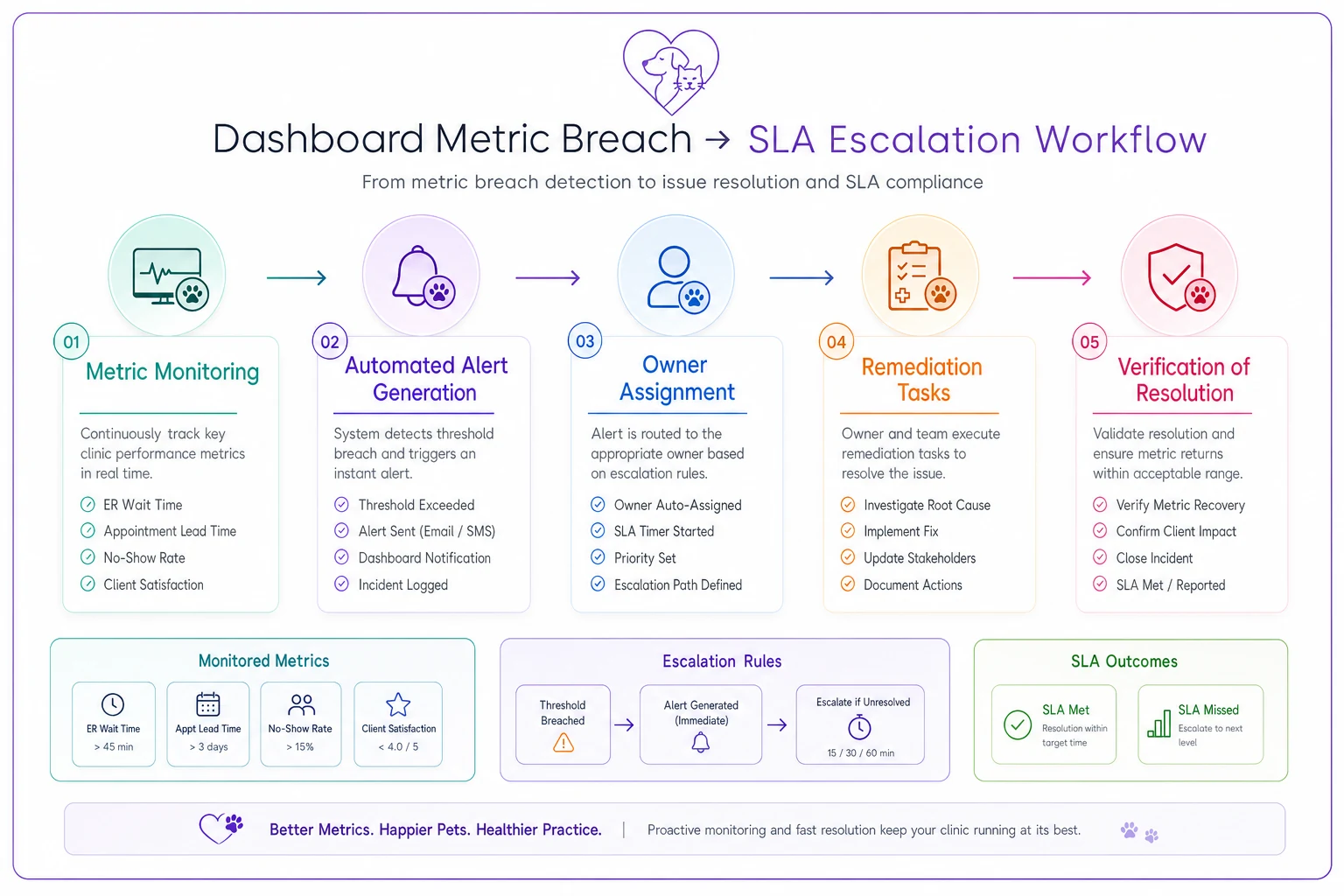
This shows the path from a red metric to a defined remediation action so nothing just sits and gets worse.
Staffing and remediation: leaks are usually role gaps
Revenue leakage is very often a staffing problem wearing a billing problem's clothes. When charge capture is bad, it's usually because no single person owns the reconciliation between what was done and what was billed. When receivables age, it's because collections is "everyone's job," which in practice means it's nobody's.
-
Charge capture Tied to whoever closes out the medical record — with a daily reconciliation check.
-
Clearance Front-desk lead, checked against the dashboard weekly.
-
Collections cadence One named person or role that runs the aging report and works the sequence.
-
Pricing governance Owner (usually the practice manager) who runs the quarterly review.
-
Write-off approvals Manager-level, above a set dollar amount.
Remediation rules matter as much as ownership. When a metric goes red, what actually happens? A useful remediation rule is specific: "If charge capture drops below 95% for two consecutive weeks, the closing tech runs a same-day reconciliation for two weeks and reviews missed items with the manager." Vague accountability produces vague results.
What changes as you scale
At one location with a tight team, a lot of this runs on informal memory. The manager knows who owes money, the front desk remembers which clients need deposits, and charge capture works because the same handful of people do everything. It's fragile, but it holds.
Add a second location, or grow the team past the point where one person sees everything, and the informal system collapses fast. Pricing drifts differently at each site. One front desk enforces clearance, the other doesn't. Receivables age in inconsistent ways because there's no shared cadence. You end up with two revenue cycles that look nothing alike and no way to compare them.
This is where the dashboard-plus-SLA approach stops being nice-to-have and becomes the only thing keeping the cycle coherent across people who can't all see each other's work.
It's also where a centralized operational platform earns its keep. When charge capture, aging, clearance status, and write-offs all live in one place — instead of scattered across your PIMS, a spreadsheet, and someone's memory — the dashboard builds itself and red flags surface on their own. AI-assisted operational software can flag an aging balance before it crosses a threshold, catch a visit that closed without a matching charge, and route a clearance exception to the right person before the appointment happens. The value isn't automation for its own sake — it's that the leaks get caught while you can still do something about them, instead of showing up in a quarterly report as money that's already gone.
A real scenario
A three-doctor small-animal clinic running around 330–360 invoiced visits a month couldn't figure out why cash lagged behind appointment volume. When they actually mapped it, two things stood out: charge capture was sitting near 93% (they were losing services on busy days), and roughly 14% of receivables had aged past 90 days with no consistent follow-up.
Nothing fancy fixed it. They assigned charge-capture reconciliation to the closing tech as a daily task, put a signed-estimate-plus-deposit rule on anything over $800, and stood up a basic collections cadence with one person owning the aging report. Within about four months, charge capture came up to the 97–98% range and 90-plus day receivables dropped under 7%. The revenue bump wasn't dramatic month to month — a few thousand dollars recovered here and there — but annualized it landed somewhere in the low-to-mid five figures they'd simply been leaving on the table. Nothing about their medicine or their pricing changed. They just stopped letting money fall through the gaps between steps.
When this system makes sense — and when it's overkill
Not every clinic needs the full apparatus on day one. If you're a solo practitioner doing modest volume and you personally see every invoice, formal SLA thresholds are probably more structure than you need — start with pricing governance and a basic collections cadence and leave it there.
The full system starts paying off the moment you can no longer personally watch every dollar move through the cycle. That's usually somewhere around multi-doctor volume, a growing support team, or a second location. If you're regularly surprised by your receivables, if discounts happen without anyone tracking them, or if your fee schedule hasn't been touched in over a year — those are signs you've outgrown the informal version, whether you've admitted it or not.
Brand-new practices still finding their volume are probably better off nailing clinical SOPs and clearance basics before layering on dashboards you don't yet have the data to fill.
Revenue leakage isn't a villain you can point at. It's the accumulated cost of a cycle where nobody owns the whole thing and the steps don't connect. Pricing governance keeps your margins from eroding while you're not looking. Pre-visit clearance moves the money conversation to when you still have leverage. A collections cadence stops balances from aging into oblivion. A days-to-payment dashboard tied to real escalation rules turns all of it from "something we should probably watch" into a system that catches problems before they compound.
The clinics that get this right aren't working harder at billing. They've built a cycle where every leak point has an owner, every metric has a threshold, and every red flag has a next step already decided. Start by mapping your leaks, put owners on each one, and build a small dashboard you'll actually look at every week. The money's already yours — the system just makes sure it makes it into the account.
Ready to elevate your clinic’s efficiency?
Join 500+ veterinary clinics using Veterinaryly to save time, reduce administrative overhead, and improve patient care.