



Last week's Reuters report on potential Fed rate hikes sent a wave of anxiety through the veterinary community. Federal Reserve officials are now openly discussing raising interest rates to combat inflation risks, which means your clinic's financial picture could shift dramatically in the coming months.
Rate hikes don't just affect your equipment loans and lines of credit. They fundamentally alter how pet owners make healthcare decisions for their animals.
During the 2022-2023 rate surge, clinics that understood the operational ripple effects adapted quickly. Those that treated it as just a financing issue? Many are still recovering.
The Hidden Cascade Effect Nobody Talks About
When borrowing costs rise, veterinary clinics face a triple squeeze that most financial advisors completely overlook.
Your operational costs jump immediately. That equipment lease you were planning? It just got 15-20% more expensive. The practice expansion loan? Add another $800-1,200 per month in interest payments. One clinic in Denver saw their monthly debt service jump from $4,800 to $6,400 after refinancing their real estate loan — that's basically a full-time tech's salary disappearing into interest payments.
Pet owners start making different choices. When household budgets tighten due to higher mortgage and credit card rates, elective procedures get postponed. Dental cleanings move from "next month" to "maybe in six months." That suspicious lump? Owners opt for monitoring instead of immediate biopsy. Your appointment book starts showing gaps you haven't seen in years.
Vendors and suppliers hit you with their own increased costs. They're dealing with higher borrowing costs too, which means your inventory costs creep up 3-5% across the board. That stable cost structure you built your pricing around? It starts crumbling.
A clinic in Phoenix showed me their numbers recently — same patient volume, same services, but their net margin dropped from 18% to 11% in four months. Nothing changed except the economic environment.
Why Traditional Cash Flow Management Falls Apart
Most veterinary clinics manage cash flow like it's 2019 — weekly deposits, monthly expenses, quarterly reviews. That rhythm worked when rates were stable and client behavior was predictable. Rate hikes destroy that predictability.
Never miss a pet’s appointment again.
Veterinaryly helps you schedule, confirm, and manage every appointment and patient record effortlessly.
- Centralized appointment & patient management
- Automated client reminders
- Staff scheduling & task tracking
No credit card required
Your accounts receivable age faster because clients need payment plans for procedures they used to pay upfront. Insurance reimbursements take longer as companies tighten their own cash management. Meanwhile, your vendors want faster payment or they'll increase prices further.
The clinics that survive these periods don't just monitor cash flow — they actively reshape it.
Immediate Cash Protection Moves
Start with your payment collection timeline. Most clinics wait 30-60 days for full payment on major procedures. Cut that in half. Require 50% deposits for any procedure over $500, collected at scheduling, not day-of. Yes, you'll lose some appointments initially, but the clients who book are actually able to pay.
Renegotiate every vendor contract you have. Not for better prices — for better terms. Moving from net-30 to net-45 gives you an extra two weeks of float. Across 10-15 vendors, that's thousands in working capital you don't have to borrow.
Kill your underperforming services immediately. That exotic animal program that brings in $2,000 monthly but requires $8,000 in specialized inventory? Gone. The grooming service that barely breaks even? Suspended. Every dollar of working capital matters when credit costs 8-10%.
The Capacity Reallocation Strategy
Most clinics get this wrong during tight periods — they try to maintain the same service mix with fewer resources. That's backwards.
Instead, identify your highest-margin, fastest-turnover services and flood your schedule with them. Vaccines and wellness visits might seem boring, but they require minimal inventory, quick room turnover, and immediate payment. A wellness appointment generates roughly $120-180 in revenue with 65% margins and takes 15 minutes. A dental procedure generates $800-1,200 but ties up a surgery suite for 90 minutes with 40% margins after equipment and staff costs.
One practice in Austin completely restructured their appointment scheduling around this principle. They designated Tuesday and Thursday mornings as "wellness blocks" — nothing but vaccines, annual exams, and quick rechecks. Their monthly cash collection jumped 22% just from faster turnover and immediate payment.
Building Your Interest Rate Defense System
The clinics that thrive during rate hikes don't just react — they build systematic defenses against economic pressure.
Dynamic Pricing Adjustments
Static annual price increases don't work when costs shift monthly. You need a responsive pricing model that adjusts based on real cost inputs.
| Indicator | What to Track | Action Threshold |
|---|---|---|
| Borrowing Rate | Your actual borrowing rate (including all fees) | Movement >1% |
| Competitor Pricing | Local competitor pricing for your top 10 services | Gap >15% |
| Price Sensitivity | Client price sensitivity (measured by appointment decline rates) | Decline >10% |
When any indicator moves more than 10%, adjust pricing on your elastic services — things like dental cleanings, senior wellness packages, and diagnostic panels. Keep emergency and basic care pricing stable to maintain trust.
A suburban Chicago clinic implemented this system and found they could increase diagnostic panel pricing by 12% without losing volume, while dental cleaning prices needed to stay flat or appointments dropped off dramatically.
The Working Capital Fortress
Before rates spike, most clinics run with 15-30 days of working capital. You need 45-60 days minimum when credit gets expensive.
-
Week 1-4 Suspend all non-critical inventory orders. Use existing stock down to minimum levels.
-
Week 5-8 Implement surge scheduling — add early morning and evening appointments using existing staff who want extra hours.
-
Week 9-12 Offer prepaid wellness packages at a 10% discount. Clients get a deal, you get immediate cash.
This isn't about hoarding cash — it's about creating breathing room so you don't need expensive emergency lending when something breaks.
Vendor Payment Orchestration
When cash gets tight, how you pay matters as much as what you pay.
-
Priority 1 (Pay immediately)
- Payroll and payroll taxes - Utilities - Core medical suppliers - Insurance
-
Priority 2 (Pay on terms)
- Secondary medical suppliers - Lab services - Equipment leases - Marketing services
-
Priority 3 (Negotiate extended terms)
- Office supplies - Non-medical equipment - Subscription services - Consulting services
One practice discovered they were paying $3,400 monthly in software subscriptions, half of which overlapped in functionality. They consolidated to essential platforms and saved $1,800 monthly — that's $21,600 annually that doesn't need to be borrowed.
Here's a quick visual workflow to coordinate monitoring, pricing, working capital, and vendor payments.
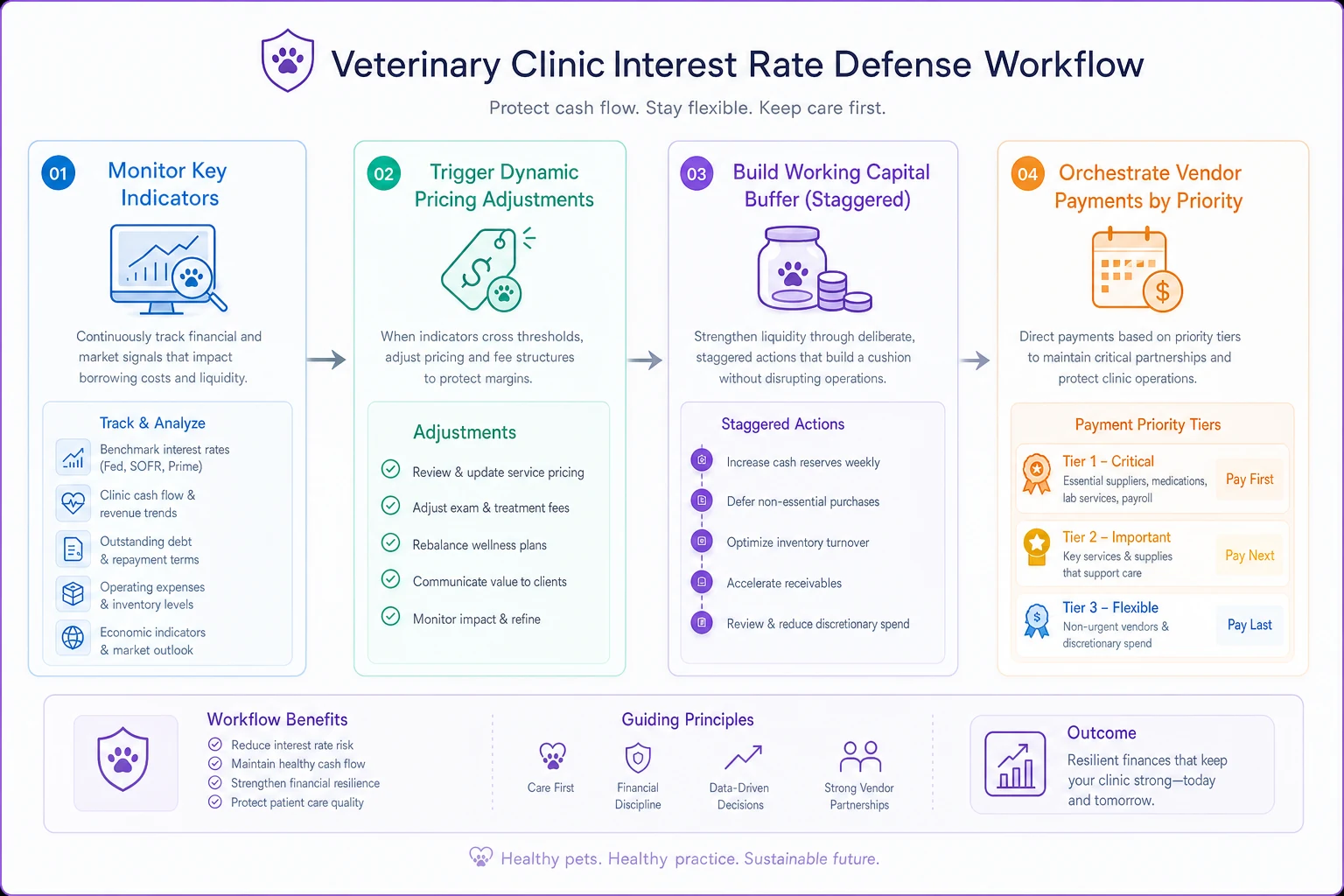
Use this workflow as a checklist when you meet with your leadership team — it helps turn abstract strategies into daily operations.
Demand Management When Clients Pull Back
When household budgets tighten, pet owners don't stop caring about their animals — they just get selective. Your job is to reshape your services to match their new decision criteria.
The Subscription Pivot
Traditional fee-for-service pricing creates friction during economic uncertainty. Clients see a $300 unexpected vet bill as a budget crisis. But a $39 monthly wellness membership? That's manageable.
Basic ($29/month): Two wellness exams, core vaccines, 10% service discount Standard ($49/month): Everything in Basic plus dental cleaning, basic bloodwork Premium ($79/month): Everything in Standard plus unlimited exams, 20% service discount
Make the monthly cost less than what they'd spend on pet insurance, while providing immediate, tangible value. A rural Georgia clinic converted 30% of their client base to memberships and stabilized revenue during the worst of their regional economic downturn.
Payment Plan Architecture
"We offer payment plans" isn't enough anymore. You need structured options that protect both cash flow and client relationships.
Emergency Care Plan: 50% down, remaining balance over 3 months, 5% processing fee Elective Procedure Plan: 25% down, 25% at procedure, remainder over 6 months, 8% fee Wellness Package Plan: 12 equal monthly payments, 3% discount for annual prepay
The processing fees aren't about profit — they cover your actual cost of capital plus administrative overhead. Being transparent about this helps clients understand you're not profiting from their financial stress.
Service Unbundling Strategy
During flush times, comprehensive packages work great. During crunches, clients need options.
-
Basic exam
$65
-
Core bloodwork
$120
-
Extended panel
$95 (additional)
-
Urinalysis
$45 (additional)
-
Chest x-rays
$140 (additional)
Clients can prioritize based on their pet's specific needs and their budget constraints. The total revenue per visit might drop, but visit frequency often increases because the entry point is lower.
The Technology Leverage Point
Modern operational software becomes critical here — not as a nice-to-have, but as survival infrastructure.
Manual cash flow tracking breaks down when variables multiply. You can't spreadsheet your way through daily payment collection rates, vendor payment optimization, and dynamic pricing adjustments while actually running a clinic.
AI-powered platforms can track payment patterns, predict cash crunches weeks in advance, and automatically suggest scheduling adjustments to optimize cash collection. One platform analyzes appointment types, payment history, and current booking patterns to forecast next month's cash position within 5% accuracy.
These systems identify revenue leakage you'd never catch manually. Missed charges, inconsistent pricing, forgotten follow-ups — small leaks that become floods during tight periods. A typical clinic running modern operational software recovers 8-12% additional revenue just from charge capture accuracy.
The automation aspect handles the repetitive tasks that eat up staff time — appointment reminders, payment collection emails, inventory reorder points. Every hour your team doesn't spend on administration is an hour they can spend on revenue-generating activity.
Pro-tip: Automate payment reminders and pre-appointment deposit requests to materially improve collection velocity without adding staff time.
Invest in tools that integrate scheduling, payments, and inventory so the insights are actionable and the team can follow a single operating rhythm.
Your 30-Day Action Plan
Strategy without execution is worthless. Follow this specific roadmap:
-
Days 1-7
Financial Reality Check
- Calculate exact monthly debt service costs - List all variable rate debt - Identify refinancing opportunities - Map current cash conversion cycle -
Days 8-14
Service Profitability Analysis
- Calculate true margins on every service - Identify top 10 revenue generators - Find bottom 10 profit drains - Design service elimination plan -
Days 15-21
Cash Flow Acceleration
- Implement deposit requirements - Launch prepaid packages - Renegotiate vendor terms - Restructure payment plans -
Days 22-30
Operational Restructuring
- Redesign appointment templates - Create membership programs - Deploy cash tracking systems - Train team on new protocols
This timeline gives you breathing room while maintaining operational momentum.
The Difference Between Surviving and Thriving
Rate hikes don't affect all clinics equally. The ones with strong operational discipline often emerge stronger because poorly-run competitors fail or sell.
I worked with a three-location practice group during the last major rate spike. While their competitors panicked and made reactive cuts, they methodically implemented cash flow optimization, shifted to membership models, and invested in operational efficiency. Eighteen months later, they acquired two struggling competitors at favorable valuations and doubled their market presence. The difference? They treated rising rates as an operational challenge requiring systematic solutions, not a financial crisis requiring emergency measures.
Start with cash flow protection, but remember that tracking the wrong metrics will blind you to early warning signs. Focus on metrics that predict problems, not just report them — appointment fill rates, payment collection velocity, and service mix evolution tell you more about clinic health than traditional P&L statements ever will.
The Fed might control interest rates, but you control your clinic's response. Make it count.
Ready to elevate your clinic’s efficiency?
Join 500+ veterinary clinics using Veterinaryly to save time, reduce administrative overhead, and improve patient care.