

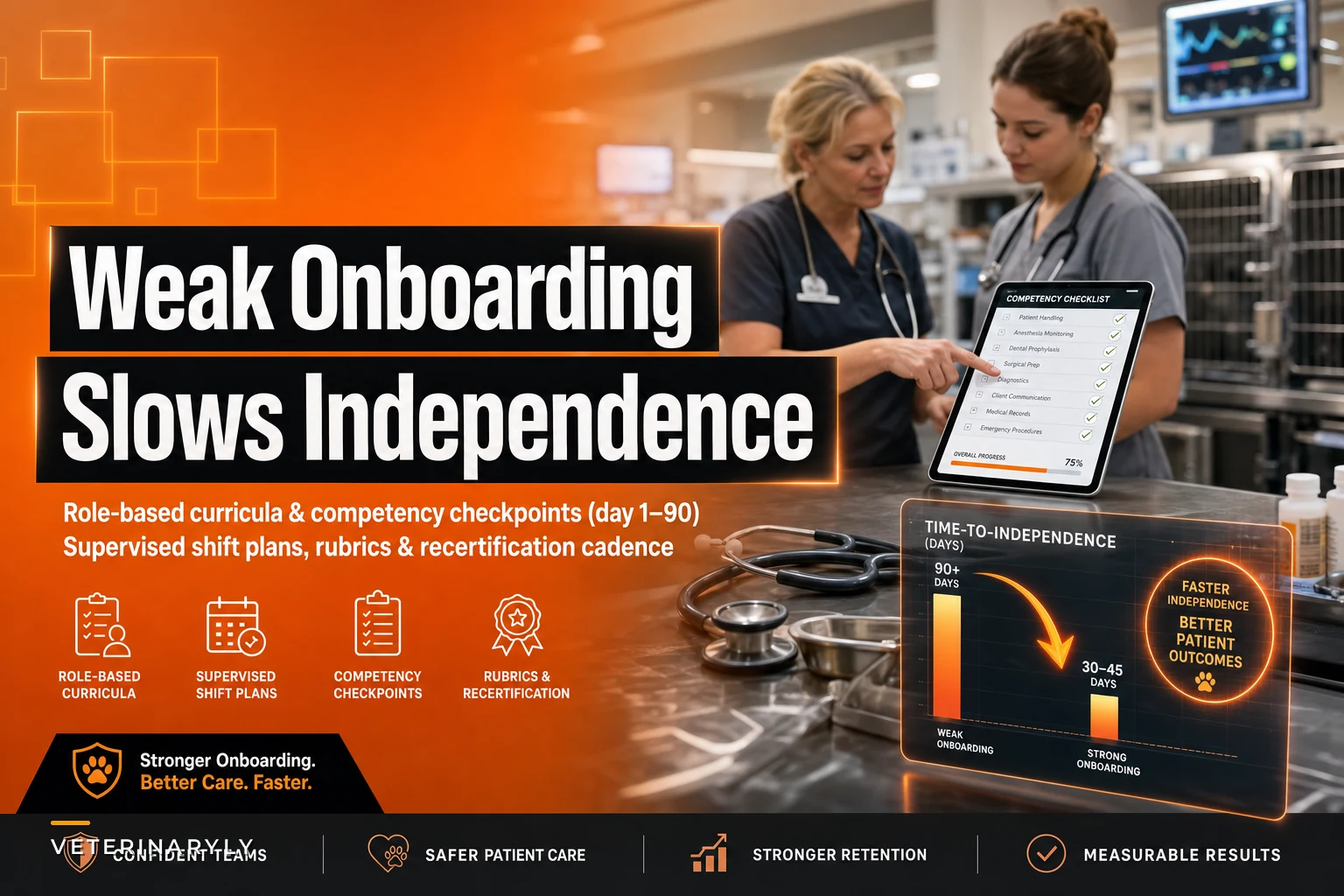

Your new veterinary tech has been working for four months. They still can't run anesthesia monitoring without someone hovering. Your receptionist of three months freezes when a client asks about payment plans. That associate vet you hired? Six months in and they're still asking basic questions about your chronic care protocols.
This isn't a hiring problem. It's an onboarding structure problem.
Most veterinary clinics run what I call "shadow and pray" onboarding. New hires follow someone around for a week or two, get thrown into the schedule, and everyone hopes they figure it out. Six months later, you're wondering why they still need constant supervision and why your experienced staff is burned out from endless re-training.
The solution became obvious after watching hundreds of veterinary practices struggle with this exact pattern: structured competency progression with observable checkpoints. Not just a checklist of tasks to learn, but a mapped pathway from day one dependency to full independence, with clear milestones everyone can track.
The Hidden Cost of Unstructured Onboarding
A veterinary clinic with eight staff members and typical turnover (around 35% annually) loses roughly $42,000 to $58,000 per year just from extended onboarding inefficiency. That's not the cost of hiring or training—that's pure productivity loss from people taking twice as long as necessary to become independent.
New tech takes 6 months instead of 3 months to handle routine procedures solo. During those extra 3 months, you're essentially paying for 1.5 employees to do one person's job. At $18-22/hour, that's around $9,400 in overlapped labor per hire.
New reception staff takes 4 months instead of 6 weeks to handle complex scheduling and billing questions. The experienced receptionist spending 30% of their time re-explaining processes? That's another $7,200 annually per position.
Associate vets requiring senior vet oversight for 8-10 months instead of 3-4 months means your $150k associate is operating at 60% capacity while your $200k senior vet loses 20% of their production time to mentoring. The math gets ugly fast.
The real damage happens in ways that don't show up on spreadsheets. Experienced staff get frustrated constantly answering the same questions. New hires feel incompetent and unsupported. Clients notice the hesitation, the checking with supervisors, the "let me ask someone" responses. Some of your best techs leave because they're tired of being perpetual trainers instead of doing the work they love.
Why Traditional Veterinary Onboarding Fails
Most clinics operate with one of three onboarding approaches, and they all have fundamental flaws.
Never miss a pet’s appointment again.
Veterinaryly helps you schedule, confirm, and manage every appointment and patient record effortlessly.
- Centralized appointment & patient management
- Automated client reminders
- Staff scheduling & task tracking
No credit card required
The Buddy System: Assign new hires to shadow whoever's available that day. Different people teach different methods. No consistent standards. The new hire learns five different ways to do the same task and doesn't know which one is "right."
The Checklist Approach: Hand them a list of 147 things to learn. No prioritization, no progression pathway, no way to verify actual competency. They can check off "knows how to process lab samples" but then contaminate three samples their first solo week.
The Sink-or-Swim Method: Two days of orientation, then straight into the deep end. "You'll learn by doing!" Except they learn bad habits, make preventable mistakes, and develop workarounds instead of proper procedures.
The core problem with all these approaches? They focus on task exposure rather than competency development. There's a massive difference between "has seen how to place a catheter" and "can reliably place catheters in difficult patients without supervision."
Building Role-Based Competency Pathways
A functional veterinary onboarding program starts with role-specific competency maps that progress from basic to complex, with clear dependencies and risk stratification.
For a veterinary technician role, the progression looks like this:
-
Days 1-7
Foundation Skills
- Patient restraint techniques (must demonstrate safe handling of fractious cat before progressing) - Basic vitals collection (must accurately record TPR on 10 consecutive patients) - Cleaning and sterilization protocols (must pass contamination prevention quiz) - Inventory basics (must complete cycle count with <2% error rate) -
Days 8-21
Supervised Clinical Skills
- Venipuncture on compliant patients (5 successful draws with supervisor present) - Subcutaneous fluid administration (10 supervised administrations) - Basic radiograph positioning (demonstrate proper positioning for standard views) - Medication preparation and labeling (zero errors on 20 consecutive preparations) -
Days 22-45
Intermediate Independence
- Solo blood draws on easy patients (maintain 80% first-stick success rate) - Anesthesia monitoring for stable patients (complete 5 procedures with distant supervision) - Client education for routine procedures (observed delivery of 3 discharge instruction sessions) - Lab sample processing (zero mislabeling or contamination events over 15 samples) -
Days 46-90
Advanced Competencies
- Difficult venipuncture and catheter placement - Emergency triage assistance - Surgical preparation and monitoring - Training newer staff members
Each competency includes specific observable behaviors, not vague goals. Instead of "understands anesthesia monitoring," you want "maintains anesthetic record with vitals every 5 minutes, recognizes and responds appropriately to 20% change in heart rate, blood pressure, or respiratory rate within 60 seconds of occurrence."
The pathway creates natural checkpoints where everyone knows what comes next. No more guessing whether someone's ready for the next level of responsibility.
The Supervised Shift Structure
Random shadowing creates random results. Structured supervision accelerates competency while reducing risk.
Week 1-2: Full Shadow Phase - New hire observes only, asks questions, takes notes. They're assigned to one primary trainer per area (one for clinical skills, one for administrative tasks, one for client interaction). This prevents conflicting instruction and creates accountability.
A simple visual workflow can make these phases easier to communicate.
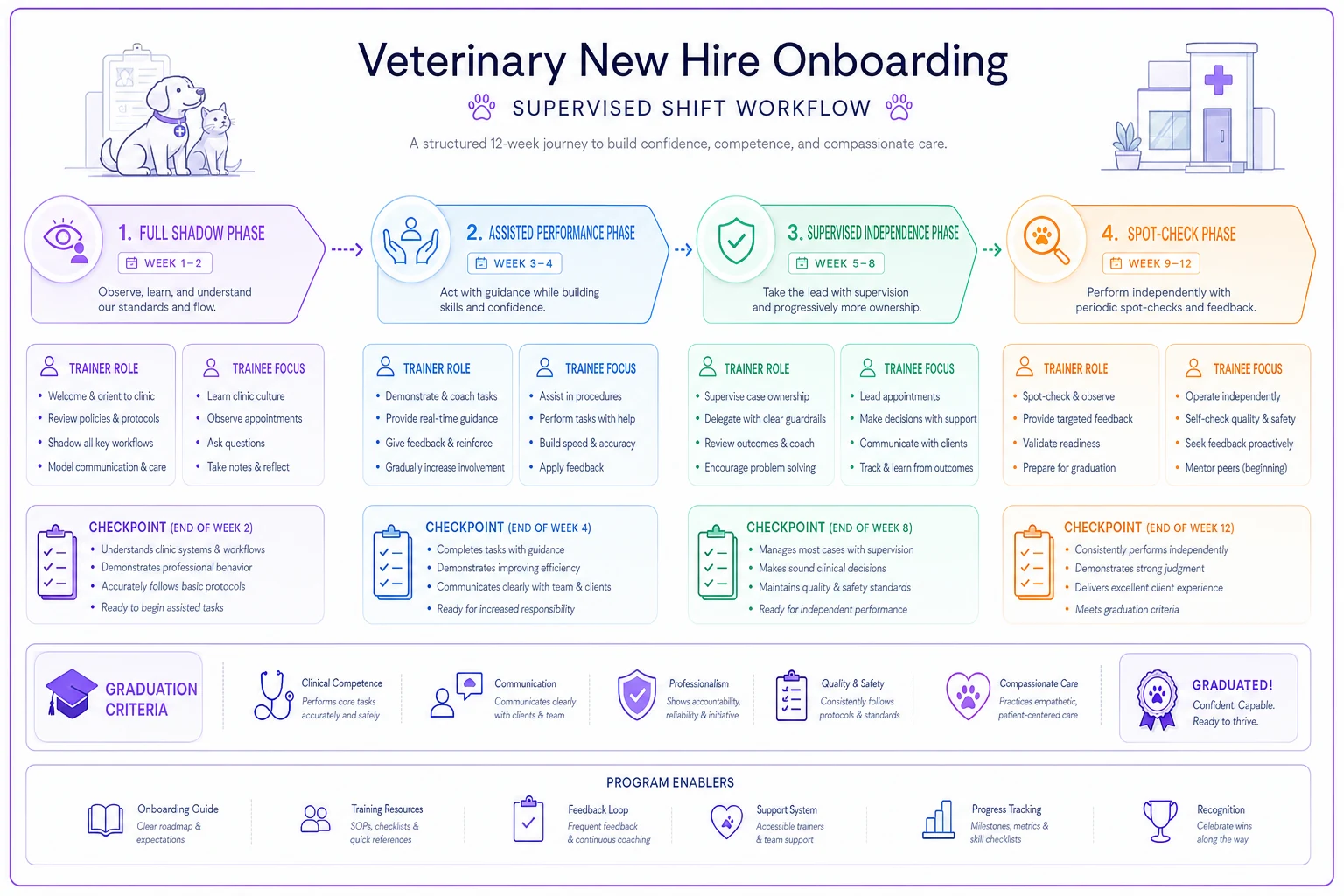
Week 3-4: Assisted Performance Phase - New hire performs tasks with trainer providing step-by-step guidance. Trainer has hands available to take over if needed. Speed doesn't matter—accuracy and proper technique do.
Week 5-8: Supervised Independence Phase - New hire performs tasks solo with trainer observing from distance. Trainer intervenes only for safety issues or critical errors. Debrief happens after each procedure, not during.
Week 9-12: Spot-Check Phase - New hire works independently with random competency checks. Trainer reviews random samples of work (every 5th radiograph, every 10th blood draw, random client interactions).
This structure seems slow initially but actually accelerates time-to-independence. New hires know exactly what phase they're in and what's expected. Trainers know when to step back. Everyone can see progress clearly.
The key difference from traditional shadowing is intentionality. Each phase has specific goals and graduation criteria.
Creating Observable Competency Checkpoints
Vague assessments create false confidence. "Sarah seems ready to handle appointments alone" is not a competency assessment. Observable checkpoints remove ambiguity.
-
Appointment Scheduling Competency
- Correctly identifies appointment type needed based on client description (measured: 20 consecutive calls with appropriate appointment type selected) - Maintains proper appointment spacing per doctor preference (measured: zero same-doctor back-to-back surgical bookings over 50 scheduled appointments) - Accurately quotes estimate ranges for common procedures (measured: quotes within 10% of actual cost for 15 consecutive standard procedures)
-
Payment Processing Competency
- Processes payment plans according to clinic policy (measured: 5 payment plans set up with correct terms and documentation) - Handles declined cards professionally (measured: observed handling of 3 declined payment situations) - Applies appropriate discounts and promotions (measured: zero unauthorized discounts over 30 transactions)
-
Client Communication Competency
- De-escalates upset clients (measured: successfully calms and retains 3 frustrated clients) - Explains medical concepts in lay terms (measured: client understanding confirmed via callback on 10 post-discharge instruction deliveries) - Manages difficult scheduling requests (measured: finds acceptable solutions for 5 "emergency squeeze-in" requests)
The checkpoints need to be binary—either they demonstrated the competency or they didn't. No "mostly" or "pretty good." This clarity helps both trainer and trainee understand exactly where they stand.
Some competencies are more subjective than others, but even soft skills like client communication can be measured through specific scenarios and outcomes rather than general impressions.
Assessment Rubrics That Actually Work
Generic evaluation forms with 1-5 scales for "communication" and "technical skills" tell you nothing useful. Effective assessment rubrics measure specific, observable behaviors tied to real job requirements.
Here's a practical rubric structure for surgical assistance competency:
| Assessment Level | Criteria |
|---|---|
| Pass | Surgical pack prepared with all required instruments in correct order<br>Patient properly clipped with appropriate margins (1-2 inch minimum from incision site)<br>Surgical site scrubbed using appropriate technique<br>Sterile field maintained throughout setup<br>Completed within 15 minutes for routine spay/neuter |
| Needs Work | Minor clipper lines or slightly inadequate margins<br>Correct technique but exceeds time limit by <5 minutes<br>All items present but minor organization issues |
| Fail | Contamination of sterile field<br>Missing critical instruments<br>Inadequate surgical site preparation<br>Exceeds time limit by >5 minutes |
This rubric leaves no room for interpretation. The new hire either maintained sterile field or they didn't. The surgical site was properly prepped or it wasn't. This objectivity reduces trainer bias and gives clear targets for improvement.
The 30-60-90 Day Review Cadence
Traditional annual reviews are useless for new hires. By the time you identify issues, bad habits are entrenched. A structured review cadence catches problems early and celebrates wins while they still matter.
30-Day Review: Foundation Check focuses on basic competencies and cultural fit. Can they arrive on time? Do they follow basic protocols? Are they retaining initial training? This isn't about advanced skills—it's about trajectory. If someone can't master basic patient restraint or client greeting protocols after 30 days with proper training, you have a problem.
60-Day Review: Independence Assessment evaluates readiness for solo work on routine tasks. They should be handling basic procedures without constant supervision. Not perfectly, but safely and correctly.
90-Day Review: Full Role Evaluation determines if they're on track for full autonomy or need extended support in specific areas. By 90 days with structured training, most positions should be operating at 85% independence.
Each review includes specific examples, not general impressions. "Failed to recognize signs of respiratory distress in post-operative patient on March 15" versus "needs to improve monitoring skills."
The reviews also create natural checkpoints for both parties to assess fit. Sometimes great people aren't right for specific roles, and catching that at 30 or 60 days is better than discovering it at 6 months.
Building Your Re-Certification Audit System
Competency isn't static. That tech who was excellent at catheter placement six months ago might have developed bad habits. The receptionist who handled angry clients beautifully might have gotten lax about documentation. Without periodic competency audits, standards drift.
A practical audit cadence includes:
-
Quarterly Spot Checks - Random review of 5 procedures per employee, focusing on high-risk or high-frequency tasks
-
Semi-Annual Skills Refresh - Group training on updated protocols and peer observation sessions
-
Annual Deep Dive - Comprehensive competency re-assessment with focus on advanced skills
The audits shouldn't feel like gotcha moments. When that experienced tech's catheter placement success rate drops from 90% to 70%, the audit catches it before it becomes a crisis.
Most skill degradation happens gradually and isn't intentional. People develop shortcuts that seem harmless but introduce risk. Regular competency checks maintain standards without creating adversarial relationships.
From Manual Tracking to Automated Competency Management
Tracking all these competencies, checkpoints, and assessments manually becomes overwhelming fast. You end up with scattered spreadsheets, forgotten paper forms, and no real visibility into where your team stands.
This is where operational software becomes game-changing. Instead of maintaining dozens of paper checklists, AI-powered platforms can track competency progression automatically, flag when someone's due for re-assessment, and even identify patterns across your team.
If multiple new hires struggle with the same checkpoint, export those flags first—it's usually a training or SOP issue, not individual failure.
For instance, if three new hires all struggle with the same competency checkpoint, that's not a people problem—it's a training problem. Proper SOPs help, but you need to see the pattern first. Automated tracking surfaces these insights without someone manually comparing every assessment.
The software can also handle the administrative burden. Automated reminders for 30-60-90 day reviews. Dashboards showing each employee's competency status. Alerts when someone attempts a procedure they're not certified for. Even simple things like making sure trainers document their observations consistently.
The real value isn't just organization—it's visibility. When you can see exactly where each team member stands on their competency progression, you make better decisions about scheduling, training focus, and additional support needs.
Real Implementation at Mesa Valley Animal Hospital
Mesa Valley Animal Hospital, a 4-doctor practice in Colorado, implemented this structured competency system after struggling with 50% first-year technician turnover and average time-to-independence exceeding 7 months.
They started by mapping competencies for their three main roles: veterinary technician, client service representative, and veterinary assistant. Nothing fancy initially—just clear progressions from basic to advanced skills with observable checkpoints.
Their veterinary technician pathway included 47 specific competencies across 6 categories. Each competency had clear pass criteria and required demonstration. New techs received a physical binder showing their progression pathway on day one.
-
Average time-to-independence dropped from 7 months to 4 months
-
First-year turnover decreased from 50% to 20%
-
Training-related errors reduced by roughly 60%
-
Senior staff reported spending 40% less time re-explaining procedures
Their client satisfaction scores increased notably once new staff had clear competency benchmarks. Clients could feel the difference between someone who'd been properly certified versus someone just winging it.
The initial setup took about three months of planning and documentation, but the payoff was immediate once they started using it with new hires.
Common Pitfalls When Building Competency Programs
Even with good intentions, competency programs fail when they become bureaucratic nightmares or checkbox exercises.
Over-Complicating the System - One clinic created 200+ micro-competencies for a technician role. Nobody could track them all. The trainers gave up. The new hires felt overwhelmed. Focus on 40-50 meaningful competencies rather than trying to document every possible skill.
Inconsistent Standards - Dr. Johnson thinks "good enough" catheter placement means 80% first-stick success. Dr. Williams expects 95%. Without agreed standards, competency assessment becomes subjective opinion.
No Follow-Through on Failures - What happens when someone doesn't pass a competency checkpoint? Many clinics just... ignore it and hope they improve. You need clear remediation protocols.
Treating All Roles the Same - Your receptionist competency progression shouldn't mirror your technician pathway. Different roles have different complexity curves, risk profiles, and independence timelines.
Forgetting the Why - Competency programs aren't about creating more paperwork or making people jump through hoops. They're about giving new hires clear paths to success while protecting patient safety.
The most successful programs start simple and add complexity gradually. Better to have 30 well-tracked competencies than 100 ignored ones.
Making Competency Progression Visible and Motivating
People need to see their progress. That new tech who's been working for six weeks needs to know they've mastered 18 of 47 competencies and are exactly on track. Otherwise, the program feels endless.
Simple visibility tools make massive differences:
-
Physical competency boards in break rooms showing progression
-
Weekly huddles celebrating competency achievements
-
Certificates or badges for major milestone completions
-
Peer mentorship once certain competencies are achieved
-
Clear connection between competency completion and responsibility expansion
The visibility shouldn't be about competition between team members, but about individual progress toward mastery. When someone can see they're 60% through their competency pathway and ahead of schedule, they stay motivated even when the work feels challenging.
Building a competency-based onboarding program takes effort upfront, but the payoff is undeniable. New hires become productive faster, experienced staff spend less time re-training, and your clients receive more consistent care. Most importantly, your team knows exactly what success looks like, which makes achieving it significantly more likely.
Ready to elevate your clinic’s efficiency?
Join 500+ veterinary clinics using Veterinaryly to save time, reduce administrative overhead, and improve patient care.