

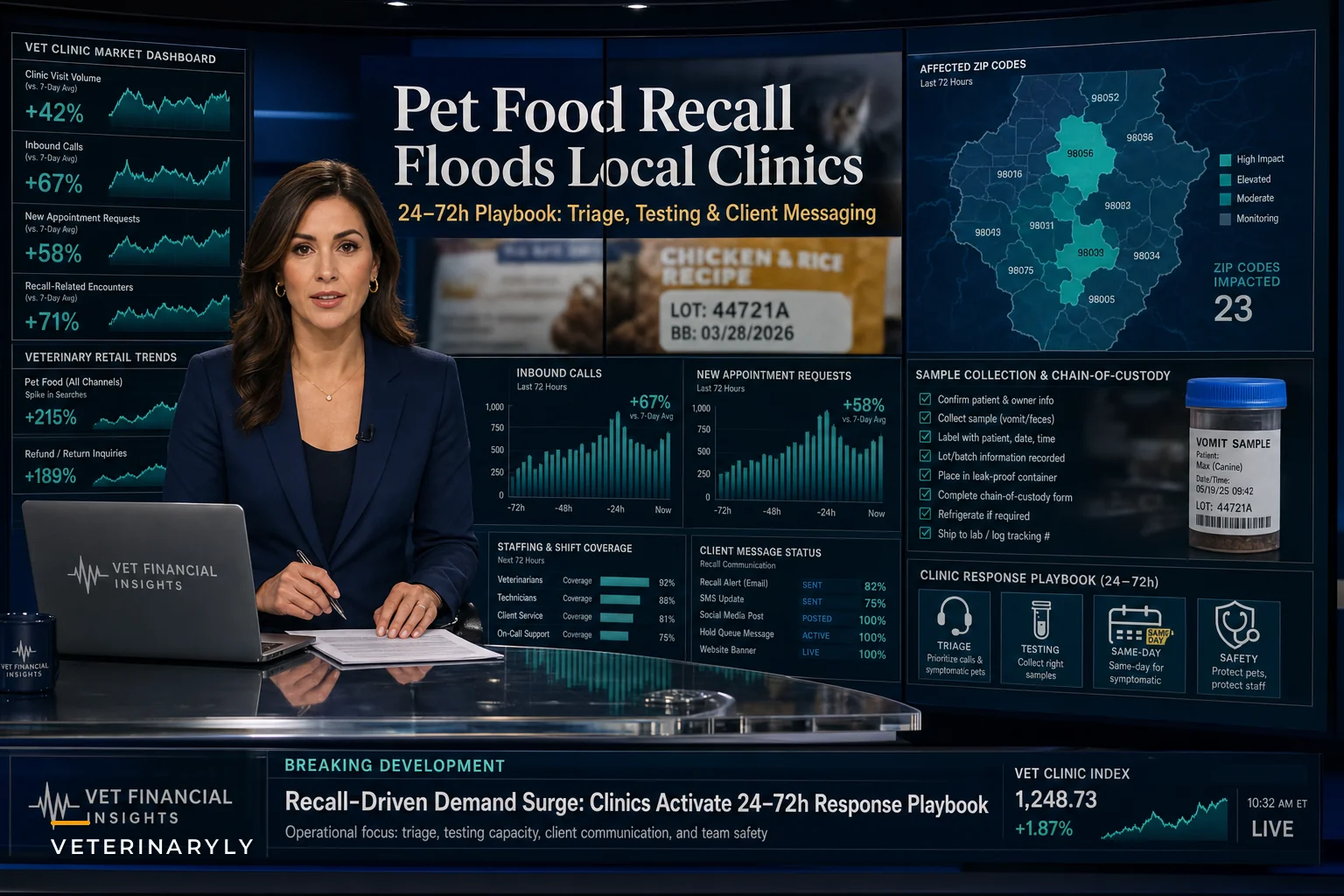

A recall almost never arrives as a single clean event. It shows up as a phone that won't stop ringing, three walk-ins at the front desk holding half-empty freezer bags, and a technician asking whether the vomiting Lab from this morning is "one of the recall dogs." By the time your team realizes it's a surge and not just a busy Tuesday, you're already behind.
The mid-August Oma's Pride situation is a good example of how fast this moves. The company voluntarily pulled a lot of its frozen raw dog food after FDA testing turned up Salmonella, and as USA Today reported, the affected product had been sold across roughly a dozen states with illnesses already reported. The FDA's own recall notice narrowed it to a specific lot — but your clients don't read lot numbers. They read the headline, look at their freezer, and call you.
That gap between what the recall technically covers and what your phones actually experience is where clinics either hold the line or lose two days to chaos. This post is about the operational side of a pet food recall clinic response: how to triage the surge, run testing without losing samples, and keep client communication from consuming your entire front desk.
The First 48 Hours Are a Sorting Problem, Not a Medical One
The instinct when a recall breaks is to treat every incoming pet as a potential case. That's the mistake that jams your schedule. Most dogs exposed to a Salmonella-positive raw food will never show clinical signs, and a good chunk of the calls you get won't even involve the recalled lot. Your real job in the first two days isn't diagnosing — it's sorting.
Think of the inbound flow in three buckets:
-
Symptomatic and exposed — vomiting, diarrhea, lethargy, fever, and a plausible link to the product. These need same-day slots.
-
Exposed but asymptomatic — ate the food, feeling fine. These mostly need guidance, monitoring instructions, and a clear threshold for when to come in. Not an appointment.
-
Anxious but unexposed — different brand, different lot, or just spooked by the news. These need reassurance and a two-minute script.
When clinics skip the pre-sort, all three buckets get funneled into the same "we'll fit you in today" pile. Asymptomatic and unexposed dogs consume the same appointment capacity as genuinely sick ones, and by mid-afternoon you've got a four-hour wait and a waiting room full of dogs that shouldn't be sharing air with immunosuppressed patients.
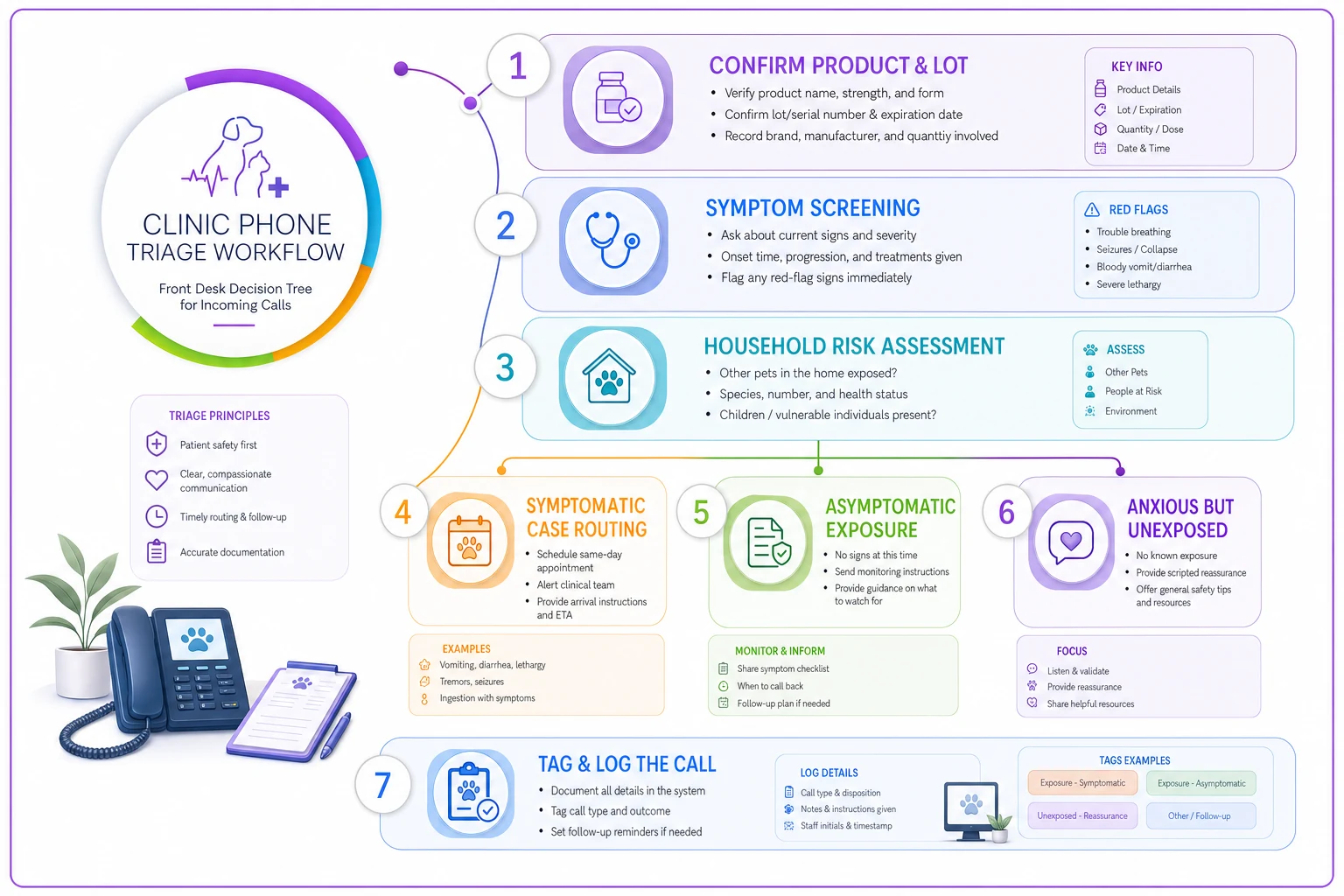
The single most useful thing you can do on day one is give your front desk a decision tree they can run in under a minute. Not clinical judgment — a routing rule. Symptomatic, book. Asymptomatic and exposed, send monitoring instructions and set a callback threshold. Neither, reassure and log the call. That last part matters more than it sounds.
Build the Triage Script Before You Need It
A recall triage script is different from your normal teletriage flow because the volume is lopsided and the anxiety is high. People aren't calling because their dog is sick — they're calling because they're scared their dog might get sick. Your script has to handle fear efficiently without dismissing legitimate cases.
Never miss a pet’s appointment again.
Veterinaryly helps you schedule, confirm, and manage every appointment and patient record effortlessly.
- Centralized appointment & patient management
- Automated client reminders
- Staff scheduling & task tracking
No credit card required
A rough structure that holds up under pressure:
-
Confirm the product. Ask for the brand, product name, and lot number if they can read it off the bag. Half the time the caller isn't feeding the recalled product at all, and this question resolves the call in 90 seconds.
-
Screen for symptoms. Vomiting, diarrhea (especially bloody), fever, appetite loss, lethargy. Any yes moves them toward same-day booking.
-
Ask about the household. Kids, elderly, or immunocompromised people handling the food or the dog? Salmonella is zoonotic, and this changes your urgency and hygiene guidance.
-
Give the monitoring threshold. For asymptomatic dogs
what to watch for and the specific point at which they should come in.
-
Log everything. Even the reassurance calls.
That fifth step is where most clinics drop the ball. In a surge, reassurance calls feel like wasted time, so nobody documents them. Then three days later one of those "fine" dogs comes in symptomatic, and you have no record of the original contact, no product info, and no timeline. You're rebuilding history from a stressed owner's memory.
Clinics that handle recalls well treat the phone log as clinical data, not customer service noise. Every recall-related call — booked or not — gets a tag. That tag becomes your denominator later when you're trying to understand how many exposures you actually saw versus how many turned into cases.
A visual decision tree helps staff run the triage in under a minute.
Clinics that handle recalls well treat the phone log as clinical data, not customer service noise. Every recall-related call — booked or not — gets a tag. That tag becomes your denominator later when you're trying to understand how many exposures you actually saw versus how many turned into cases.
Testing Volume Is Where the Real Bottleneck Lives
Triage is a front-desk problem. Testing is where a recall actually breaks your operations, because it hits the part of your workflow with the least slack: sample collection, labeling, and result routing.
During a normal week your clinic might send out a handful of fecal panels. During a recall surge, that can jump to dozens in a few days, and the samples don't arrive in a neat sequence — they come in clusters. Three symptomatic dogs in the same hour, all needing enteric testing, all with owners standing there asking how long results take.
The failure mode is predictable. Under volume, sample handling gets sloppy: a tube goes out with a handwritten label that smudges, two samples from similar-looking Labs get mixed up, or a result comes back and nobody's sure which patient it belongs to because the requisition was filled out in a hurry. A single mislabeled Salmonella culture during a recall isn't just an annoyance — it's a potential wrong-treatment decision and a very awkward client conversation.
This is exactly the kind of surge that exposes weak sample discipline, which is why having a standardized collection and labeling system already in place matters. If you haven't tightened that workflow yet, our breakdown on preventing lost samples and reducing lab delays covers the labeling and result-routing structure that keeps samples matched to patients when volume spikes.
A recall is the worst possible time to discover your labeling process only worked because you were never busy enough to stress-test it.
A few things that specifically hold up under recall conditions:
-
Pre-print labels at check-in, not at collection. When you're batching samples, the label should already exist before the tube does.
-
Assign one person as sample custodian per shift during the surge. Not "whoever's free" — one named owner of the batch, responsible for logging what went out and what came back.
-
Confirm your lab's turnaround for enteric panels before you promise anything. Owners will ask. Guessing wrong sets an expectation you can't meet and generates a second round of anxious calls.
Pre-print labels at check-in whenever you're batching samples to cut mislabel risk.
A recall is the worst possible time to discover your labeling process only worked because you were never busy enough to stress-test it.
What Sanitation Actually Requires (Beyond the Usual)
Your daily cleaning protocol isn't built for a Salmonella-exposure surge, and the difference is worth spelling out. This is a zoonotic pathogen coming into your building on paws, in stool, and sometimes on the packaging that anxious owners bring in to show you.
Two big shifts during a recall:
Isolation from the front door in. Symptomatic diarrhea cases shouldn't sit in the general waiting room. If you have an exam room you can designate as the recall/enteric room, use it — and clean it between patients with something actually rated for Salmonella, not just your standard surface spray. Reception and kennel staff both need to know which room that is and why.
Handling contaminated packaging. Owners will show up with the bag. That bag is potentially contaminated. Decide in advance whether you're accepting it, where it goes, and how staff handle it. A surprising number of clinics never think about this until someone's holding a leaking freezer bag over the reception counter.
The part that quietly costs clinics: staff exposure. If your technicians are handling enteric samples and contaminated surfaces all week without escalated PPE and hand-hygiene discipline, you're one careless stretch away from having two people out sick during the exact surge when you need everyone. Sanitation during a recall isn't only patient safety — it's staffing continuity.
Communication: The Part That Determines Your Reputation
Medically, most clinics handle recalls reasonably well. Where they get hurt is communication — specifically the gap between the flood of questions and the clinic's ability to answer them consistently.
The problem is consistency, not effort. When five different staff members answer the same recall question five slightly different ways, clients notice, and the ones who got the vaguer answer call back. That's a self-inflicted second wave of volume. As the ABC News coverage of the recall showed, national reporting drives a very specific set of questions — is my brand affected, what are the symptoms, what do I do with the food — and your team should be answering all of them the same way, every time.
A comparison of how clinics typically handle recall communication:
| Approach | What Happens | Result |
|---|---|---|
| Reactive, per-call | Each staff member improvises answers | Inconsistent info, repeat calls, front-desk burnout |
| One-off email blast | Single mass message, no follow-up path | Reduces initial calls, but no handling for individual cases |
| Structured multi-channel | Pre-written scripts + proactive outreach + tagged follow-ups | Fewer repeat calls, consistent messaging, trackable cases |
The structured approach isn't complicated — it just requires making decisions before the surge instead of during it. That means:
-
One approved FAQ your whole team reads from
-
A proactive message to any client you know purchased or was prescribed a related diet
-
A clear answer on billing — is recall-related testing charged normally, discounted, or is the client pursuing reimbursement from the manufacturer? Decide this on day one, because "I'm not sure what this costs" is about the worst thing your front desk can say during a recall
The proactive outreach piece deserves emphasis. If you sell food or keep purchase history, you can get ahead of calls by contacting affected clients before they contact you. A short, factual message — here's the recall, here's whether it affects what you bought, here's what to watch for — does two things: it cuts inbound panic calls, and it positions your clinic as the calm authority instead of a reactive one. Clients remember which vet reached out first.
A Real Scenario
A two-doctor small-animal practice in a suburban area sold a raw frozen line that got caught in a regional recall. In the first three days, recall-related calls jumped from a normal handful to somewhere around 60–70, and fecal/enteric test requests went from maybe 4–5 a week to close to 30.
The first day was rough. Everything got booked as same-day, the schedule blew up, two owners waited over three hours, and one enteric sample went out with an ambiguous label and had to be recollected — which meant calling the owner back to come in again. Not a great look during a recall.
They regrouped that evening. Built a one-page triage script, designated a single exam room as the enteric room, assigned one tech per shift as sample custodian, and wrote a short FAQ everyone answered from. They also sent a plain email to every client who'd bought the line in the prior 90 days.
The difference over the next few days wasn't dramatic on paper but it was real in the building. "Just checking again" calls dropped noticeably because the messaging was consistent. Same-day slots went to actually-symptomatic dogs instead of everyone. No further mislabeled samples. The proactive email surfaced a couple of genuinely symptomatic dogs earlier than they'd have come in otherwise — arguably the best clinical outcome of the whole week. Total additional recall revenue from testing and visits landed somewhere in the low four figures, but the owner's takeaway wasn't the revenue. It was that a written system turned a chaotic surge into a busy-but-controlled week.
When to Scale Up, and When You're Overreacting
Not every recall justifies standing up a full response. A national recall of a product you don't sell, feeding a demographic you rarely see, might warrant nothing more than an updated FAQ and a heads-up to reception. Spinning up isolation rooms and dedicated sample custodians for a product that touched three of your patients is wasted effort.
Scale up the full response when:
-
The recalled product is something you sell or have prescribed
-
Illnesses have been reported and it's getting regional or national coverage
-
You're already seeing symptomatic cases with a plausible link
-
The pathogen is zoonotic and your client base includes vulnerable households
Keep it light when:
-
The product isn't sold or recommended in your area
-
No local cases have appeared
-
Coverage is minimal and the affected lot is narrow
The mistake cuts both ways. Over-responding burns staff on a non-event. Under-responding means you're improvising when the surge hits, which is how samples get lost and messaging goes inconsistent. The judgment call is worth making deliberately on day one, not by default.
The Underlying Problem a Recall Exposes
Most clinics have no standing surge protocol. Day-to-day operations run fine on informal habits, and those habits quietly assume steady, predictable volume. A recall removes that assumption in about six hours.
The clinics that handle it well aren't smarter or better-staffed. They just have a few things decided in advance — a routing rule for the front desk, a sample custodian role, an approved FAQ, a designated isolation room, a billing answer. None of that is exotic. It's the operational equivalent of a fire drill: boring to set up, invaluable the day it matters.
A recall is temporary. The gaps it exposes are not. If this one didn't hit your patient base hard, the useful move is to write down the three or four decisions you'd have scrambled to make — and keep them somewhere your team can find them. The next surge, whether it's a recall, an outbreak, or just a bad week, will run on whatever system you built before it arrived.
Ready to elevate your clinic’s efficiency?
Join 500+ veterinary clinics using Veterinaryly to save time, reduce administrative overhead, and improve patient care.