

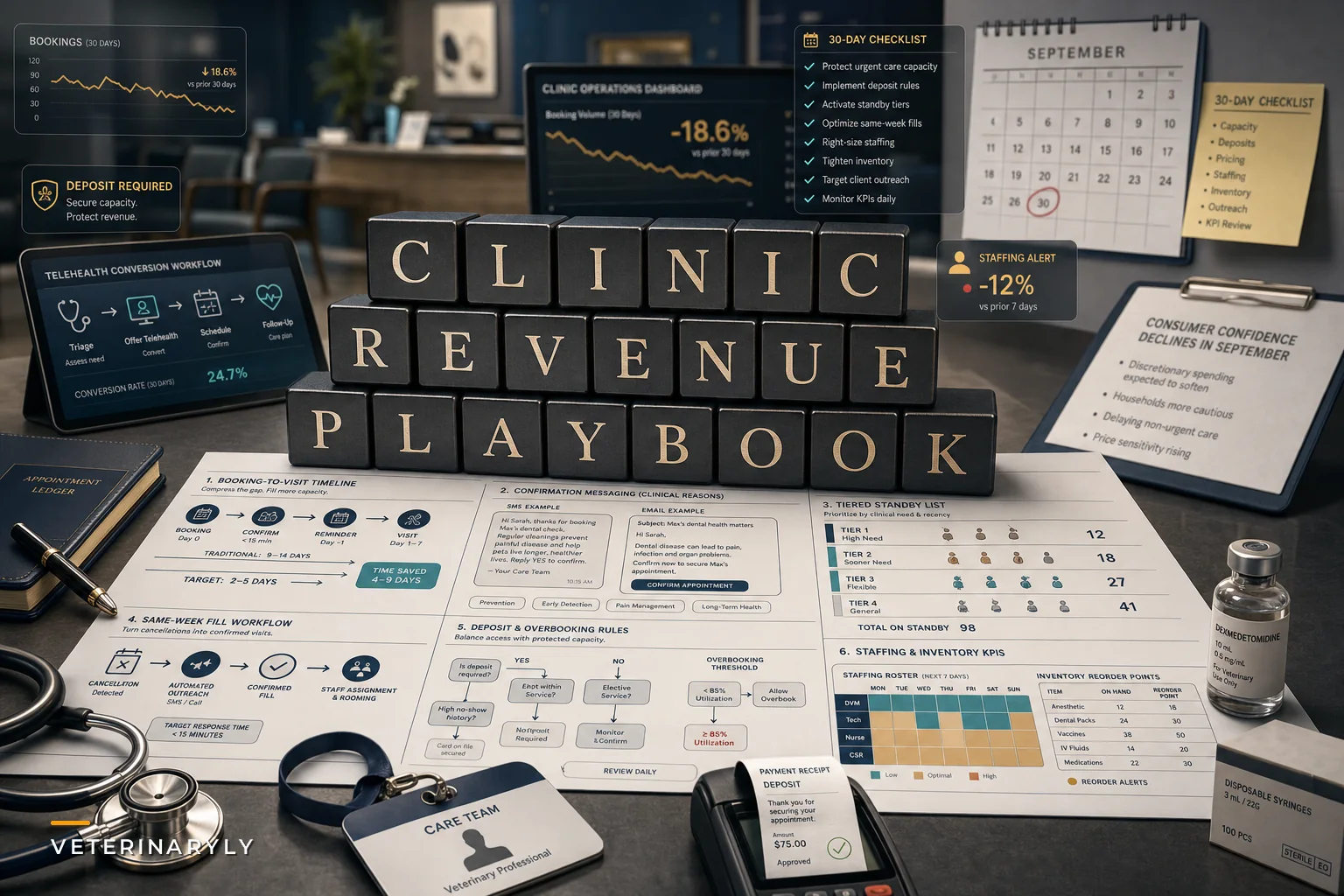

The Conference Board's Consumer Confidence Index dropped 6.7 points to 81.9 in September 2026 — the lowest reading since 2014. Reuters coverage tied the slide mostly to softening labor market sentiment, which is the part that matters for clinics. When people get nervous about their jobs, they don't cancel the mortgage. They cancel the dental cleaning, the gym membership, and yeah — the senior dog's non-urgent dental under anesthesia.
For veterinary clinics, consumer confidence doesn't show up as a headline. It shows up in your schedule gaps, your aging receivables, and the awkward conversation at checkout where a client asks if the bloodwork "really needs to happen today." The clinics that weather this well aren't the ones with the best marketing. They're the ones who tightened a few operational screws early, before the softness hit the P&L.
The part most clinics misread first
The mistake I see when demand softens: owners assume the problem is volume. It usually isn't, at least not at first. Front door traffic stays roughly the same for a while. What changes is the composition of each visit.
Clients still bring the limping dog in. But now they decline the dental estimate, push the recommended dental out "a few months," ask to split the vaccine package, and skip the preventive panel. The appointment happens — the revenue per appointment quietly shrinks. In real operations this is the dangerous phase, because your appointment count looks healthy on the dashboard while your average transaction value is sliding 8–15%.
If you're only watching "appointments booked," you'll miss the softening entirely until a slow month lands and suddenly you're short on payroll coverage. The signal to watch isn't the schedule. It's revenue per visit, decline rates on estimates, and the gap between recommended and accepted care.
Where consumer confidence actually bites your operation
The pressure shows up in four predictable places. Each one needs a different operational response, and clinics that lump them together tend to overreact in one area while ignoring another.
Never miss a pet’s appointment again.
Veterinaryly helps you schedule, confirm, and manage every appointment and patient record effortlessly.
- Centralized appointment & patient management
- Automated client reminders
- Staff scheduling & task tracking
No credit card required
| Pressure point | What it looks like in the clinic | Wrong reaction | Better reaction |
|---|---|---|---|
| Elective softening | Dentals, mass removals, wellness add-ons deferred | Blanket discounting | Payment staging + re-care tracking |
| Payment friction | More "can I pay part now?" at checkout | Letting balances walk out the door | Clear deposit + plan policy at booking |
| No-shows / cancels | Late cancels on non-urgent visits | Punitive fees that burn goodwill | Confirmations + strategic overbooking |
| Price sensitivity | Clients line-shopping estimates | Dropping prices across the board | Transparent bundling + alternatives |
The through-line: softness is a per-transaction problem, not a shut-the-doors problem. Your job isn't to slash prices. It's to protect utilization and capture the revenue that's still available to capture.
Protect your schedule before it protects itself
When households tighten, the non-urgent visit becomes the first thing people cancel — usually within 24 hours of the appointment, when their week falls apart or the budget feels tighter than it did when they booked three weeks ago.
-
Shorten the booking-to-visit window for electives. A dental booked six weeks out has six weeks to get canceled. When you can offer a slot inside 10–14 days, cancellation rates on those visits drop noticeably. Confidence-driven cancellations are mostly about time for second thoughts.
-
Confirm with a reason, not just a reminder. "Reminder
Bella's appt Tuesday 2pm" gets ignored. "Bella's dental is Tuesday — her pre-anesthetic bloodwork is already scheduled so we can go ahead safely" re-anchors the client to why they booked.
-
Build a tiered standby list. When a cancel hits, you want a ranked list of clients who've said "call me if something opens sooner." Filling a canceled dental slot same-week is worth far more than any cancellation fee.
-
Separate urgent from elective capacity. If your urgent caseload is stable — and it usually is during downturns, sick pets still get sick — protect those blocks and let elective capacity flex.
Here's a simple workflow to manage elective bookings, confirmations, standby lists, and same-week fills.
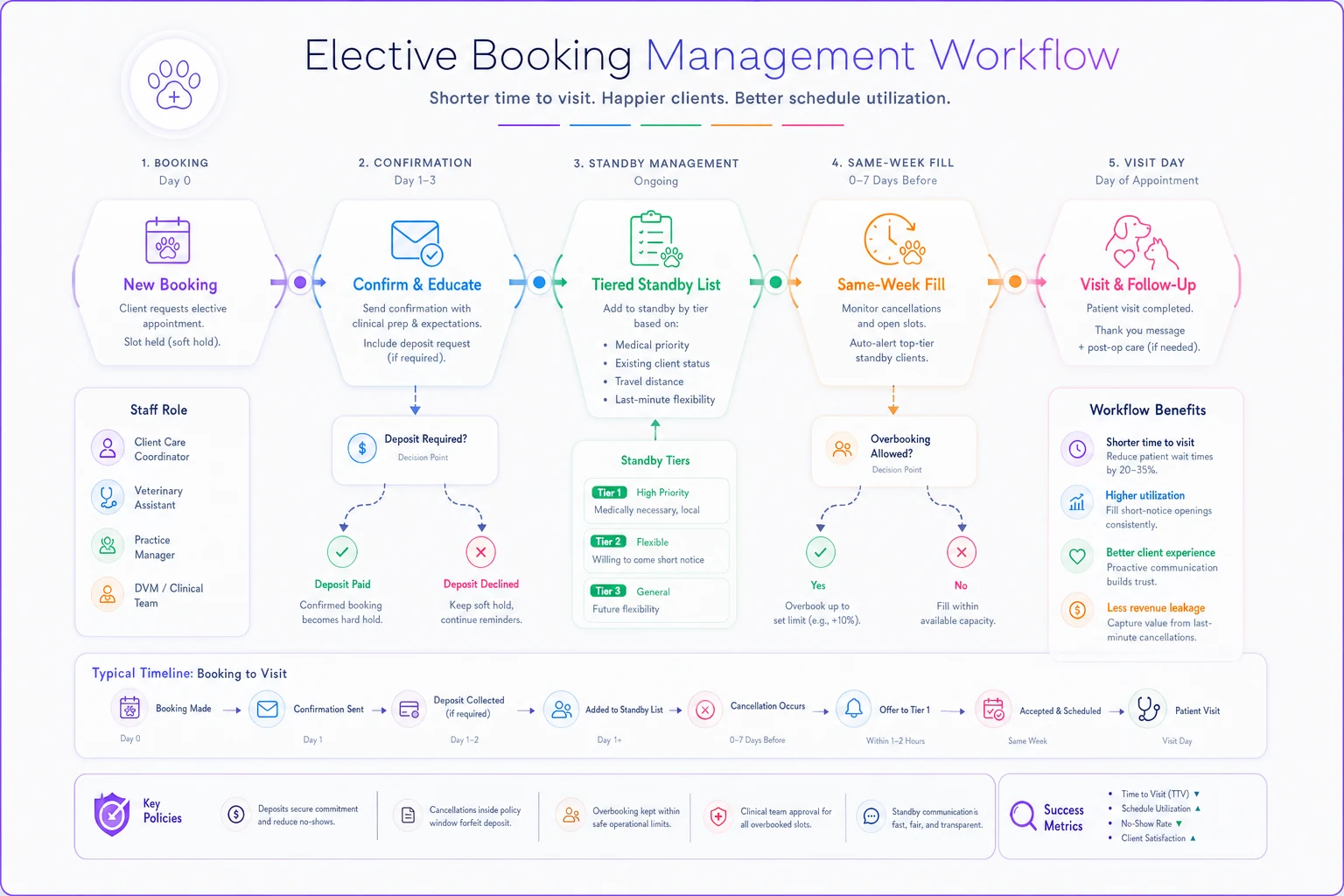
Prioritize filling canceled elective slots from your tiered standby list before offering them publicly.
The underlying problem a downturn exposes is that most clinic schedules are built on hope — the assumption that booked means committed. When confidence is high, that mostly holds. When it drops, the fragility shows up fast.
Pricing and payment policy: tighten without alienating
This is where clinics make their biggest unforced errors. Two opposite ones, actually.
Error one: panic-discounting. Someone sees a soft week and emails a 20%-off wellness promo. Now you've trained price-sensitive clients to wait for deals, compressed your margin, and signaled to your best clients that they've been overpaying. Discounts are almost impossible to walk back.
Error two: rigid payment rules that push care away. "Full payment at time of service, no exceptions" feels disciplined, but during a confidence dip it quietly converts "I'll do the dental" into "let me think about it." The client doesn't come back.
-
Set a deposit policy for procedures over a dollar threshold (say, anything over ~$400). Collect it at booking, not at check-in. This filters soft commitments and protects your anesthesia slots.
-
Offer two or three approved payment paths — a third-party financing option, an in-house split for existing good-standing clients, and the standard pay-in-full. Decide these in advance so nobody improvises at the front desk.
-
Build estimates in tiers
the ideal plan, the acceptable plan, the "we need to address this now" plan. Price sensitivity drops when clients feel they have choices rather than a single take-it-or-leave-it number.
-
Train the team to present the clinical why before the number. "Her teeth are causing pain and the infection can reach the heart" lands differently than leading with $900.
Clients don't actually object to price. They object to price that isn't connected to a reason they understand and a path they can afford.
A quick operational checklist for the first 30 days
If confidence is sliding in your area, run through this before you touch anything dramatic:
-
- [ ] Pull revenue-per-visit and estimate-decline rates for the last 90 days — establish your real baseline
-
- [ ] Identify your top 5 elective procedures and check decline/deferral trends on each
-
- [ ] Set or confirm a deposit threshold for high-cost procedures
-
- [ ] Document approved payment-plan options so the front desk stops improvising
-
- [ ] Build or refresh a ranked standby/cancellation list
-
- [ ] Review confirmation messaging — add the reason to every elective reminder
-
- [ ] Flag clients with overdue preventive care for proactive outreach (more on this below)
-
- [ ] Check inventory ordering against softened demand so you're not overstocking electives
None of these are "cut prices" or "lay off staff." Those are last resorts, and clinics that jump to them first usually cut into recoverable revenue and future capacity.
The retention angle most clinics ignore during downturns
A confidence dip is one of the better moments to invest in existing client relationships rather than chase new ones. New-client acquisition gets expensive and slow when wallets tighten. A lapsed or wobbling existing client is far cheaper to bring back — they already trust you.
Clinics that hold revenue steady during soft periods tend to run disciplined re-care outreach: who's overdue for a senior panel, whose heartworm prevention lapsed, whose dental got deferred six months ago and is now due for a nudge. Unglamorous, repetitive follow-up work — exactly the kind of thing that falls apart when the team is busy and gets forgotten when the team is slow.
This is where having your scheduling, reminders, and recall tracking in one connected system starts to matter. When your platform can surface which clients are overdue, which deferred procedures are coming due, and which cancellations need a standby call, your team spends its energy on the conversation rather than on figuring out who to call. AI-assisted recall and reminder workflows won't replace clinical judgment — but they catch the slow drip of lapsed clients that quietly drains revenue when everyone's distracted. The point isn't automation for its own sake; it's making sure the follow-up actually happens when it's easiest to skip.
A realistic scenario
Take a two-doctor general practice running around 330–360 appointments a month. Heading into a soft stretch, appointment count held steady but average transaction value slipped from roughly $185 to about $160 as clients declined add-ons and deferred dentals. A quiet revenue hit of somewhere near $8k–$9k a month — invisible on the booking dashboard.
They didn't discount. Instead they introduced deposits on procedures over $400, rebuilt estimates into three tiers, added the clinical "why" to elective confirmations, and started a weekly recall pull for overdue senior panels and deferred dentals. Within about two months, dental acceptance recovered a good chunk of the gap, deferred procedures started rebooking at a higher rate, and late cancellations on electives dropped because deposits filtered the soft bookings up front.
No heroics. Just tightening the operational joints that slack off when nobody's watching.
When these moves make sense — and when they don't
When this makes sense: You're seeing declining revenue-per-visit, rising estimate declines, or an uptick in payment-plan requests. Early tightening beats late panic every time.
When to hold off: If your data shows stable per-visit revenue and acceptance rates, don't go inventing deposit policies that annoy loyal clients over a problem you don't actually have. Watch the metrics first.
Who should be careful: High-end specialty or referral practices where deposit and payment-staging policies can read as distrust to a clientele that isn't pulling back. Match the response to your real client behavior, not the national headline.
The bigger picture
Consumer confidence is one of several macro signals that ripple into clinic cash flow — the same way interest rate shifts do. If you want the broader framework for protecting capacity and cash during economic pressure, the breakdown on how a Fed rate hike could hit your clinic covers the cash-flow side in more depth, and most of those principles stack cleanly on top of what's here.
A single bad month rarely sinks a clinic. What sinks clinics is reacting late and reacting wrong — slashing prices, cutting hours, or ignoring the slow bleed of deferred care until it's a crater. You can track the confidence trend yourself through the Conference Board's index, but honestly, your own revenue-per-visit numbers will tell you more about your specific market than any national figure.
Soft periods reward operational discipline. Tighten the schedule, give clients clear and humane payment paths, keep your preventive-care engine running, and protect the per-visit revenue that's still very much on the table. The demand doesn't vanish during a confidence dip — it just gets more selective. Your job is to stay the easy, trustworthy choice when the money feels tight.
Ready to elevate your clinic’s efficiency?
Join 500+ veterinary clinics using Veterinaryly to save time, reduce administrative overhead, and improve patient care.