



Most clinics don't have a staffing problem. They have a staffing system problem that only shows up as a staffing problem when someone quits.
The vet tech who left after eight months? That wasn't a bad hire. That was a role that was never clearly defined, a pay band nobody governed, a career ladder that didn't exist, and an onboarding path that dumped her into the deep end and hoped for the best. The resignation is just the last domino. Everything upstream broke months earlier.
What makes veterinary staffing so brutal is that every part of the people lifecycle is connected, and clinics tend to manage each part in isolation. Hiring is one person's job. Pay decisions happen ad hoc when someone threatens to leave. Onboarding is whatever the last person remembered to show the new hire. Nobody tracks why people actually leave. So the clinic keeps re-solving the same problem at the most expensive possible moment — after the person is already gone.
This post walks through the full lifecycle as one connected system: role profiles, competency-based hiring, pay-band governance, career ladders, onboarding-to-certification paths, and exit analytics tied back to your operational numbers. The goal isn't a list of HR tips. It's to show you where the whole thing quietly breaks and how the pieces are supposed to feed each other.
Start with role profiles, because everything downstream inherits their flaws
A role profile isn't a job posting. A job posting is what you write when you're already desperate. A role profile is the underlying definition of what the person actually does, what "good" looks like, and how they fit into the workflow around them.
One pattern that comes up constantly: a clinic posts for a "veterinary technician." Three people apply. All three have the title on their resume. But one has run anesthesia solo for four years, one has mostly done restraint and kennel work, and one is basically a strong assistant who got a title bump. The clinic hires based on vibe and availability, and then acts surprised when the new tech can't do the thing they urgently needed.
The role never got defined at the competency level, so hiring was a coin flip.
A usable role profile breaks the job into layers:
-
Core responsibilities — what this person owns day to day
-
Required competencies — the specific skills, rated by level (e.g., "IV catheter placement: independent" vs. "with supervision")
-
Workflow position — who they hand off to, who hands off to them, what breaks if they're absent
-
Success signals at 30 / 60 / 90 days — observable, not vague
-
Growth path — what the next role up looks like
That last line matters more than people think. A role profile with no "next" attached to it is a role profile for someone who will leave. We'll come back to that when we hit career ladders — but notice how the exit problem is already baked in at the definition stage.
Competency-based hiring rubrics: stop hiring resumes, start hiring demonstrated skill
Once roles are defined by competency, hiring gets a lot less mystical. The rubric is just the role profile turned into a scoring tool.
Never miss a pet’s appointment again.
Veterinaryly helps you schedule, confirm, and manage every appointment and patient record effortlessly.
- Centralized appointment & patient management
- Automated client reminders
- Staff scheduling & task tracking
No credit card required
The mistake most clinics make is interviewing for personality and hoping skill sorts itself out. Personality matters — a clinic floor with the wrong energy is miserable — but a warm person who can't place a catheter under pressure is still going to bottleneck your surgery days. You need to score both, separately, so you don't let one mask the other.
A competency rubric for a tech role might look like this:
| Competency | Weight | How it's assessed | Pass bar |
|---|---|---|---|
| Clinical skills (IV, blood draw, anesthesia monitoring) | High | Practical / working interview | Independent on 3 of 5 core tasks |
| Client communication | Medium | Scenario question + roleplay | Clear, calm, no jargon dumping |
| Records / documentation | Medium | Sample note review | Complete, legible, accurate |
| Team coordination | Medium | Behavioral questions | Concrete examples, not clichés |
| Composure under pressure | High | Situational + working interview | Stays functional in a busy sim |
The working interview is the single highest-signal thing you can do, and most clinics either skip it or run it so casually it tells them nothing. Watching someone actually handle a fractious cat, or watching how they document what they just did, gives you more information than an hour of "tell me about a time when."
One thing worth naming: interviewers unconsciously anchor on the first candidate they meet and grade everyone else relative to that person. A scoring rubric filled in during the interview — not from memory afterward — kills most of that bias. When each interviewer submits numbers before comparing notes, you stop hiring "the best of who showed up this week" and start hiring against a fixed bar.
Pay-band governance: the quiet cause of half your turnover
This is the part almost no small clinic does well, and it's the one that leaks the most money.
Pay usually works like this at a growing clinic: the owner makes offers based on gut and what the last hire got. Raises happen when someone asks, or when someone gives notice and gets a panic counteroffer. Nobody has a written structure. Over three or four years, this produces pay chaos — a tech hired during a tight market makes more than a more experienced tech hired two years earlier, and everyone eventually finds out. Because they always find out.
Pay compression and pay inversion are morale poison. The moment your best senior tech learns the new hire she's training makes 90% of her wage, you've started the clock on her resignation. And the counteroffer you'll eventually make to keep her costs more than just doing this right from the start.
Pay-band governance means:
-
Define bands per role and level. Each role has a floor, midpoint, and ceiling. Not one number — a range with structure.
-
Tie position in the band to competency, not tenure. Someone who's been there five years but plateaued sits mid-band. Someone advancing fast climbs faster.
-
Set rules for movement. How does someone go from the bottom of a band to the midpoint? Write it down. If it's invisible, people assume it's arbitrary — and they're usually right.
-
Review the whole map at least annually. Look for compression and inversion on purpose, before it detonates.
-
Kill the panic counteroffer as a strategy. If you only pay people fairly when they threaten to quit, you're training your staff to threaten to quit.
The connective insight here: pay bands are only defensible if roles and competencies are already defined. You can't justify why someone sits where they sit in a band without a competency framework underneath it. This is why the lifecycle has to be built as a system — each piece props up the next.
Career ladders: the reason people stay when they could leave for $2 more an hour
Veterinary staff, especially good techs, rarely leave purely over money. They leave because they can't see a future where they are. "I've been doing the exact same thing for three years and there's nowhere to go" is one of the most common real reasons behind a resignation that gets officially recorded as "left for higher pay."
A career ladder makes the future visible. For a tech, it might run something like: Assistant → Technician → Senior/Lead Technician → Specialty or Charge Tech → Practice Manager or Training Lead. Each rung needs:
-
The competencies required to reach it
-
The pay band attached to it
-
The responsibilities that come with it
-
A rough sense of what "ready" looks like
The mistake here is treating the ladder as a poster on the break room wall. A ladder only works if people are actually moved up it and the criteria are real. If everyone can see that the last three promotions went to whoever complained loudest, the ladder is worse than nothing — it's proof the system is fake.
This ties tightly back to role profiles and pay bands. The ladder is the sequence of role profiles, and each rung's pay is a band. When these three systems are built together, an employee can look at their own situation and answer: Where am I? What's next? What do I need to do to get there? What will it pay? A clinic where people can't answer those four questions has a retention problem it just hasn't discovered yet.
Onboarding-to-certification paths: from first day to genuinely independent
Getting the right person in the door is half the job. The other half is getting them productive without burning them out or breaking your clinical standards in the process.
The failure mode is well known: throw the new hire into the rotation, let them shadow whoever's free, sign nothing off, and assume that after a few weeks they "get it." Then a mistake happens, and everyone realizes nobody ever actually verified the new tech could do the thing they were doing unsupervised.
A structured onboarding-to-certification path replaces "they've been here a month, they're probably fine" with observable, signed-off competencies. It maps directly onto the role profile — for each required competency, there's a stage of observe → do with supervision → do independently → signed off. This is exactly the kind of role-based readiness verification covered in our new-hire competency and sign-off program, and it's worth building deliberately because it shortens the single most expensive gap in staffing: time-to-independence.
Make sure the sign-off form records who observed, the date, and where the signed document is stored so movement in pay bands can be audited.
Think about what that gap actually costs. A new tech who takes five months to reach full independence instead of three is two extra months of a senior person partially covering for them, two extra months of slower room turnover, and two extra months of the new hire feeling like they're drowning — which is, not coincidentally, exactly when a lot of early-tenure people quit. Weak onboarding doesn't just slow productivity. It actively feeds turnover, which throws you back to the start of the hiring cycle you were trying to escape.
Tie certification milestones to the pay bands and the career ladder and the whole thing snaps into place. Hitting a signed-off competency set isn't just a checkbox — it's the mechanism for band movement and the first rung of the ladder. Onboarding stops being a chore and becomes the visible on-ramp to everything else.
Exit-interview analytics: closing the loop the clinic never closes
Most clinics either don't do exit interviews or do them so awkwardly they get nothing useful. The departing person, wanting a reference and wanting to be done, says "it was a great experience, just found something closer to home." That tells you nothing. Meanwhile the real reason — she was passed over for a lead role that went to someone junior, or her pay had been quietly compressed, or her schedule was chaos for a year — never gets recorded.
To make exit data useful, it needs to be:
-
Structured. Ask the same core questions every time so you can spot patterns across departures, not just react to one dramatic exit.
-
Categorized. Tag each departure by driver
pay, growth, schedule, management, workload, relocation, clinical scope, culture.
-
Tied to operational data. This is the piece that turns exit interviews from HR ritual into a management tool.
That last point deserves weight. Turnover isn't just a people cost — it's an operational one. When a tech leaves, room throughput drops, senior staff get pulled off their own work to cover and train, overtime spikes, and scheduling gets reactive. If you're already fighting the labor-cost creep that comes from reactive rostering and capacity-based scheduling problems, turnover is pouring fuel on it. Every departure quietly raises your labor cost per appointment for months.
When you tag exit reasons and line them up against your operational KPIs, patterns you couldn't see before become obvious. If half your voluntary departures over a year cluster around "no growth path" and "scheduling," you now know your career ladder and rostering are your two biggest retention leaks — not pay, even though pay is what everyone says on the way out. That's the difference between guessing and actually managing.
A real scenario
A three-doctor small-animal clinic was losing techs at a rate that had the owner constantly in hiring mode. Over roughly eighteen months they'd cycled through five technicians across four positions. Every departure "officially" was about pay, so the owner kept nudging starting wages up — which fixed nothing and quietly created compression with the two techs who'd stayed.
When they finally sat down and structured the whole thing — wrote real role profiles, built three pay bands with defined movement rules, sketched a four-rung ladder, and started running short structured exit conversations — the picture changed fast. Two of the last three exits weren't really about pay at all. One left because she'd asked about becoming a lead tech twice and gotten a shrug. One left because her schedule had been unpredictable for the better part of a year.
Nothing magic happened after that. But over the following year, turnover dropped to a single departure. Time-to-independence for the one new hire they made came down noticeably because onboarding finally had signed-off stages instead of vibes. The overtime they'd been burning to cover perpetual short-staffing eased up — the owner figured somewhere in the range of a few thousand dollars a month once they weren't constantly training a replacement. The interesting part: they didn't raise wages much further. They just made the rest of the system honest.
When building this out actually makes sense — and when it doesn't
This is real work, and it's not for every clinic at every stage.
It makes sense when:
-
You have more than a handful of employees and turnover is a recurring cost, not a rare event
-
Pay decisions have started feeling arbitrary or you've had a compression blowup
-
You're growing and can't keep the whole staffing picture in one person's head anymore
-
You've made panic counteroffers more than once
It's probably overkill when:
-
You're a solo doctor with two long-tenured staff who aren't going anywhere. Formal pay bands for three people is bureaucracy for its own sake.
-
You're in genuine survival mode financially — stabilize cash flow first, then build the people system.
Who should be careful: clinics that will build the framework and then ignore it. A career ladder nobody uses, or pay bands the owner overrides on gut every time, does more damage than having none — because now the staff has proof the system is theater. Half-implementing this is worse than not starting.
Where software fits — without overcomplicating it
None of this requires software to be true. You can run the whole lifecycle on documents and discipline. But it falls apart at scale for a predictable reason: the pieces live in separate places. Role profiles in one folder, pay decisions in the owner's head, onboarding checklists on paper, exit notes nowhere at all. The connections between them — the thing that makes it a system — exist only if someone manually keeps them connected.
That's the point where an operational platform that keeps these threads linked starts earning its place. When role competencies, sign-off progress, band position, and departure reasons all live in one connected workflow instead of five disconnected ones, the loop actually closes. You can see that "no growth path" is your top exit driver without building a spreadsheet by hand. Automated onboarding checklists chase the sign-offs so a new hire doesn't sit half-certified for two months because everyone was busy. The value isn't the automation itself — it's that the parts of the lifecycle stop drifting away from each other the moment the clinic gets busy, which is exactly when they always used to.
Use tooling to remove the manual glue work. Don't use it to skip the thinking. The role profiles, the competency bars, the pay logic, the ladder — those still have to reflect how your clinic actually works.
Pulling it together
The reason a good veterinary recruitment and retention system feels hard is that clinics experience it as a series of separate fires — a resignation here, a pay dispute there, a new hire who never quite got up to speed — when it's really one connected chain. Role profiles set the standard. Competency rubrics hire to that standard. Pay bands make it fair and defensible. Career ladders give people a reason to stay. Onboarding paths get them independent fast. Exit analytics tell you where the chain is breaking so you can fix the cause instead of the symptom.
Here's a simple workflow diagram to visualize how the pieces connect.
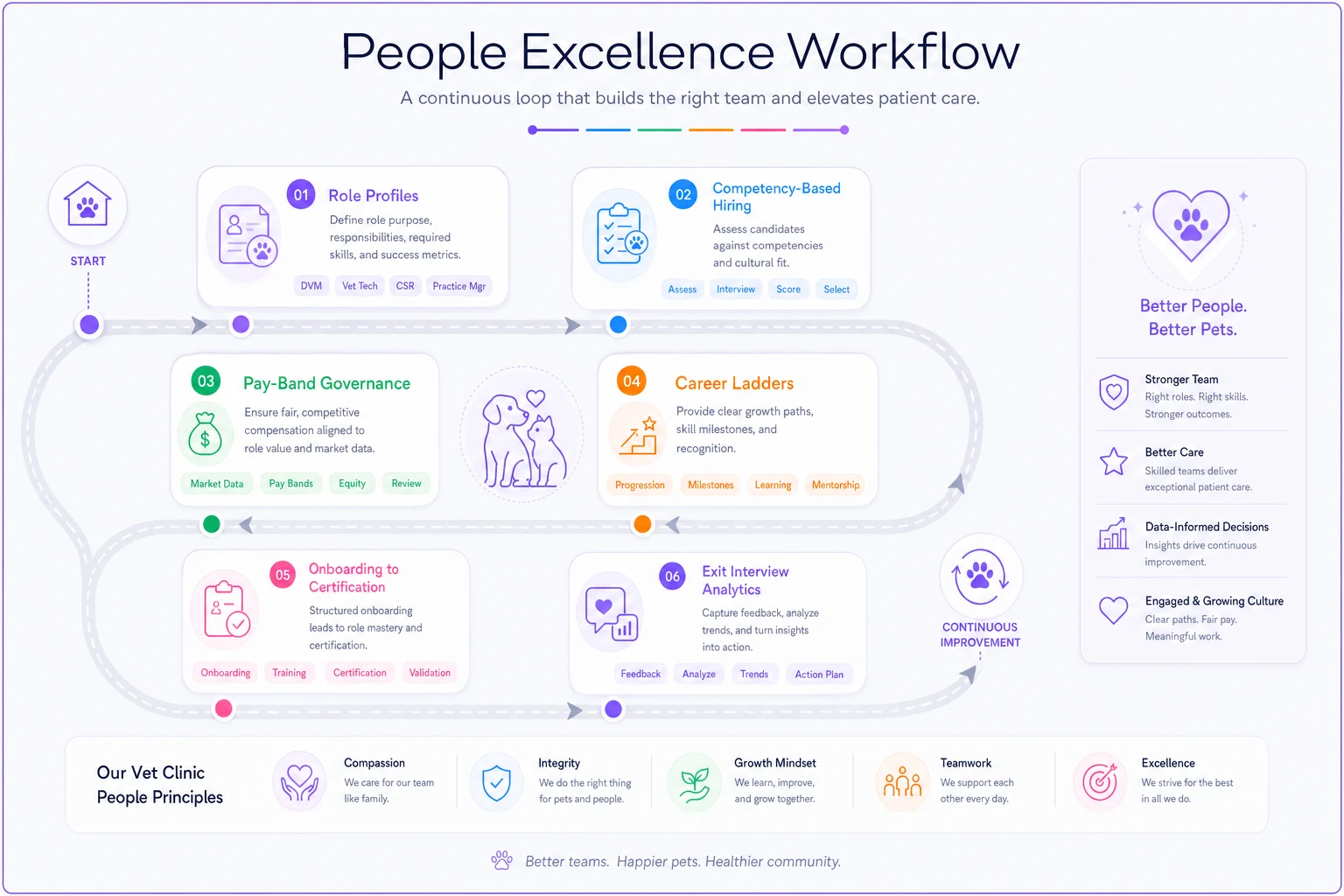
This diagram emphasizes the feedback loop and where intervention points sit so you can see which systems to fix first.
Fix any one piece in isolation and you'll get temporary relief. Build them so they feed each other, and staffing stops being the emergency that eats your week and becomes something the clinic just quietly does well.
Ready to elevate your clinic’s efficiency?
Join 500+ veterinary clinics using Veterinaryly to save time, reduce administrative overhead, and improve patient care.