



Most clinics don't lose money on inventory because they buy too little. They lose it because something sits on a shelf, quietly ages past its expiry date, and gets tossed during a cleanout nobody scheduled. Cefpodoxime, insulin, a half-used bottle of a vaccine nobody reached for — it adds up faster than people expect, and it rarely shows up in a way that gets anyone's attention until the trash bag is full.
The fix isn't "order less." It's getting the math right so you hold the smallest amount of stock that still keeps you from running dry, and so the oldest stock always leaves first. That's what a real veterinary inventory par level formula does — it ties your shelf quantities to actual usage and lead time instead of gut feel.
This post walks through the formulas, the seasonality adjustments most clinics skip, the rotation rules that stop expiry losses, and a weekly audit checklist you can run in under 30 minutes.
Start with the number most clinics never calculate: daily usage
Everything downstream depends on knowing how fast each item actually moves. Not "we go through a lot of those." The real number.
Pull 90 days of dispensing or usage data for an item and divide by the number of days. That gives you average daily usage (ADU). Ninety days smooths out the random weeks and gives you something stable to build on.
A typical example looks like this. Say you dispensed 540 units of a common NSAID over the last 90 days:
-
ADU = 540 ÷ 90 = 6 units/day
That single number drives your reorder point and your par level. Skip it and you're guessing — which is exactly why so many back rooms hold a six-month supply of one thing and run out of another mid-afternoon.
One pattern worth flagging: clinics almost always overestimate usage on the items they feel busy with and underestimate the slow, steady movers. The data corrects both.
The reorder point formula
Your reorder point (ROP) is the shelf quantity that triggers a new order. The logic is simple: it has to cover how much you'll use while you wait for the order to arrive, plus a cushion for the days things go sideways.
Never miss a pet’s appointment again.
Veterinaryly helps you schedule, confirm, and manage every appointment and patient record effortlessly.
- Centralized appointment & patient management
- Automated client reminders
- Staff scheduling & task tracking
No credit card required
ROP = (ADU × Lead Time in days) + Safety Stock
Lead time is the real number of days from placing an order to having it stocked and usable — not the vendor's promise. If your distributor says two days but it realistically takes four by the time it's received, counted, and shelved, use four.
Safety stock is your buffer against demand spikes and late deliveries. A practical starting point for most clinic items:
Safety Stock = ADU × (Max Lead Time − Average Lead Time)
Worked example for that NSAID:
-
ADU = 6/day
-
Average lead time = 4 days
-
Max lead time (worst case you've actually seen) = 7 days
-
Safety Stock = 6 × (7 − 4) = 18 units
-
ROP = (6 × 4) + 18 = 42 units
So when stock hits 42, you reorder. Not before, not after.
The mistake here is setting safety stock as a flat percentage across everything. A 20% buffer on fast movers might be fine; on a slow, expensive, short-dated item it just guarantees expiry waste. Safety stock should scale with how unpredictable the item is and how bad a stockout would be — not with the price tag alone.
Par levels: how much you actually keep on hand
The par level is your target maximum — the quantity you top up to when you order. Reorder point tells you when; par level tells you how much.
Par Level = (ADU × (Lead Time + Review Period)) + Safety Stock
Review period is how often you check and reorder the item. If you review weekly, that's 7 days.
Continuing the example, with a weekly review:
-
Par = (6 × (4 + 7)) + 18 = (6 × 11) + 18 = 84 units
So when you hit the ROP of 42, you order enough to bring you back up toward 84. Order quantity = Par − current count (roughly), adjusted for pack sizes.
This is where clinics consistently get it wrong with short-dated inventory. For anything with a limited shelf life — vaccines, reconstituted meds, certain biologics — your par level should never exceed what you'll realistically use before expiry. Run this check:
Max safe par = ADU × (days until expiry of incoming stock − safety margin)
If your formula spits out a par of 84 units but the product expires in 60 days and you only use 6/day, your true usage window is around 360 units — fine here. But flip it: a slow mover at 0.5/day with a 90-day shelf life caps at roughly 40 units regardless of what the par formula wants. The formula and the expiry ceiling, whichever is lower, wins.
Seasonality: the adjustment that saves (and sinks) clinics
Flat par levels break the moment demand isn't flat. Flea and tick preventives, heartworm testing supplies, certain vaccines, allergy meds — these swing hard by season, and a par level set in January will either leave you short in May or drowning in October.
The clean way to handle it is a seasonal index. Compare each month's usage to your annual monthly average.
Seasonal Index = (Average usage that month) ÷ (Average usage across all months)
Example for a flea/tick product across a year:
| Month | Avg monthly usage | Seasonal Index |
|---|---|---|
| January | 40 | 0.50 |
| April | 95 | 1.19 |
| June | 140 | 1.75 |
| September | 110 | 1.38 |
| December | 35 | 0.44 |
| Annual avg | 80 | 1.00 |
Then adjust ADU before running your par formula:
Seasonally adjusted ADU = Base ADU × Seasonal Index for the upcoming period
Heading into June, your base ADU of ~2.7/day becomes 2.7 × 1.75 ≈ 4.7/day, and every downstream number — ROP, par, safety stock — recalculates off that. Heading into December, you deliberately drag it down so you're not sitting on spring-weight stock through the slow months.
The common failure isn't ignoring seasonality entirely — it's adjusting up for peak season and forgetting to adjust back down afterward. That's how clinics end up with a pile of expired preventive every winter. Set a calendar reminder to re-index at least quarterly for seasonal SKUs.
Rotation rules that stop expiry losses
You can nail every formula above and still throw away product if the oldest stock doesn't leave first. Rotation is where math meets the back-room reality of how staff grab things when they're rushed.
The non-negotiable rules:
-
FEFO over FIFO. First-Expired-First-Out, not just First-In-First-Out. A newer delivery can have an earlier expiry than what's already on the shelf. Sort by expiry date, not arrival date.
-
Physical placement enforces behavior. Oldest/soonest-expiring stock goes to the front or the left; new stock goes behind. If staff have to reach past old stock to get new, rotation fails. Make the easy grab the correct grab.
-
Mark expiry dates visibly. Write the expiry month in marker on the box in a spot that's readable without turning it. Faded manufacturer print on the back panel does not count.
-
Flag the "use-by" tier. Anything within 60 days of expiry gets a colored dot or a dedicated "use first" shelf. Staff dispense from there preferentially.
-
No partial-box burial. Opened or partial boxes get finished before a new one is opened. Sounds obvious; it's the single most common source of "we had two mostly-full bottles expire."
A workflow that holds up in practice: deliveries get checked in, expiry-sorted, and shelved behind existing stock in one motion. Nobody shelves a box without reading its expiry and comparing it to what's already there.
This simple receiving workflow prevents most rotation mistakes.
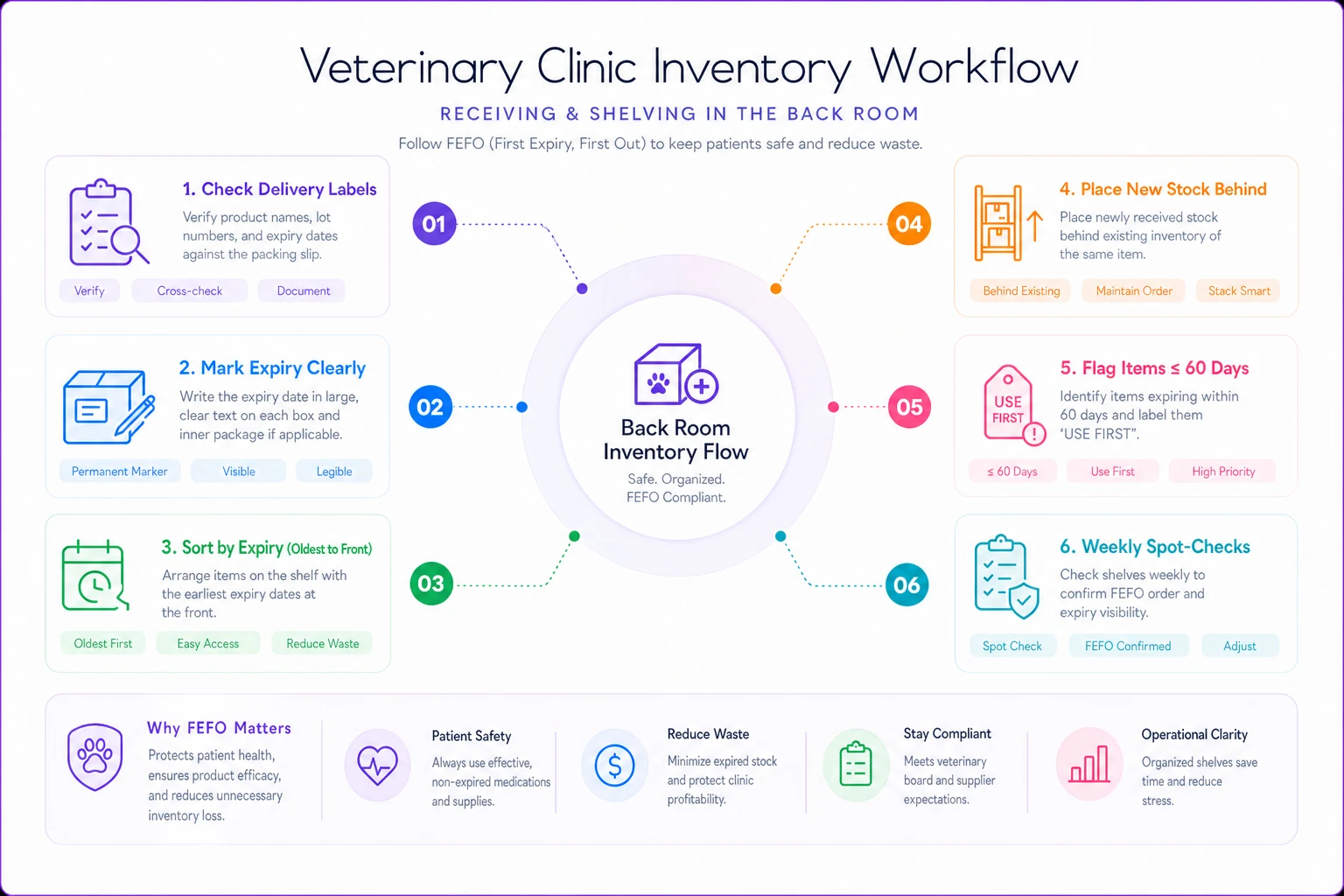
At receiving, compare incoming expiry dates against what's on the shelf before shelving to prevent accidental burying of short-dated stock.
It takes an extra 20 seconds per item at receiving and eliminates most of the guesswork later. Clinics that skip this step at receiving always pay for it at cleanout.
A weekly audit you can run in under 30 minutes
The point of a weekly audit isn't a full count — that's a monthly or quarterly job. It's catching the items drifting toward a stockout or an expiry before they cross the line.
Sampling rule: You don't count everything weekly. Count:
-
100% of short-dated and high-value items (vaccines, insulin, controlled substances, anything over your dollar threshold)
-
A rotating ~20% sample of everything else, so the full catalog cycles through roughly every 4–5 weeks
-
Any item flagged at or near its reorder point
For controlled substances specifically, the count isn't a sample — it's a full reconciliation every time, and it ties into separate compliance obligations. If that side of your inventory feels loose, the workflow in Prevent Audit Failures: Controlled‑Substance Inventory and Compliance Workflow for Veterinary Clinics covers it properly.
The weekly checklist:
-
[ ] Pull the list of items at or below reorder point — place orders
-
[ ] Count 100% of short-dated and high-value SKUs
-
[ ] Count this week's rotating 20% sample
-
[ ] Flag everything expiring within 60 days → move to "use first" tier
-
[ ] Flag everything expiring within 30 days → escalate for active use or planned return
-
[ ] Confirm FEFO placement on at least a few random shelves (spot-check rotation discipline)
-
[ ] Note any item that hit a stockout since last audit (your ROP or safety stock is wrong)
-
[ ] Note any discrepancy between system count and physical count
Escalation thresholds:
| Trigger | Action |
|---|---|
| Item expiring ≤30 days, slow movement | Escalate to lead vet — push usage or initiate vendor return |
| Physical count off by >5% from system | Investigate before reordering; possible dispensing/logging gap |
| Same item stocks out twice in a quarter | Recalculate ADU and safety stock — the numbers are stale |
| Any controlled-substance discrepancy | Immediate full reconciliation, no exceptions |
| Expiry write-off exceeds set monthly dollar cap | Review par levels on affected SKUs for over-ordering |
The discrepancy threshold matters more than people think. A recurring count gap usually isn't theft — it's an item being dispensed without being logged, which quietly corrupts your ADU and throws off every formula built on it. If you're seeing consistent gaps on the same SKUs, that's almost always a logging problem, not a counting problem.
A real scenario
A two-vet suburban clinic was writing off somewhere between $700 and $1,100 a month in expired product — mostly vaccines, a couple of short-dated injectables, and seasonal preventives that piled up heading into winter. They were also stocking out on routine meds often enough that a staffer was making emergency distributor runs a couple times a month.
The root issue was a flat ordering habit: someone eyeballed the shelf and reordered to a quantity that "felt right," same amount year-round. No ADU, no seasonal adjustment, no FEFO.
They rebuilt it over a few weeks — calculated ADU from 90 days of data, set reorder points and par levels per item, applied seasonal indices to the preventives and vaccines, and switched the back room to FEFO with a "use first" shelf. Nothing fancy, just the math above applied consistently.
Within about three months, expiry write-offs dropped to under $250 most months, and the emergency runs mostly stopped. The seasonal re-indexing was what killed the winter vaccine waste specifically — they just stopped ordering spring volumes into a slow season. Not a dramatic transformation, but a steady, obvious improvement in a line item that had been bleeding quietly for years.
Where this fits into the bigger picture
Par-level math is one piece. It works best when your purchasing side is disciplined too — consistent lead times, reliable pack sizes, and vendors who deliver when they say they will. If your lead times are all over the map, your safety stock has to balloon to compensate, which drags you right back toward expiry waste. Tightening up the vendor side, covered in Procurement and Vendor Contract Governance for Clinics, makes every formula here tighter and cheaper to run.
Expired stock is almost always a math-and-rotation failure, not a buying failure. Get your daily usage right, let it drive your reorder points and par levels, adjust for the seasons you actually have, and make sure the oldest thing always leaves first. Run the 30-minute audit weekly and act on the escalation triggers. Do that consistently and the overflowing cleanout bag — and the quiet money in it — mostly goes away.
Expired stock is almost always a math-and-rotation failure, not a buying failure. Get your daily usage right, let it drive your reorder points and par levels, adjust for the seasons you actually have, and make sure the oldest thing always leaves first. Run the 30-minute audit weekly and act on the escalation triggers. Do that consistently and the overflowing cleanout bag — and the quiet money in it — mostly goes away.
Ready to elevate your clinic’s efficiency?
Join 500+ veterinary clinics using Veterinaryly to save time, reduce administrative overhead, and improve patient care.