

Most clinics don't lose money on vendors because they picked the wrong one. They lose money because nobody's watching the contract after the ink dries. A distributor auto-renews at a 9% higher rate. A software vendor quietly drops phone support to email-only. A reference lab misses turnaround times for three straight months and nobody tracks it, so there's no leverage at renewal.
The core problem with veterinary procurement vendor contract management isn't sourcing — it's governance. You can negotiate a great deal and still bleed thousands a year because the agreement lives in someone's inbox and the renewal date lives in nobody's head.
This post is a practical playbook: a lightweight RFP template, a vendor scorecard you'll actually use, contract clauses that put SLAs and penalties in writing (with sample language), a central renewal calendar, and approval thresholds so a $400 order and a $40,000 contract don't go through the same rubber-stamp process.
Start with the failure mode, not the RFP
Before templates, it's worth being honest about how procurement actually breaks in a clinic. It's rarely dramatic. It's slow.
A typical pattern: the practice manager sets up a distributor account years ago. Pricing was competitive then. Over time, rebates shift, formulary changes happen, and the "loyalty" pricing quietly erodes. Nobody re-bids because switching feels like a hassle and the relationship is comfortable. Meanwhile a competing distributor would've matched or beaten the price — but nobody asked.
The second failure is the handshake vendor. Someone knows a rep, service starts informally, and there's never a real contract. When something goes wrong — a delayed controlled-substance order, a billing dispute — there's no SLA, no penalty clause, no documented expectation. You're negotiating from zero every single time.
The third, and most expensive, is the auto-renewal with a notice window. Many contracts require 60 or 90 days' written notice to cancel or renegotiate. Miss it, and you're locked in for another year at whatever terms the vendor set. Clinics miss these windows constantly because there's no calendar tracking them.
Governance fixes all three. It doesn't require a procurement department — just structure.
The RFP template (keep it to one page)
You don't need a corporate RFP. A long one scares off small regional vendors who often give better service than the national players. What you need is a consistent set of questions so you're comparing apples to apples.
Never miss a pet’s appointment again.
Veterinaryly helps you schedule, confirm, and manage every appointment and patient record effortlessly.
- Centralized appointment & patient management
- Automated client reminders
- Staff scheduling & task tracking
No credit card required
-
1. Scope and volume. What you're buying, estimated annual volume or spend, and any seasonality. Vendors price differently when they see real numbers.
-
2. Pricing and price protection. Ask for unit pricing and a price-lock term. The key question most clinics forget: "How much notice do you give before a price increase, and is there a cap on annual increases?"
-
3. Service levels. Turnaround times, delivery windows, support response times, uptime for software. Make them commit in writing.
-
4. Onboarding and offboarding. How long to switch on, and — critically — how you get your data or account closed out if you leave. This matters most for practice management software and lab portals.
-
5. References. Two clinics of similar size. Actually call them, and ask specifically about problems, not praise.
-
6. Term and renewal. Contract length, auto-renewal terms, and the notice window required to cancel.
Send the same six sections to every candidate. When responses come back in wildly different formats, that itself tells you something about how organized the vendor is.
A vendor scorecard you'll actually use
The mistake here is building a scorecard so detailed nobody fills it out. Twenty weighted criteria across five stakeholders sounds thorough and gets abandoned by the second vendor.
Keep it to six to eight factors, weight the ones that matter for that category, and score 1–5. Weighting is where the judgment lives — for a reference lab, turnaround time and accuracy dominate. For a distributor, price and fill rate matter more. For software, support and data portability outrank everything.
Here's a working example for evaluating a reference lab:
| Criterion | Weight | Vendor A (1–5) | Vendor B (1–5) | A Weighted | B Weighted |
|---|---|---|---|---|---|
| Result turnaround time | 25% | 4 | 5 | 1.00 | 1.25 |
| Diagnostic accuracy / QA | 25% | 5 | 4 | 1.25 | 1.00 |
| Pricing | 20% | 3 | 4 | 0.60 | 0.80 |
| Portal / result routing | 15% | 4 | 3 | 0.60 | 0.45 |
| Support responsiveness | 10% | 5 | 3 | 0.50 | 0.30 |
| Contract flexibility | 5% | 4 | 4 | 0.20 | 0.20 |
| Total | 100% | 4.15 | 4.00 |
Vendor B looks cheaper and faster, but Vendor A edges ahead on accuracy and support — which, for a lab, is where errors turn into liability. The scorecard doesn't make the decision for you, but it forces you to say why you're choosing one, and that reasoning is worth keeping in the file for the next renewal.
One thing worth adding: score your existing vendors on the same card once a year. That's how you catch the distributor whose service has drifted from a 5 to a 3 without anyone noticing.
If lab and imaging quality is a big part of your vendor mix, pair this with the QA controls covered in your diagnostic vendor process — the scorecard tells you who to keep, the QA process tells you whether their output is safe.
Contract clauses that give you leverage
This is where clinics leave the most money and protection on the table. A quote or an order form is not a contract. If there's no SLA and no penalty, the vendor has no real incentive to fix chronic problems — there's no cost to them for failing.
You don't need a lawyer to draft everything, but anything above your higher approval threshold should get a legal review. Below are the clauses that matter most, with sample language you can adapt.
Service level agreement (SLA) with defined metrics
> "Vendor shall deliver routine diagnostic results within 24 hours of specimen receipt for at least 95% of samples measured monthly. STAT results shall be delivered within 4 hours for at least 98% of such samples."
Penalty / service credit clause
> "For any calendar month in which Vendor's routine turnaround performance falls below 95%, Client shall receive a service credit equal to 5% of that month's invoiced amount. Should performance fall below 90% for two consecutive months, Client may terminate this Agreement upon 30 days' written notice without penalty."
That last part matters more than the credit. The real leverage isn't the 5% — it's the right to walk away without being trapped by the term.
Price protection and increase caps
> "Unit pricing shall remain fixed for the initial twelve (12) month term. Any price increase upon renewal shall not exceed 4% or the annual change in [relevant index], whichever is lower, and Vendor shall provide no fewer than 60 days' written notice of any increase."
Termination and notice window
> "Either party may terminate this Agreement for convenience upon 60 days' written notice. This Agreement shall not automatically renew unless Client provides written confirmation of renewal no fewer than 30 days prior to the term end date."
Flip the default here. Standard vendor contracts auto-renew unless you opt out. Whenever you can negotiate it, make renewal require active confirmation instead. It's a small wording change that eliminates the entire "we missed the notice window" problem.
Data portability and exit (software vendors)
> "Upon termination for any reason, Vendor shall, within 30 days, provide Client with a complete export of Client data in a standard, non-proprietary format (CSV, PDF, or equivalent) at no additional charge."
Clinics get held hostage on this one constantly. The time to negotiate your exit is before you sign, not when you're trying to leave and suddenly there's a "data migration fee."
Compliance and controlled-substance handling
For any vendor touching controlled substances, hazardous materials, or protected records, require documented compliance with the relevant regulations and the right to audit. Keep this tied to your internal compliance workflows rather than assuming the vendor's word is enough.
Approval thresholds so small and large purchases aren't treated the same
Procurement feels chaotic in most clinics because there are only two modes: someone just buys it, or everything gets stuck waiting on the owner. Neither works at any real scale.
| Purchase amount | Approval required | Contract review | Competitive bids |
|---|---|---|---|
| Under $500 | Practice manager | No | Not required |
| $500 – $5,000 | Practice manager + owner sign-off | Standard terms only | 1 comparison quote |
| $5,000 – $25,000 | Owner / medical director | Full contract review | 2–3 bids (RFP) |
| Over $25,000 | Owner + legal review | Legal review required | Formal RFP required |
Adjust the numbers to your practice size — a single-doctor clinic and a five-doctor hospital will draw these lines differently. The point isn't the exact figures. It's that everyone knows the rule before the purchase, so nothing gets buried and nothing gets stalled.
This ties directly into broader operational control. If you run more than one location, inconsistent approval authority between sites is a recurring headache, and it's worth reading alongside a proper multi-location governance model so procurement authority matches your overall structure.
The central renewal calendar — the single highest-ROI habit
If you do nothing else from this post, do this. Almost every dollar of silent price creep and every missed-notice lock-in comes down to the same root cause: nobody was tracking renewal dates in one place.
Track the notice-window deadline as your primary date and set reminders 30 days before it.
-
Vendor name and contract category
-
Annual spend
-
Contract start and end dates
-
Notice window deadline (end date minus the required notice period)
-
Auto-renew
yes/no
-
Current price and last increase
-
Owner (who's responsible for the decision)
-
Last scorecard result
The critical column is the notice-window deadline, not the end date. If a contract ends December 31 and requires 60 days' notice, your real deadline is November 1. Track that date, and set a reminder 30 days before it.
-
1. 90 days out Pull the vendor's scorecard and last 12 months of performance. Did they hit their SLAs?
-
2. 75 days out If performance slipped or pricing crept up, request a renegotiation or quietly line up one alternative quote for leverage.
-
3. 60 days out (or your actual notice deadline) Decide — renew, renegotiate, or terminate — and send written notice if needed.
-
4. After renewal Update the calendar with new dates and terms immediately, before you close the file.
Here's a simple workflow to visualize the renewal calendar process.
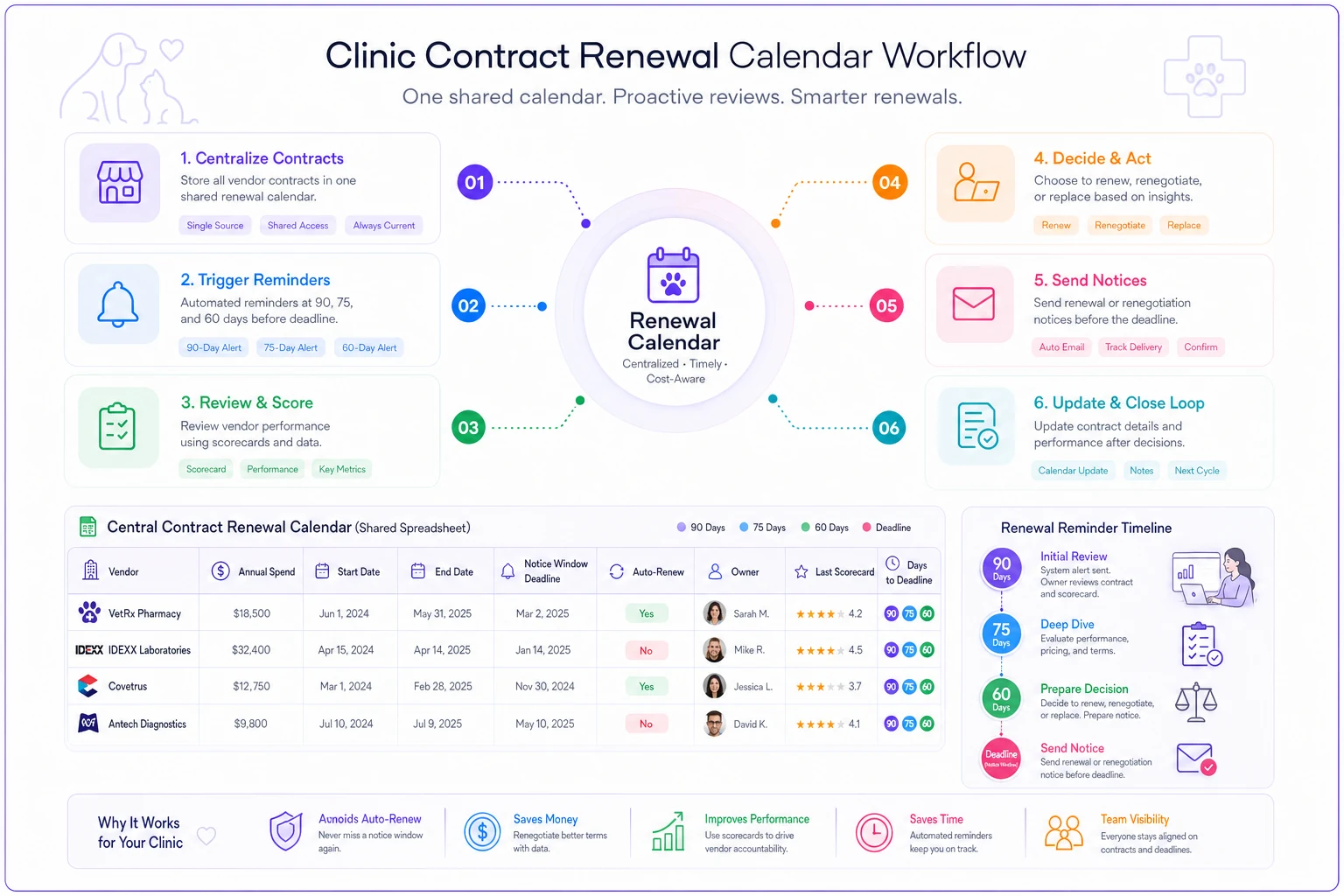
Use the calendar to trigger the review steps and update terms immediately after any renewal.
Clinics that run this consistently save real money — not because they're constantly switching vendors, but because vendors behave differently when they know you're paying attention and renewal isn't automatic.
A real scenario
A three-doctor small-animal practice was spending roughly $18k–$20k a month across its main distributor, reference lab, and practice management software. No renewal calendar, no scorecards, contracts scattered across two email accounts.
Over a single year they had three quiet leaks: the distributor's pricing had drifted about 7% above a competing regional supplier, the lab had been missing its (verbal, unwritten) turnaround expectation on roughly one in six routine panels for months with no consequence, and the software had auto-renewed at an 11% increase because the 60-day notice window passed unnoticed.
They built the calendar and scorecards over about a weekend. At the next distributor renewal, showing a competing quote got them back to competitive pricing — savings of roughly $1,100–$1,400 a month. They renegotiated the lab agreement with a written 95% turnaround SLA and a service-credit clause. The software increase they couldn't undo mid-term, but they flagged the notice deadline and renegotiated the following cycle down to a capped 4% increase.
Nothing exotic. Mostly the same vendors. The gains came almost entirely from governance — knowing the dates, having the data, and negotiating from a position where walking away was actually on the table.
When this level of structure makes sense — and when it doesn't
Do this fully if: you're spending more than a few thousand dollars a month on outside vendors, you have multiple contracts with different renewal dates, or you've ever been surprised by a price increase or auto-renewal. The bigger and more spread-out your spend, the more this pays off.
Keep it lightweight if: you're a solo practice with two or three simple vendor relationships and low total spend. You still want the renewal calendar — that part is universal — but a full RFP process for a $600 order is overkill.
Who should skip parts of this: if a vendor relationship is genuinely small and low-risk, don't force it through a formal RFP. Judgment matters. The thresholds table exists precisely so you don't apply heavyweight process to lightweight purchases. Reserve the RFP, legal review, and scorecard for the contracts where the money and the risk actually live.
Where this connects to the rest of your operations
Procurement governance doesn't sit in a silo. Vendor pricing feeds directly into your margins, and the same discipline that catches silent price creep is the discipline that catches revenue leakage in your billing workflow — both are cases where money quietly disappears because no one owns the tracking.
Whether you run this in spreadsheets or inside a workflow platform that centralizes contracts, renewal reminders, and approval routing, the underlying system is the same: every contract has an owner, a scorecard, a notice deadline, and written SLAs with teeth. Automation helps mainly by making sure renewal reminders actually fire and approval thresholds get enforced instead of ignored — but the governance logic has to exist first.
Get the structure right, keep the calendar current, and put real numbers into your contracts. That's what turns procurement from a place you lose money by default into one where vendors compete to keep your business.
Ready to elevate your clinic’s efficiency?
Join 500+ veterinary clinics using Veterinaryly to save time, reduce administrative overhead, and improve patient care.