

Most controlled-substance failures don't come from theft or diversion. They come from a partial reconciliation on a Tuesday afternoon when the tech got pulled into a hit-by-car case, promised themselves they'd finish the count later, and never did. Three weeks later there's a 0.4 mL gap in a ketamine vial nobody can explain, and now you're staring at a log with your DEA registration attached to it.
That's the real risk. Not dramatic diversion — the slow accumulation of small documentation gaps that, when a DEA inspector or state board investigator lines them up, look like a pattern of negligence. "We were busy" doesn't hold up during an audit.
This is a practical veterinary controlled substance compliance workflow — the daily mechanics, the escalation rules, and the mock-audit scripts that keep your logs defensible. Not the legal theory. The operational parts that actually break.
The failure almost always starts at the drawer
If you want to know where a clinic's compliance is going to fall apart, watch how the controlled drawer gets handled during the first hour of a busy morning.
The pattern is almost always the same. The morning tech opens the safe, pulls what they think they'll need for the day's procedures, and logs it "later." The afternoon shift comes in, uses whatever's staged, and assumes the morning person already documented it. By close, the person doing the count is reconciling against a log that's missing two entries and has one recorded in the wrong unit. The count is "off by a little," everyone shrugs, and it gets fudged to match.
That fudge is the actual violation. Not the discrepancy — the decision to erase it.
This isn't a laziness problem. It's that most clinics treat the controlled log as a record you fill out after the work, instead of a gate you pass through to get the drug. When documentation is downstream of use, it competes with patient care and loses every time.
The fix is moving the log to the point of access. Nothing leaves the drawer without a real-time entry — date, time, patient, drug, quantity drawn, quantity administered, quantity wasted, and two initials on any waste. If that slows the morning down a bit, good. The friction is the control.
What a defensible daily drawer check actually looks like
A "drawer check" isn't a vibe. It's a specific closing-and-opening ritual that produces a signed, timestamped record every single day, whether or not any controlled substances were touched.
Never miss a pet’s appointment again.
Veterinaryly helps you schedule, confirm, and manage every appointment and patient record effortlessly.
- Centralized appointment & patient management
- Automated client reminders
- Staff scheduling & task tracking
No credit card required
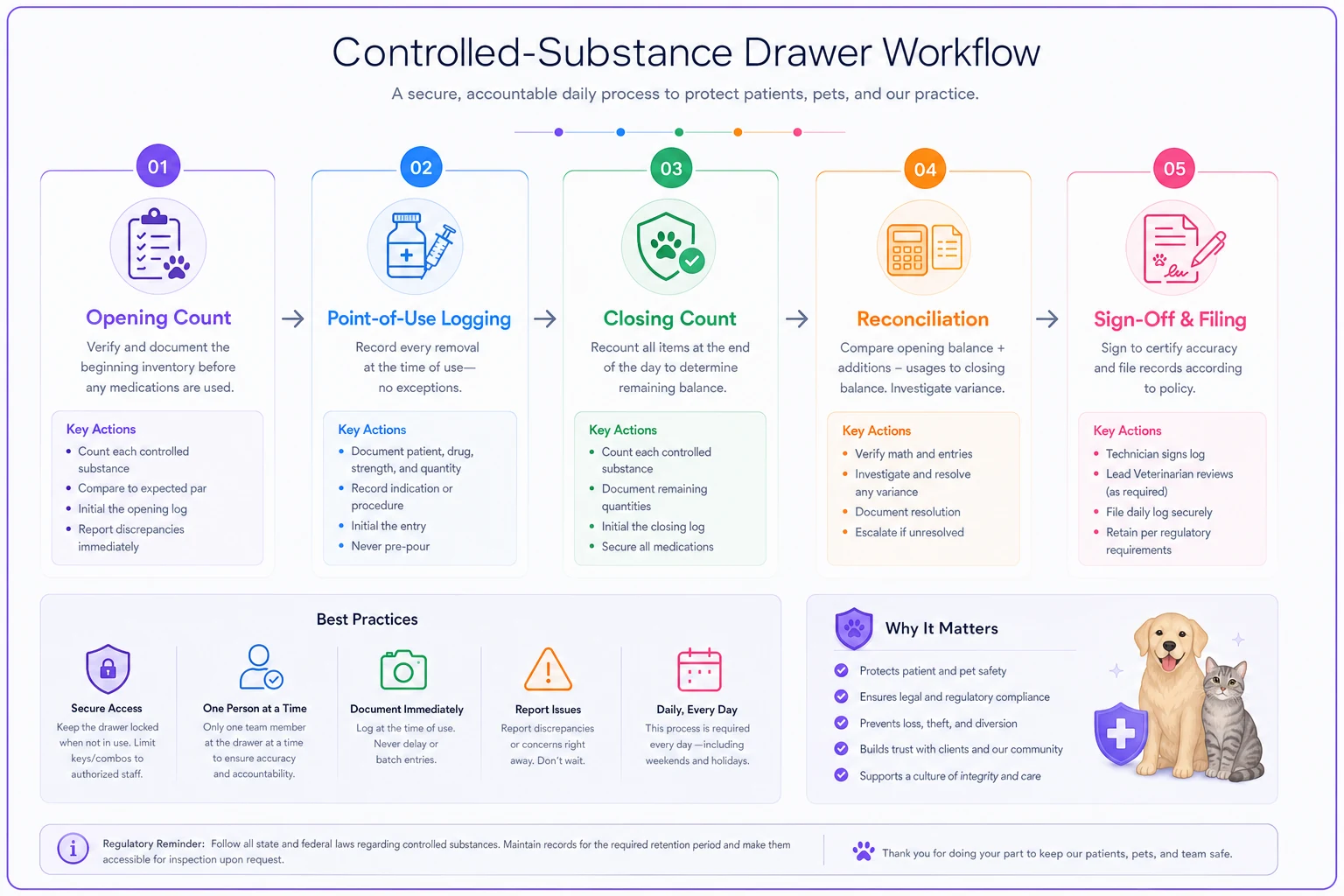
Here's the daily process for any clinic holding Schedule II–IV drugs:
-
Opening count (start of day). One person counts physical inventory of every controlled item and records it against the running balance from the previous close. If it matches, they initial. If it doesn't, escalation starts before any drug is dispensed that day.
-
Point-of-use logging (all day). Every draw is logged at the drawer, in real time, with patient linkage. Waste is witnessed and co-signed at the moment it happens — not reconstructed at close.
-
Closing count (end of day). A different person than the opener recounts physical inventory. Two-person integrity matters here — the same individual opening and closing every day is exactly the gap an investigator looks for.
-
Reconciliation. Closing physical count must equal
opening count − administered − wasted + received. Any variance triggers the discrepancy protocol immediately, not tomorrow.
-
Sign-off. Both counters initial the daily sheet. The sheet gets filed in sequence — no gaps in dates, ever. A missing day is worse than a bad count.
The single most common structural mistake is letting one trusted senior tech "own" the controlled log. It feels efficient. It's actually the highest-risk arrangement possible, because it removes the second set of eyes that catches honest mistakes and deters dishonest ones. Rotate the count. Document who did it.
This diagram shows the daily flow in one view.
Rotate the count. Document who did it.
The discrepancy you don't escalate is the one that ends you
Discrepancies are not the problem. Unescalated discrepancies are.
An inspector expects to see variances — you're handling liquid volumes, breakable vials, and emergency cases where exact waste is genuinely hard to measure. What they're actually testing is whether your clinic notices, investigates, and documents those variances consistently. A clean log with zero discrepancies over two years doesn't look impressive to an investigator. It looks fabricated.
| Variance Type | Example | Action | Timeframe |
|---|---|---|---|
| Minor measurable (within expected waste range) | 0.1–0.2 mL on a partial-vial draw | Recount, note in daily log, both initials | Same shift |
| Countable-unit mismatch | One tablet or one full vial missing | Immediate recount by two people; check all staging areas and prior entries | Within the day |
| Unresolved after recount | Count still off at close | Notify practice owner/DEA registrant; begin internal investigation log | Within 24 hours |
| Suspected diversion | Pattern of loss, tampered packaging, altered entries | Registrant decision on DEA Form 106 / state reporting | Per regulatory deadline |
The part clinics skip is the middle. They handle the tiny stuff casually and they know the "call the authorities" endpoint exists, but there's nothing connecting the two. So a real discrepancy either gets treated like a rounding error or gets ignored because nobody wants to trigger the nuclear option. Build the middle rungs. That's where compliance actually lives.
One more thing worth stating plainly: the entry about a discrepancy should never be erasable. Catch an error, draw a single line through it, initial, date, and write the correction beside it. Whiteout, deletions, and "let me just fix that real quick" are how a paperwork mistake becomes an integrity finding.
Transfers between locations are the quiet failure point
If you run more than one location, your controlled-substance exposure multiplies in a way that's easy to underestimate. Drugs moving between sites is exactly the kind of hand-off where accountability blurs — and multi-site coordination is its own operational discipline, which we've written about more broadly in our governance model for multi-location veterinary operations.
A typical breakdown looks like this: the main hospital is short on hydromorphone, the satellite has extra, and a relief vet grabs a vial on the way over. No transfer document, no dual sign-off, no adjustment to either location's running balance. Both logs are now wrong, and neither clinic knows it until a count doesn't reconcile — usually weeks later, at the worst possible time.
-
Sending location, receiving location, date, and time
-
Drug, strength, quantity, and lot number
-
Signature of the person releasing and the person receiving
-
Corresponding balance adjustment entered at both sites the same day
-
The transfer form filed at both locations
The rule that prevents most of this is simple: no controlled substance moves without a completed transfer form traveling with it. Not a text. Not "I'll log it when I get there." The form is the permission slip. No form, no movement.
Disposal and waste documentation is where "small" becomes "systematic"
Waste is the most under-documented, most scrutinized part of the whole workflow. It's where a clinic loses the benefit of the doubt fastest, because partial doses and expired stock create constant opportunities for volume to disappear on paper without anyone actually stealing anything.
Two categories, two different rules.
Procedural waste — the leftover after you draw more than you administer — must be witnessed and co-signed at the moment of wasting. The exact amount administered, the exact amount wasted, and two initials. A single person documenting their own waste with no witness is the pattern investigators build cases around, even when nothing was actually diverted.
Expired or unusable stock goes through reverse distribution or a DEA-authorized disposal method — never down the sink or into the sharps bin because it was convenient. This gets its own disposal log: drug, quantity, lot, expiration, disposal method, date, and the manifest or witness signatures tied to it.
The mistake that comes up most often is a clinic that documents administration beautifully and treats waste as an afterthought. On a busy surgery day you might waste small volumes across a dozen procedures. Individually trivial. Added up across a month and left uncounted, it becomes exactly the kind of unexplained drain that turns a routine inspection into an extended one.
Mock audits: the rehearsal that actually prevents the failure
The uncomfortable truth about compliance is that you usually don't find out your system is broken during normal operations. You find out during the real audit, when it's already too late to fix anything. The only reliable way to surface gaps beforehand is to audit yourself, on purpose, before someone else does.
A mock audit shouldn't be gentle. Run it like an inspector would.
-
Pull the running balance for three random controlled drugs and physically count them right now. Do the numbers reconcile to the log this exact minute?
-
Pick a random date from three months ago. Are the opening count, closing count, and reconciliation all present and signed by two different people?
-
Trace one administered dose from the log back to the patient record. Do the quantities and timestamps match?
-
Trace one waste entry. Is it witnessed and co-signed?
-
Find a discrepancy from the last six months. Was it escalated per your ladder, or quietly fudged?
-
Ask a random staff member to walk you through what they'd do if the closing count was off by one vial. Do they actually know the protocol, or is it just written down somewhere?
That last question matters more than people expect. A perfect binder means nothing if the people at the drawer at 7 a.m. don't know the escalation rule. The purpose of the mock audit isn't just to check the paper — it's to check whether the behavior holds up when you're not watching.
A quick reconciliation checklist your closing person can actually use
-
- [ ] Physical count completed for every controlled item
-
- [ ] Count reconciles to
opening − administered − wasted + received
-
- [ ] All waste entries co-signed and witnessed
-
- [ ] Any variance logged and escalated per the ladder
-
- [ ] Corrections made with single-line strikethrough, initialed, never erased
-
- [ ] Both opener and closer are different people, both initialed
-
- [ ] No gaps in dated sheets since last close
-
- [ ] Transfer forms (if any) reconciled at both locations
Print it out, laminate it, tape it inside the drawer. A checklist nobody can find at closing is not a checklist.
A real scenario
A two-location small-animal practice — around 30 staff between sites, doing roughly 900 procedures a month combined — had one senior tech "in charge" of the controlled log at each location. Counts happened once a day, done by the same person who staged the drugs. Waste was reconstructed at close from memory. No formal transfer process between sites.
Their first honest mock audit was ugly. Tracing 10 random administrations back to patient records, three didn't reconcile — not because of diversion, but because doses were logged in the wrong units and one transfer between locations had never been recorded on either side. Two closing counts in the prior quarter had been quietly adjusted to match.
They didn't buy anything new to fix it. They changed the workflow: point-of-use logging, opener and closer required to be different people, witnessed waste at the moment of wasting, and a one-page transfer form that had to physically travel with any drug moving between sites. Escalation rules got printed and taped inside the drawer.
Six months later the next mock audit reconciled cleanly across all traced entries, and — more tellingly — the log now showed a handful of properly escalated and resolved discrepancies instead of a suspiciously perfect record. That's what defensible looks like. Not flawless. Documented.
Where software helps — and where it doesn't
None of this requires software. Plenty of clinics run defensible controlled-substance logs on paper, and paper has one real advantage: it's hard to bulk-delete.
That said, the parts that break most — missing days, one-person counts, waste logged from memory, transfers that never got recorded on both sides — are exactly the kinds of gaps that structured operational software handles well. A system that requires a real-time entry before the drawer opens, flags a variance the moment reconciliation fails, and won't let a daily sheet close with a gap removes the "I'll do it later" failure mode entirely. The same principle applies to tracking specimens end-to-end in standardized lab collection and result-routing — the point isn't the tool, it's that the workflow refuses to let steps get skipped.
The line worth drawing: software should enforce the rules you've already decided on. It should not be your compliance thinking. A clinic that adopts a system without first defining its escalation ladder, its two-person count rule, and its transfer process just ends up with disorganized digital records instead of disorganized paper ones.
When a stricter system makes sense — and when it doesn't
Do the full workflow if: you hold Schedule II drugs, run more than one location, have regular staff turnover, or have ever had a count come up short without a clear explanation. The friction pays for itself the first time an inspector walks in.
You can run lighter if: you're a solo practitioner with a small formulary and personally handle every draw and count. Even then, keep the two-person rule for waste — a solo vet witnessing their own waste indefinitely is a gap, and bringing in one other credentialed person for that step closes it.
Who should not skip this: anyone thinking "we've never had a problem." A clean history isn't a control. It's usually just an audit that hasn't happened yet.
The bottom line
Controlled-substance compliance in a veterinary clinic isn't won during the audit. It's won in the boring daily mechanics — who counts, when they count, whether the log gates the drawer or trails behind it, and whether a discrepancy triggers a real response or a quiet edit. Inspectors aren't looking for perfection. They're looking for a system that notices its own mistakes and documents how it handled them.
Build the ladder, split the counts, witness the waste, paper the transfers, and rehearse the audit before it's real. Do that consistently and the actual inspection stops being something to fear — it just becomes another day you're already prepared for.
Ready to elevate your clinic’s efficiency?
Join 500+ veterinary clinics using Veterinaryly to save time, reduce administrative overhead, and improve patient care.