
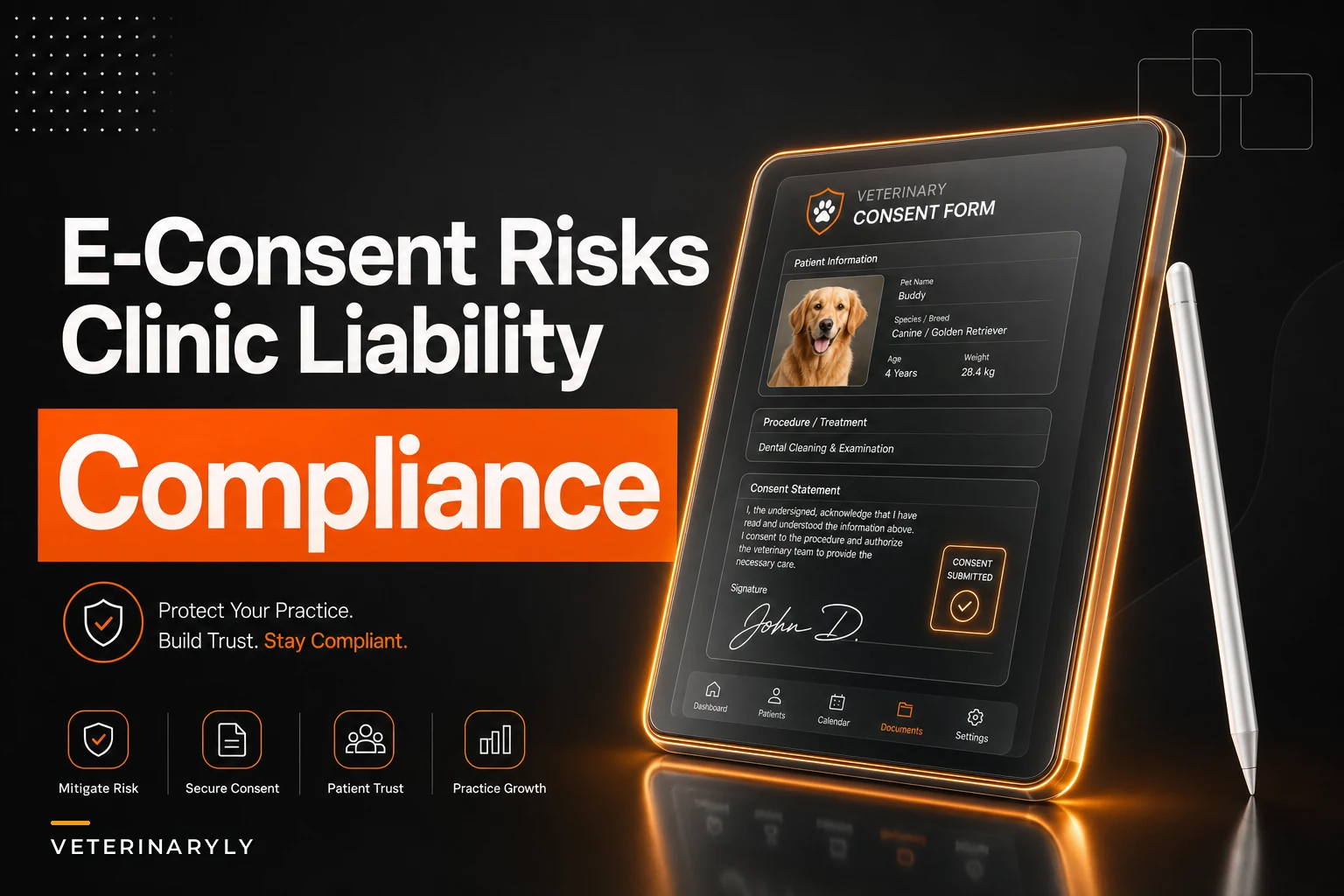

Most clinics think consent is handled the moment a pet owner taps a signature box on a tablet. The signature isn't the hard part. What holds up when a case goes sideways is everything wrapped around that signature — which version of the form the owner saw, what fields were required for that specific procedure, when it was signed relative to induction, and whether any of it matches what's in the medical record.
That's where most e-consent falls apart. Not at the signing. At the proving.
If you can't reconstruct exactly what a client agreed to on a specific date, for a specific procedure, at a specific risk level, your electronic consent is basically decorative. It looks modern, it feels efficient, and it does almost nothing for you when a client's attorney asks, "Show me what my client actually saw before you sedated their dog."
This post is about building a veterinary e-consent workflow that survives that question.
Where e-consent quietly becomes indefensible
The failures aren't dramatic. They're small and boring, which is exactly why they slip through.
Version drift is the big one. A clinic updates its anesthesia consent language in March — maybe adds a paragraph about aspiration risk after a bad case. The old form is still cached on two front-desk tablets. For six weeks, some clients sign the March version and some sign the January version, and nobody can tell which afterward because both just say "Anesthesia Consent" in the record. When a dispute surfaces in July, you genuinely cannot say what the owner saw. That's not a paperwork problem. That's a lost case.
The second failure is "one form fits everything." A routine nail trim under mild sedation and a splenectomy on a 12-year-old shepherd get the same generic consent because it's easier to maintain one document. The problem is obvious in hindsight: high-risk procedures require the owner to acknowledge things a low-risk procedure doesn't — CPR preference, blood product authorization, cost ceilings for intra-op complications. If those fields aren't mandatory and tied to the procedure's risk level, staff skip them under time pressure, and your highest-liability cases end up with your thinnest consent.
The third is timestamp ambiguity. A consent form signed at 7:42 AM tells a very different story than one signed at 9:15 AM when the incision started at 9:05. In practice, this usually happens when consent is collected verbally at drop-off, the tablet signature is captured later "when things calm down," and the recorded time reflects the tablet — not the actual conversation. That gap between real agreement and recorded signature is where defensibility dies.
None of these are exotic edge cases. They're the default state of most clinics that "went digital" without redesigning the underlying workflow.
Consent versioning: the part everyone underbuilds
Versioning sounds like an IT concern. It's actually the backbone of a defensible consent program, and it's what clinics most consistently get wrong because it's invisible until you need it.
Never miss a pet’s appointment again.
Veterinaryly helps you schedule, confirm, and manage every appointment and patient record effortlessly.
- Centralized appointment & patient management
- Automated client reminders
- Staff scheduling & task tracking
No credit card required
The standard that actually protects you: every consent document carries a version number and an effective date, and every signed instance permanently stores which version was presented — not a link to the current version, a frozen copy of the exact one the client saw.
That distinction matters more than it sounds. If your system stores "signed the anesthesia consent" and points to a live document, then every time you update that document, every past signature now appears to reference language that didn't exist when it was signed. You've retroactively rewritten history without meaning to. A frozen snapshot at signing time is the only version that holds.
A workable versioning model looks like this:
| Element | Weak setup | Defensible setup |
|---|---|---|
| Document identity | "Anesthesia Consent" | "Anesthesia Consent v3.2, effective 2024-03-15" |
| Stored at signing | Link to current form | Frozen PDF/HTML of exact version shown |
| Update handling | Overwrite the file | New version created, old versions archived, never deleted |
| Reconstruction | "Probably the current one" | Exact version + effective date range |
| Change log | None | Who changed it, what changed, when, why |
The change log is underrated. When you update anesthesia language after a complication, you want a record showing when the clinic became aware of a risk and when it started disclosing it. That timeline can protect you or sink you, and either way you want it to exist and be accurate rather than reconstructed from memory months later.
Mandatory fields by procedure risk-level
This is where e-consent earns its keep — and where a paper-to-digital "lift and shift" adds no real value.
The insight most clinics miss: consent requirements should scale with procedure risk, and the system should enforce that scaling, not rely on staff to remember it. A tired tech at 6 PM will not remember that the geriatric dental needs the blood-pressure-drop acknowledgment. A well-built workflow won't let them proceed without it.
A practical risk tiering that maps cleanly to required fields:
-
- Low risk (nail trims under light sedation, minor superficial procedures): basic authorization, sedation acknowledgment, contact number for the day.
-
- Moderate risk (routine dentals, mass removals, spays/neuters): everything above, plus anesthesia risk acknowledgment, pre-anesthetic bloodwork decision (accepted/declined with initials), and an estimate range acknowledgment.
-
- High risk (geriatric anesthesia, emergency surgery, GDV, splenectomy, anything with significant intra-op complication potential): everything above, plus explicit CPR/DNR election, blood product authorization, an intra-operative cost ceiling with a "call at this threshold" number, and a named authorized decision-maker if the primary owner is unreachable.
Tie required fields to procedure codes so staff can't bypass them under time pressure.
The mechanism that makes this real: the procedure selected on the consent drives which fields are required, and the form cannot be submitted with any required field blank. No override without a documented reason. That single rule eliminates the most common consent gap in the clinic — high-risk cases missing high-risk acknowledgments.
Worth mentioning: clinics that tier their consent almost always find their verbal consent conversations improve too. When the form forces a CPR election, the tech actually has that conversation with the owner instead of assuming. The workflow ends up changing the medicine, not just the paperwork.
Timestamping and pre-op EMR integration
Timestamps only mean something if they reflect reality and connect to the rest of the record.
The standard to hold: the consent signature time must be captured at the moment of signing, tied to the specific procedure, and reconcilable against the surgical timeline in the EMR. If your consent lives in one system and your anesthesia record lives in another and they never communicate, you're manually stitching timestamps together after the fact — which is the fragile, error-prone process that creates these gaps to begin with.
What good integration looks like in practice:
-
The procedure is scheduled and the risk level is set at booking or pre-op check-in.
-
That risk level pulls the correct consent version with the correct mandatory fields.
-
The owner reviews and signs; the signature captures a server-side timestamp, the version shown, the device, and the signer's name and relationship to the patient.
-
The signed consent writes back into the patient's EMR as a discrete, timestamped record — not a scanned attachment nobody can search.
-
Induction/incision times in the anesthesia record now sit alongside the consent timestamp, so the sequence is verifiable: consent preceded the procedure, by how long, for the right version.
That fifth step is the one that separates a clinic that can defend itself from one that can't. Consent-before-procedure isn't just a nicety — it's the entire point. If your records can't show the sequence cleanly, you're relying on staff testimony months later, which is a bad position to be in.
This is the same discipline that shows up in solid peri-operative documentation and handoff templates — consent isn't a standalone form, it's the front end of the surgical record, and it should hand off cleanly into everything downstream. The same way structured lab collection and result-routing prevents things from falling between systems, consent needs to route into the record rather than dead-ending on a tablet.
Here's a simple workflow visualization of consent collection through EMR integration.
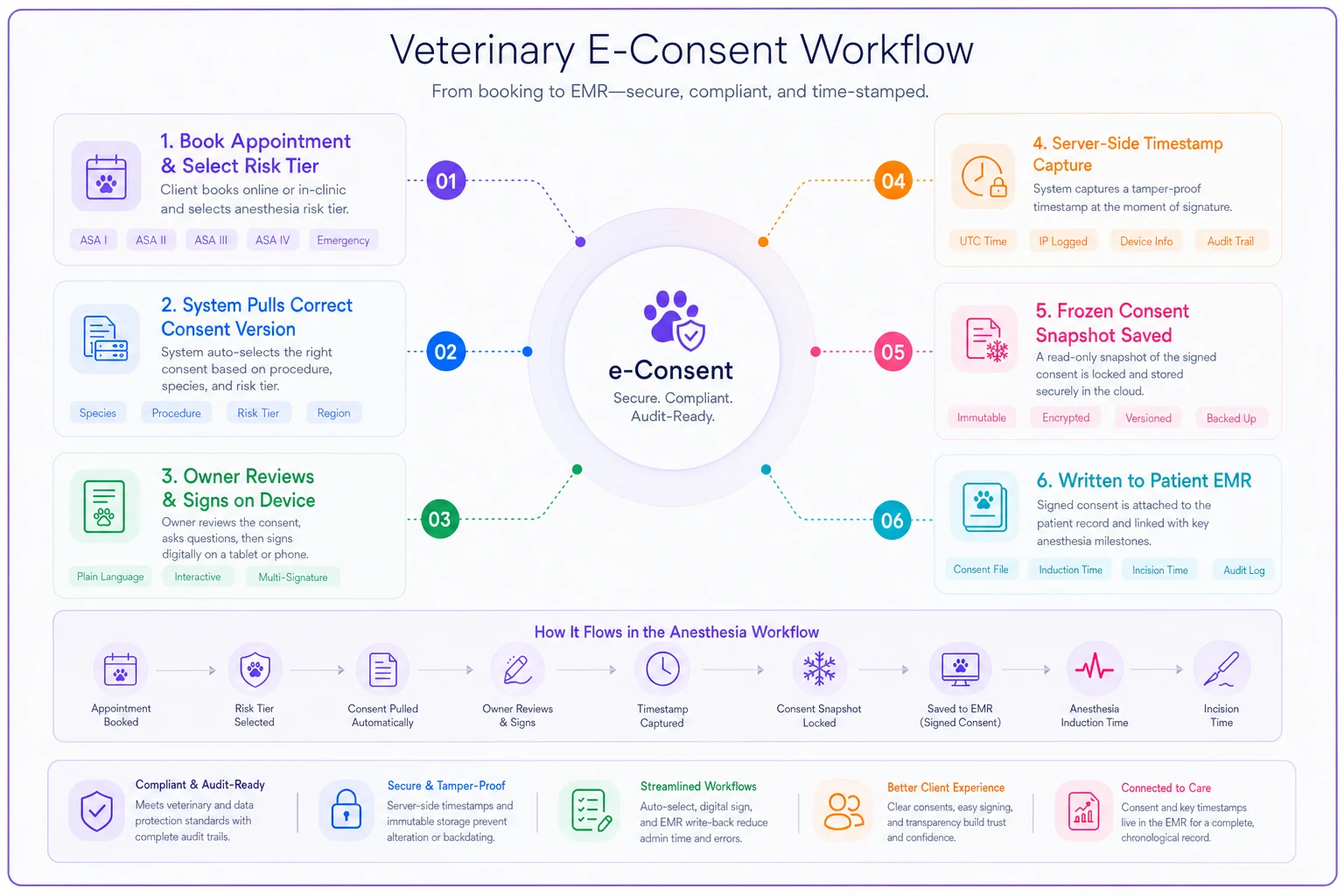
A quick visual like this makes it obvious where failures occur and which handoffs need automation.
A real scenario
A three-doctor small-animal practice running roughly 30–40 surgical procedures a week had "gone paperless" with a generic tablet form about a year earlier. Same consent document for every procedure. Signatures captured, stored as flat PDFs in a shared drive, filed by date.
The problem surfaced during a complication review after an anesthetic death in a senior patient. When they pulled the consent, they couldn't confirm which version the owner had signed — the form had been edited twice that year and old copies were mixed in with current ones. The CPR/DNR election field didn't exist on the version that was likely used. And the signature timestamp came from the drop-off tablet, captured before the doctor had finalized the anesthetic plan, so it didn't reflect the actual risk disclosure conversation.
Nothing about the medicine was necessarily wrong. But the documentation couldn't support the clinic's account of what was discussed.
They rebuilt the workflow over about two months: risk-tiered forms with mandatory fields, versioning with frozen snapshots at signing, timestamps captured at signature and written back into the patient record next to the anesthesia timeline. On the surface the change wasn't dramatic — consent completion went from "usually signed" to effectively 100% of required fields present before induction, because the system wouldn't allow a high-risk case to proceed without them. The real win was that any consent from that point forward could be fully reconstructed: version, fields, time, signer, and sequence relative to the procedure.
Staff time cost was close to neutral — a bit more clicking per case, offset by no more hunting through the shared drive when someone needed to pull a form.
When this level of rigor makes sense — and when it doesn't
Not every clinic needs the full build on day one, and pretending otherwise leads to abandoned rollouts.
This makes sense when you do regular high-risk anesthesia, geriatric surgery, or emergency work; you're multi-doctor or multi-location where consent language drifts between people; or you've already had one uncomfortable "which form did they sign?" moment. If any of those are true, the versioning and risk-tiering aren't optional — they're the difference between a defensible record and a hopeful one.
This is lower priority when you're a single-doctor practice doing almost exclusively low-risk work and rarely touching high-liability procedures. You still want versioning and real timestamps, but the elaborate risk-tiering matters less if you don't do the cases that require it.
Who should not do a rushed rollout: any clinic that tries to digitize consent without first deciding its risk tiers and required fields on paper. If you don't know what "high-risk consent" should contain before you build it, you'll just digitize your existing gaps and make them faster.
A pre-rollout checklist
Before you flip the switch on any e-consent workflow, confirm:
-
- [ ] Every consent document carries a version number and effective date
-
- [ ] Signed instances store a frozen copy of the exact version shown, not a live link
-
- [ ] Old versions are archived and reconstructable, never overwritten or deleted
-
- [ ] Procedures are mapped to risk tiers, and each tier has defined mandatory fields
-
- [ ] The form cannot be submitted with any required field blank
-
- [ ] Any field override requires a documented reason and is logged
-
- [ ] Signature timestamps are server-side and captured at the moment of signing
-
- [ ] Each signature records signer name, relationship to patient, and device
-
- [ ] Consent writes back into the EMR as a discrete, searchable record
-
- [ ] Consent timestamps are reconcilable against induction/incision times
-
- [ ] A change log records who edited consent language, what changed, and when
If you can check all of those, you can answer the attorney's question — the one about what the owner actually saw — without flinching.
The point isn't the tablet
E-consent didn't create liability, and it doesn't remove it. What it changes is how reconstructable your consent is when you need it most. A clinic with well-versioned, risk-tiered, timestamped consent tied into the medical record can walk backward through any case and show exactly what was agreed to, by whom, and when — before anything happened.
The signature was never the hard part. Build the workflow so the record around it tells a complete, verifiable story, and the tablet becomes an actual asset instead of a false sense of security.
E-consent didn't create liability, and it doesn't remove it. What it changes is how reconstructable your consent is when you need it most. A clinic with well-versioned, risk-tiered, timestamped consent tied into the medical record can walk backward through any case and show exactly what was agreed to, by whom, and when — before anything happened.
The signature was never the hard part. Build the workflow so the record around it tells a complete, verifiable story, and the tablet becomes an actual asset instead of a false sense of security.
Ready to elevate your clinic’s efficiency?
Join 500+ veterinary clinics using Veterinaryly to save time, reduce administrative overhead, and improve patient care.