


Most veterinary clinics track new clients obsessively but completely ignore what happens after the first visit. The result? Clients disappear somewhere between their puppy's first vaccines and when they should be scheduling that dental cleaning three years later.
The gap between acquiring a client and keeping them for life isn't about customer service or bedside manner. It's an operational problem that starts with how you segment clients and ends with whether your recall system connects to revenue tracking at all.
The Lifecycle Math Nobody Does
A typical small animal clinic with around 2,800 active clients sees roughly this pattern: 40% come once a year for vaccines, 35% show up sporadically for emergencies, 20% maintain regular wellness schedules, and 5% are chronic care patients who generate disproportionate revenue.
But the clinic usually treats all these segments identically. Same recall postcards. Same phone scripts. Same follow-up timing. The diabetic cat owner who needs monthly glucose curves gets the same generic "time for vaccines" reminder as the healthy dog owner who came once for a broken toenail.
This operational blindness compounds over time. Staff waste hours calling clients who haven't responded to three previous attempts. Meanwhile, high-value clients with aging pets slip through because nobody flagged them for proactive outreach when their pet hit senior status at age seven.
The veterinary client retention system most clinics run on isn't really a system at all. It's a collection of disconnected tasks that nobody has mapped to actual revenue outcomes.
Segmentation That Actually Works
Wellness Maintainers - These clients follow preventive care schedules. They respond to standard recalls, book appointments in advance, and generate predictable revenue. Operational need: automated scheduling with minimal touch.
Never miss a pet’s appointment again.
Veterinaryly helps you schedule, confirm, and manage every appointment and patient record effortlessly.
- Centralized appointment & patient management
- Automated client reminders
- Staff scheduling & task tracking
No credit card required
Crisis Responders - Only show up for problems. Haven't established preventive care habits. Often price-sensitive. Operational need: education-focused outreach timed around life stage transitions.
Chronic Managers - Pets with ongoing conditions like diabetes or renal disease that need structured care pathways. High lifetime value but also high operational complexity. Operational need: condition-specific recall protocols tied to treatment milestones.
New Pet Owners - First-time or recently acquired pets. High potential lifetime value if captured early. Operational need: intensive onboarding sequence over the first 18 months.
Lapsed Actives - Previously regular clients who've gone dark. Often signals a service failure or a life change. Operational need: escalating win-back campaigns with clear re-engagement offers.
Tie each segment to a recall cadence and an expected revenue bucket for prioritization.
What makes this segmentation operational rather than theoretical is tying each segment to specific recall cadences, scripts, and escalation rules. A wellness maintainer who misses their annual exam gets a different treatment than a chronic care patient who misses their quarterly recheck.
Multi-Channel Recall That Scales
The biggest mistake clinics make with recall systems is assuming one channel fits every situation. Email works great for wellness maintainers but gets ignored by crisis responders. Text messages have high open rates but poor conversion for complex care plans.
Here's how channel selection should map to client segments and message types:
| Segment | Primary Channel | Secondary | Escalation | Message Focus |
|---|---|---|---|---|
| Wellness Maintainers | Text | Phone after 30 days | Convenience, online booking | |
| Crisis Responders | Text | Phone | Personal outreach | Prevention saves money |
| Chronic Managers | Phone | Doctor callback | Treatment compliance | |
| New Pet Owners | Email sequence | Text | Welcome call | Education, relationship |
| Lapsed Actives | Phone | Handwritten note | We miss you, special offer |
The operational challenge isn't just choosing channels - it's coordinating them without overwhelming staff. A properly structured veterinary client retention system automates the first two touches for most segments, only escalating to manual outreach when automated attempts fail.
For chronic care patients specifically, this might mean an automated text reminder seven days before their recheck, an email three days out with pre-visit instructions, and a phone call only if they haven't confirmed 24 hours prior. The sequencing matters as much as the channel choice.
Scripts That Convert Without Sounding Robotic
Generic recall scripts kill conversion rates. "Hi, Fluffy is due for vaccines" doesn't create urgency or value. The script needs to match both the segment and the specific recall reason.
Take overdue dental cleanings. Instead of "Fluffy needs a dental," a script for a wellness maintainer might sound like: "During Fluffy's last exam, Dr. Smith noted some early tartar buildup. We can address this now with a routine cleaning, or it may progress to extractions which typically run $800-1,200 more."
For a crisis responder who only comes in for emergencies, the angle changes: "We noticed Fluffy hasn't had a preventive exam in two years. A lot of what we see in emergency visits - like the tooth root abscess you dealt with last time - is preventable with regular care. Can we get a wellness visit on the books to catch issues before they become painful emergencies?"
The scripting extends beyond phone calls. Email subject lines, text copy, voicemail scripts - they all need segment-specific versions. A new puppy owner gets "Time for Bella's next puppy shot!" while a senior pet owner might see "Managing Max's golden years - overdue for senior screening."
This level of customization sounds overwhelming until you realize most clinics only need 15 or so core scripts to cover the vast majority of situations. Build them once, train staff properly, and track which ones actually drive appointments.
The Escalation Framework
Not every client deserves the same level of pursuit. A client who spent $4,000 on surgery last year warrants different escalation than someone who came once for a nail trim. This is where escalation rules become critical for operational efficiency.
The escalation ladder typically looks like:
Here's a simple visual of the escalation workflow.
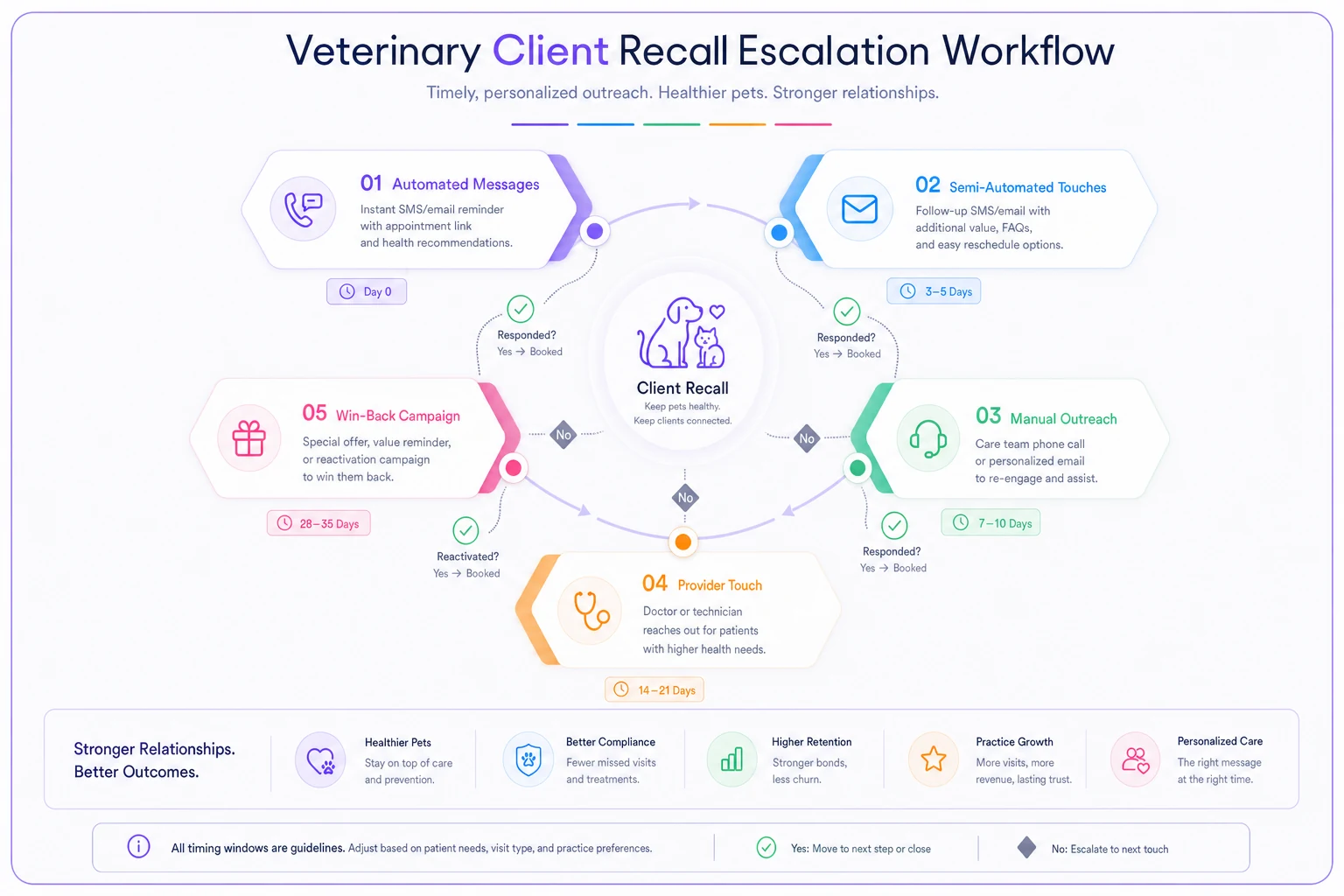
Level 1 - Automated (Days 0-14)
-
System-generated email or text based on segment
-
Include online booking link
-
Track opens and clicks but don't act yet
Level 2 - Semi-Automated (Days 15-30)
-
Second automated touch via different channel
-
More urgent messaging
-
Flag high-value clients for review
Level 3 - Manual Outreach (Days 31-45)
-
Staff phone call using segment script
-
Note attempt in system
-
Leave specific voicemail if no answer
Level 4 - Provider Touch (Days 46-60)
-
Doctor or senior tech makes the call
-
Personalized message about the specific pet
-
Only for top 20% lifetime value clients
Level 5 - Win-Back Campaign (Day 61+)
-
Special offer or incentive
-
Handwritten note for highest-value clients
-
Move to quarterly touch program
Timing and intensity adjust based on both client value and recall reason. An overdue rabies vaccine might compress this timeline to 30 days total, while an overdue wellness exam for a young healthy pet might stretch to 90 days.
What most clinics miss is the "stop pursuing" decision. Chasing every inactive client wastes significant operational resources. A reasonable framework: stop after three attempts for clients under $500 annual value, five attempts for $500-2,000, and customize the approach for anyone over $2,000 annually.
Lost Client Recovery That Makes Sense
Clients leave for different reasons, and win-back strategy needs to reflect that. A client who switched vets after a bad experience needs a completely different approach than one who moved, lost their pet, or just drifted away from preventive care.
The operational challenge is identifying why they left without making awkward survey calls. Transaction patterns usually tell the story. A client who stopped suddenly after years of regular visits following an emergency? Likely a service issue. Gradual decline in visit frequency? Probably price sensitivity or life changes. Abrupt stop after a chronic diagnosis? Could be overwhelm or a move to specialty care.
Service Recovery Track (suspected bad experience)
-
Personal call from the practice manager
-
Acknowledgment without admission
-
Specific offer to make it right
-
Clear mention of service improvements
Price Sensitivity Track (declining frequency)
-
Wellness plan or payment options
-
Bundle services for savings
-
Emphasize that prevention costs less than crisis care
-
Gradual re-engagement strategy
Specialty Referral Track (complex cases)
-
Offer co-management
-
Update on new capabilities
-
Specialist relationship highlights
-
Focus on convenience of local care
Timing matters too. Attempting recovery too soon feels desperate. Waiting too long means they've established care elsewhere. For regular clients, the sweet spot is usually 4-6 months of inactivity. For sporadic users, more like 8-12 months.
Building the KPI Dashboard
Most veterinary client retention systems fail because nobody connects recall activity to actual revenue. You need a dashboard that tracks both activity metrics and financial outcomes.
The activity side should cover:
-
Recalls sent by segment and channel
-
Response rates by segment and channel
-
Conversion to appointments
-
Time from recall to booking
-
Escalation effectiveness
-
Staff time per successful booking
The revenue side needs:
-
Revenue per recall campaign
-
Lifetime value by segment
-
Reactivation revenue
-
Cost per reactivated client
-
Preventive care compliance rates
-
Service mix changes post-recall
A functional dashboard might show that email recalls to wellness maintainers generate $47 per send, while phone calls to lapsed chronic patients yield $312 per successful contact. That data drives real resource allocation decisions.
A monthly view might look something like this:
| Segment | Sent | Responded | Booked | Revenue | Cost | ROI |
|---|---|---|---|---|---|---|
| Wellness | 245 | 89 | 67 | $8,710 | $490 | 17.8x |
| Crisis | 178 | 31 | 19 | $3,420 | $534 | 6.4x |
| Chronic | 48 | 38 | 34 | $9,180 | $336 | 27.3x |
| Lapsed | 92 | 12 | 8 | $1,920 | $368 | 5.2x |
This level of visibility transforms recall from a checkbox activity into a revenue-driving operation. Staff understand why chronic patient recalls get priority. Managers can justify investing in better email automation when they see the ROI difference.
Automation Without Losing the Personal Touch
The tension in building a veterinary client retention system is maintaining efficiency while preserving the relationship-based nature of veterinary care. Pure automation feels cold. Pure manual outreach doesn't scale.
The balance comes from automation that enhances rather than replaces personal interaction. Automated systems handle the routine - sending reminders, tracking responses, flagging overdue accounts. This frees staff for high-value touches: calling chronic patients, welcoming new clients, recovering lapsed relationships.
Modern operational platforms can segment clients based on transaction history, generate channel-appropriate messages, and flag clients who are showing early signs of lapsing. But the decision to pick up the phone for a longtime client whose senior dog hasn't been in for six months? That stays human.
The practices seeing real retention improvements use automation to surface insights, not make decisions. The system might flag that Mrs. Johnson's diabetic cat is overdue for glucose monitoring, but the tech who calls can add, "I remember Mittens was doing so well on the new insulin dose. How's she been doing at home?" That combination of operational efficiency and personal knowledge is what actually drives retention.
Implementation Without Disruption
Rolling out a new retention system while keeping daily operations running requires careful staging. Start with one segment - usually wellness maintainers since they're the most responsive and least operationally complex. Get the recall cadence, channels, and scripts working before expanding.
Month one might focus just on email automation for annual exams. Month two adds text messaging. Month three introduces phone escalation. By month six, you're running multi-channel campaigns across all segments, but the team has adapted gradually rather than facing wholesale change all at once.
The technology side matters but isn't the bottleneck most clinics assume. Most practice management systems can handle basic segmentation and recall. The real challenge is getting staff to follow the protocols consistently - which means clear documentation, regular training, and visible tracking of results.
Smart clinics also integrate their recall system with teletriage protocols, using remote consultations as another touchpoint for reconnecting with lapsed clients. A client calling about a minor concern gets triaged appropriately, but also receives a follow-up about their overdue preventive care.
The Revenue Reality
A mid-sized clinic with around 2,800 active clients typically sees these patterns when implementing a proper veterinary client retention system:
-
15-20% increase in annual wellness visits within six months
-
25-30% improvement in chronic care compliance
-
8-12% of lapsed clients reactivated per quarter
-
Average lifetime value increases by $240-380 per client
For a practice doing $1.3 million annually, that translates to roughly $195,000-260,000 in additional revenue without adding a single new client. The operational investment - staff time, technology, training - usually runs $25,000-40,000 in the first year.
The less tangible benefits matter too. Staff spend less time on unsuccessful recall attempts. Doctors see more preventive cases and fewer crisis presentations. Client satisfaction improves when their pet's health is proactively managed rather than reactively patched together.
Beyond the Basics
Once the core retention system runs smoothly, more advanced tactics become practical. Predictive analytics can identify clients likely to lapse before they actually do. Life stage marketing can proactively educate clients about upcoming needs. Automated wellness plan renewals can lock in recurring revenue with minimal manual effort.
Some practices layer in loyalty programs, though the operational complexity often outweighs the benefit for smaller clinics. Others focus on building retention into every client touchpoint - appointment confirmations that mention upcoming needs, invoice emails with care recommendations, even seasonal reminders tied to specific services.
The practices that genuinely excel at retention treat it as an operational system, not a marketing campaign. Every interaction either strengthens or weakens the client relationship. Every process either makes it easier or harder for clients to get appropriate care. Every communication either adds value or creates noise.
Building a veterinary client retention system that actually predicts and drives revenue isn't about sophisticated technology or complex algorithms. It's about understanding your client segments, mapping appropriate outreach strategies, and connecting activity to financial outcomes. Most clinics already have the tools. What they lack is the operational discipline to use them systematically rather than sporadically.
The difference between clinics that grow predictably and those that struggle isn't always the quality of medicine or even client service. A lot of it comes down to whether they've built repeatable systems that turn first visits into lifetime relationships. In a market where acquiring a new client costs significantly more than keeping an existing one, that operational capability becomes the difference between thriving and merely surviving.
Ready to elevate your clinic’s efficiency?
Join 500+ veterinary clinics using Veterinaryly to save time, reduce administrative overhead, and improve patient care.