
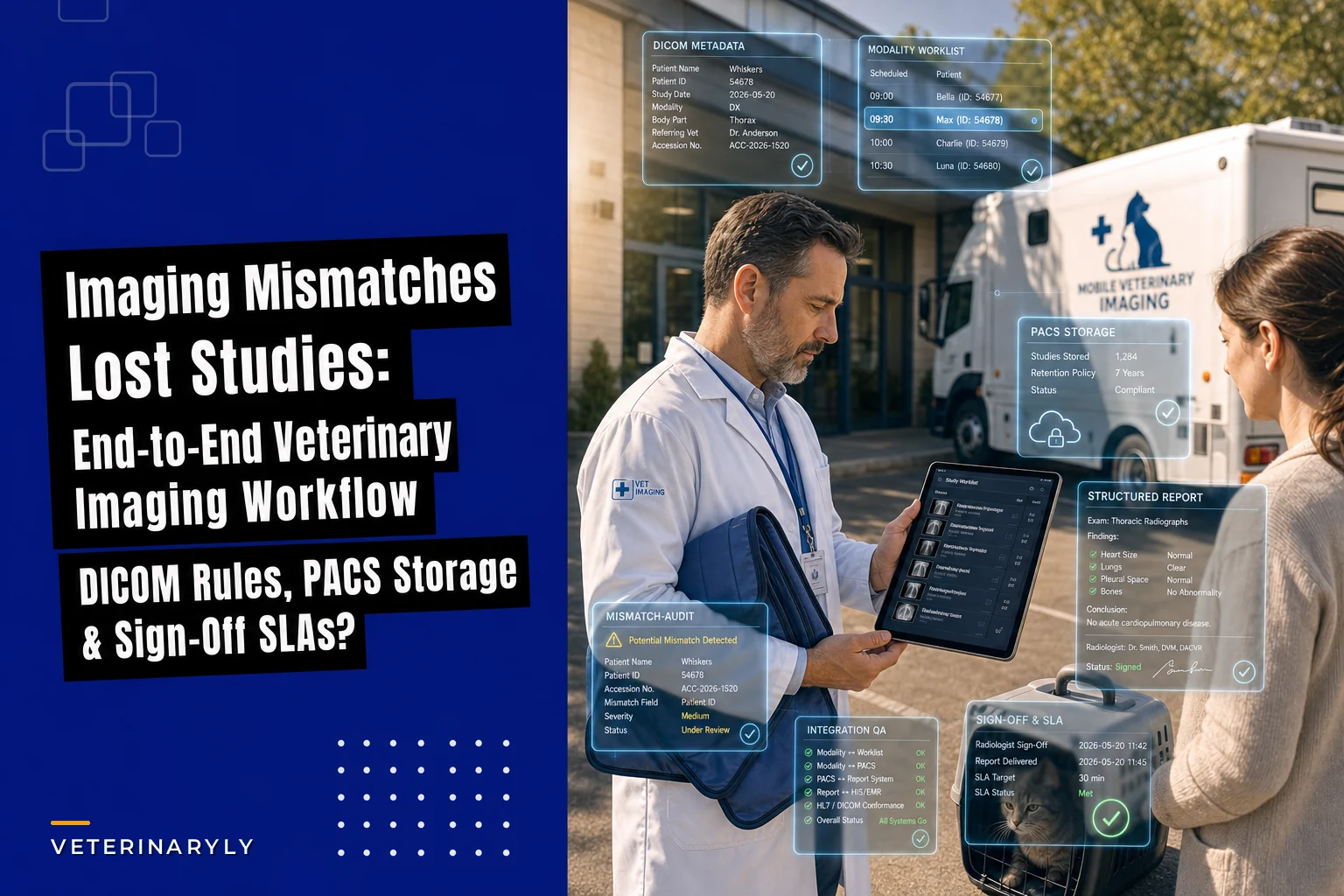

There's a specific kind of chaos that only shows up in imaging. A dog comes in for a limp, the tech shoots four views, and three weeks later nobody can find them. Or worse — they find them, but they're filed under a cat named Biscuit who was in the same afternoon block. The radiographs are technically fine. The machine worked. The problem is everything around the machine.
This is the part of the veterinary imaging workflow that DICOM standards were supposed to solve, and mostly do — but only if your clinic actually enforces the metadata rules the standard depends on. When clinics skip that enforcement, they don't lose the ability to take images. They lose the ability to trust them. And a study you can't trust is worse than no study at all, because someone might act on it.
The failures happen at predictable points, and they're almost never where people expect.
Where imaging pipelines actually break
Most people assume the risk is technical — corrupted file, dead hard drive, PACS going down. Those happen, but they're rare and usually recoverable. The failures that quietly cost clinics money and create liability are almost always data-entry and handoff failures, not hardware failures.
The pattern goes like this. A modality — your CR/DR plate, ultrasound, or CT — tags every image it produces with a set of DICOM fields: Patient Name, Patient ID, Accession Number, Study Date, Modality, and a handful of others. If those fields are wrong at the moment of capture, every downstream system inherits the mistake. PACS doesn't know Biscuit the cat isn't Biscuit the dog. It just files what it's told.
In practice, the wrong-patient problem usually happens one of three ways:
-
Manual entry at the modality. The tech types the patient name directly into the ultrasound or X-ray console instead of pulling from a worklist. Typos, wrong spelling variants, or grabbing the last patient still loaded on screen.
-
Reused accession numbers or no accession number at all. Two studies end up sharing an identifier, and PACS merges or overwrites.
-
Species and breed fields left blank or defaulted. Sounds minor until a reviewing radiologist gets a "canine" tag on a feline thorax and calibrates their read wrong.
A clinic can run for years like this and only notice when something goes badly — an insurance dispute, a referral radiologist flagging a mismatch, or a client who swears their pet never had that procedure.
The metadata rules that are actually mandatory (not optional)
There's a difference between DICOM fields that exist and DICOM fields your clinic requires to be populated correctly before a study is considered valid. Most clinics never draw that line, so everything is treated as optional in practice.
Never miss a pet’s appointment again.
Veterinaryly helps you schedule, confirm, and manage every appointment and patient record effortlessly.
- Centralized appointment & patient management
- Automated client reminders
- Staff scheduling & task tracking
No credit card required
Draw the line. These are the fields that should block a study from being marked complete if they're wrong or empty:
| Field | Why it's mandatory | Common failure |
|---|---|---|
| Patient ID | Ties study to the correct medical record | Free-typed, doesn't match PIMS ID |
| Patient Name | Human-readable verification | "Rex" vs "Rex Smith" vs "Rex (Johnson)" |
| Accession Number | Unique per study, links order → images → report | Reused, blank, or auto-incremented incorrectly |
| Study Date/Time | Sequencing, retention, dispute resolution | Console clock never set, off by hours or days |
| Modality | Drives storage rules and reporting template | Defaulted or wrong on multi-modality consoles |
| Referring/Requesting Vet | Sign-off routing | Left blank, report goes nowhere |
| Species | Affects interpretation and calibration | Defaulted to a single species |
The single highest-leverage fix is modality worklist (MWL). Instead of a tech typing patient details at the console, the console pulls the day's ordered studies directly from your practice management system. Patient, ID, accession number, and referring vet all populate automatically from the order. Manual typing at the modality drops to near zero.
If your equipment supports MWL and you're not using it, that's the first thing to fix — before any policy, any template, any of the rest of this. It removes the most common source of mismatches right at the source.
Storage and retention: the part everyone underestimates
Imaging storage is deceptively cheap until it isn't. A single CT study can run 200–500 MB. A busy general practice shooting radiographs and ultrasound daily generates far more data than most owners expect, and it compounds year over year.
The real problem isn't cost though — it's retention policy that nobody ever wrote down. When there's no policy, one of two things happens: clinics keep everything forever with no backup discipline, or someone quietly deletes old studies to free space with no rules about what's safe to remove.
-
Active storage (0–24 months) Fast local PACS, immediately retrievable, backed up nightly.
-
Near-line storage (2–7 years) Cheaper storage, retrievable within minutes, still backed up. Most jurisdictions require records retention in this range — check your state or provincial requirements, since imaging usually falls under the same medical-record rules.
-
Archive/cold storage (beyond your legal minimum) Optional, compressed, off-site.
Two rules that prevent most disasters:
-
The 3‑2‑1 principle. Three copies of the data, on two different media types, one off-site. A single NAS in the back room is not a backup strategy. It's a single point of failure with a comforting blinking light.
-
Test your restores. A backup you've never actually restored from is a hypothesis, not a backup. Pull a random study from backup once a quarter and confirm it opens with intact metadata.
The pattern that repeats: clinics discover their backup was silently failing only when they need it. The imaging drive dies, they go to the backup, and it's been throwing errors for months that nobody caught because the alert email went to a mailbox no one checks. That's not bad luck — it's an audit gap.
The imaging drive dies, they go to the backup, and it's been throwing errors for months that nobody caught because the alert email went to a mailbox no one checks. That's not bad luck — it's an audit gap.
Reporting templates and sign‑off SLAs
A study isn't finished when the images are captured. It's finished when someone qualified has interpreted it, documented findings in a structured way, and signed off — and when the referring vet actually receives that read.
The gap between "images exist" and "report is signed and delivered" is where cases stall. A dog's thoracic rads get shot Friday afternoon, sent to a teleradiology service, and the read comes back Saturday — but nobody's watching the inbox until Monday. That's a two-day delay on a case that might have needed same-day action.
Structured reporting templates matter more than most clinics think. A free-text "looks okay" note is nearly useless three months later. A structured template forces completeness:
-
Study type and views obtained
-
Technical quality (adequate / limited, with reason)
-
Systematic findings by region
-
Impression / differential
-
Recommendations and follow-up
-
Interpreting clinician and sign-off timestamp
Then attach an SLA to each step so delays are visible instead of invisible:
| Study urgency | Target read + sign-off | Escalation if breached |
|---|---|---|
| Emergent (in-clinic critical) | Within 1 hour | Notify attending vet directly |
| Same-day (surgical/acute) | Within 4 hours | Flag to shift lead |
| Routine (recheck, screening) | Within 24–48 hours | Daily unread-study review |
The point of the SLA isn't to punish anyone. It's to make an overdue read impossible to miss. A study that blows its SLA should surface on a list someone owns — not a shared inbox, not "whoever checks it" — an actual person who is responsible for escalating when something is overdue.
Mismatch‑audit steps: catching the wrong-patient study before it matters
Even with worklist enforcement, mismatches slip through — a corrected order, a re-shoot under the wrong open study, a manual override. So you need a routine that catches drift. This is the same discipline that keeps lab results from ending up on the wrong chart; if you've already tightened your sample collection and result-routing process, imaging is the natural next system to lock down, because the failure mode is nearly identical: right data, wrong record.
A weekly mismatch audit doesn't take long once it's a routine:
-
Reconcile orders to studies. Pull every imaging order from the past week. Every order should have exactly one matching study by accession number. Orders with no study = lost or never-performed. Studies with no order = something was shot off-book.
-
Cross-check Patient ID against name. Sort studies by Patient ID and eyeball the names. A single ID tied to two different names is your smoking gun.
-
Check species/modality sanity. Feline studies tagged canine, ultrasound studies tagged as radiography — these are fast to spot and usually indicate a console defaulting.
-
Verify sign-off status. Any study older than its SLA that's still unsigned gets escalated, not ignored.
-
Spot-check date/time. Studies with timestamps that don't line up with the visit date usually mean the console clock is wrong — fix it before the drift gets worse.
Keep a simple log of what the audit finds. Over a few weeks it tells you where your pipeline leaks — almost always one console, one tech's habit, or one workflow step — and you fix the source instead of chasing individual errors forever.
The workflow looks like this:
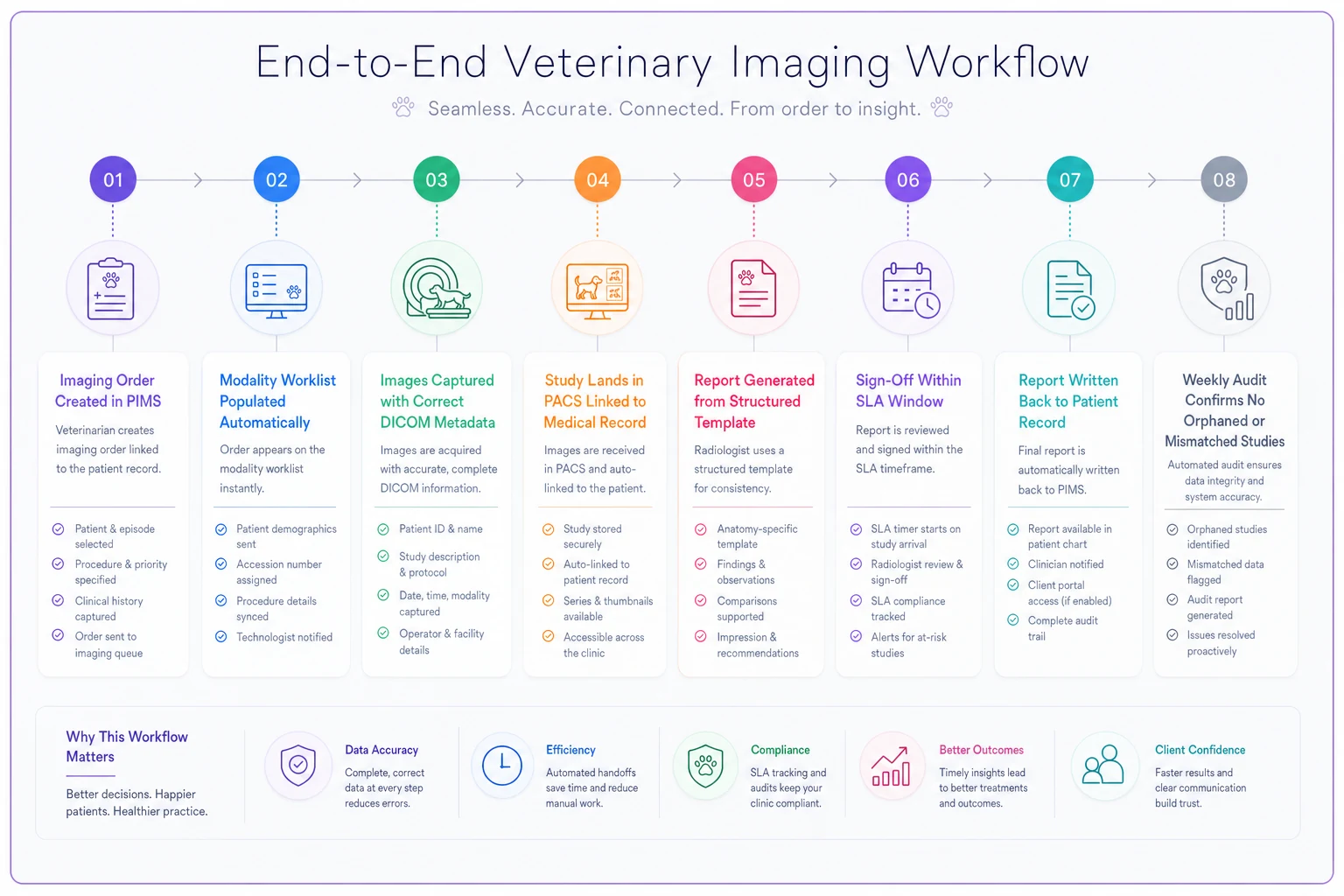
Use that flow as the checklist for your weekly audit so each step is verified and someone owns the escalation if something is missing.
Integration QA: the seams between systems
Every handoff between systems is a place data can silently drop or mutate. PIMS → modality worklist → PACS → reporting → back into the medical record. Each arrow is a seam, and seams are where things fail.
A basic integration QA routine covers a few things worth doing consistently.
-
Round-trip test monthly. Create a test order in your PIMS, confirm it appears on the modality worklist, shoot a dummy image, confirm it lands in PACS with correct metadata, then confirm the report writes back to the correct record. If any step drops a field, you've found a config problem before a real patient hits it.
-
Watch for orphaned studies. Images that made it to PACS but never linked back to a medical record. These are the ones that go "missing." They exist, they're just unreachable through the chart.
-
Confirm character and name handling. Apostrophes, hyphens, and long names break naive integrations. Test a patient named "O'Malley-Featherstone III" and see what survives.
Include a monthly round-trip test order that uses edge-case names (apostrophes, hyphens, long suffixes) to catch parsing issues early.
This is where a connected practice management platform genuinely earns its keep. When the order, the worklist, the storage rules, and the sign-off routing all live in one system rather than three disconnected ones, the seams get shorter and mismatches get caught earlier. AI-assisted workflow tools can flag anomalies automatically — a Patient ID with two names, a study past its SLA, a backup that failed last night — so problems surface without someone having to remember to look for them.
A short real scenario
A three-vet general practice, somewhere around 320–360 imaging studies a month across digital radiography and ultrasound, was manually entering patient details at both consoles. Their referring specialty hospital flagged two wrong-patient studies in a single quarter — the kind of thing that ends referral relationships fast.
They did three things: turned on modality worklist so orders populated the consoles automatically, set a weekly 20-minute mismatch audit, and put a 24-hour sign-off SLA on routine reads with a daily unread-study check.
Within about two months, manual typing at the console effectively stopped, and the audit was catching maybe one or two drift errors a week instead of the silent pile they'd been accumulating. Orphaned studies dropped to near zero. The bigger win was less visible: the referring hospital stopped flagging mismatches, and the practice stopped burning staff time hunting for radiographs that were technically "somewhere in PACS." Nobody could put an exact dollar figure on it, but the reduction in re-shoots alone — patients re-radiographed because the original couldn't be found — was noticeable across a full quarter.
When this level of rigor makes sense — and when it's overkill
When it makes sense: You're shooting more than a handful of studies a week, you refer out for reads, or you have more than one person operating imaging equipment. The moment there's a handoff between people or systems, the mismatch risk is real and the structure pays for itself.
When it's lighter-touch: A single-doctor practice shooting occasional radiographs, reading them in-house, and filing them the same day can run a simpler version — worklist if the equipment supports it, a basic naming convention, and reliable backups. You still need retention and backup discipline. You don't need a formal weekly audit meeting.
Don't build a five-tier SLA matrix for a clinic doing twelve studies a month. Match the process to the volume. Heavy process that nobody follows is just as damaging as no process, because staff route around rules that feel absurd for their actual workload. That same tension between overbuilt and underbuilt systems shows up in scheduling too — we covered it in the piece on capacity-first appointment flow.
Closing thought
Imaging failures rarely announce themselves. The machine works, the images look fine, everything seems normal — until a study is on the wrong patient or can't be found when a case actually depends on it. The fix isn't better equipment. It's enforcing the metadata rules DICOM already gives you, writing down retention and backup policy, attaching SLAs to sign-off so delays become visible, and running a short audit that catches drift before it compounds.
Start with modality worklist. Then add the weekly audit. Everything else builds from those two, and both are small enough to implement in a week without buying anything new.
Ready to elevate your clinic’s efficiency?
Join 500+ veterinary clinics using Veterinaryly to save time, reduce administrative overhead, and improve patient care.