
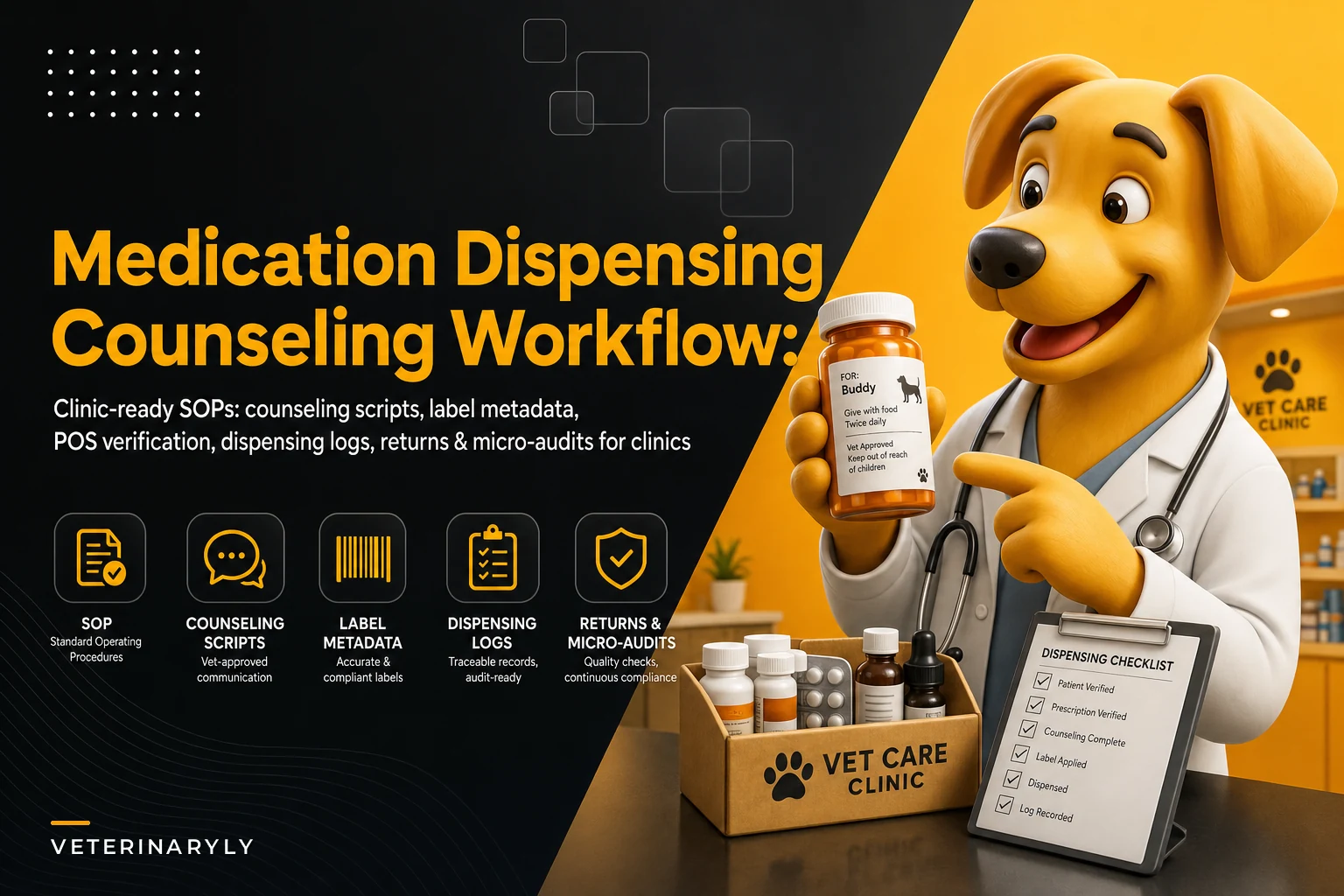

A cat goes home with a bottle of methimazole. The label says "give one tablet twice daily." What it doesn't say: the tablet needs to be split, the owner should wear gloves, and the pet needs a recheck in two weeks. Three weeks later the owner calls, worried the cat is vomiting and lethargic. Nobody wrote down which strength went out the door, the counseling was verbal and rushed, and now you're reconstructing a dispensing event from memory and a POS line item that just says "Methimazole - 30ct."
That gap — between what's on the label, what was actually said, and what got logged — is where most outpatient dispensing mistakes live. Not in the pharmacy math. In the handoff.
This covers the full path a medication takes from "doctor decides to prescribe" to "client walks out with it correctly" — and the micro-checks that catch errors before the pet is affected. Narrow on purpose. This isn't controlled-substance inventory (that's its own subject, covered separately in the controlled-substance inventory and compliance workflow post). This is the everyday outpatient stuff: antibiotics, NSAIDs, thyroid meds, eye drops — things that go home dozens of times a week and rarely get a second look.
Where the workflow actually breaks
The label is built from memory or a shortcut. A tech types the sig from what they think the doctor wants, or copies it from the last time that drug went out. Strength changes, weight changes, and the auto-filled sig doesn't.
Counseling happens or it doesn't — and nobody knows which. In a busy clinic, the person handing the bag at checkout isn't always the person who filled it. The front desk assumes the tech counseled. The tech assumes the doctor did. The client gets a bottle and an "any questions?" and leaves.
The POS and the log disagree. The point of sale records a sale. The dispensing log — if it exists as anything beyond the invoice — records what physically left inventory. When those two don't reconcile, you can't tell whether a shortage is theft, a miscount, or a med that went out unbilled.
Returns and disposal are a shrug. A client brings back an unopened bottle of an expensive chronic med. What happens? In too many clinics: it goes back on the shelf, disappears into a drawer, or gets tossed with no record. All three create problems.
The pattern underneath all of this is the same: dispensing gets treated as a single moment ("hand over the meds") when it's actually a chain of five distinct steps, each of which can fail independently.
The five-step chain, and what has to be true at each one
Think of an outpatient prescription as passing through five gates. A mistake that gets past gate one gets more expensive at every gate after.
Never miss a pet’s appointment again.
Veterinaryly helps you schedule, confirm, and manage every appointment and patient record effortlessly.
- Centralized appointment & patient management
- Automated client reminders
- Staff scheduling & task tracking
No credit card required
-
Prescription decision — the doctor specifies drug, strength, dose, route, frequency, duration, and any warnings. This lives in the record, not in someone's head.
-
Label generation — the label is built from the prescription data, not retyped. Strength and quantity match what's physically pulled.
-
Fill and verify — someone confirms the physical product matches the label and the record. Right drug, right strength, right count.
-
Counseling at handoff — a scripted conversation happens, and the fact that it happened gets recorded.
-
Log and reconcile — the dispensing event is logged with full metadata, and the log reconciles against POS and inventory.
Where clinics collapse this is by treating steps 2–4 as one motion done by one hurried person. The fix isn't more staff. It's putting a hard stop between fill and handoff, and making counseling a required, checkable event rather than a courtesy.
Here's a simple visualization of the five gates.
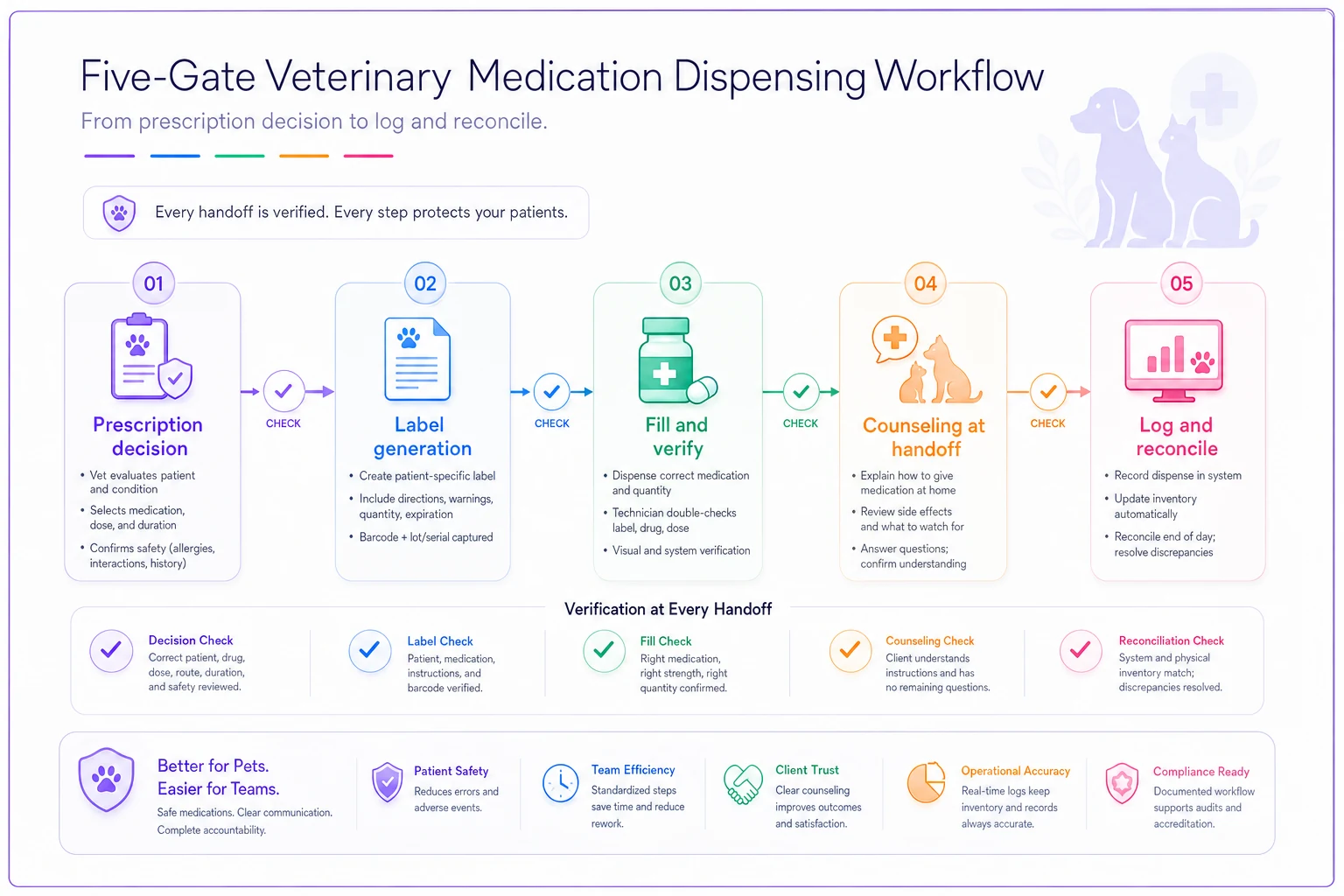
The visual shows how a mistake that slips past an earlier gate becomes harder to catch later in the chain.
Mandatory label metadata (the part everyone shortcuts)
A label that reads "Amoxicillin - give as directed" is a liability magnet. "As directed" means nothing three weeks later when the owner is confused and the record doesn't help.
Here's what should be non-negotiable on every outpatient label:
-
Patient name AND owner last name (prevents the two-dog-household mixups)
-
Species and weight at time of prescribing (so the dose can be sanity-checked later)
-
Drug name, strength, and concentration — spelled out, not abbreviated
-
Exact sig
dose, route, frequency, duration — no "as directed"
-
Quantity dispensed as a physical count
-
Refills authorized (or explicitly "no refills")
-
Prescribing veterinarian
-
Fill date and expiration/beyond-use date
-
Warnings and auxiliary labels (give with food, shake well, wear gloves, may cause drowsiness)
-
Storage requirements (refrigerate, protect from light)
The most common label error in outpatient settings isn't the drug — it's the duration and refill fields left blank or wrong. A pet on a 30-day NSAID trial gets a bottle with no stop date and one accidental refill authorization, and now there's a dog on chronic carprofen with no rechecks and no bloodwork. That's not a labeling typo. That's a monitoring failure that started as a labeling typo.
The rule that fixes most of this: the label pulls from the prescription record — nobody retypes a sig. If the sig is wrong on the label, it's wrong in the record, and it gets caught at verification instead of at the client's kitchen table.
Counseling scripts that actually get used
The reason counseling gets skipped isn't that staff don't care. It's that "counsel the client" is a vague instruction, and vague instructions lose to a full waiting room every time.
The fix is a short, drug-category script that fits on a card or a screen. Not a lecture — a checklist the counselor runs through out loud. For most outpatient meds, four or five scripts cover the majority of what leaves the building.
Example: NSAID counseling script (dogs)
-
Confirm what the medication is for and how long
-
Give with food, once daily unless told otherwise
-
Watch for
vomiting, diarrhea, dark stools, loss of appetite, yellowing of the gums or eyes
-
Stop the drug and call if any of those appear
-
Do not combine with any other pain med (including anything from home) without asking first
-
Recheck bloodwork in ___ (fill from the plan)
-
Confirm the client can repeat back the dose and the warning signs
That last line matters more than the rest. Teach-back — having the client repeat the key instruction — catches the misunderstanding while they're still standing in front of you. A client who says "so, one pill in the morning with breakfast, and I watch for throwing up" has actually absorbed it. A client who nods has not necessarily.
The categories worth having a standing script for:
| Drug category | The one thing most owners get wrong |
|---|---|
| NSAIDs | Combining with other pain meds; skipping recheck bloodwork |
| Antibiotics | Stopping early once the pet "seems better" |
| Thyroid / cardiac | Timing consistency; not realizing it's lifelong |
| Ophthalmics | Contamination of the tip; wrong eye; order of multiple drops |
| Ear/topical | Not cleaning first; stopping too soon |
| Insulin | Handling, storage, syringe units vs mL confusion |
The metadata that matters for counseling is simple: who counseled, on what date, and that teach-back was confirmed. One line in the record. That's the difference between "we always counsel" and being able to prove it when a client claims they were never told about the food requirement.
The POS check that catches the discrepancies
The point of sale and the dispensing log answer two different questions. The POS says "what did we charge for." The log says "what physically left inventory." When you only have the POS, unbilled dispensing is invisible.
A simple reconciliation habit closes this. At checkout, the person at the register confirms three things line up:
-
The medication on the invoice matches the label on the bag
-
The quantity charged matches the quantity dispensed
-
Nothing in the bag is missing from the invoice
That third check is the important one. A tech fills three meds, the doctor adds a fourth verbally, and only three make it onto the invoice. The client walks out with a free bottle of gabapentin and your inventory count is now off with no explanation. Do that a few times a week and you're looking at a meaningful annual leak that never shows up as an obvious problem — it just quietly drains margin.
The best micro-check here is a two-item match at register: bag contents vs. invoice line items, done out loud. Fifteen seconds. It catches both the unbilled item and the "charged but not actually in the bag" mistake, which is the one that generates the angry phone call.
Dispensing logs and reconciliation
Your dispensing log is the spine of this whole thing. If a client calls three weeks later about a reaction, the log should let you answer — in under a minute — exactly what went out: drug, strength, lot, quantity, who filled it, who counseled, and what the label said.
A workable outpatient dispensing log entry captures:
-
Date and time
-
Patient and owner
-
Drug, strength, quantity
-
Lot number and expiration (yes, even for non-controlled — this is what makes recalls survivable)
-
Prescribing vet and filling staff
-
Counseling confirmed (Y/N + who)
-
Linked invoice number
Reconciliation then becomes a periodic sanity check: does what the log says left inventory match what the counts say is gone, and does it match what the POS billed? Three sources, one truth. When they disagree, you investigate before the gap grows.
Clinics that skip lot numbers on outpatient meds find out how much that shortcut costs the day a manufacturer recall hits and they can't tell which clients got the affected lot. It's one of those things that feels like overkill until it isn't.
Returns and disposal SOPs (the part with real legal exposure)
Returns are where good intentions create bad outcomes. A client brings back an unopened, in-date bottle of an expensive med. Restocking it feels thrifty. It's also, in most jurisdictions, not allowed for dispensed drugs — once it's left your control, you can't guarantee storage conditions, and reselling it is a real problem.
A clean returns/disposal SOP handles three cases distinctly:
-
Returned, unopened, in-date — document the return, do NOT restock, route to disposal or a documented credit-and-destroy process per your state rules.
-
Returned, opened or expired — document and dispose per DEA/state guidelines (non-hazardous vs. hazardous waste stream matters).
-
Client-initiated disposal question — give clear take-back guidance rather than "flush it" or "trash it," both of which create environmental and diversion issues.
Every disposal event gets logged the same way a dispensing event does: what, how much, lot, date, method, and two initials for anything requiring witnessed destruction. That witnessed-destruction habit is familiar to anyone who's built a real controlled-substance process, and it's worth extending to high-value or high-risk outpatient meds too.
A quick micro-audit you can run this month
You don't need a full audit to find out whether this workflow is holding. Pull ten recent outpatient dispensing events at random and check:
-
[ ] Label sig matches the prescription in the record exactly
-
[ ] Duration and refill fields are filled in (not blank, not "as directed")
-
[ ] Quantity on label matches quantity billed
-
[ ] Counseling was recorded with a name and date
-
[ ] Lot number is captured in the log
-
[ ] Warnings/auxiliary labels present where required
-
[ ] For any returns in the batch
documented, not restocked
If more than two of your ten fail on any single line, that line is your priority fix. Most clinics fail hardest on counseling documentation and lot capture — the two things that feel optional right up until you need them.
What this looks like in practice
A three-doctor small-animal practice was running somewhere around 60–70 outpatient prescriptions a week. No formal dispensing log beyond the invoice, verbal counseling with nothing recorded, no lot capture on non-controlled meds. Twice in one quarter they had reaction calls they couldn't fully reconstruct, and their monthly inventory counts were consistently off by an amount that mapped to a few hundred dollars of unbilled product a month.
They made three changes — nothing complicated: labels pulled from the record instead of retyped, a required counseling checkbox with the counselor's initials, and a two-item bag-vs-invoice match at the register. Within a couple months the inventory discrepancies dropped to near noise, the register check was flagging one or two unbilled items a week that used to just walk out the door, and when a reaction call came in, the tech could pull the full dispensing history in under a minute. No new hires. Just closing the gaps between the five gates.
When to formalize this — and when not to overbuild
If you're a small practice doing a handful of outpatient scripts a day, you don't need a heavy system — you need the label-from-record rule and the counseling checkbox, and that's most of the benefit. Over-building a rigid pharmacy SOP for a two-person clinic just creates paperwork nobody keeps up with.
The moment to formalize the full log-and-reconcile loop is when more than one person fills and hands off meds, because that's when the "I assumed you counseled" failures start. Multi-doctor practices and anyone with separate fill/checkout roles should treat the reconciliation loop as mandatory, not optional.
Where practices naturally move toward operational software is when the record, the label, the log, and the POS stop talking to each other — when reconciliation means opening three systems and manually eyeballing them. Platforms that pull the label directly from the prescription record and log the dispensing event automatically remove the retyping step, which is where a surprising share of these errors originate. But that's a convenience built on top of good discipline, not a substitute for it. The workflow works on paper too; software just makes the reconciliation faster and harder to skip.
The thread that ties it together
Outpatient dispensing errors almost never come from one dramatic mistake. They come from five small handoffs where a step got assumed instead of confirmed. The label got retyped instead of pulled. The counseling got nodded through instead of confirmed with teach-back. The item left the building without hitting the invoice. The lot never got logged. The return went back on the shelf.
Fix the handoffs and the errors have nowhere to hide. If you're already building tight documentation discipline elsewhere — the kind of structured handoffs described in the perioperative documentation and handoff templates post — this is the same muscle applied to the pharmacy. Same principle: don't let the important step depend on someone remembering to do it.
Fix the handoffs and the errors have nowhere to hide. If you're already building tight documentation discipline elsewhere — the kind of structured handoffs described in the perioperative documentation and handoff templates post — this is the same muscle applied to the pharmacy. Same principle: don't let the important step depend on someone remembering to do it.
Ready to elevate your clinic’s efficiency?
Join 500+ veterinary clinics using Veterinaryly to save time, reduce administrative overhead, and improve patient care.