



Most clinics don't have a technology problem. They have a sequencing problem. There's a new PIMS feature, a digital radiology upgrade, a client app the rep keeps emailing about, a lab integration someone promised would "save hours," and a cardboard box with a dental charting tablet nobody finished setting up. Each one looked reasonable on its own. Together they form a half-finished pile of partially adopted tools that confuse staff and drain money.
The clinics that handle this well aren't smarter about tech. They're more disciplined about order. They score every digital investment the same way, every time, and they refuse to start project B until project A is actually live and being used. That discipline is the whole point of a veterinary practice digital roadmap — not a software wishlist, but a ranked, governed sequence of decisions tied to clinical impact and real risk.
This is the system for building one.
Why clinics end up with a drawer full of half-adopted tech
The pattern is almost always the same, and it's rarely about laziness. It's about how buying decisions actually happen inside a busy practice.
A tool gets purchased because of a trigger — a bad week, a conference demo, a competitor's new app, a frustrated associate. The purchase is emotional and fast. Implementation, which is slow and boring and requires actual workflow redesign, never gets the same energy. So the tool arrives, gets a half-day of attention, and then collides with a full appointment book.
What tends to happen across a lot of practices is that the failure isn't the software. It's that three or four tools were adopted in parallel, each needing staff behavior change at the same time. People can absorb maybe one meaningful workflow change at a time without quality dropping. Launch four at once and all four get done badly.
There's also a dependency problem nobody maps up front. A client-communication app that pulls appointment data is useless if your scheduling data is messy. A new lab integration assumes your result-routing rules are already clean. Buy the shiny layer before the foundation is solid and you've just automated a mess faster.
The roadmap forces two questions before any money moves: Is this the highest-value thing we could do right now? and Does anything need to be true first before this will actually work?
The scoring matrix: four dimensions, one number
Every proposed digital investment gets scored on four axes. Keep the scale 1 to 5 — anything more granular just invites fake precision and endless debate.
Never miss a pet’s appointment again.
Veterinaryly helps you schedule, confirm, and manage every appointment and patient record effortlessly.
- Centralized appointment & patient management
- Automated client reminders
- Staff scheduling & task tracking
No credit card required
Clinical impact. How much does this improve patient outcomes, diagnostic accuracy, or safety? A medication-interaction check scores high. A prettier invoice template scores low. Be honest here; this is where teams inflate scores because everything feels important.
Effort. How much work does real adoption actually require? This includes staff training, data cleanup, and the weeks of hand-holding after go-live — not just the install. Score this inverted so high scores mean low effort.
Dependencies. Does this require other systems, data quality, or process changes to be in place first? Fewer dependencies score higher. A standalone tool scores 5. Something that needs three other things working first scores 1.
Compliance and risk. Does this touch controlled substances, consent, medical records integrity, or client data? Low inherent risk scores high for prioritization, but any high-risk project gets flagged separately for a governance review regardless of its total score.
| Dimension | Weight | 1 (poor) | 3 (moderate) | 5 (strong) |
|---|---|---|---|---|
| Clinical impact | ×3 | Convenience only | Indirect outcome effect | Direct safety/diagnostic gain |
| Effort (inverted) | ×2 | Months, heavy retraining | Weeks, some cleanup | Days, minimal change |
| Dependencies | ×2 | Needs 3+ things first | One prerequisite | Fully standalone |
| Compliance risk (inverted) | ×1 | Touches CS/records/consent | Some client data | No sensitive data |
Multiply each score by its weight, add it up, and you get a single prioritization number. Clinical impact is weighted heaviest on purpose — it's the thing clinics say matters most and then quietly deprioritize when a billing feature is easier to install.
A worked example: a practice is weighing two projects. A digital controlled-substance log scores clinical impact 4, effort 3, dependencies 4, compliance risk 1. Weighted: 12 + 6 + 8 + 1 = 27, plus a mandatory governance flag. A new online-booking widget scores impact 2, effort 4, dependencies 2, compliance risk 4. Weighted: 6 + 8 + 4 + 4 = 22. The CS log wins on priority but needs the compliance review before it starts — which is exactly the right outcome.
Sequencing rules: the part everyone skips
A ranked list isn't a roadmap yet. The score tells you what matters; sequencing rules tell you what order is safe. Without rules, teams start the highest-scoring project and hit a dependency wall two weeks in.
A few rules that save a lot of pain:
-
Nothing starts until its dependencies are green. If a project depends on clean scheduling data or a working lab-result routing process, those get finished and verified first — even if they score lower on their own.
-
One major workflow change live at a time, per team. Front desk can absorb one change while the clinical floor handles a different one. Don't stack two front-desk changes in the same month.
-
High compliance-risk projects go through governance before scoring rank matters. A high score doesn't skip the review. It just means the review happens sooner.
-
Foundation before features. Data quality, integrations, and reconciliation come before client-facing bells and whistles. Your underlying data and analytics strategy is the floor everything else stands on — if it's weak, polish on top just makes bad data look trustworthy. Building a strong clinical data and analytics strategy before layering new tools is what separates practices that actually improve outcomes from ones that just buy more dashboards.
-
Every project needs an owner and an end date. "Ongoing" means never finished. A roadmap item either ships by a date or gets formally paused and pulled from the active list.
That last rule matters more than it sounds. The drawer full of dead tech exists because nobody was ever on the hook for calling a project done or dead. Ambiguity is where initiatives go to quietly rot.
The sequencing flow generally looks something like this — from initial proposal through scoring, dependency checks, piloting, and finally clinic-wide rollout or formal cancellation:
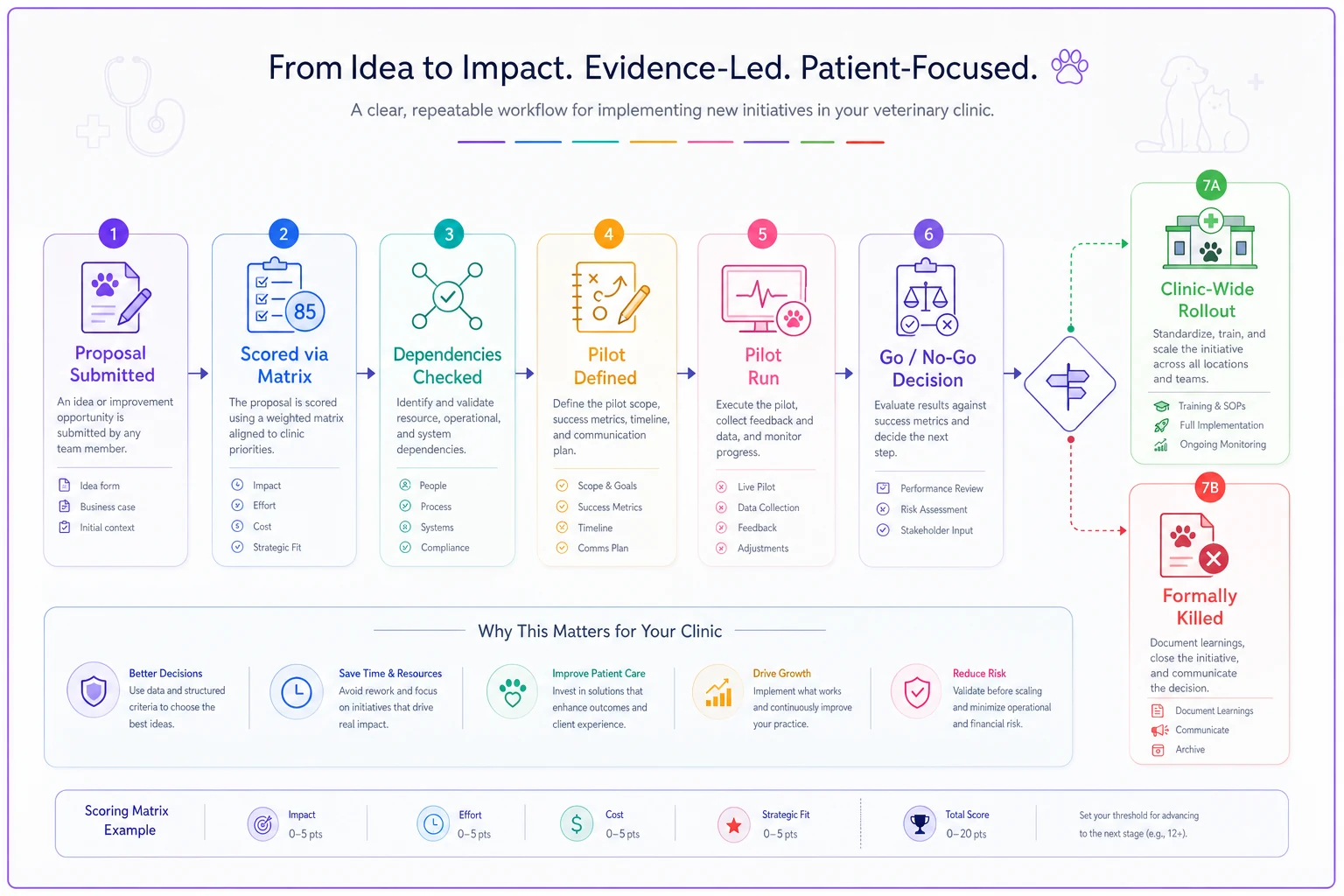
That path sounds obvious written out, but most practices skip two or three steps in the middle and wonder why adoption failed.
Pilot criteria: proving it works before you commit the whole practice
The biggest money-saver in the entire roadmap is the pilot. Most wasted tech spend isn't the license fee — it's the practice-wide rollout of something that turned out not to fit.
Before any tool goes clinic-wide, it earns its place through a small pilot with pass/fail criteria defined before the pilot starts. Setting criteria afterward is how teams talk themselves into keeping tools they already paid for.
-
Scope one shift, one doctor's caseload, or one service line — not the whole floor.
-
Duration long enough to hit real volume, usually two to four weeks.
-
Success metric defined up front e.g., "charting time per visit drops, no increase in missed charges, staff rate it usable at 4/5 or better."
-
Failure trigger defined up front e.g., "if it adds steps without a clear benefit, we stop."
-
A named pilot owner who collects feedback and reports results.
-
A rollback plan so the clinic can cleanly revert if the pilot fails.
-
A decision date — pilots don't drift into permanent limbo.
Pro-tip: Set failure triggers before the pilot starts so you can kill tools that don't deliver.
A practice piloting a new digital dental charting tool ran it with two doctors for three weeks. The pre-set bar was simple: charts had to be faster and more complete, or it didn't roll out. It cleared the completeness bar but added a couple of minutes per patient during the learning curve, and the doctors projected it would level out. They rolled it out — but to one more doctor first, not the whole team. That staged caution is the point. The pilot gave them data instead of a guess.
The honest version of pilot discipline is being willing to kill something you were excited about. A tool that fails its pilot saved you the far larger cost of a failed full rollout. That's a win, even when it doesn't feel like one.
When a big tech investment actually makes sense — and when it doesn't
Not every gap needs software. Some need a cleaned-up process, and bolting a tool onto a broken process just makes the breakage faster and more expensive.
This makes sense when:
-
The underlying workflow is already defined and mostly working, and the tool removes genuine manual drudgery.
-
The problem is frequent and measurable — something that happens dozens of times a week, not twice a quarter.
-
There's a clear owner who will see adoption through past the exciting first week.
-
Dependencies are already solid or explicitly sequenced to be solved first.
This is a bad idea when:
-
You're buying software to fix a process nobody has actually mapped. Define the process on paper first; automate second.
-
The real problem is accountability or training, which no tool fixes.
-
You're mid-rollout on something else and the team has no bandwidth to absorb another change.
-
The purchase is driven by fear of missing out rather than a scored, ranked need.
Who should probably not chase the latest clinical tech right now: a practice with messy records, unclear SOPs, and no reconciliation between systems. More tools on an unstable foundation multiplies the chaos. Stabilize the base, then layer. The same logic applies to how you bring vendors in — tool decisions and the contracts behind them should run through the same disciplined lens as your procurement and vendor governance, so you're not locked into something that failed its pilot.
Governance: the meetings that keep the roadmap alive
A roadmap without governance becomes a document nobody opens. The scoring and sequencing only hold up if there's a recurring, slightly boring meeting where decisions get made and recorded.
Keep it lightweight. A monthly 45-minute roadmap review with a consistent agenda beats a dramatic quarterly strategy offsite that produces slides and no action.
Monthly roadmap review — agenda template:
-
Active projects status (5 min each)
on track, at risk, or blocked. Blocked items name the blocker and the owner responsible for clearing it.
-
Pilot results and decisions any pilot hitting its decision date gets a go / no-go / extend call — recorded, with reasoning.
-
New proposals scored anything new gets run through the matrix live, in the meeting, so scoring stays consistent and isn't gamed in a hallway.
-
Compliance-flagged items separate review for anything touching controlled substances, consent, or records integrity.
-
Sequencing check confirm nothing violates the "one workflow change at a time" rule, and reprioritize if something higher-value came up.
-
Kill list projects that have stalled past their date get formally paused or removed. This is the most-skipped and most-valuable agenda item.
Who's in the room matters. You need someone clinical, someone operational, and someone who actually understands the data and systems. The clinical voice keeps impact scoring honest. The ops voice keeps effort scoring realistic. The systems voice catches the dependency traps everyone else misses.
One quiet benefit of scoring proposals in front of the group: the "my rep says this is amazing" purchases lose most of their power. A single champion can push a bad tool through on enthusiasm. A scoring matrix in a standing meeting makes that much harder. It's not a perfect filter, but it slows down the impulse buys enough to matter.
A real scenario: a three-doctor practice untangling its tech pile
A three-doctor small-animal practice had accumulated, over roughly two years, a PIMS they used maybe 60% of, a client app with low adoption, a lab integration that routed results inconsistently, and two abandoned tablet projects. Monthly software spend sat somewhere around $2,800–$3,200, and a decent chunk of it was for tools nobody fully used.
They built a roadmap from scratch. Scored everything. The client app and a new online-booking upgrade — the two things leadership had been most excited about — ranked near the bottom because both depended on clean scheduling and result-routing data the practice didn't have yet. The unglamorous winner was fixing lab-result routing and reconciliation, which scored high on clinical impact and was blocking three other projects downstream.
They sequenced it: result routing first, verified live over a month, then re-piloted the client app on the now-clean foundation. Two abandoned tools got formally killed and cancelled, trimming somewhere around $400–$500 a month. The client app, relaunched on solid data, actually got adopted the second time because the thing it depended on finally worked.
Nothing here was a dramatic revenue turnaround. It was quieter than that — less wasted spend, tools that actually got used, and a clear order for the next six months instead of a pile of maybes. The practice stopped buying and started sequencing.
The roadmap is a muscle, not a document
The spreadsheet is the easy part. The hard part is holding the line — running the monthly review when the week is slammed, scoring the rep's exciting demo honestly, killing the project you were personally attached to, and refusing to start the next thing until the current thing is actually live.
A veterinary practice digital roadmap works because it replaces emotion and FOMO with a repeatable decision process: score it, check dependencies, sequence it, pilot it, govern it. Clinics that do this consistently don't end up with a drawer of dead tablets. They end up with fewer tools, used better, adopted in an order that didn't break the team. And when the next shiny thing shows up — and it will — they already have a way to decide whether it's worth starting at all.
Ready to elevate your clinic’s efficiency?
Join 500+ veterinary clinics using Veterinaryly to save time, reduce administrative overhead, and improve patient care.