



Most clinics don't have a pricing problem. They have a pricing governance problem. The number on the invoice is usually fine — it's how that number got there, who's allowed to change it, and why three DVMs charge three different fees for the same laceration repair that quietly bleeds margin.
Walk into almost any established practice and ask: "What's the rule for pricing a dental with two extractions?" You'll get a shrug, a "depends who's doing it," or a printed fee guide that hasn't been touched since the last associate left. That gap — between what the price list says and what actually happens at checkout — is where a veterinary pricing governance framework earns its keep.
This isn't about raising prices. It's about making pricing reproducible. Same inputs, same output, every time, regardless of who's standing at the terminal.
Why pricing drifts in every clinic (and gets worse as you grow)
Pricing starts clean. One owner, one fee schedule, one brain deciding what things cost. The owner knows the true cost of a spay because they built the number themselves — anesthesia, tech time, consumables, monitoring, recovery, and a margin they can live with.
Then the clinic grows, and the number stops being a rule and becomes a memory. New associates inherit the fee schedule but not the reasoning behind it. So they improvise. A client pushes back on a dental estimate and the DVM knocks $80 off to keep the peace. A tech waives a nail trim because the dog was "already in for something else." A front desk person applies a senior discount that technically expired two years ago because it's still saved as a button in the system.
None of these moments are dramatic. That's exactly why they're dangerous. Pricing erosion never shows up as one big leak — it's a hundred small, defensible decisions that each felt reasonable at the time.
-
Cost basis goes stale. Consumable and drug costs climb 6–12% a year, but fee schedules get reviewed "when someone gets around to it." The margin you set two years ago isn't the margin you're earning today.
-
Bundles get inconsistent. A wellness package includes vaccines at one location and excludes them at another, and nobody can explain the logic.
-
Discounts become entitlements. A courtesy discount given once becomes an expectation forever, especially with long-term clients.
-
Nobody owns the change. Prices get updated by whoever happens to be in the practice management system that day, with no record of what changed or why.
The clinics that stay profitable aren't the ones with the highest prices. They're the ones where pricing behaves the same on a Tuesday morning as it does during a Friday-night rush.
The four layers of a real pricing engine
A pricing governance framework isn't a spreadsheet. It's four connected layers, each feeding the next. When one layer is missing, the whole thing gets improvised downstream — which is exactly where drift comes from.
Never miss a pet’s appointment again.
Veterinaryly helps you schedule, confirm, and manage every appointment and patient record effortlessly.
- Centralized appointment & patient management
- Automated client reminders
- Staff scheduling & task tracking
No credit card required
| Layer | What it answers | Who owns it | What breaks without it |
|---|---|---|---|
| Base-case costing | What does this service actually cost us? | Owner / practice manager | Prices set by gut feel, invisible margin erosion |
| Bundled service rules | How do we combine and price packages? | Medical director + manager | Inconsistent bundles, cannibalized à la carte revenue |
| Discount governance | Who can discount, how much, and when? | Owner / finance lead | Discount creep, checkout negotiations |
| Review cadence & change control | When do we revisit, and who approves changes? | Owner / leadership | Stale pricing, untracked changes, staff confusion |
The point of separating these layers is accountability. When a price is wrong, you want to know which layer failed — was the cost basis outdated, or did someone override a discount rule they shouldn't have? Lumping it all together makes every pricing problem feel like a mystery.
Layer 1: Base-case costing you can actually defend
Base-case costing is where most clinics quietly lose the plot. The temptation is to price by "what the practice down the road charges." That works right up until your cost structure diverges from theirs — different lease, different staffing model, different case mix — and suddenly you're anchored to someone else's economics.
-
Direct consumables — every item used or discarded. Sutures, gauze, IV catheter, fluids, gloves, the drape. Pull real costs from your purchasing data, not estimates.
-
Drug cost at true acquisition — including the portion of a vial you'll waste. A drug drawn at 0.4 mL from a 10 mL vial has a real per-use cost most clinics undercount.
-
Labor time by role — DVM minutes, tech minutes, and assistant minutes, each at fully-loaded cost (wage plus taxes and benefits, not just the hourly rate).
-
Equipment and overhead allocation — a per-minute rate that spreads rent, utilities, equipment depreciation, and software across your operating hours.
-
Target margin — the deliberate markup that keeps the practice solvent, set as a policy, not decided service by service.
Pull a month's purchasing invoices to reconcile consumable costs instead of relying on catalog prices to avoid undercounting per-use costs.
A worked example
-
Consumables (scaler tips, polish, gauze, ET tube, monitoring pads)
~$18
-
Anesthetic drugs at true per-use cost (pre-med, induction, gas, reversal)
~$26
-
Labor
15 DVM minutes + 55 tech minutes at fully-loaded rates: ~$62
-
Overhead allocation (70 minutes of table/suite time at your per-minute rate)
~$41
That's roughly $147 in true cost before margin. If your target margin on dentals is set at a 2.4x multiple on cost, your base-case price lands near $350. Now you have a number you can explain — to a client, to an associate, to yourself at tax time.
The insight isn't the exact figure. It's that once you know the $147, discounting to $280 stops feeling like "being nice" and starts looking like what it actually is: cutting your margin nearly in half. You can't govern a discount you can't measure against a real cost.
Most clinics never do this math per service, which is why fee changes feel arbitrary and staff have no intuition for what's safe to give away. If you want to see how this connects to broader financial leakage, the mechanics overlap heavily with what's covered in Revenue Leakage Is Hiding in Your Billing Workflow — undercosted services and missed charges are two sides of the same margin problem.
Layer 2: Bundled service rules that don't cannibalize revenue
Bundles are where good intentions turn into quiet losses. Wellness packages, dental month promotions, puppy/kitten plans — they're great for retention and cash flow, but only if the bundle math is governed as tightly as individual services.
-
Price the bundle from base-case costs, not from à la carte prices. Sum the true costs of everything included, apply your target bundle margin (which can be lower than à la carte, but must be deliberately lower), and that's your floor.
-
Define what's in and what's out — explicitly. If a wellness plan excludes dental radiographs, that exclusion is written into the rule, not left to whoever's building the estimate.
-
Set a maximum bundle discount as a policy. If à la carte totals $520 and the bundle sells at $440, that 15% gap should be an intentional decision tied to expected retention or visit frequency — not a number someone picked because it looked appealing.
-
Standardize bundle contents across every location and provider. A "senior wellness bundle" should contain the exact same services in every exam room you run.
When bundling makes sense — and when it doesn't
Bundling works well for predictable, repeatable care: wellness, preventive, chronic disease monitoring, dental season promotions. The costs are stable, the contents are known, and the discount buys loyalty and forecastable revenue.
It's a bad idea for anything with high case variability — surgery with unknown complications, workups where diagnostics depend on findings, anything where you can't define the contents before the pet is on the table. Bundling variable-cost care means absorbing risk you can't price. If you can't write down exactly what's included before the visit, it shouldn't be a fixed-price bundle.
Layer 3: Discount governance — the layer everyone skips
Most clinics don't have a discount policy. They have discount habits. And habits scale badly.
The core of discount governance is an approval matrix — a simple, enforced rule set that defines who can discount, by how much, and under what circumstances. Without it, every team member becomes their own pricing authority, and the person most likely to give away margin is usually the one most trying to avoid an awkward conversation.
| Discount size | Who can approve | Requires reason code? | Reviewed monthly? |
|---|---|---|---|
| 0–10% | Any DVM / manager | Yes | Sampled |
| 11–20% | Practice manager | Yes | All |
| 21–35% | Owner / medical director | Yes, documented | All |
| Over 35% | Owner only | Written justification | All |
| Waived fees | Owner / manager only | Mandatory reason code | All |
Two things make this matrix actually work instead of becoming another ignored policy:
Reason codes on every discount. Every discount gets tagged — "financial hardship," "goodwill/service recovery," "staff/family," "promotional," "senior program." Without categories, you can't tell the difference between strategic discounting and pure leakage. A clinic giving 4% of revenue away in "goodwill" discounts has a very different problem than one burning through expired promo codes.
A monthly discount review. Someone actually looks at the numbers — total discount dollars, breakdown by reason code, breakdown by provider. This is where you catch the associate who discounts 30% more than everyone else, or the front-desk button that's been applying an expired offer for months.
A realistic scenario
A three-DVM small-animal practice ran a discount audit after noticing collections felt soft relative to appointment volume. They found discounts running at roughly 7% of gross production — but only about a third of that was intentional (documented hardship, approved promotions). The rest was untracked: expired senior discounts still saved as buttons, verbal price-matching against a competitor nobody could name, and one associate rounding estimates down "to keep it simple."
They didn't raise a single price. They put in a reason-code requirement, implemented the approval matrix, and started reviewing discounts monthly. Within a couple of billing cycles, unintentional discounting dropped to under 2% of production. On production of roughly $180k a month, that recovered something in the range of $8k–$9k monthly — money that was already earned and simply being given away without a conscious decision.
That's the thing about discount governance: it's almost pure recovered margin, because the work was already done. This connects directly to how you measure the practice overall — if your dashboards don't surface discount rate as a tracked metric, it stays invisible, which is exactly the trap described in Why Tracking the Wrong KPIs Costs Your Clinic Revenue.
Layer 4: Review cadence and change control
The first three layers set your pricing. This layer keeps it from rotting.
-
Quarterly Review base-case costing on your top 20–30 revenue services against current acquisition costs. These drive most of your margin, so they get the most attention.
-
Quarterly Review the discount report — dollars, reason codes, provider breakdown.
-
Twice a year Full fee-schedule review, including bundles.
-
Ad hoc Any time a major cost input jumps (a key drug increases 15%+, a new lease, a wage adjustment), trigger a targeted review of affected services rather than waiting for the calendar.
Change control: the part that prevents chaos
Every price change should go through a light but real change-control process. Not bureaucracy — just a record. The goal is that six months from now, you can answer "why did this price change, and who approved it?" without guessing.
``
[Proposal] → [Impact Check] → [Approval] → [Implementation] → [Log]
``
-
Proposal — someone documents the requested change and the reason (cost increase, market adjustment, correcting an error).
-
Impact check — quick review of what it does to margin and how it compares to base-case cost.
-
Approval — signed off by whoever owns that layer, per your authority matrix.
-
Implementation — updated in the practice management system on a defined date, not piecemeal.
-
Log — recorded with date, old price, new price, reason, and approver.
The log is the unglamorous hero here. In multi-location groups especially, the difference between controlled pricing and chaos is whether anyone can reconstruct what changed and why. Without it, every location drifts independently, and reconciling them later is a nightmare.
Here's a simple visual of the change-control workflow.
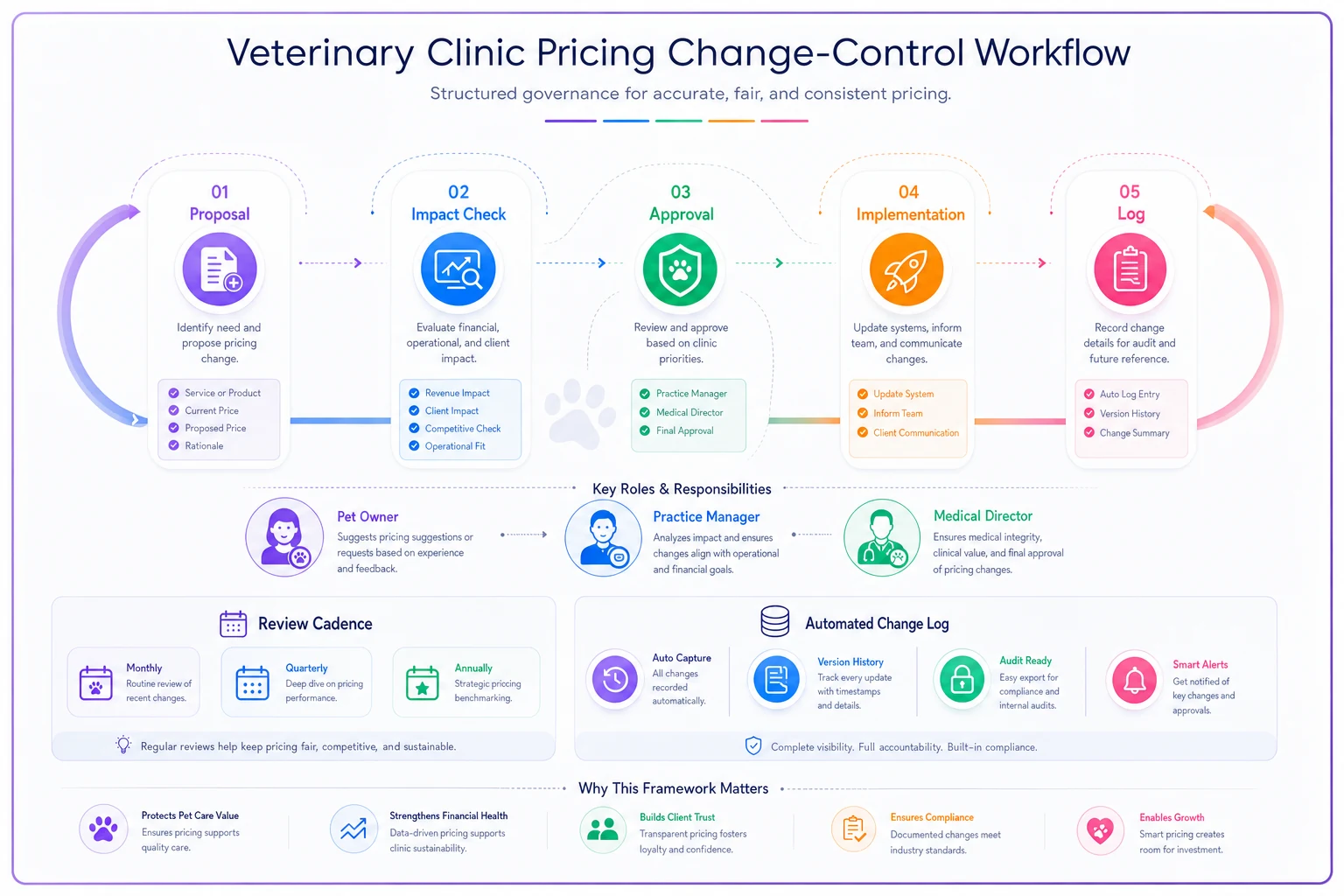
The visual should make it obvious who approves what and where the automatic logging happens during implementation.
A pre-implementation checklist
-
[ ] Base-case costs built for your top revenue services (not guessed)
-
[ ] Target margins set as policy, per service category
-
[ ] Bundle contents defined explicitly and priced from cost
-
[ ] Maximum bundle discounts set intentionally
-
[ ] Discount authority matrix documented and understood by staff
-
[ ] Reason codes configured in your PIMS for every discount type
-
[ ] Review cadence scheduled on someone's actual calendar
-
[ ] Change-control log location decided and owned
-
[ ] Expired promotions and stale discount buttons cleaned out of the system
Getting through this list before you do anything else is the difference between a governance framework and a document nobody uses.
Where software fits — and where it doesn't
None of this requires software to design. You can build a pricing governance framework on paper and a spreadsheet, and plenty of well-run clinics do exactly that when they're small enough for one person to see everything.
Where it gets hard is enforcement at scale. A policy that says "discounts over 20% require manager approval" means nothing if the system lets anyone type any number into an estimate. Reason codes mean nothing if they're optional. A quarterly review means nothing if pulling the discount report takes three hours of manual exports and reconciliation.
That's the honest case for operational software with sensible automation built in: it shifts governance from hoping people follow the rules to the rules being how the system works. Discount ceilings enforced at the point of sale. Reason codes required before a discount saves. Change logs written automatically. Cost inputs pulling from purchasing data so base-case costing updates when a drug price moves. The framework is the thinking; the software makes the thinking stick when you're not standing over everyone's shoulder.
But the sequence matters. Buying software before you've defined your costing, bundles, and discount rules just gives you a faster way to enforce nothing. Build the framework first. Automate it second.
The real payoff
A pricing governance framework won't show up as a dramatic overnight swing in your bank account. What it does is quieter and more durable: it makes pricing reproducible. The same dental costs the same whether your senior DVM or your newest associate is doing it. The same discount requires the same approval no matter who's asking. The same review happens every quarter whether or not anyone remembered to schedule it.
That reproducibility is what protects margin as you grow. Clinics that struggle at three locations usually aren't struggling because their prices are wrong — they're struggling because pricing is fifty small improvised decisions a day, made by people who never saw the reasoning behind the numbers. Governance replaces improvisation with rules, and rules are the only thing that actually scales.
Start with base-case costing on your biggest services. Get the discount matrix on paper and enforced. Put the review on the calendar. Everything else builds from there.
Ready to elevate your clinic’s efficiency?
Join 500+ veterinary clinics using Veterinaryly to save time, reduce administrative overhead, and improve patient care.