

Most clinics treat no-shows like weather. Something that happens, you grumble about it, you move on. But if you actually add up the empty exam rooms over a quarter, the number tends to land somewhere uncomfortable — enough to cover a part-time tech, or the lease on your second ultrasound.
This isn't a piece about reminders. You already send reminders. This is about the mechanics that sit around the reminder: the cadence that actually changes behavior, the rules that fill a slot the moment it opens, the cancellation fees that hold up, and the collection scripts that recover money without torching the client relationship. Veterinary no-show cancellation recovery is a set of small, boring levers — and most clinics are pulling maybe one of them.
Start by measuring the leak, not the symptom
The number most clinics quote is "no-show rate." It's almost useless on its own because it bundles together completely different problems. A 9% no-show rate made up of forgotten wellness visits needs a different fix than a 9% rate driven by last-minute surgical cancellations.
Break it into three buckets before you touch anything:
| Metric | What it tells you | Rough target for most GP clinics |
|---|---|---|
| No-show rate (by visit type) | Who forgot or ghosted | Under 5% for wellness, under 3% for procedures |
| Same-day cancellation rate | Who bailed too late to rebook | Under 6% |
| Slot-recovery rate | % of freed slots you actually refilled | Above 60% is a real win |
That last row is the one almost nobody tracks, and it's where the money is. A same-day cancellation only costs you revenue if the slot stays empty. If you refill it, the cancellation was a minor annoyance, not a loss.
Clinics obsess over lowering the cancellation rate — which is hard, slow, and partly outside your control — while ignoring slot-recovery rate, which you can meaningfully move in a matter of weeks. The back half is where you'll get faster wins.
The confirmation cadence that actually changes behavior
The mistake most clinics make: a single reminder text "24 hours before" feels responsible, so they send it and assume the job is done. But a reminder isn't a nudge. A reminder says this is happening. A nudge asks the client to do something small — and that small action is what locks in the commitment.
Never miss a pet’s appointment again.
Veterinaryly helps you schedule, confirm, and manage every appointment and patient record effortlessly.
- Centralized appointment & patient management
- Automated client reminders
- Staff scheduling & task tracking
No credit card required
-
At booking — immediate confirmation with the date, prep instructions, and the cancellation policy stated plainly (not buried). Setting the expectation at booking is the single highest-leverage moment, and it's the one most clinics skip.
-
72 hours out — a soft touch. "Rocco's appointment is Thursday at 2:15. Still works? Reply C to confirm or R to reschedule." The reply is the nudge. People who type "C" show up at noticeably higher rates than people who were simply told.
-
Day before — only to the clients who haven't confirmed yet. Don't re-ping the ones who already replied; it reads as noise and trains people to ignore you.
-
Morning of, for procedures only — fasting reminder plus arrival time.
The behavioral piece is the explicit confirmation. Asking someone to actively say "yes" creates a small commitment, and clients who go silent across two touches are your real risk list — flag them, don't just hope.
One small thing most clinics get wrong: timing. A reminder landing at 9am on a workday gets buried. Late afternoon and early evening pull better confirmation rates. Not dramatically, but consistently.
Waitlist and slot-recovery rules (the part that prints money)
When a 2:15 cancels at 11am, the clock is ticking. Every hour that slot sits empty, the odds of filling it drop. The clinics that recover well don't improvise this — they have a rule the front desk can execute without asking anyone.
-
Maintain a standing waitlist segmented by visit type and urgency. A derm recheck and a sick-pet visit are not interchangeable fills.
-
When a slot opens, contact the top 3 waitlist matches simultaneously, not one at a time. Sequential calling wastes the window. First to confirm takes it; you message the others that it's filled.
-
Give waitlisted clients a time-boxed response window — "this 2:15 today is open, reply within 30 minutes to claim it." Open-ended offers die in voicemail.
-
Keep a short "flexible client" tag on people who've said they'd take short-notice openings. These are gold for same-day gaps.
This is where overbooking discipline matters too, because recovery and capacity are the same conversation from two angles. If your schedule is already stacked past what the floor can handle, a "recovered" slot just creates downstream chaos. Worth reading alongside our breakdown on capacity-first appointment flow — recovery only helps when the recovered slot is real capacity, not a double-booked room that'll blow up at 4pm.
A quick workflow, end to end
Slot opens → front desk logs the cancellation reason (one tap: forgot / sick pet / cost / rescheduled) → system pulls top waitlist matches by visit type → batch message goes out with a 30-minute claim window → first confirm fills the slot → remaining candidates auto-notified it's gone → cancellation reason feeds your monthly review.
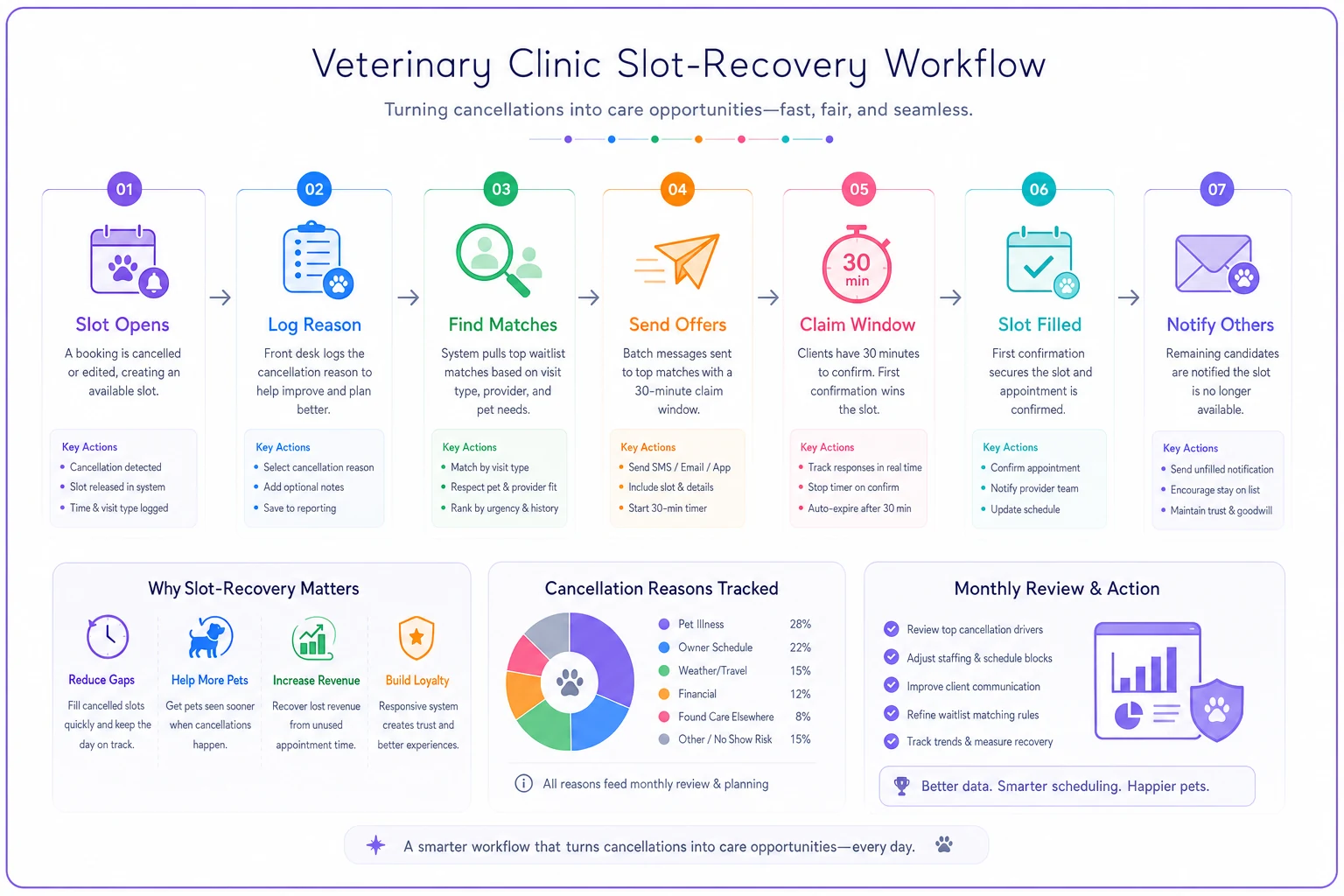
Simple diagram of the end-to-end slot-recovery workflow.
The reason-logging step looks trivial and isn't. After a few weeks you'll see why people cancel, and "cost" showing up repeatedly is a pricing or estimate-timing problem, not a reminder problem.
Cancellation-fee mechanics that hold up
Cancellation fees are where clinics either do nothing or overcorrect into something that drives clients away. Both are mistakes.
-
Fees apply only to high-value or hard-to-fill slots — surgery, dental, long sedated procedures. Charging a late-cancel fee on a $65 nail trim creates more front-desk friction than it's worth.
-
A card on file for procedures, authorized at booking, with the policy stated out loud and in the confirmation text. No surprises. The client agreed when they booked.
-
A clear grace rule — cancel more than 24 hours out, no charge. Inside 24 hours or no-show, a defined fee (often a deposit amount, not the full visit cost).
-
Staff discretion to waive, once, with a logged reason. The first offense from a 10-year client is a relationship moment, not a revenue moment. Repeat offenders are different.
The insight most people miss: the fee's job isn't to collect money. It's to make the confirmation step feel consequential. Clients who know a deposit is on the line actually read the 72-hour message and reply. The fee changes behavior upstream far more than it recovers cash downstream.
Put the deposit amount in both the booking script and the confirmation text to avoid surprises.
A deposit model tends to beat a punitive fee. "We'll apply your $75 deposit to the visit" feels like normal business. "We'll charge you $75 for not showing" feels like a penalty — and people argue penalties.
Collection scripts for when money is actually owed
A fee triggered, or a client left with an unpaid balance after a same-day cancellation on a prepped procedure. Now you're in collections — and this is where good clinics lose money out of sheer discomfort. Staff don't like asking, so they don't, and the balance ages into a write-off.
First contact (friendly, 3–5 days after): > "Hi, this is [name] from [clinic]. We've got a small balance of $[X] on Bella's account from the [date] appointment. Can I take care of that over the phone now, or would you like a payment link texted to you?" Notice it assumes payment and offers two easy paths. No apology, no lecture.
Second contact (10–14 days, if unpaid): > "Just following up on the $[X] balance for Bella. We want to keep her account in good standing for future visits — can we settle this today?" The "future visits" line is doing quiet work. It reminds them the relationship continues.
Final contact (30 days): > "This is a final reminder about the $[X] balance on your account. If we don't hear back by [date], the balance will be sent to [process]. We'd much rather resolve it directly with you." Keep three things true across all of them: state the exact amount, offer an immediate payment path, and never get moralistic. The goal is the balance paid and the client still booking.
For the deeper billing side — aging buckets, write-off thresholds, who owns follow-up — this plugs into a broader revenue-cycle system, and we go into the SLAs and staffing for that in this breakdown on billing-workflow revenue leakage.
KPI triggers: when to actually act
Metrics are decoration unless they trigger a specific action at a specific threshold. Set the triggers in advance so nobody has to debate it in the moment:
-
No-show rate climbs above 6% for two consecutive weeks → audit the confirmation cadence; are messages actually sending, are replies being logged?
-
Slot-recovery rate drops below 50% → waitlist is stale or too small; rebuild the flexible-client list.
-
Same-day cancellations spike in one visit category → investigate that category specifically (cost? prep confusion? a provider's schedule?).
-
"Cost" cancellation reason exceeds ~20% of logged reasons → your estimate timing is the problem, not your reminders.
-
Fee-waiver rate above ~40% → either the policy is too aggressive or staff aren't comfortable enforcing it. Fix the policy, don't blame the staff.
That last one matters. A waiver rate near half means your written policy and your real policy don't match — and clients can smell that.
A real scenario
A two-doctor small-animal clinic running roughly 320–340 appointments a month was sitting at an 8% no-show rate with almost no slot recovery. Freed slots just stayed empty. Call it a dozen or so empty slots a week, a meaningful chunk of them procedure-adjacent.
-
Added the active-confirmation step at 72 hours (reply C or R).
-
Built a flexible-client waitlist and a 30-minute batch-claim rule for same-day openings.
-
Put cards on file for dentals and surgeries with a stated $75 deposit.
Over about three months, the no-show rate settled into the 4–5% range, and more importantly slot-recovery climbed past 60% — most same-day cancellations were getting refilled within the hour. The deposit model also cut late procedure cancellations noticeably, because clients were now reading and replying to the confirmation. Nobody could give an exact dollar figure, but the front desk stopped seeing dead afternoons, and that was the point.
The interesting part: the deposit barely ever got charged. It mostly just made people confirm.
When this is worth it — and when it isn't
Worth it if: you're running near capacity, your no-show or same-day cancellation rate is above ~5%, or you do a steady volume of procedures where an empty slot is expensive to leave empty.
Not worth the full build if: you're a tiny single-doctor practice with a loyal, mostly-retired client base and a 2% no-show rate. The confirmation cadence alone is plenty. Don't bolt a collections process onto a problem you don't have.
Who should skip the fee piece entirely: clinics in very price-sensitive communities where a deposit requirement at booking would actively lose you first-time clients. For you, lean hard on cadence and waitlist, skip the fees, and revisit later once the relationship exists.
Where tooling quietly helps
None of this requires software to exist — a disciplined front desk with a spreadsheet can run it. What software changes is whether it survives a busy Tuesday. The confirmation cadence that only messages unconfirmed clients, the batch-claim waitlist window, the auto-logged cancellation reasons feeding your KPI triggers — those are exactly the things that get dropped when the lobby is full and two staff called out.
Operational platforms with built-in automation handle the repetitive timing and tagging so the rules run the same whether it's a slow Monday or a chaotic Friday. That's the honest pitch: consistency under load. The thinking still has to be yours — which slots get fees, what the waitlist segments are, where the KPI thresholds sit. The tool just makes sure the staged confirmation actually goes out at 5pm instead of whenever someone remembers.
Start with the confirmation cadence and the slot-recovery rule. Those two move the number fastest and cost you nothing but a few weeks of consistency. Add fees and collection scripts once you've got the front half running clean.
Ready to elevate your clinic’s efficiency?
Join 500+ veterinary clinics using Veterinaryly to save time, reduce administrative overhead, and improve patient care.