



Most clinics don't lose money on new services because the medicine was wrong. They lose money because the decision to launch was never really a decision — it was a feeling. A vet got certified in something over a weekend, the owner saw a competitor advertising dental radiography, or a rep left a slick brochure on the break room counter. Six months later there's a $40k machine depreciating in a corner, booked twice a week, and nobody wants to talk about it.
A real veterinary service line strategy isn't about picking exciting services. It's about having a repeatable way to say yes, no, or not yet — using the same filters every time, so your gut feeling has to survive contact with numbers before you spend anything.
What follows is a five-step playbook with actual go/no-go thresholds, then three worked examples: dentistry, imaging, and a small inpatient/hospitalization line. The point isn't to hand you magic numbers. It's to show you where the decision usually breaks and how to pressure-test a launch before it eats your cash.
Why most service-line decisions are made backwards
The common pattern: capability comes first, demand is assumed second, and capacity is discovered last — usually the hard way.
A clinic decides to add ultrasound. The reasoning is "we refer out a lot of abdominal scans, we should keep that revenue." Fair. But nobody checks whether the referrals are actually scans or scans plus a specialist read the GP isn't comfortable doing alone. Nobody checks whether the one doctor who can run the probe is already the bottleneck for every surgery day. So the machine arrives, it gets used by one person, and when that person takes a two-week vacation the whole line stops.
The deeper issue is that a new service isn't a product you bolt on. It's a load you add to an existing system — the schedule, the inventory, the techs, the front desk, the follow-up workflow. If any of those is already near capacity, the new service doesn't just underperform. It drags down everything around it. A dental line that creates a surgical anesthesia backlog can cost you more in delayed wellness surgeries than it earns in cleanings.
That's why a service-line decision has to run through the whole operation, not just the P&L line for that one service.
The five-step launch playbook
Here's the sequence. Each step has a gate. If you fail a gate, you stop or fix before moving on. You don't skip ahead because you're excited.
Never miss a pet’s appointment again.
Veterinaryly helps you schedule, confirm, and manage every appointment and patient record effortlessly.
- Centralized appointment & patient management
- Automated client reminders
- Staff scheduling & task tracking
No credit card required
Step 1 — Market scan
You're answering one question: is there real, local, recurring demand we can capture — not just demand that exists in the abstract?
Pull your own referral and decline data first. This is the number clinics ignore most. How many cases in the last 12 months did you refer out or lose entirely for this service? Not "pets in your area that might need it" — cases you already touched and sent elsewhere. That's the most honest demand signal you have because those are clients who already trust you.
Then look outward: what's the nearest clinic offering it, what do they charge, and how long is their wait? A six-week wait for dental at the practice down the road is a louder buy signal than any market report.
Go/no-go gate: You can identify at least ~8–12 real cases per month from existing demand (referrals out + declines + current unmet need). Below roughly 6–8/month, the line almost never clears its fixed cost unless pricing is premium.
Where this breaks: Clinics count potential demand ("every senior pet should get bloodwork imaging") instead of captured demand. Potential demand is free to imagine and expensive to be wrong about.
Step 2 — Pilot
Before you buy anything, run a version of the service you can run today, even if it's clumsy. Rent equipment, bring in a mobile specialist one day a month, or offer the service manually and track the response.
The pilot answers questions the spreadsheet can't: Do clients actually say yes at your price? How long does the appointment really take once you include setup, cleanup, and documentation? Does your front desk know how to explain and book it?
A dentistry pilot might be two dedicated dental days a month using your existing anesthesia setup. An imaging pilot might be a mobile ultrasonographer who comes in biweekly. You're not trying to profit yet. You're trying to measure reality.
Go/no-go gate: Pilot conversion (offered → booked) holds around 40%+ for discretionary services, and actual time-per-case lands within ~20% of your estimate. Big time overruns here are the single best predictor of a line that will quietly lose money later.
Step 3 — Capacity check
This is the step that gets skipped, and it's the one that quietly kills margins. You're checking whether your existing constraints can absorb the new load.
Map the service against your real bottlenecks:
-
Rooms Does it need a dedicated space, or does it compete with exam rooms during peak hours?
-
Anesthesia / recovery Dentistry and many imaging procedures compete for the same monitored recovery capacity as your surgeries.
-
Doctor hours Is this on top of a full appointment book, or are you carving protected time?
-
Tech hours Most new clinical lines are tech-limited, not doctor-limited. A dental under anesthesia can tie up a tech for 60–90 minutes.
The honest version of this step involves looking at your current utilization. If your surgery suite already runs at 85% on the days you'd schedule dentals, you don't have room — you have a collision waiting to happen.
Go/no-go gate: You can fit projected volume into existing capacity below ~80% peak utilization of the shared constraint — OR you have a funded plan to add that capacity. If the only way the math works is running your bottleneck at 95%, the line is a no-go until you fix the constraint.
Step 4 — Staffing plan
Who runs this when the person who championed it is out?
A service line owned by one person isn't a service line — it's a hobby with a revenue number attached. The staffing plan has to name at least two people who can deliver the core workflow, plus the front-desk script for booking and the tech competency sign-offs required.
This is also where consent and documentation standards get defined before launch, not after a problem. New clinical services usually introduce new risk and new conversations — anesthesia, sedation, procedures with real complication rates. Getting your e-consent workflow sorted for the new line upfront saves you from retrofitting consent forms after the first bad outcome.
Go/no-go gate: At least two trained deliverers (or a credible 90-day plan to get there), a written booking script, and defined consent + documentation for the service. If it only works when one specific DVM is in the building, don't launch at full commitment — stay in extended pilot.
Step 5 — ROI gate
Now the numbers. Not just "does it make money" — how fast does it clear its own cost, and what happens to margin if volume comes in 30% light?
Build three scenarios: conservative, expected, and optimistic. Run the ROI gate on the conservative one, because that's the number your launch will actually hit in month three.
Go/no-go gate: Conservative scenario shows positive contribution margin within ~6 months of operating costs, and full payback of equipment within a window you can stomach (commonly 18–30 months for imaging-type capital). If the line only works in the optimistic case, it's not a plan — it's a bet.
Here's a visual of the five-step launch playbook workflow.
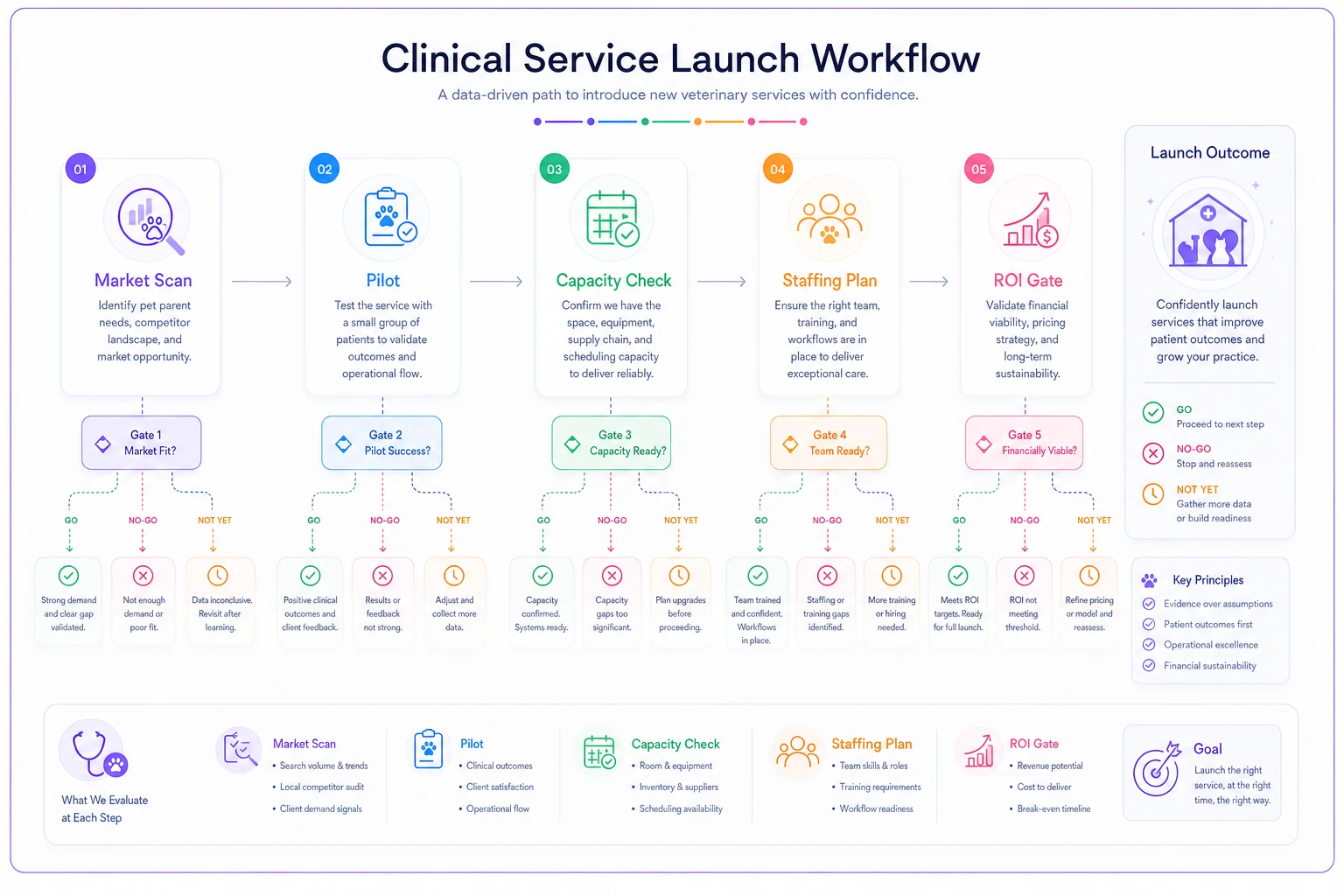
Use the visual to walk your team through each gate so everyone sees the same stop / fix / go criteria.
Worked example: Dentistry line
Let's run a mid-sized general practice considering a dedicated dental service — meaning real dental radiography, nerve blocks, charting, and extractions, not just a cleaning tacked onto a wellness visit.
Market scan: Looking back over the year, the clinic finds it referred out or deferred roughly 10–14 advanced dental cases a month (extractions, suspected resorptive lesions). Nearest full dental service has a 4–5 week wait. Strong signal.
Pilot: Two dental days a month using existing anesthesia. Conversion on recommended dentals runs around 45%. But the time estimate is off — cases they budgeted at 60 minutes are running 85–100 minutes once charting and radiographs are included. That overrun is the real finding.
Capacity check: The dental radiography and recovery compete directly with surgery days. Surgery suite is already around 80% utilized. This fails the capacity gate at projected volume. The fix: move dentals to a protected half-day that doesn't collide with spay/neuter blocks.
Staffing: Two techs trained on dental radiographs and anesthetic monitoring, one DVM comfortable with surgical extractions and blocks. Second DVM in training. Consent updated for extraction and anesthetic risk.
ROI gate: Dental radiography unit plus hand instruments and a monitor runs somewhere in the $18k–$28k range. Conservative volume (8 advanced cases/month at the clinic's fee) clears monthly operating cost comfortably and pays back equipment inside ~18 months.
Verdict: Go — but only after the capacity fix. Launched into the existing surgery schedule, it would have cannibalized higher-margin procedures.
Worked example: Imaging (ultrasound) line
Same clinic, now weighing in-house abdominal ultrasound.
Market scan: They refer out around 6–8 scans a month. But a chunk of those referrals are cases where the GP wants a specialist interpretation, not just images. That matters — buying a probe doesn't buy the skill. Captured demand for scans they could realistically read or send for telemedicine read is closer to 5–6/month. Borderline.
Pilot: Mobile ultrasonographer biweekly. Clients accept readily when it means staying in-house. But two visits a month only surfaces about 5 cases — confirming the demand ceiling found in the scan.
Capacity check: Passes easily. Ultrasound uses an exam room, not the surgery bottleneck, and can be scheduled off-peak.
Staffing: Here's the problem. Only one DVM is comfortable scanning. No second operator, and building ultrasound competency takes months of repeated scans — which low volume won't provide. Fails the staffing gate.
ROI gate: A capable unit runs $25k–$45k+. At 5 scans a month, conservative contribution margin barely covers operating cost, and equipment payback stretches past 30 months.
Verdict: No-go for now. Smarter move: keep the mobile ultrasonographer on a regular schedule. You capture most of the revenue, carry no capital risk, and sidestep the single-operator trap. This is the "not yet" outcome a disciplined service-line strategy is designed to produce.
Worked example: Inpatient / extended hospitalization line
Now a stretchier case — adding overnight and extended daytime hospitalization for stable patients that currently get transferred to the emergency referral center.
Market scan: The clinic transfers out roughly 12–18 cases a month that are stable — IV fluids, monitoring, post-op observation — not true ICU cases. Clients consistently push back on the transfer cost and distance. Clear unmet demand.
Pilot: Extend observation hours on staffed days first. Even this limited version shows clients strongly prefer staying in-house, and it surfaces the real constraint immediately: overnight monitoring needs people, and people are expensive and hard to staff.
Capacity check: Cages and fluid pumps are the easy part. The bottleneck is monitored overnight coverage. Daytime extended hospitalization fits; true overnight does not without new staffing.
Staffing: This is where this line lives or dies. On-call and overnight coverage reshapes your entire scheduling model, not just this service. If you run multiple sites, the coordination gets harder still — centralizing standards and coverage across locations is its own discipline, and the trade-offs are worth reading up on in a practical operating model for multi-site clinics.
ROI gate: Equipment cost is modest. Labor cost is not. Conservative math only works if you launch daytime extended hospitalization and leave overnight as a later phase tied to a real staffing solution.
Verdict: Phased go. Daytime line now, overnight gated behind a staffing plan. The playbook stops you from biting off the whole thing at once.
Comparing the three decisions
Putting the three side by side makes the pattern pretty obvious. Capital cost was almost never the deciding factor — the thing that killed or shaped each decision was capacity and people.
| Service | Captured demand/mo | Main constraint | Capital | Verdict |
|---|---|---|---|---|
| Dentistry | ~10–14 | Shared surgery/recovery capacity | $18k–$28k | Go (after capacity fix) |
| Ultrasound | ~5–6 | Single operator + skill-building | $25k–$45k+ | No-go (use mobile) |
| Inpatient | ~12–18 | Overnight staffing/labor | Low equipment, high labor | Phased go |
The shared bottleneck, the single operator, the overnight staffing problem — that's what clinics consistently underweight when they get excited about a new piece of equipment. The numbers in the table are almost secondary to whether you can actually staff and absorb the service without wrecking what's already working.
When adding a service line actually makes sense
You have captured (not imagined) demand you're currently losing.
-
You have captured (not imagined) demand you're currently losing.
-
The service rides on a constraint that has real headroom.
-
You can name two deliverers, not one.
-
The conservative scenario — not the optimistic one — clears its cost.
-
A failed launch wouldn't threaten your core operation's cash flow.
These criteria help keep the launch disciplined and protect the core operation while you test new lines.
When it's a bad idea
The business case depends on a single champion staying forever.
-
The business case depends on a single champion staying forever.
-
Your bottleneck is already running hot and this adds to it.
-
Demand is "everyone should get this" rather than "we turn these away weekly."
-
The only path to ROI is the optimistic column.
-
You'd be buying capital to avoid a referral relationship that's actually working fine.
If you see multiple items from this list in your plan, pause and revisit the gates before buying equipment.
Who should not do this right now
If your current services aren't running cleanly — if your schedule is chaotic, your follow-up leaks, or your utilization is a mystery — a new service line will amplify the mess, not distract from it. Fix the base system first.
-
If your current services aren't running cleanly — if your schedule is chaotic, your follow-up leaks, or your utilization is a mystery — a new service line will amplify the mess, not distract from it.
-
Fix the base system first. A new revenue line built on a shaky operational foundation just gives you a bigger, more expensive problem.
Address core operational issues before adding complexity in the form of a new clinical service.
Keeping the decision repeatable
The reason to treat this as a playbook rather than a one-off analysis is that you'll make this decision many times — new equipment, new certifications, new client requests. If every decision runs through the same five gates, you build institutional memory. You start to see which gate tends to fail for your clinic. Some practices always stumble on staffing; others consistently overestimate demand.
The data you already generate every day is enough to pressure-test most of these decisions — most clinics just never pull it together in one place.
Pull utilization and referral-out patterns from your practice management system to run the market scan and capacity check quickly.
Treating the decision as repeatable helps the team learn where the failures consistently happen and avoids reinventing the evaluation each time.
This gets a lot easier when your utilization, referral-out patterns, and per-service time data already live in your practice management system rather than in someone's head. Clinics that track where they send cases, how long procedures actually run, and how booked their shared constraints are can run the market scan and capacity check in an afternoon instead of guessing. The data you already generate every day is enough to pressure-test most of these decisions — most clinics just never pull it together in one place.
A service-line decision is really a capacity decision wearing a clinical costume. Get the gates right, respect the bottleneck, name a second person, and run the conservative numbers — and you'll add the services that strengthen the practice while walking away, calmly, from the ones that would have quietly drained it.
Ready to elevate your clinic’s efficiency?
Join 500+ veterinary clinics using Veterinaryly to save time, reduce administrative overhead, and improve patient care.