


Most clinics don't set out to become a group. They buy a second location because the owner-DVM is maxed out, or a retiring colleague offers a good deal, or a landlord opens up a space across town. Then suddenly there are three sites, four medical directors with four opinions, two practice management systems that don't talk to each other, and a founder spending every Sunday night trying to figure out why one location is quietly bleeding cash.
Nobody warns you that running three clinics isn't running one clinic three times. It's a different job. The work shifts from doing medicine and managing a team to designing the system that lets other people do medicine and manage their teams consistently. A multi-site veterinary clinic operating model is what makes that shift survivable—it defines who decides what, what stays standard everywhere, what each site is allowed to adapt, and how changes roll out without chaos.
This isn't a governance philosophy piece. We covered the centralize-vs-decentralize debate separately in Decentralized Chaos or Central Control? A Governance Model for Multi‑Location Veterinary Operations. This is the operating layer underneath it: the roles, the decision rights, the standard bundles, the change cadence, and a rollout you can actually execute over 6–18 months.
The real failure isn't a bad decision—it's an unclear owner
When a single clinic struggles, you can usually point to one thing: a billing leak, a scheduling mess, a staffing gap. When a group of clinics struggles, the root cause is almost always structural. Nobody knows who owns the decision.
Here's a pattern that shows up constantly. A regional manager wants to standardize vaccine pricing across four sites. One medical director says pricing is a clinical call because it ties to protocol. The ops lead at central says pricing is a finance call. The site that's been undercutting everyone says it's a local market thing and central doesn't understand their clients. Three weeks of email threads later, nothing changes, and the price spread between sites is still 22%.
That's not a disagreement about pricing. That's a missing decision right. In a healthy operating model, you'd already know that pricing bands are set centrally, pricing within the band is a regional call, and anything outside the band needs an exception request with a reason. The conversation takes ten minutes instead of three weeks. (If pricing is your current fire, the mechanics are in Pricing Governance for Veterinary Clinics.)
Most multi-site friction isn't people being difficult. It's smart people stepping on each other because the lines were never drawn.
Three layers, three different jobs
Central exists to protect the things that must be identical everywhere—compliance, financial controls, the core medical standard, the brand promise, the data backbone. Central should own a short list of non-negotiables and almost nothing else. The most common mistake is central trying to run everything, which turns the home office into a bottleneck where every supply reorder and every schedule change waits on a VP's inbox.
Never miss a pet’s appointment again.
Veterinaryly helps you schedule, confirm, and manage every appointment and patient record effortlessly.
- Centralized appointment & patient management
- Automated client reminders
- Staff scheduling & task tracking
No credit card required
Region exists to translate. A regional lead takes central's standards and makes them work across a handful of sites with real local differences—different client income levels, different competitor density, different DVM skill mixes. Region is also the first escalation point. If a site has a problem it can't solve, it shouldn't land on the founder's desk; it should land on region.
Site exists to execute and to flex within guardrails. The site team runs the day, handles the clients, makes the dozens of small calls that can't wait. A good operating model gives the site room to breathe—they can adjust appointment templates, run a local promo within approved limits, swap a vendor if the approved one is out of stock—without asking permission for every move.
The design principle: push decisions down to the lowest level that can make them well, and only pull them up when consistency or risk genuinely requires it. Get it wrong in the pull-up direction, you get a bottleneck. Get it wrong in the push-down direction, you get 12 clinics that share a logo and nothing else.
A decision-rights matrix you can actually use
The single most valuable artifact in a multi-site operating model is a decision matrix. Not a 40-page policy binder—a one-page table that says, for each recurring decision, who recommends, who decides, who gets consulted, and who just needs to be told.
Here's a trimmed version of what a working matrix looks like:
| Decision | Site | Region | Central |
|---|---|---|---|
| Daily appointment template tweaks | Decides | Informed | — |
| Hiring a vet tech | Recommends | Decides | Informed |
| Hiring a DVM or site lead | Recommends | Recommends | Decides |
| Medical protocol (core) | Follows | Consulted | Decides |
| Medical protocol (local adaptation) | Recommends | Decides | Informed |
| Price band | Follows | Consulted | Decides |
| Price within band | Recommends | Decides | Informed |
| Local promotion | Decides (within rules) | Informed | — |
| New equipment > $10k | Recommends | Recommends | Decides |
| Vendor substitution (approved list) | Decides | Informed | — |
| New vendor onboarding | Recommends | Consulted | Decides |
| Firing for cause | Recommends | Decides | Consulted |
One more thing: review this table twice a year.
The exact assignments matter less than the fact that they exist and everyone has seen them. The failure mode groups fall into is keeping this in people's heads. It works fine until the regional manager quits, takes all the context with them, and the new hire spends four months re-litigating decisions that were already settled.
Decisions that made sense with three sites and one region often need to shift as you grow. A $10k equipment threshold that central approved personally at three sites becomes absurd at fifteen.
Standard operating bundles instead of a thousand loose SOPs
Individual SOPs are necessary but they don't scale as a pile. By the time a group hits six or seven sites, you've got hundreds of documents, nobody knows which version is current, and each site has quietly forked its own copy.
The fix is to package SOPs into bundles—grouped sets tied to a role or a workflow, versioned together, deployed together. Think of a bundle as "everything a new site needs to run the surgery suite the same way we do everywhere else," not forty separate PDFs.
-
Front-of-house bundle — scheduling templates, check-in flow, payment collection, no-show handling
-
Clinical core bundle — core protocols, documentation standards, handoff templates, controlled-substance handling
-
Lab & diagnostics bundle — collection, labeling, result routing, imaging workflow
-
People bundle — onboarding checklists, competency sign-offs, scheduling rules, shift-swap policy
-
Finance & compliance bundle — pricing bands, billing workflow, inventory controls, audit prep
Each bundle has a single owner, a version number, and a last-reviewed date. When something changes, you version the whole bundle and push it—so a site is never running the Q1 billing workflow against the Q3 pricing bands.
Bundles make drift visible. When a site is on bundle v2.1 and everyone else is on v2.4, you can see it and go fix it. Loose SOPs hide drift until it causes a problem—usually an audit miss or a client complaint about why the clinic across town does it differently.
This is where clinic management software earns its keep. A platform that stores bundles centrally, tracks which version each site is running, and shows who's acknowledged the latest update turns "we think everyone's current" into something you can actually verify. The point isn't the software—it's that version control across sites is nearly impossible to do by hand once you pass a handful of locations.
Change control: the cadence that keeps everyone sane
A scenario that plays out constantly: central rolls out a new vaccine reminder script. It's a good script. But it drops into site inboxes on a random Tuesday, mid-day, with no heads-up, no training, and no clear start date. Half the staff never see it. A quarter start using it immediately. The rest keep doing the old thing. Two months later central notices compliance is a mess and blames the sites.
The problem wasn't the change. It was no change-control cadence.
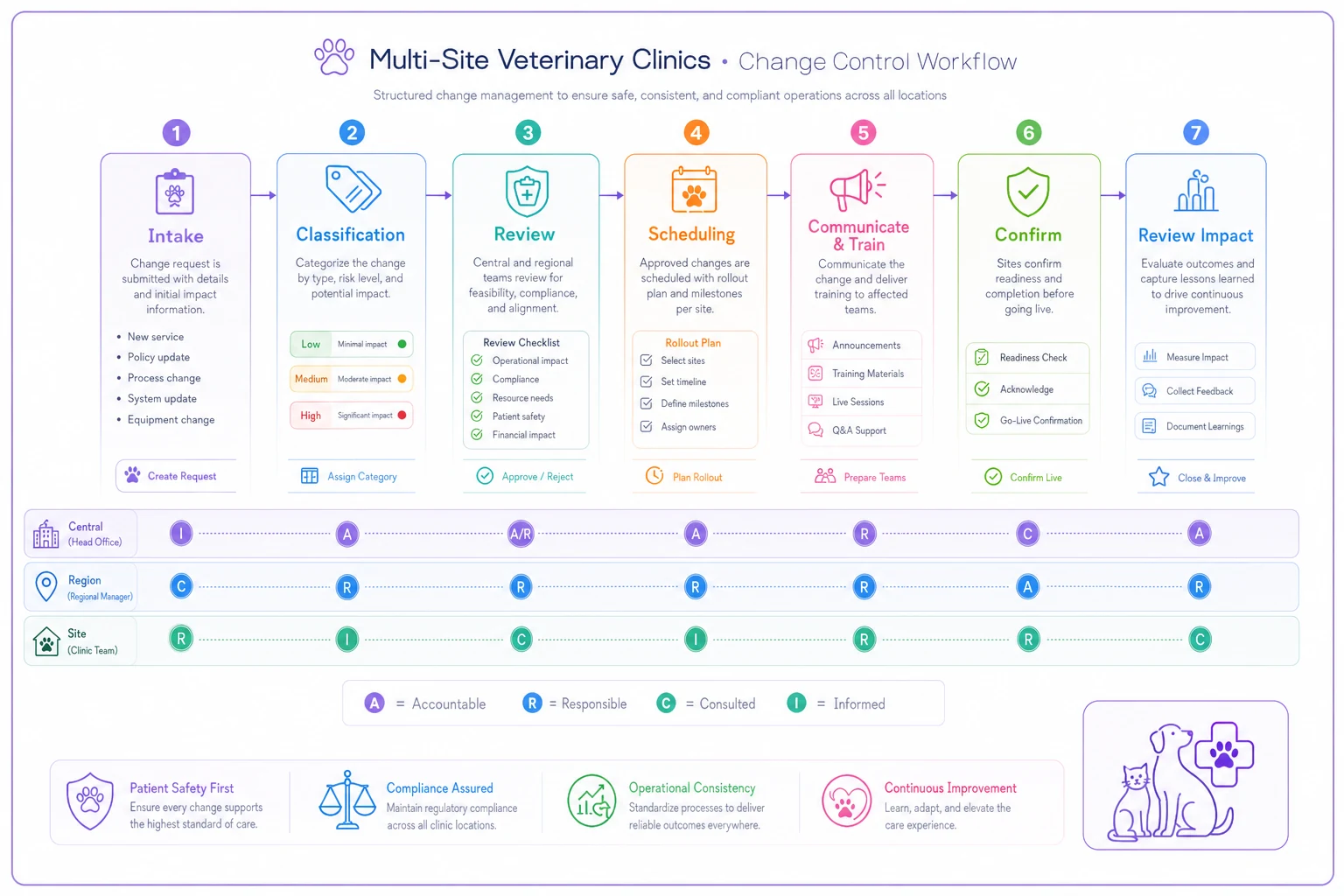
Here's a visual of the cadence to keep things predictable and trackable.
-
Intake — anyone can propose a change through one channel. No more hallway decisions or one-off emails that become unofficial policy.
-
Classify — is it minor (a wording tweak), standard (a new workflow), or major (a system or protocol shift)? The class sets the process.
-
Review — the right owner checks it against existing bundles for conflicts. This is where you catch the new script that contradicts an existing consent step.
-
Schedule — changes batch into a predictable release window. Many groups run a monthly release for standard changes and quarterly for major ones, with an emergency lane for compliance or safety.
-
Communicate & train — the change goes out before the go-live date with a short explainer and whatever training is needed.
-
Confirm — sites acknowledge, and you track who has and hasn't.
-
Review impact — a few weeks later, check whether the change did what it was supposed to.
When staff know the first week of every month brings a batch of updates with proper notice, they stop dreading surprises and start trusting the system. Random changes breed resistance. Predictable ones get adopted.
When staff know the first week of every month brings a batch of updates with proper notice, they stop dreading surprises and start trusting the system. Random changes breed resistance. Predictable ones get adopted.
A 6–18 month rollout roadmap
You can't install all of this at once, and trying to is itself a classic failure mode. Teams get whiplash, the founder burns out, and the whole thing stalls. Sequence it.
Months 0–3: Map and stabilize. Document the current state honestly—who actually decides what today, even if the answer is "the founder, at 10pm." Build the first decision-rights matrix. Pick one pilot site. Don't change much yet; just get visibility. The goal is a clear picture, not reform.
Months 3–6: Standardize the core. Build your first two or three bundles—usually clinical core and finance/compliance, because that's where inconsistency hurts most. Roll them to the pilot site and one other. Stand up the change-control intake channel even if it's just a shared form at first.
Months 6–9: Add the regional layer. If you've been running flat with everyone reporting to central, this is when you name regional leads and hand them real decision rights from the matrix. This is the hardest cultural step—founders struggle to let go. The tell that you've done it right is that problems start getting solved at region without reaching you.
Months 9–12: Roll the bundles wide. Deploy standardized bundles across all sites, batched through the change cadence you built. Expect pushback from sites that liked their own way. The matrix is your backstop—it says what's standard and what's local, so the conversation stays about facts, not feelings.
Months 12–18: Tune and institutionalize. Review the decision matrix against your new size. Retire bundles that aren't working. Build the dashboards that let region and central see version drift, compliance, and the handful of KPIs that actually matter. This is also when hiring and onboarding should slot cleanly into the model—covered in depth in A Recruitment and Retention System for Veterinary Clinics.
Smaller groups (three to five sites) can compress this toward the 9–12 month end. Larger or more scattered groups should plan for the full 18, because the coordination cost grows faster than the site count.
A real scenario
A four-site small-animal group—roughly 55 staff total—was growing but the founder was the bottleneck for nearly everything. Vendor substitutions, PTO over three days, equipment under $5k, pricing questions, hiring sign-offs. On a typical week she was clearing somewhere around 30–40 approval requests, many of which she had no real context on and rubber-stamped anyway.
The spread across sites told the story. The same senior dental cleaning ranged from about $310 to $395 depending on location, nobody could explain why, and client reviews had started mentioning it. Onboarding time-to-independence for a new tech ranged from three weeks at one site to nearly nine at another, because each site onboarded its own way.
They spent about four months building a decision matrix and two core bundles—clinical and finance—and named two regional leads from existing senior staff. They didn't buy anything fancy at first; the initial bundle library lived in a shared drive with strict version naming.
Six months in, the founder's weekly approval load dropped to under ten, and those ten were genuinely founder-level calls. The pricing spread on that dental compressed into a band of about $340–$365. New-tech onboarding landed consistently around four to five weeks across all sites. Nothing about the medicine changed. What changed was that decisions had owners and the standard had a single source of truth.
When this is worth it—and when it isn't
When it makes sense: You've got three or more sites, or two sites with a clear plan to grow, and you're already feeling the founder-bottleneck or drift between locations. If approvals pile on one person's desk and sites are quietly doing their own thing, you're past due.
When it's premature: A single location, or two very small sites that share most staff and the same owner working across both. Building regional layers and change cadences for two rooms a mile apart is overhead you don't need yet. Keep it light—one decision list, a few shared SOPs.
Who should not force this: Groups built intentionally as loosely affiliated independent practices, where each DVM-owner wants autonomy and the shared services are purely back-office. If the whole value proposition is independence, don't impose a central medical standard—you'll lose the people you acquired for. In that case, standardize only compliance and finance, and leave the rest alone.
The quiet truth about operating models
The founders who make the jump from one clinic to a stable group aren't always the best clinicians or even the best managers. They're the ones who figured out that their job changed—that at some point you stop being the person who solves every problem and become the person who builds the system that solves problems without you.
A multi-site veterinary clinic operating model is just that system written down: who decides, what stays standard, what flexes locally, and how change moves through the organization without breaking things. Get those four right and the group mostly runs itself. Leave them implicit and you'll spend your evenings refereeing decisions that should never have reached you.
Start with the decision matrix—one page, this week—and build outward from there.
Start with the decision matrix—one page, this week—and build outward from there.
Ready to elevate your clinic’s efficiency?
Join 500+ veterinary clinics using Veterinaryly to save time, reduce administrative overhead, and improve patient care.