
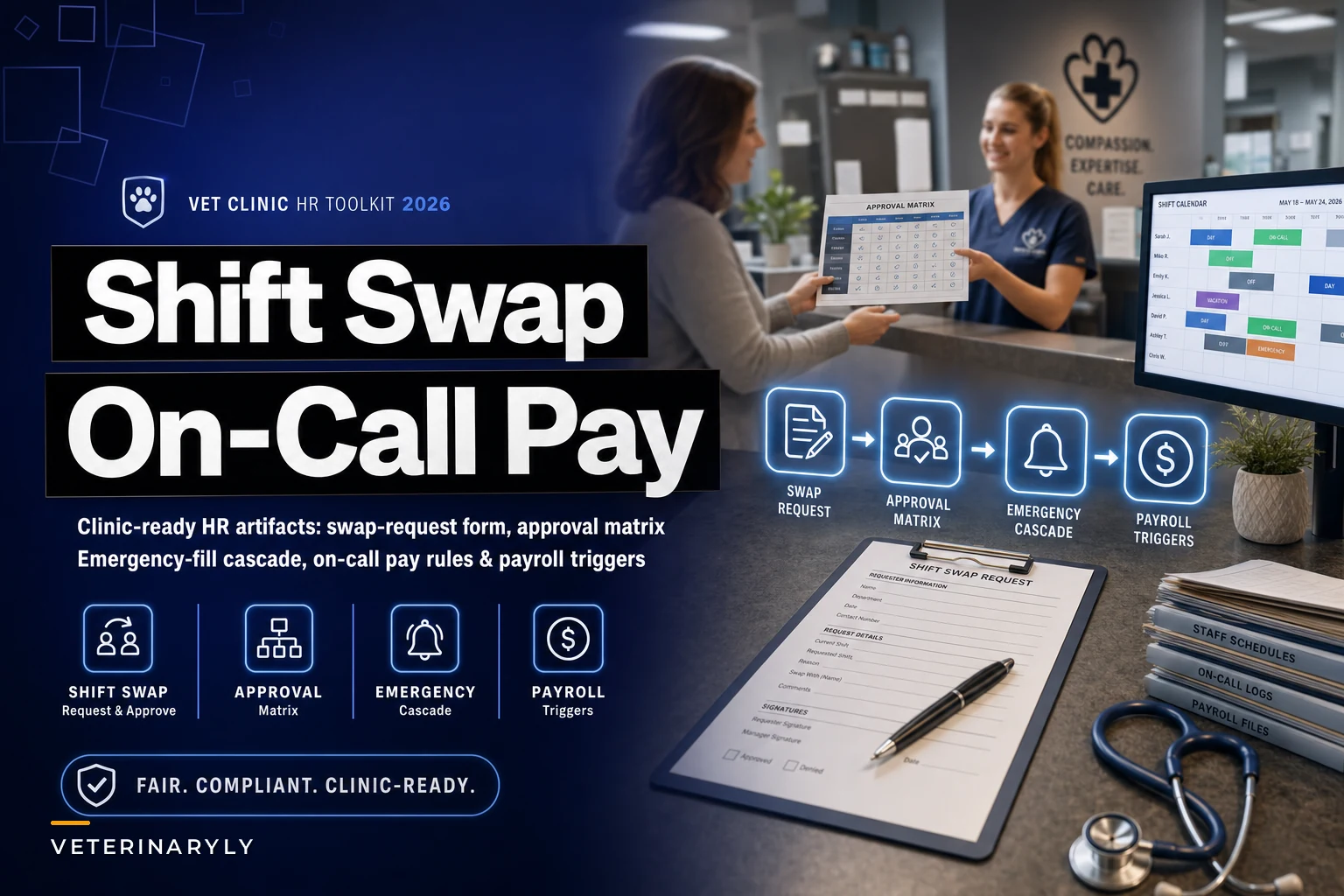

Most clinics don't have a scheduling problem. They have a shift-change problem. The base roster gets built fine — the mess starts the moment someone texts the practice manager at 9pm asking to swap Thursday for Sunday, and someone else covers a callout by "just showing up," and three weeks later payroll can't figure out who's owed on-call pay and who accidentally tripped into overtime.
That gap — between the schedule you published and the schedule that actually happened — is where clinics quietly bleed labor dollars and burn out their best techs. A written veterinary shift swap policy with a real approval matrix, an emergency-fill cascade, and hard payroll triggers is what closes it. Below is a set of clinic-ready artifacts you can adapt, plus the reasoning behind each one so you're not just copying templates blindly.
Why swaps break down (and it's rarely the staff's fault)
The typical failure looks like this: a DVM and a tech agree to trade shifts over text. Nobody updates the master schedule. The front desk still sees the original names. On the day of the swap, the person who traded out assumes they're covered, the person who traded in forgot, and you open with one fewer set of hands during a full appointment book.
Underneath that, three things are usually broken at once:
-
No single source of truth. Swaps live in text threads, sticky notes, and one person's memory.
-
No approval logic. A swap that creates an overtime liability or leaves a shift without a licensed DVM gets approved the same casual way as a harmless tech-for-tech trade.
-
No payroll linkage. The swap happens operationally but never triggers the pay-rule changes it should — on-call differentials, holiday rates, overtime thresholds.
The insight most owners miss: a swap isn't a scheduling event, it's a compliance and payroll event wearing scheduling clothes. Treat it that way and half the chaos disappears.
If your base scheduling is also reactive, these swap problems compound. A tighter foundation — the kind covered in a capacity-based approach to appointment flow — reduces the number of desperate last-minute swaps in the first place.
Artifact 1: The swap-request form (keep it boring on purpose)
The form's whole job is to force the information you'll need later before the swap is allowed to happen. Overdesign it and staff won't use it. Underdesign it and you're back to text threads.
Never miss a pet’s appointment again.
Veterinaryly helps you schedule, confirm, and manage every appointment and patient record effortlessly.
- Centralized appointment & patient management
- Automated client reminders
- Staff scheduling & task tracking
No credit card required
A clinic-ready swap-request form should capture:
-
Requesting employee name + role (DVM / LVT / assistant / CSR)
-
Shift being given up (date, start/end, location)
-
Proposed covering employee + role
-
Reason code (personal, illness, appointment, other)
-
Whether the covering employee has confirmed (yes/no — not "asked")
-
Any known overtime impact the requester is aware of
-
Date/time submitted
That "confirmed vs. asked" field matters more than it looks. A large share of failed swaps trace back to one person assuming coverage that was never actually agreed to. Making confirmation an explicit checkbox — not an assumption — kills that failure mode.
Make the confirmation checkbox required before the form can be submitted to eliminate assumed coverage failures.
One rule worth enforcing: no verbal swaps count. If it isn't on the form, the published schedule stands and the originally-scheduled person is responsible. Sounds harsh; it's the only thing that makes the system trustworthy.
Artifact 2: The approval matrix
Not every swap needs the same level of scrutiny, and treating them all identically is why managers either become bottlenecks or rubber-stamp risky trades. An approval matrix routes each swap to the right level of oversight based on what it actually changes.
An approval matrix should capture swap types, coverage risk, payroll risk, the appropriate approver, and a target response time. Keep it short and actionable.
| Swap type | Coverage risk | Payroll/OT risk | Approver | Target response |
|---|---|---|---|---|
| Same-role, same-week, no OT (tech↔tech) | Low | Low | Shift lead / auto-approve | Under 4 hrs |
| Same-role, crosses OT threshold | Low | High | Practice manager | Same day |
| DVM↔DVM swap | Medium | Medium | Lead DVM + manager | Same day |
| Cross-role (tech covering assistant, etc.) | Medium | Medium | Practice manager | Same day |
| Weekend / holiday / on-call shift | High | High | Practice manager + owner | Within 24 hrs |
| Swap leaving shift without licensed DVM | Critical | — | Blocked — must re-fill | Immediate |
The pattern worth internalizing: coverage risk and payroll risk are two separate axes. A tech-for-tech trade might be zero coverage risk but push someone from 38 to 44 hours — that's a payroll decision, not a scheduling one. Your matrix has to catch both.
For multi-location practices, decide early whether swap approval sits with the local manager or a central operations lead. Both work, but ambiguity doesn't. The trade-offs around that centralization question are the same ones laid out in this governance model for multi-location operations.
Artifact 3: The emergency-fill cascade
Swaps are planned. Callouts aren't. The 6am "I've got a fever and can't come in" text is a different animal, and it needs its own protocol — because in the moment, whoever's scrambling will make emotional decisions (calling their favorite tech first, guilt-tripping people) instead of systematic ones.
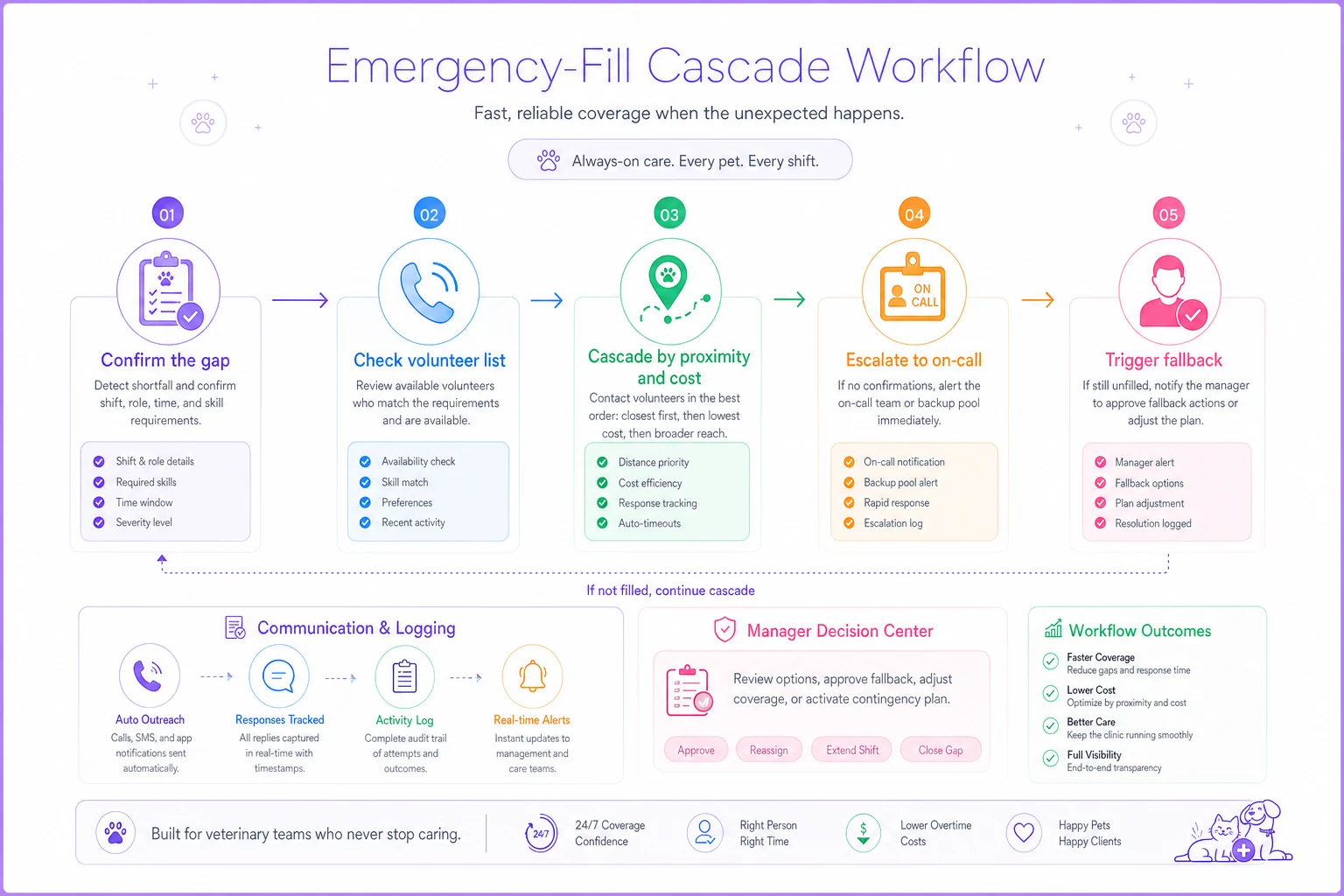
A cascade removes the improvisation. Here's a workable order of operations:
-
Confirm the gap. Log the callout, identify exactly which shift/role is now uncovered and how critical it is (is this the only DVM? the only surgery tech?).
-
Check the volunteer list first. Maintain a standing list of staff who've pre-indicated they want extra shifts. Contact them before anyone else — willing pickups are cheaper on morale than pressured ones.
-
Cascade by proximity and cost. Contact off-shift staff already scheduled that week before staff who'd be coming in on a true day off, which often triggers OT or day-off premiums.
-
Escalate to on-call. If nobody picks up within your defined window — say, 30 minutes — activate whoever holds the on-call slot for that day.
-
Trigger the fallback. If on-call can't cover, the manager decides: reduce the appointment book, extend remaining staff's hours, or reroute via referral or teletriage. This is a documented decision, not a panic.
Here's a simple visual of that cascade so everyone knows the steps to follow when a callout hits.
The mistake clinics make is skipping straight to step 4 or 5 because it's faster in the moment — then paying premium rates for coverage they could've filled cheaper at step 2 or 3. The cascade exists to slow you down just enough to make the calmer, cheaper call first.
Keep a simple log of every cascade activation: who was called, when, who accepted, what it cost. Over a quarter that log will tell you whether your callout rate is a staffing problem or a specific-person problem.
Artifact 4: On-call pay rules that don't cause fights
On-call pay is where clinics get into the most disputes, usually because the rules were never written down — they just accreted through precedent. Somebody got paid a certain way once, now everyone expects it, and nobody can point to an actual policy.
Write these rules explicitly:
-
On-call standby rate. What you pay simply for being reachable and available — often a flat per-shift stipend or a reduced hourly rate.
-
Call-in / activation rate. What kicks in when the on-call person is actually called to work, including any minimum (e.g., "activation guarantees a 2-hour minimum at full rate").
-
Distinction between reachable-from-home and required-on-site. These are legally and practically different and should pay differently.
-
Holiday and overnight differentials, and whether they stack.
-
How swapped on-call shifts transfer. If someone swaps an on-call shift, the on-call pay follows the person actually holding the phone — this needs to be spelled out or your payroll gets messy fast.
A common real-world tangle: a tech swaps into a weekend that carries on-call responsibility, doesn't realize the pay rules apply, then disputes the paycheck. The fix isn't more explanation after the fact — it's tagging the shift's pay attributes to the shift itself, so whoever holds it inherits the correct rules automatically.
Artifact 5: Payroll triggers — connecting the schedule to the paycheck
This is the piece that's almost always missing. Swaps and callouts change who worked when, but that change often never flows into payroll correctly. The result is a monthly reconciliation headache and a slow leak of both overpayments and underpayments.
Define explicit triggers — events in the schedule that must fire a payroll consequence:
| Schedule event | Payroll trigger |
|---|---|
| Approved swap crossing 40 hrs (or your OT threshold) | Flag OT for approver before confirming |
| Shift picked up on employee's scheduled day off | Apply day-off premium if applicable |
| On-call shift activated (called in) | Switch from standby rate to call-in rate + minimum |
| Holiday/weekend shift swapped in | Attach holiday/weekend differential to new holder |
| Callout not covered, remaining staff extended | Track added hours against OT threshold |
The principle here: pay attributes belong to the shift, not the person. When a shift carries "holiday + on-call + OT-eligible" tags, those follow whoever ends up working it. Manage it that way and payroll stops being detective work at month's end.
This is where clinic scheduling software genuinely earns its keep. A platform that lets a swap request check the approval matrix, flag the overtime consequence before approval, and carry the shift's pay attributes forward without anyone re-keying anything — that's not about replacing judgment. It's about making sure the manager sees the OT flag at the moment of the decision instead of discovering it two weeks later. If your tools can't connect the swap to its payroll consequence, that reconciliation work lands on someone's desk every single pay period without fail.
The KPIs that tell you if any of this is working
Policies without measurement drift back into chaos within a couple of months. A handful of schedule-health and compliance metrics keep the system honest:
-
Swap approval turnaround — median time from request to decision. Rising numbers mean your matrix is bottlenecking.
-
Percentage of swaps submitted on-form vs. after-the-fact — the single best indicator of whether staff actually trust the process.
-
Callout fill rate at each cascade level — how often you fill at steps 2–3 vs. 4–5. More filling low in the cascade means lower cost.
-
Uncovered-shift incidents — shifts that opened understaffed. This is your hard failure count.
-
On-call activation rate — if it's near-constant, your base roster is under-built, not your on-call plan.
-
OT dollars from swaps/callouts vs. from base schedule — separates avoidable overtime from structural overtime.
Track these monthly, not annually. Schedule health degrades fast, and the leading indicators — approval turnaround, on-form submission rate — move well before the lagging ones like OT dollars do.
A realistic before/after
A three-DVM small-animal clinic, roughly 25 staff across two locations, was running swaps entirely over text and a shared paper calendar. Over a typical quarter they'd have a handful of uncovered-shift mornings, and payroll spent close to a full day each cycle reconciling on-call and swap-related pay disputes. Avoidable overtime from panic-filled callouts was somewhere in the $2k–$3k range monthly — rough estimate, but the pattern was consistent.
They put in a real swap-request form, a two-tier approval matrix, and a documented cascade. Nothing fancy, mostly discipline. Within about two months, on-form swap submissions went from maybe half to nearly all of them. Uncovered mornings dropped to near zero. Reconciliation time shrank to a couple hours because pay attributes now traveled with the shifts. Overtime didn't vanish, but the avoidable slice — premium-rate scrambles — came down noticeably because the cascade pushed toward cheaper pickups first.
Nobody would call it dramatic. It just stopped being a recurring fire.
When to build the full system — and when not to bother
This makes sense when: you're running more than one DVM shift, you have on-call or emergency coverage, you cross OT thresholds regularly, or you operate across multiple locations. The coordination cost is high enough that structure pays for itself quickly.
This is overkill when:
-
you're a solo-doctor practice with four or five staff and everyone's within earshot. A shared calendar and a group chat genuinely work at that scale — imposing an approval matrix would just add friction for coverage decisions that take ten seconds anyway.
Who should NOT start here: if your base roster is chronically understaffed, fixing swaps won't help. You'll just have a very well-documented record of shifts you can't cover. Solve the capacity and staffing baseline first, then layer these swap and on-call artifacts on top. The best swap policy in the world can't manufacture staff who don't exist.
Pulling it together
Shift swaps, callouts, and on-call coverage feel like small daily annoyances until you add up what they cost across a year — uncovered mornings, premium-rate panic fills, payroll disputes, the slow erosion of trust when someone's paycheck doesn't match what they actually worked. Every one of those is downstream of a missing artifact: no form, no approval logic, no cascade, no payroll linkage.
Start with the form and the approval matrix, since those unlock the rest. Add the cascade before your next flu season, and get your on-call and payroll rules written down before the next dispute rather than after. The point isn't to bury a small clinic in process — it's to make sure the schedule you published and the schedule that actually happened stay close enough that nobody gets burned.
Ready to elevate your clinic’s efficiency?
Join 500+ veterinary clinics using Veterinaryly to save time, reduce administrative overhead, and improve patient care.