
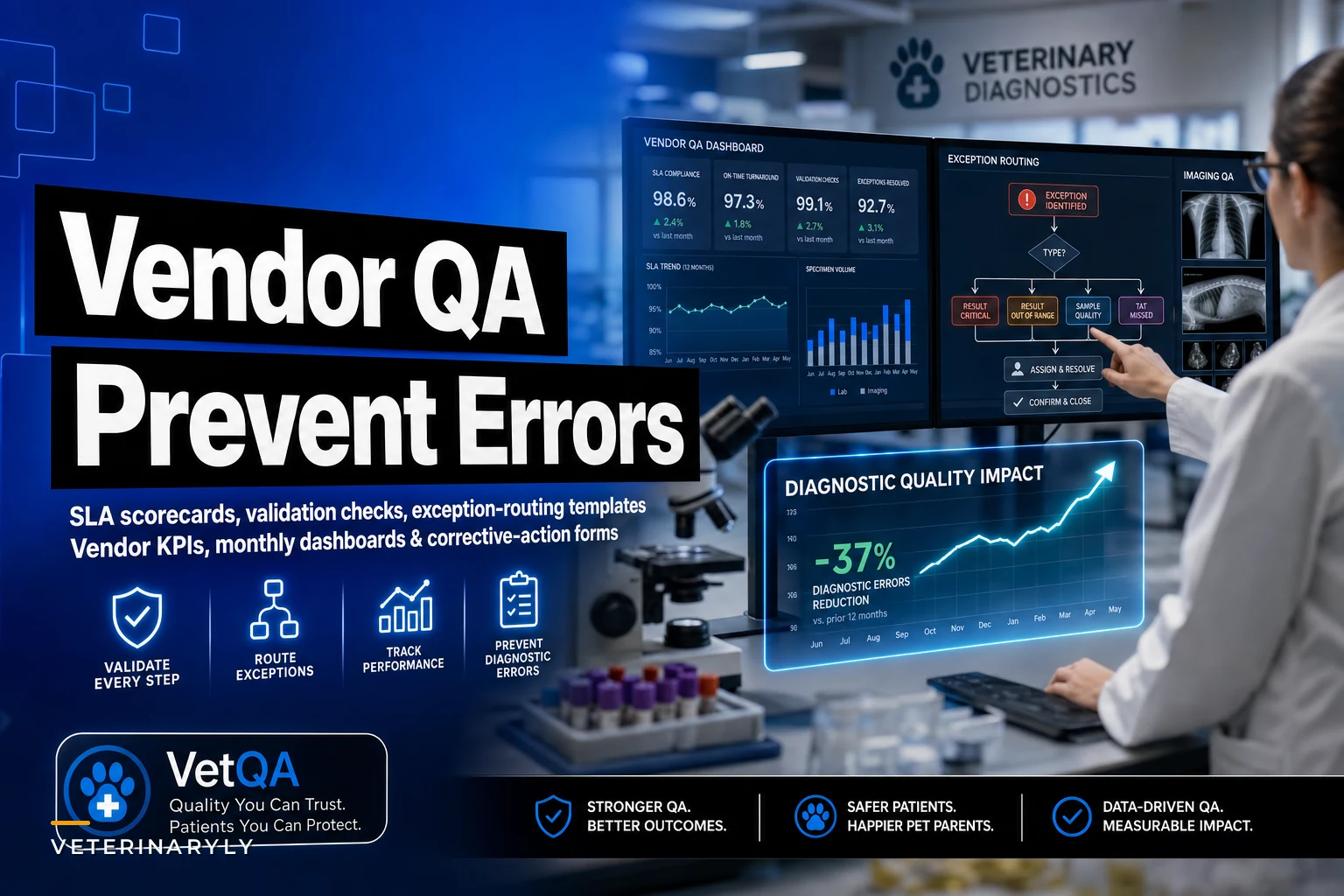

Most clinics treat their reference lab and teleradiology providers like a black box. You send the sample or the study out, you wait, you get a result back, and you assume the result is correct. That assumption holds right up until the day it doesn't — a hemolyzed sample that should have been rejected gets run anyway, a potassium comes back wildly off, and you're treating a cat for something it doesn't have.
The gap isn't clinical. It's that almost nobody actively measures vendor quality. You measure your own turnaround times, your own labeling accuracy, your own imaging protocols. But the moment a sample or a study leaves the building, the accountability just evaporates. Veterinary vendor QA for labs and imaging is the part of quality control that clinics skip because it feels like someone else's job.
It isn't. When a vendor makes a mistake, the client blames you, the patient suffers, and the medical record has your name on it.
The specific failure most clinics never catch
Results come back, they look plausible, they get entered, and nobody asks whether the vendor did its own quality checks correctly.
A typical example: a mixed-animal practice sends chemistry panels to a regional reference lab. Over a six-week stretch, three separate panels come back with liver values that don't fit the clinical picture. The vet re-runs one in-house, gets a normal result, and only then realizes the outside lab has a drifting analyzer. Nobody at the clinic had been tracking how often outside results disagreed with the clinical picture or with in-house rechecks, so the problem simmered for six weeks before anyone connected the dots.
That's the real issue. Individual errors are almost invisible. It's only in aggregate — across dozens of samples — that you see a vendor is underperforming. And you can't see the aggregate if you're not scoring it.
This ties directly into your internal collection and routing discipline. If your samples are leaving the building clean and labeled correctly — which is its own project, covered in standardized lab collection, labeling, and result-routing — then any error that comes back is genuinely the vendor's. Clean internal process is what lets you attribute blame accurately. Without it, the vendor just says "your sample was compromised" and you have no data to argue.
Start with an SLA scorecard, not a vibe
Most clinics evaluate vendors on feel. "They're usually pretty fast." "Their radiologist is good." That's not measurement, that's memory, and memory tends to be generous to vendors you've worked with for years.
Never miss a pet’s appointment again.
Veterinaryly helps you schedule, confirm, and manage every appointment and patient record effortlessly.
- Centralized appointment & patient management
- Automated client reminders
- Staff scheduling & task tracking
No credit card required
An SLA scorecard forces you to define what "good" actually means before you can hold anyone to it. The key is picking a small set of measurable commitments and tracking them month over month. Don't overbuild this. Five or six metrics per vendor is plenty.
A practical starting scorecard you can adapt for both lab and imaging vendors:
| KPI | Lab target | Imaging target | How you measure it |
|---|---|---|---|
| Turnaround time (routine) | ≤ 24 hrs | ≤ 48 hrs | Timestamp sent vs. result received |
| Turnaround time (STAT) | ≤ 4 hrs | ≤ 12 hrs | Same, flagged STAT only |
| Rejected/unusable sample rate | < 2% | < 3% (non-diagnostic studies) | Count / total submitted |
| Result-clinical mismatch flags | < 1% | < 1% | Clinician-flagged discrepancies |
| Amended/corrected reports | < 0.5% | < 0.5% | Vendor-issued corrections |
| Missing/incomplete reports | 0 tolerated | 0 tolerated | Studies with absent findings |
The mismatch and correction rows are the ones people forget, and they're the most important. Turnaround is easy to track and easy to complain about. But a vendor that's fast and wrong is far more dangerous than one that's slow and accurate. A corrected report is the vendor admitting they got it wrong the first time — if that number creeps above half a percent, you have a real problem.
Score each vendor monthly. Green if they hit the target, yellow if they're within a defined tolerance, red if they blow past it. Two reds in a row on any accuracy metric is a conversation with the vendor, not a shrug.
Incoming-data validation: catch the error before it hits the chart
The scorecard tells you how a vendor is doing over time. Validation checks catch the individual bad result before it does damage. These are two different jobs, and clinics that only do one of them stay exposed.
Validation is about screening every incoming result against a set of rules the moment it arrives — before it gets locked into the record. The goal is to flag anything that looks physically impossible, internally inconsistent, or wildly out of range for the patient.
A basic set of validation checks for lab results:
-
Range sanity check — values outside biological plausibility (a glucose of 900 on an asymptomatic patient, a potassium that would be incompatible with life)
-
Internal consistency — do related values agree? A severely elevated BUN with a perfectly normal creatinine and normal USG deserves a second look
-
Sample quality notes — did the vendor flag hemolysis, lipemia, or clotting but run it anyway?
-
Patient match — species, age, and prior results. A canine reference range applied to a rabbit sample is a silent killer
-
Delta check — compare to the patient's previous result. A value that swung dramatically since last month without a clinical reason is a flag
For imaging, validation looks a little different but follows the same logic: confirm the study matches the patient and body part ordered, confirm the report actually addresses the clinical question asked, and flag any report that's vague to the point of being useless ("cannot rule out" with no next step). Imaging mismatches — wrong patient, wrong study attached — are their own recurring nightmare, and the mechanics of preventing them are covered in the end-to-end veterinary imaging workflow.
Validation checks don't need to be perfect. They just need to catch the obvious stuff before it reaches a treatment decision. A rule that flags 15 results a month and catches even one dangerous error has already paid for itself several times over.
Exception routing: what happens when a check fails
A flagged result that sits in an inbox is worse than no flag at all, because now you have documented evidence that someone noticed and didn't act. Exception routing is the rule for what happens the second a validation check trips.
-
Critical / life-threatening flag → Immediate notification to the attending vet by phone or direct message, result held from auto-entry, documented callback to vendor within the hour if the value is suspect.
-
Clinical mismatch flag → Routed to the ordering clinician's review queue same day, result marked "pending confirmation," no billing or treatment action until reviewed.
-
Sample/study quality flag → Routed to the tech who collected it plus the vendor liaison, decision made whether to redraw/rescan, logged on the vendor scorecard.
-
Turnaround breach → Auto-logged to the scorecard, escalated to vendor only if it's the second breach that week or a STAT.
-
Amended report received → Original and correction both preserved in the record, clinician notified, logged as a vendor correction event.
Simple visual of the routing tiers and notification steps.
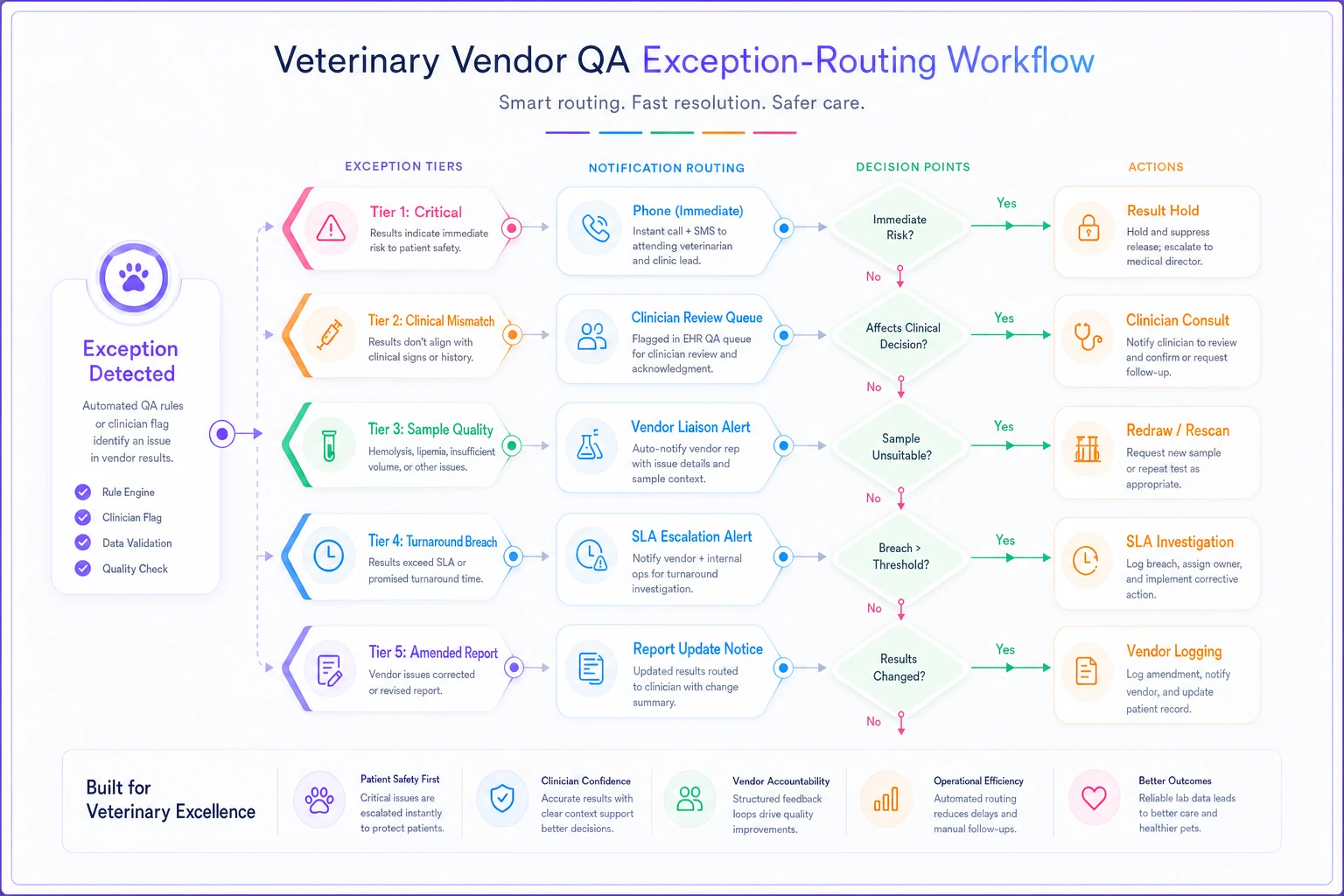
Every exception needs a named owner and a deadline. "The team will review it" means nobody will. Assign the queue to a specific role — usually a lead tech or the practice manager — and give them the authority to hold a result out of the chart until it's cleared.
The monthly vendor-performance dashboard
Once you're scoring and routing, you need one place that rolls it all up so you can actually make decisions. A monthly dashboard turns scattered incidents into a pattern you can act on.
-
Scorecard status for the month (greens, yellows, reds)
-
Trend line on turnaround and correction rates over the last six months
-
Total exceptions raised, by tier
-
Open corrective actions and their status
-
A short notes field for context ("new radiologist started this month, expect variance")
The pattern worth watching for is slow drift rather than sudden failure. Vendors rarely fall off a cliff. They degrade — turnaround creeps from 22 hours to 27, correction rate ticks from 0.3% to 0.6%, mismatch flags go from one a month to four. None of those is alarming on its own. Six months of the dashboard side by side makes the trend impossible to ignore. That's the whole point of tracking it monthly instead of reacting incident by incident.
Corrective-action forms that actually change vendor behavior
When a vendor crosses into red, a phone call and a promise isn't accountability. A corrective-action form is. It creates a paper trail, forces the vendor to name a root cause, and gives you leverage at renewal.
-
Incident summary — what happened, with dates and case numbers
-
KPI(s) affected — tied directly to the scorecard
-
Impact — clinical, financial, or client-trust consequences
-
Vendor's stated root cause — in their words
-
Corrective action committed — specific and dated
-
Follow-up date — when you'll verify it worked
-
Outcome — resolved, escalated, or vendor-under-review
The value isn't the form itself, it's the follow-up date. Vendors will happily write "we've retrained our staff" and move on. A logged follow-up date, checked against the next month's scorecard, is what tells you whether anything actually changed. If the same KPI is red again at follow-up, that's a documented pattern — and that's what you take to a competing vendor when you're ready to switch.
A real scenario
A three-doctor small-animal practice had been using a single reference lab for years, mostly out of habit. No formal QA, just the general sense that things were fine.
They started running a basic monthly scorecard and validation checks after a couple of odd chemistry results spooked one of the associates. Within two months, the numbers told a story the vibe had completely hidden: STAT turnaround was averaging closer to 6–7 hours against a promised 4, and the correction rate was sitting around 0.8% — well above the half-percent they'd set as tolerable.
They filed corrective actions on both. Turnaround improved after the vendor added a second afternoon courier run. The correction rate didn't budge, and after two more months of red, they split their volume — moved the higher-stakes panels to a second lab and kept routine work with the original. Over the following quarter, discrepancy flags on the critical panels dropped noticeably, and the associates stopped re-running chemistries "just to be safe," which had quietly been costing them both time and reagent.
Nothing dramatic. No huge revenue swing. Just fewer diagnostic surprises, less second-guessing, and a documented reason to renegotiate at contract time.
When this is worth building — and when it isn't
This level of vendor QA makes sense when you're sending real diagnostic volume out the door and clinical decisions ride on the results coming back correct. If you're running most diagnostics in-house and only outsource the occasional specialty panel, a full scorecard-and-dashboard system is overkill. Track the exceptions, skip the monthly rollup.
It's also a bad idea to build this if you can't commit to the follow-up. A scorecard nobody reviews and corrective-action forms nobody closes out are just documentation of your own negligence. Either assign a clear owner and put it on the calendar, or don't start. Half-built QA is worse than none, because it creates a false sense of oversight.
And if you're a single-doctor practice with one trusted vendor and years of clean results, be honest about your actual risk. The point isn't paperwork for its own sake. The point is catching drift before it becomes a misdiagnosis. Scale the system to the size of the risk you're actually carrying.
Where the manual work gets heavy
The honest downside of doing all this is that it's tedious. Timestamping every send-and-receive, delta-checking results against prior values, routing flags to the right person, keeping six months of scorecards current — that's real work, and it's exactly the kind of work that gets abandoned during a busy stretch.
Automate validation and exception routing so your QA survives the busiest weeks.
This is where an operational platform with built-in validation rules and automated exception routing genuinely earns its place. When incoming results are automatically screened against your range and delta rules, flags routed to the right queue by tier, and scorecard metrics accumulated without anyone manually tallying them, the system survives the busy weeks — which is the only time any of this actually matters. The goal isn't to replace clinical judgment. It's to make sure a bad result never quietly reaches a treatment decision because the one person tracking it was slammed that day.
The tooling is secondary, though. Whether you build this in a spreadsheet or automate it, the discipline is the same: define what good looks like, measure it consistently, and hold vendors to a standard with a paper trail behind it. Your labs and imaging providers are part of your diagnostic accuracy whether you measure them or not. The only choice is whether you find out about their mistakes from a dashboard — or from a patient that didn't get better.
Ready to elevate your clinic’s efficiency?
Join 500+ veterinary clinics using Veterinaryly to save time, reduce administrative overhead, and improve patient care.