

Most clinics don't have a compliance problem. They have a coordination problem that only looks like a compliance problem when something breaks.
The pattern is pretty consistent: controlled-substance logs live in a locked drawer with a paper ledger, e-consent runs through whatever the PIMS supports, cybersecurity is "the IT guy's job," and DEA registrations plus DVM licenses are tracked in someone's Outlook calendar. Different person, different cadence, no shared view. Nothing connects. And because nothing connects, nobody notices the gaps until a board inspector, an insurance auditor, or a ransomware screen forces the issue.
This article is about building the connective tissue — a unified clinic risk register and scoring model — so these four domains stop living in separate silos and start feeding a single remediation cadence. It's less about any one regulation and more about how the whole system holds together (or doesn't) as your clinic grows.
Why four separate compliance efforts quietly become one big liability
Walk into most single-location practices and risk is managed reactively and locally. The practice manager owns controlled substances. The lead DVM half-owns credentialing. A vendor owns cybersecurity. Consent lives somewhere inside the appointment workflow and nobody really "owns" it at all.
That arrangement works fine at low volume because one person can hold the whole picture in their head. The problem is risk doesn't respect org charts. A single incident routinely crosses all four domains at once.
Consider a realistic chain: a technician's login gets phished. That's a cybersecurity event. But that login also had access to the e-prescribing module, which touches controlled-substance records, which are tied to a DEA registration held by a specific vet whose credentials are now implicated. And somewhere in that mess, consent forms containing client financial data may have been exposed. One event, four domains, four different "owners," and no single register that says this is what happened, here's who's responsible, here's the deadline to fix it.
When each domain is tracked separately, you get overlapping blind spots. The controlled-substance log looks clean. The credentialing spreadsheet looks current. But nobody ever asked whether the person listed on the DEA registration is the same person whose license expired two weeks ago — because those two facts live in two different documents maintained by two different people.
What actually breaks at scale
At one location, informal coordination survives on proximity. People talk. Problems get flagged in the hallway. Add a second and third location and that informal layer collapses fast.
Never miss a pet’s appointment again.
Veterinaryly helps you schedule, confirm, and manage every appointment and patient record effortlessly.
- Centralized appointment & patient management
- Automated client reminders
- Staff scheduling & task tracking
No credit card required
-
Credential drift. A relief vet works across three locations. Their DEA registration is site-specific, but the scheduling system doesn't know that. They prescribe a controlled substance at a location not on their registration. Nobody catches it because no system cross-references "who is credentialed for what, where."
-
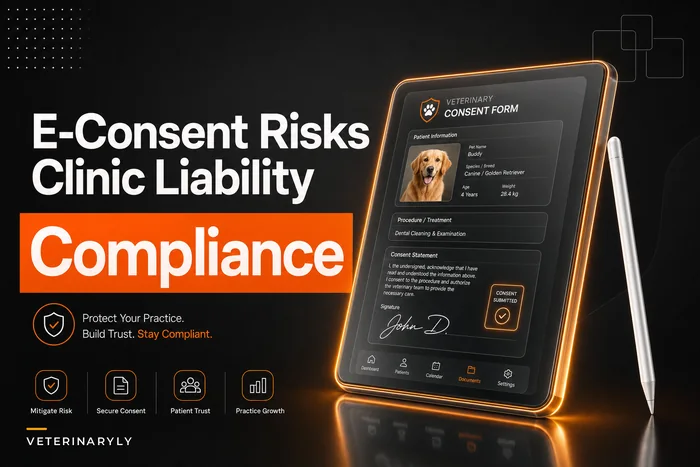
Consent inconsistency. Location A uses an updated e-consent form with a proper anesthesia risk disclosure. Location B is still running last year's PDF. Same brand, same standard of care expected — different liability exposure. This is exactly the kind of gap that turns into a claim, and it's why a disciplined e-consent workflow has to be governed centrally, not left to each front desk.
-
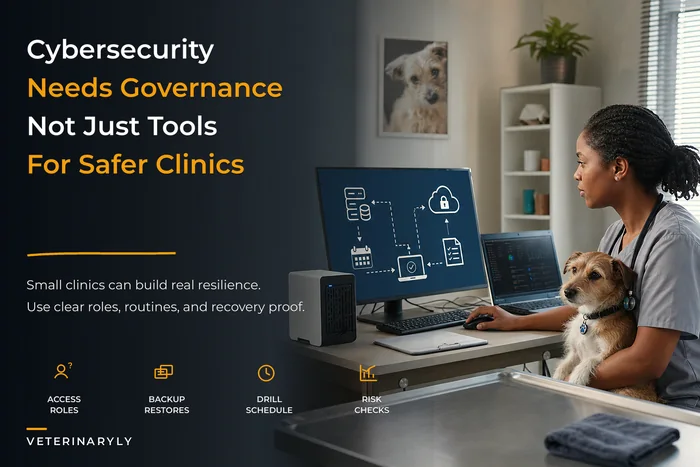
Cyber exposure multiplies. Every new location adds endpoints, a new network, more staff logins, and usually another local vendor relationship. The attack surface grows faster than anyone's tracking it. Sound cyber practice can't stay a per-site improvisation — it needs the kind of operational cybersecurity governance that applies uniformly across sites.
-
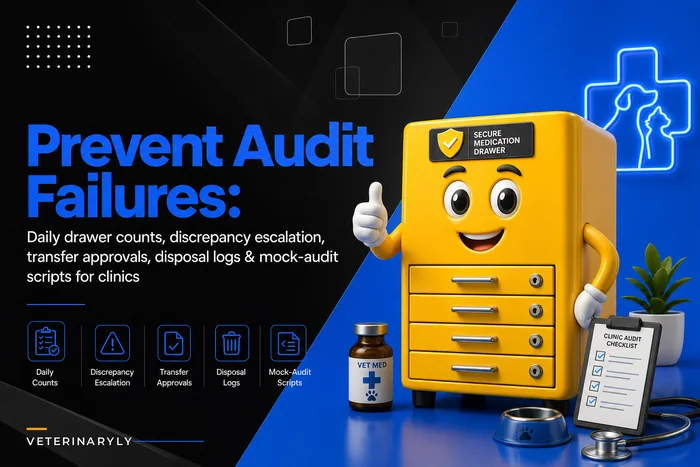
Controlled-substance reconciliation gaps. Two locations, two safes, occasional inter-site transfers of a drug in short supply. Now your chain of custody spans buildings. A single sloppy transfer log is enough to fail an inspection. This is the operational heart of a defensible controlled-substance inventory and compliance workflow.
The common failure isn't that any one domain is neglected. It's that the seams between them have no owner and no cadence.
The unified risk register: one list, one scoring model
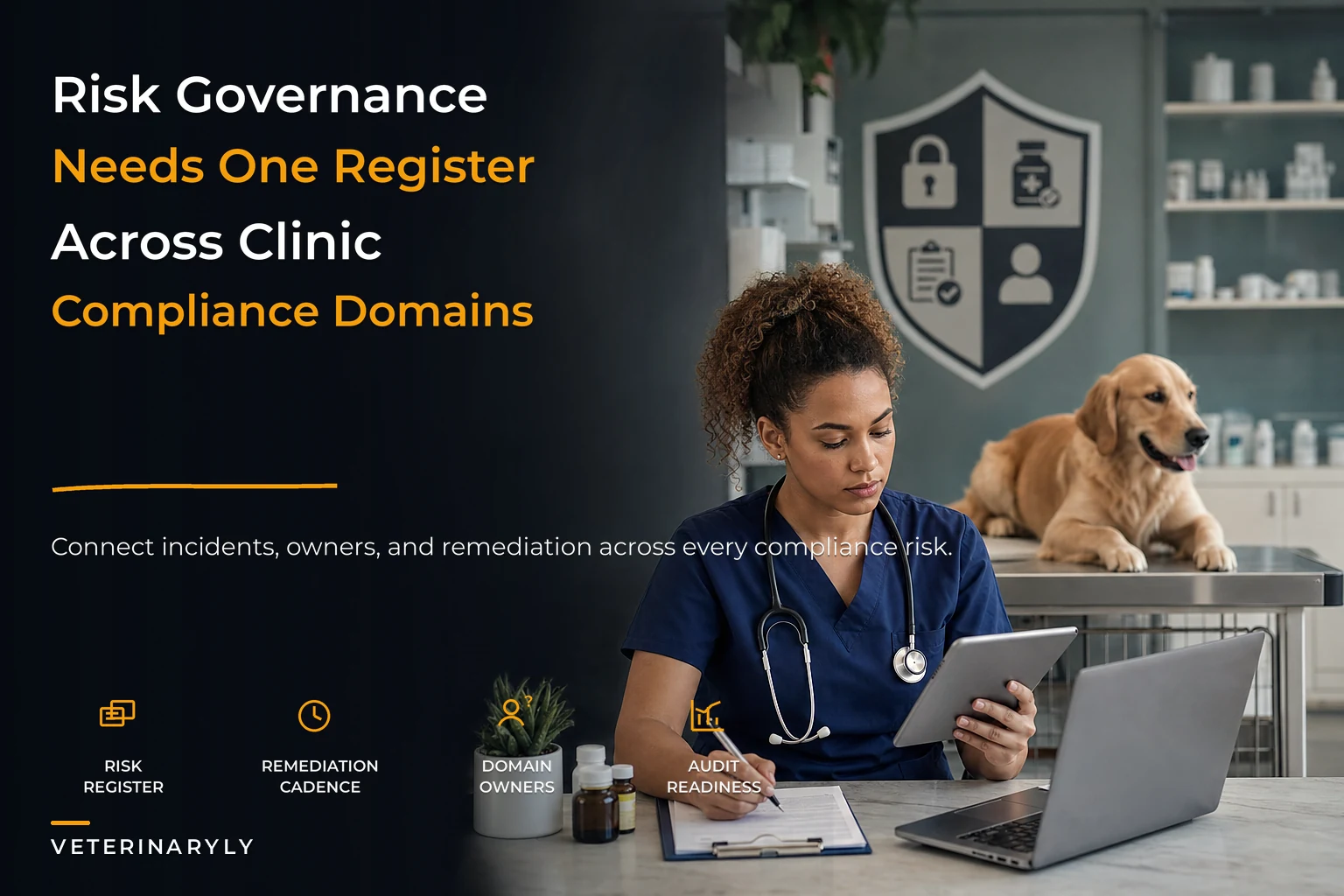
The fix starts embarrassingly simply: put every risk item, from all four domains, into a single register. Not four spreadsheets. One.
The register's job is to make risks comparable so you can prioritize honestly. A DEA log discrepancy and an unpatched server feel incomparable until you score them on the same scale. Then you can actually decide what gets fixed first.
A workable scoring model uses three inputs:
-
Likelihood — how probable is this failing or being exploited (1–5)
-
Impact — regulatory, financial, clinical, and reputational severity if it does (1–5)
-
Detectability — how likely you are to catch it before it causes harm (1–5, where 5 means you'd almost certainly miss it)
Multiply them for a composite score. High-likelihood, high-impact, low-detectability items float to the top — and those are almost always the seam problems that cross domains.
Here's how a handful of real items look when you force them onto one scale:
| Risk item | Domain | Likelihood | Impact | Detectability | Score | Owner |
|---|---|---|---|---|---|---|
| Relief DVM prescribing outside registered site | Controlled substances + credentialing | 3 | 5 | 4 | 60 | Practice Manager |
| Outdated consent form at one location | E-consent | 4 | 4 | 3 | 48 | Front-desk lead |
| Shared staff logins on treatment PCs | Cybersecurity | 4 | 4 | 2 | 32 | IT / Ops |
| Expired DVM license not flagged | Credentialing | 2 | 5 | 5 | 50 | HR / Ops |
| Unlogged inter-site CII transfer | Controlled substances | 3 | 5 | 3 | 45 | Inventory lead |
The scores aren't precise science. The point is forcing everything into one view so the highest-composite items get attention first, regardless of which "department" they belong to.
From incident to remediation: the cadence that makes it real
A register is a snapshot. What keeps it alive is a remediation cadence — a recurring rhythm where items get reviewed, assigned, worked, and closed. Without a cadence, registers rot. They become a document someone built once for an audit and never opened again.
A cadence that holds up in a busy clinic looks roughly like this:
-
Weekly (15 minutes) review anything scored above a threshold, confirm owners are moving, flag new incidents.
-
Monthly full register review, re-score items whose conditions changed, close out completed remediations.
-
Quarterly run a mock audit against one domain on rotation.
The connective piece is an incident-to-remediation template — a single standard form used no matter which domain triggered the event. Every incident, whether it's a missed narcotic count or a phishing click, flows through the same fields:
-
What happened — factual description, no blame
-
Domains touched — check all that apply (this is where cross-domain risks surface)
-
Immediate containment — what was done in the first hour
-
Root cause — the process gap, not the person
-
Remediation owner and deadline
-
Verification — how you'll confirm it's actually fixed
-
Register update — does this change any existing scores?
The magic of the shared template is step 2. When a cyber incident forces someone to check the "controlled substances" and "consent" boxes, the cross-domain exposure becomes visible by design instead of by luck.
Here's a simple visual of that incident-to-remediation workflow.
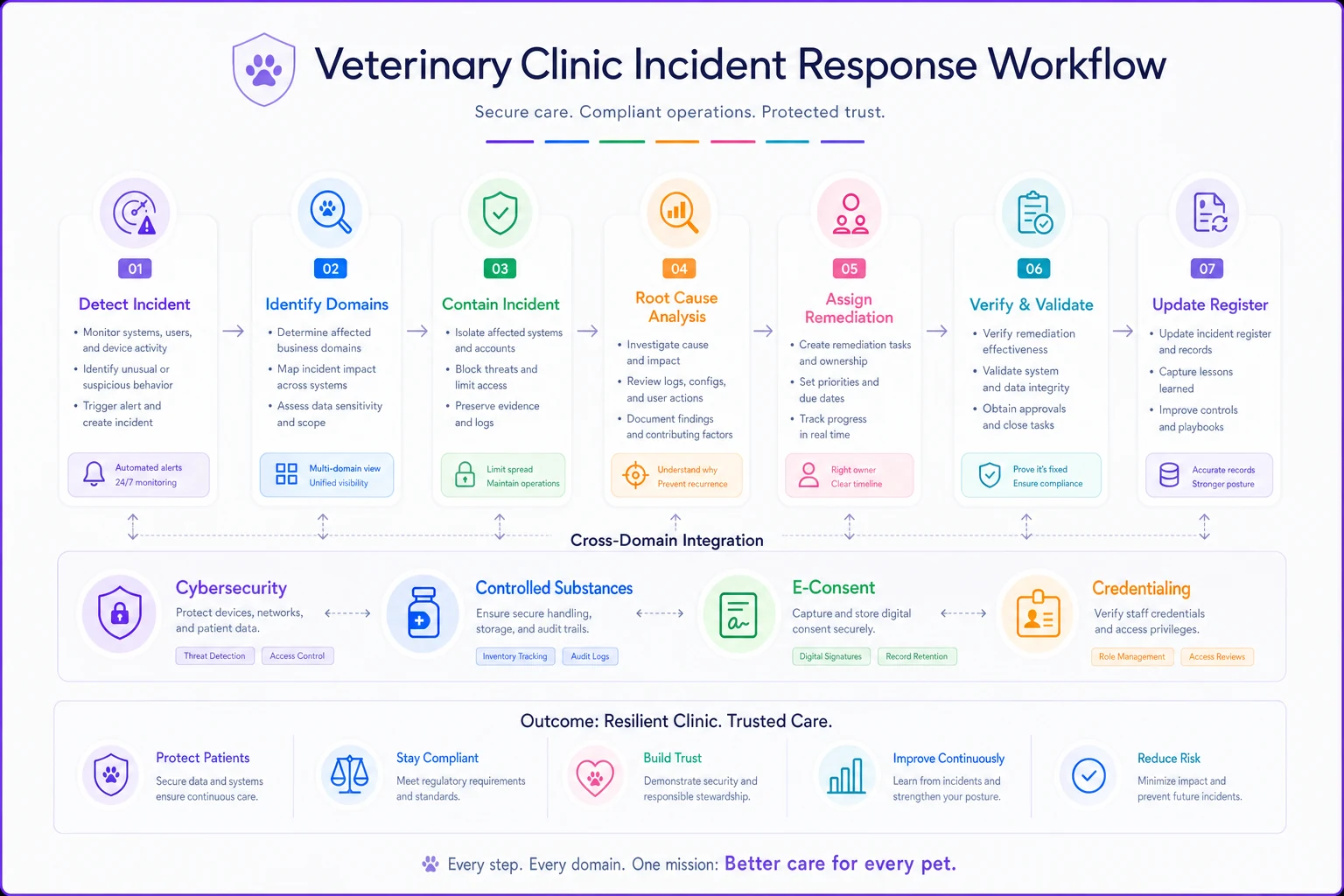
Seeing the steps as a flow makes it easier to assign handoffs and SLAs so nothing stalls between owners.
Mock-audit scripts: rehearse before the real thing
Clinics fail audits on the boring stuff — a missing signature, a log with a gap, a form version nobody updated. The way to catch those is to audit yourself first, on a rotation, using a repeatable script.
A mock-audit script is just a written walkthrough an internal person runs as if they were the inspector. Keep it blunt and checkable. A controlled-substance mock script, for example:
-
Pull three random dates from the past 90 days. Do the log balances reconcile to physical count?
-
Is every entry signed and dated by two people where required?
-
Does every prescriber on the log have a current, site-matched DEA registration?
-
Are all inter-site transfers documented with both sending and receiving signatures?
-
Is the safe access list current with no departed staff still listed?
A credentialing mock script:
-
Every active DVM and tech
license current, on file, and expiration tracked?
-
DEA registrations matched to the correct practice location?
-
Any relief or locum staff working outside their credentialed scope?
Run one domain per quarter. The point isn't to pass your own mock audit — it's to fail it privately, cheaply, and generate real remediation items you'd otherwise only discover under pressure.
A real scenario
A three-location small-animal group — roughly 22 staff, around 340 controlled-substance transactions a month — kept passing informal internal checks but had a bad afternoon when a state inspector found an inter-site drug transfer with a receiving signature but no matching sending log. Small on paper. But it opened the door to a full review, and the follow-on questions exposed that one of their relief vets had been prescribing at a location not on his DEA registration for close to four months.
Nothing was malicious. Pure seam failure — inventory tracked in one place, credentialing in another, nobody ever cross-checking the two.
They rebuilt around a single register with the scoring model above and a monthly cadence. Within two quarters the changes weren't dramatic-sounding but they mattered: transfer logs reconciled cleanly, credential expirations got flagged 60 days out instead of after the fact, and mock audits started surfacing two or three fixable items each quarter before anyone external saw them. The owner's own words were roughly that they'd stopped feeling like every inspection was a coin flip.
When this level of structure makes sense — and when it doesn't
When it makes sense: you're running more than one location, you carry meaningful controlled-substance volume, or you've had even one near-miss that touched multiple domains. Multi-site practices essentially can't avoid this; the informal coordination layer is already gone.
When it's overkill: a genuinely small single-doctor practice with low controlled-substance volume and one person who legitimately holds the whole picture. Forcing a heavy register onto that setup adds bureaucracy without reducing real risk. A lightweight version — one shared checklist and a quarterly self-review — is plenty.
Who should not do this: anyone planning to build the register, run it for one audit cycle, and abandon it. A dead register is worse than none, because it creates false confidence. If you can't commit to the cadence, don't build the artifact.
Where software actually helps
The register, templates, and scripts all work on paper or in a spreadsheet — and honestly, starting there is fine. The coordination breaks down manually at exactly the moment it matters most: when a credential expires and it needs to cross-reference a DEA registration and trigger a review of who's scheduled to prescribe next week. Doing that by hand across three locations is where things fall through the cracks.
This is where an operational platform earns its place — not as a compliance gimmick, but as the thing that keeps the seams visible. AI-assisted operational software can watch for the cross-domain triggers a human reviewer misses: flagging that an expiring license belongs to someone on next week's surgery schedule, or that a consent form version is out of sync between sites, or that a controlled-substance log has a gap before an inspector finds it. The value isn't automation for its own sake — it's that the connections between domains get surfaced automatically instead of depending on someone remembering to check.
The point of all of this
Integrated risk governance in a veterinary clinic isn't about being more paranoid. It's about refusing to manage four related risk domains as if they were unrelated. The clinics that get burned rarely neglect any single area — they just never built anything to watch the space between areas, and that space is exactly where real incidents live.
Start with one register. Score everything on one scale. Run one cadence. Rehearse with mock audits before someone external does it for you. The structure is simple. The discipline of actually keeping it alive is the hard part — and it's also the whole difference between a clinic that treats every inspection as a coin flip and one that already knows what it's going to find.
Ready to elevate your clinic’s efficiency?
Join 500+ veterinary clinics using Veterinaryly to save time, reduce administrative overhead, and improve patient care.