


An orphaned study is a radiograph, ultrasound, or lab result that exists somewhere in your systems but isn't connected to the right patient record — or isn't connected to any record at all. The CR plate fired. The analyzer ran the panel. The data landed somewhere. But the loop never closed in the EMR, so clinically, it may as well not exist.
Most clinics don't realize how many of these they're accumulating because nobody's counting. The study sits in the PACS or the lab portal, the chart shows nothing, and everyone assumes the other system has it. Then three weeks later a tech is pulling together a referral packet and can't find the abdominal series that definitely got shot.
This is a reconciliation problem, not a technology problem. The systems are usually working fine. What's missing is a routine that cross-checks them against each other on a schedule — with scripts specific enough that a CSR or tech can run them without needing a meeting to figure out what to do.
Why orphaned studies happen even when every system "works"
The failure almost never looks dramatic. It's a small break in a handoff that nobody owns.
A typical example: a dog comes in as "Bella Smith," but the modality worklist pulls an older duplicate record — "Bella Smith-2" from a prior address change. Images acquire under the duplicate. The EMR the team is actually charting in never receives them. Nothing errors out. Both records are technically valid. The study is orphaned the moment the wrong accession number gets stamped.
The common root causes tend to cluster into a few buckets:
-
Duplicate or near-duplicate patient records that split where studies land versus where charting happens.
-
Manual accession/MRN entry at the modality instead of pulling from a worklist, which introduces typos that break the match.
-
Interface hiccups where the HL7 or DICOM message is sent but not acknowledged, and nobody watches the failed-message queue.
-
Reference lab portals that live outside the EMR, so results posted online never auto-file and depend on someone manually importing a PDF.
-
Stat or add-on tests requested verbally, with no order placed, so the result arrives with nothing to match against.
If you've already tightened your imaging acquisition and sign-off flow, you've reduced the first category significantly — the end-to-end veterinary imaging workflow piece covers DICOM rules and sign-off SLAs that prevent mismatches at the source. Reconciliation is the safety net underneath that, catching whatever slips through anyway.
The real cost, which is almost always underestimated
The direct cost is the repeat study — reshooting a three-view thorax, rerunning a chem panel, the sedation, the staff time. That part's visible.
Never miss a pet’s appointment again.
Veterinaryly helps you schedule, confirm, and manage every appointment and patient record effortlessly.
- Centralized appointment & patient management
- Automated client reminders
- Staff scheduling & task tracking
No credit card required
The expensive part is what doesn't show up on the ledger. A chronic-kidney recheck where the UPC result got orphaned and a dose adjustment got delayed. A pre-anesthetic panel that "came back normal" because nobody noticed it never came back at all. A referral packet that goes out incomplete and makes the clinic look disorganized to a specialist you depend on.
In a clinic running moderate imaging and in-house lab volume, orphaned items tend to run somewhere around 1–3% of studies when nobody's reconciling. On a few thousand studies a year, that's dozens of broken loops — most harmless, some genuinely risky. You only need one orphaned pre-op coag panel to understand why this matters more than the reshoot cost.
The reconciliation model: three checkpoints, two cadences
The whole system rests on one idea: every order should produce a result, and every result should attach to an order. Reconciliation is just confirming both halves of that are true, on a rhythm, across the three places things break.
| Checkpoint | What you're matching | Common break point |
|---|---|---|
| Order → Modality/Lab | EMR orders vs. studies acquired / panels run | Order placed, study never acquired (or vice versa) |
| Result → Chart | Completed studies/results vs. filed-in-EMR | Result exists in PACS/portal but not attached |
| Chart → Sign-off | Filed results vs. clinician review status | Result attached but never read or acted on |
The daily cadence catches today's breaks while context is still fresh. The weekly cadence catches the slow leaks — portal results nobody imported, interface failures that only show up in aggregate.
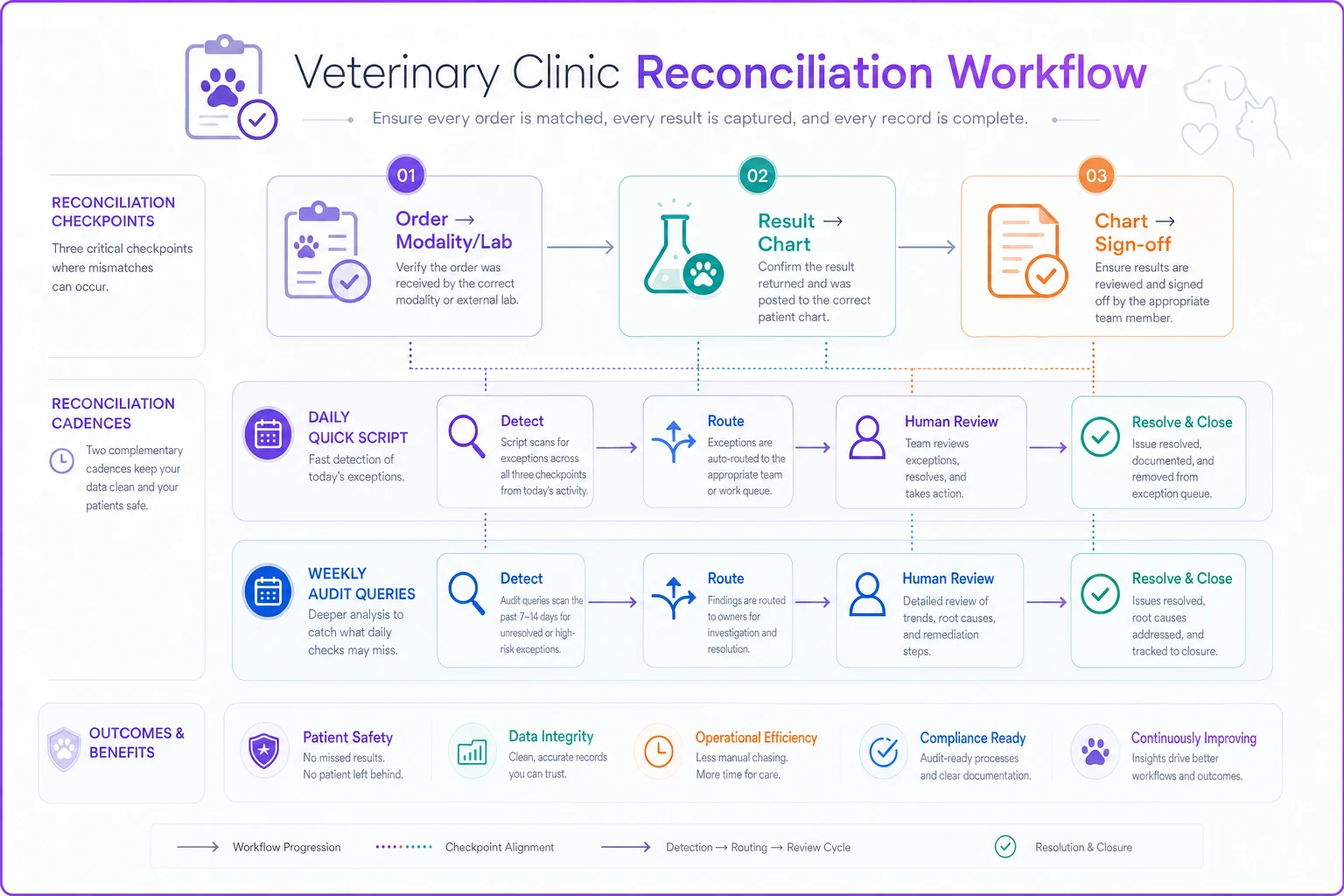
A simple visual of the three checkpoints and the daily/weekly rhythms helps teams understand where to run scripts and where automation should surface issues.
Daily reconciliation script (10–15 minutes)
Assign this to one person per shift — usually a lead tech or the imaging-responsible CSR. The point is that it's short, specific, and repeatable, not a project.
-
Pull today's imaging orders from the EMR. Compare against the PACS/modality study list for the same date. Flag any order with no matching study, and any study with no matching order.
-
Pull today's lab orders (in-house and sent-out). Confirm each has either a result filed or a documented "pending/sent" status. Anything with no status gets a note.
-
Check the interface error queue (HL7/DICOM failed messages). Clear or escalate every entry. An empty queue should be confirmed, not assumed.
-
Scan the reference lab portal for any results posted today that aren't in the EMR. Import and attach, then verify the attachment landed on the correct patient.
-
Flag duplicate-patient suspects — any case where a study attached to a record that differs by a character or an old address. Merge per your record-governance rules.
Assign the daily script to one consistent role per shift (lead tech or imaging-responsible CSR) so it becomes routine rather than optional.
Anything unresolved at end of shift goes on a short handoff list. Not into someone's head.
Weekly audit queries (the slow-leak catch)
Daily catches today. Weekly catches the patterns. These are the queries to run — your EMR/PIMS reporting or a quick database pull can usually produce them:
-
Orders older than 72 hours with no result. The classic orphan list. Sort by test type; pre-op and oncology items get priority.
-
Studies/results with no linked order. Results that arrived without a home — usually verbal add-ons or portal imports that never got matched.
-
Patients with multiple MRNs created in the last 30 days. Each one is a future orphan.
-
Results filed but not marked reviewed after 48 hours. Attachment worked; the clinical loop didn't close.
-
Sent-out panels with no result and no "received by lab" confirmation. Catches samples that never made it — which ties directly into standardized lab collection, labeling, and result-routing, where a lot of these breaks actually start.
Run these the same day each week. Friday mornings work well — catches the week's accumulation before the weekend buries it.
A short investigation playbook
When reconciliation flags something, you don't want people improvising. A simple decision path keeps it fast:
If an order has no result:
-
Check the modality or analyzer directly — was it acquired or run under a different patient ID?
-
Check the interface error queue for a failed message tied to that accession.
-
Check the reference portal if it was sent out.
-
If it genuinely wasn't done, determine whether it was never collected versus collected-and-lost. Those have different fixes.
If a result has no order:
-
Identify the patient and date from the study or result metadata.
-
Find the visit it belongs to and whether a verbal order was given.
-
Retro-create the order with a note, attach the result, and flag the verbal-order gap for the team.
The second pattern — results with no order — is the one that reveals process problems. If you're retro-creating a lot of orders, the real fix is upstream: stop accepting verbal add-ons without something placed in the system.
Where automation actually helps here
You can run all of this manually, and smaller clinics do. The trouble is that manual reconciliation depends on a person remembering to do it on the busy days — which are exactly the days things get orphaned.
An operational platform with AI-assisted reconciliation earns its place not by making clinical decisions, but by doing the cross-system matching continuously instead of once per shift. A workflow system watching the order queue, the PACS, the lab interface, and the portal can auto-flag an order that's been open past its expected turnaround, surface a result that arrived without a matching order, and route it to the right person — before anyone thinks to check. The reconciliation still happens; the software just removes the "did someone remember" dependency.
The practical model: automation handles detection and routing (what's unmatched, who should fix it), humans handle judgment (is this clinically urgent, which record is the real one, retro-create or not). Tying automated QA checks into your lab and imaging interfaces also supports the broader vendor QA for labs and imaging work — reconciliation is partly how you verify your vendors are actually delivering what they promised.
PIMS/EMR integration by clinic setup
The right reconciliation design depends on how your systems are wired.
Single PIMS + in-house analyzers + CR/DR, no reference lab portal dependency. The cleanest case. Most matching happens inside one system. Daily script focuses on order-to-study matching and the interface queue. Automation is straightforward because everything shares one patient index.
PIMS + separate PACS + reference lab portal. The most common mid-size setup, and the most orphan-prone. Three systems, three patient indexes, three chances to mismatch. Reconciliation has to cross all three. Weekly portal sweeps are non-negotiable here, and MRN governance across systems matters more than almost anything else.
Multi-location with a shared EMR but local imaging. Studies acquire locally but chart centrally, so orphans hide behind location boundaries. Run reconciliation per-site daily, roll up weekly at the group level. The common mistake is assuming the central EMR "has everything" when local modalities are where most breaks actually occur.
When a lighter version makes sense — and when it doesn't
A very low-volume clinic running a handful of studies a day can fold the daily check into end-of-day chart closing. If you're doing fewer than around 10 orderable studies a day across imaging and lab, a single end-of-day pass is usually enough.
Any clinic running a reference-lab portal alongside a separate PACS needs the full cadence. Same goes for multi-site groups and any clinic doing meaningful pre-anesthetic or oncology volume where a missed result carries real risk.
Clinics that have had even one "we never saw that result" incident should not skip reconciliation. That's not bad luck — it's an unmeasured orphan rate, and without a check in place, it'll happen again.
Real scenario
A two-doctor small-animal practice running an in-house analyzer, a CR unit, and a reference lab portal had a recurring pattern: roughly once a week, someone couldn't find a result that had definitely been ordered. They weren't tracking it formally, so the actual number was unknown.
They added a 10-minute daily script and a Friday weekly query set. The first month, the weekly "orders >72h with no result" query surfaced around 18 open items — most were portal results nobody had imported, a couple were sent-out samples with no confirmation, and one was a pre-op panel that had never actually been run.
By month three, the daily open-item count had dropped to one or two, and the Friday query rarely turned up more than a handful. Reshoot and re-draw rates dropped. But the bigger change was quieter: the "where's that result" scramble basically stopped, and referral packets went out complete the first time.
The takeaway
Orphaned studies aren't caused by broken machines or careless staff. They're caused by handoffs between systems that nobody is routinely checking against each other. EMR imaging lab reconciliation in a veterinary setting is just the discipline of confirming — on a daily and weekly rhythm — that every order produced a result and every result found its chart.
Start with the daily 10-minute script and the five weekly queries. Run them for a month and count what they catch. The number will tell you how big your silent orphan problem already was — and whether it's time to let a workflow platform watch the gaps continuously instead of relying on someone remembering to look.
Ready to elevate your clinic’s efficiency?
Join 500+ veterinary clinics using Veterinaryly to save time, reduce administrative overhead, and improve patient care.