

Most clinics don't have an integration problem until they suddenly have five of them at once. The PIMS update that broke the lab result feed. The payment processor that quietly stopped posting transactions after changing an API endpoint. The imaging bridge that started dropping study links after a vendor "improvement." Each one feels like a one-off emergency. It isn't. It's the predictable result of running integrations with no governance behind them.
The uncomfortable truth: your clinic is now a small software company whether you wanted to be one or not. You're running six to twelve connected systems passing data back and forth hundreds of times a day. Nobody owns the connections between them. And when one breaks, it usually doesn't announce itself — it shows up three days later as a missing charge, an orphaned result, or a client asking why they got billed twice.
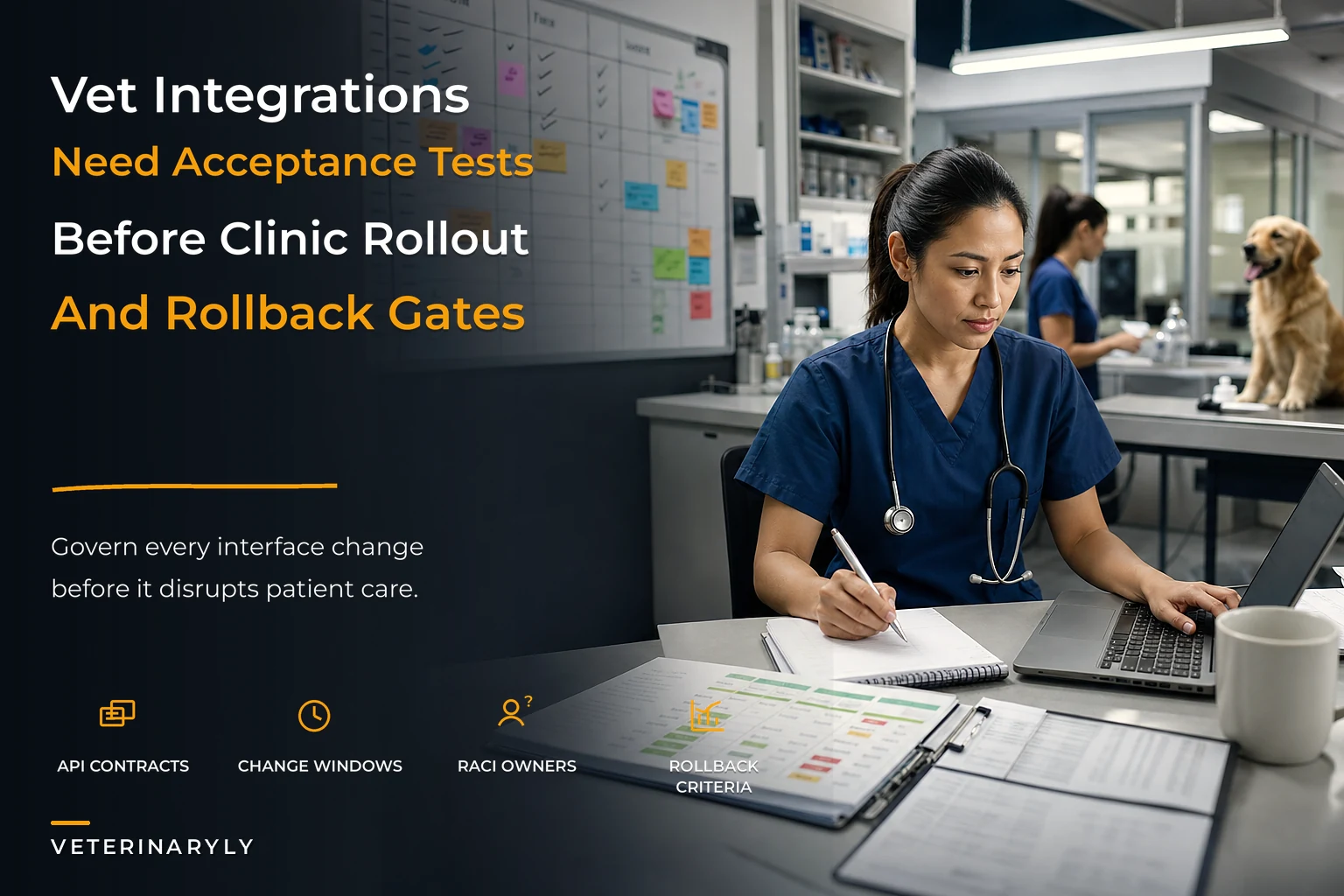
This playbook is about building the connective tissue: who's responsible for what, what you demand from vendors before you connect anything, how you test changes before they go live, and how you catch silent failures before they cost you money. The goal of veterinary integration governance isn't bureaucracy. It's preventing the slow bleed that nobody notices until the monthly reconciliation doesn't add up.
Why integrations break in ways you don't see coming
Integrations fail differently than most clinic systems. A broken autoclave is obvious. A broken API is invisible until the downstream damage surfaces.
The core problem is that every integration is a handshake between two systems built by different teams, updating on different schedules, with no obligation to tell you when something changes. Your PIMS vendor pushes an update Tuesday night. Your lab vendor rolls out a new result format next month. Neither coordinates with the other, and neither considers that the bridge between them lives in your clinic's workflow.
-
Silent field changes. A vendor renames or reformats a data field — say, how they encode a patient ID. Nothing errors out. Results just start landing in the wrong record or failing to match entirely.
-
Authentication expiry. API keys and tokens expire. When nobody owns renewal, a feed dies at 2 a.m. and you find out when a tech goes looking for a result that never arrived.
-
Partial success. The most dangerous failure mode. 95% of records sync fine; 5% silently drop. Everything looks healthy on the surface, so nobody investigates until the gaps accumulate.
-
Version drift. Three systems each assuming the other two behave a certain way. One updates, the assumptions break, and the symptom appears somewhere unrelated.
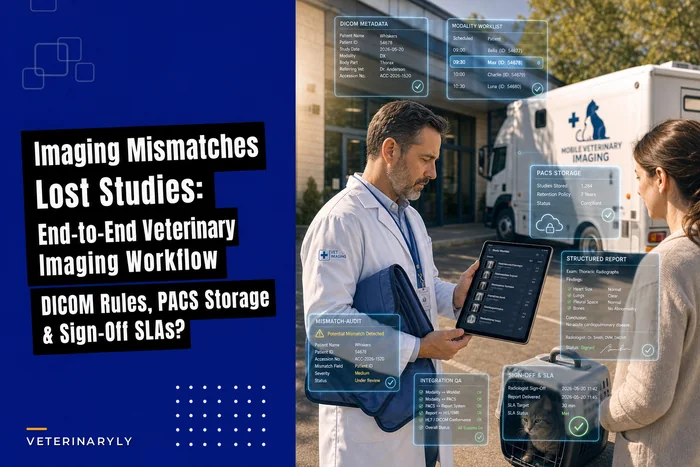
None of these are dramatic crashes. They're quiet divergences. And in a clinic, quiet divergences become lost revenue, missed diagnostics, and compliance exposure. We've covered how this plays out in diagnostics — the way studies get orphaned when EMR, imaging, and lab systems fall out of sync — but the governance problem underneath is universal.
What breaks as you grow
A single-doctor clinic with a PIMS and one lab integration can get away with no governance. The doctor notices when something's off because they touch everything.
Never miss a pet’s appointment again.
Veterinaryly helps you schedule, confirm, and manage every appointment and patient record effortlessly.
- Centralized appointment & patient management
- Automated client reminders
- Staff scheduling & task tracking
No credit card required
| Clinic stage | Typical integrations | What breaks | Who notices |
|---|---|---|---|
| Solo / 1 location | PIMS + 1 lab | Rare, obvious failures | The doctor, same day |
| 2–4 doctors | PIMS, 2 labs, imaging, payments | Silent drops start appearing | Front desk, days later |
| Multi-site | Add pharmacy, online booking, reminders, reporting | Cross-system mismatches, duplicate records | Nobody, until reconciliation |
| Multi-site + central admin | 10+ connected systems | Cascading failures, version drift | Depends entirely on monitoring |
The jump from "the doctor notices" to "nobody notices" happens earlier than owners expect — usually around the second or third doctor. That's when the person who understands the whole data flow stops touching every transaction. From there, failures live in the gaps between people's responsibilities, which is exactly where governance has to step in.
One thing worth internalizing: the number of failure points doesn't grow linearly with the number of systems. It grows with the number of connections between systems. Add one integration and you might add three or four new handshakes with existing systems. That's why clinics that felt stable at four systems suddenly feel chaotic at six.
The RACI foundation: deciding who actually owns each connection
The first thing to fix isn't technical. It's ownership. In most clinics, when you ask "who's responsible for the lab integration?" the answer is a shrug or "the vendor, I guess." That's how integrations rot.
A RACI matrix — Responsible, Accountable, Consulted, Informed — forces you to name a human for each integration and each type of event. You don't need enterprise software for this. A shared spreadsheet works fine. What matters is that every integration has exactly one Accountable owner who answers for it when it breaks.
| Integration / Event | Responsible | Accountable | Consulted | Informed |
|---|---|---|---|---|
| Lab result feed | Lead vet tech | Practice manager | Lab vendor | Front desk |
| Payment posting | Front desk lead | Practice manager | POS vendor | Owner |
| Imaging study links | Imaging tech | Medical director | PACS vendor | Techs |
| PIMS core updates | Practice manager | Owner | PIMS vendor | All staff |
| Reminder/booking sync | Front desk lead | Practice manager | Booking vendor | — |
The non-obvious part: Accountable and Responsible should rarely be the same person for critical integrations. The person doing day-to-day work is heads-down in the task. The person who answers for it needs enough distance to notice when something's drifting. When one person holds both roles, problems get normalized — they work around the broken thing instead of escalating it.
Assign the Accountable role to someone whose job includes cross-system visibility, not only the person who fixes issues day-to-day.
The RACI also fixes vendor coordination. When your lab vendor and PIMS vendor both change something, the Consulted column tells you exactly who to loop in. Without it, you get the classic finger-pointing standoff where each vendor swears the problem is on the other side while your results sit in limbo.
The API contract checklist: what to demand before you connect anything
Most clinics connect a new system by clicking "authorize" and hoping. Then they discover the actual behavior of the integration during an outage, which is the worst possible time to learn it.
Before you turn on any new integration, get clear answers — in writing — to a specific set of questions. This isn't legal contract language. It's the operational contract of how the data actually behaves.
-
What data flows, in which direction, and how often? Real-time, batched, nightly? One-way or two-way?
-
How are records matched between systems? Patient ID, client ID, a combination? What happens when a match fails — does it error, queue, or silently drop?
-
What's the authentication method and when does it expire? Who gets notified before a token or key dies?
-
How does the vendor notify you of changes? Email, a status page, an API changelog? How much notice for breaking changes?
-
What's the retry behavior on failure? Does it retry automatically, hold records in a queue, or lose them?
-
Is there a sandbox or test environment? You can't safely test changes against live patient data.
-
What are the rate limits? What happens when you hit them during a busy morning?
-
Who do you call, and what's the response time? A support email with a 48-hour SLA is useless when payments stop posting.
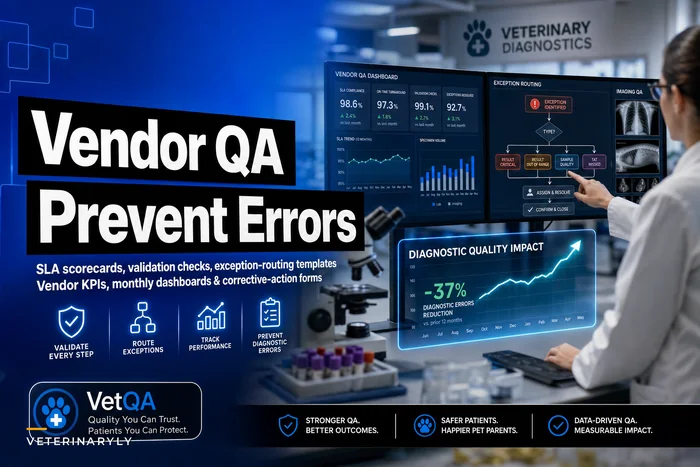
Vendors are happy to answer these before you sign and strangely evasive about them after. Get the answers while you still have leverage. For labs and imaging specifically, this connects directly to the kind of vendor QA that prevents diagnostic errors — the contract-level questions and the clinical-quality questions reinforce each other.
One more thing clinics consistently miss: ask how the vendor handles your system going down, not just theirs. If your PIMS is offline for maintenance and the lab tries to push results, do they queue and retry, or do those results evaporate?
Acceptance tests: proving an integration works before you trust it
An integration that connected successfully is not an integration that works correctly. "Connected" means the handshake completed. "Works" means the right data lands in the right place under the conditions you actually see in practice.
Acceptance testing is where you prove the second thing. The mistake clinics make is testing only the happy path — one clean record flows through, everyone nods, done. But integrations break on edge cases: the patient with two owners, the result that comes back after the appointment closed, the duplicate record, the special character in a pet's name.
-
Clean match — standard patient, standard result. Confirm it lands in the correct record.
-
Failed match — send a result for a patient ID that doesn't exist. Confirm it queues or errors visibly rather than disappearing.
-
Duplicate patient — two patients with the same name, different IDs. Confirm the result attaches to the right one.
-
Late result — result arrives after the visit is closed. Confirm it still attaches and flags for review.
-
Partial batch — send 20 results where 2 are malformed. Confirm the 18 good ones process and the 2 bad ones are flagged, not silently dropped.
-
Special characters — pet name with an apostrophe or accent. Confirm nothing breaks on encoding.
-
Reconnection — simulate the feed dropping and coming back. Confirm queued records catch up.
The test cases that matter most are the failure cases, not the success cases. If you only confirm that good data flows correctly, you've learned nothing about what happens when bad data shows up — and bad data always shows up. Your acceptance criteria should explicitly state that a failed match must be visible, not silent. That single requirement prevents most of the orphaned-record problems clinics end up chasing.
Document each test, the expected result, and who signed off. When a vendor change breaks something six months later, you have a baseline to point to instead of a debate about whether it ever worked.
Here's the acceptance testing workflow for a new or changed integration.
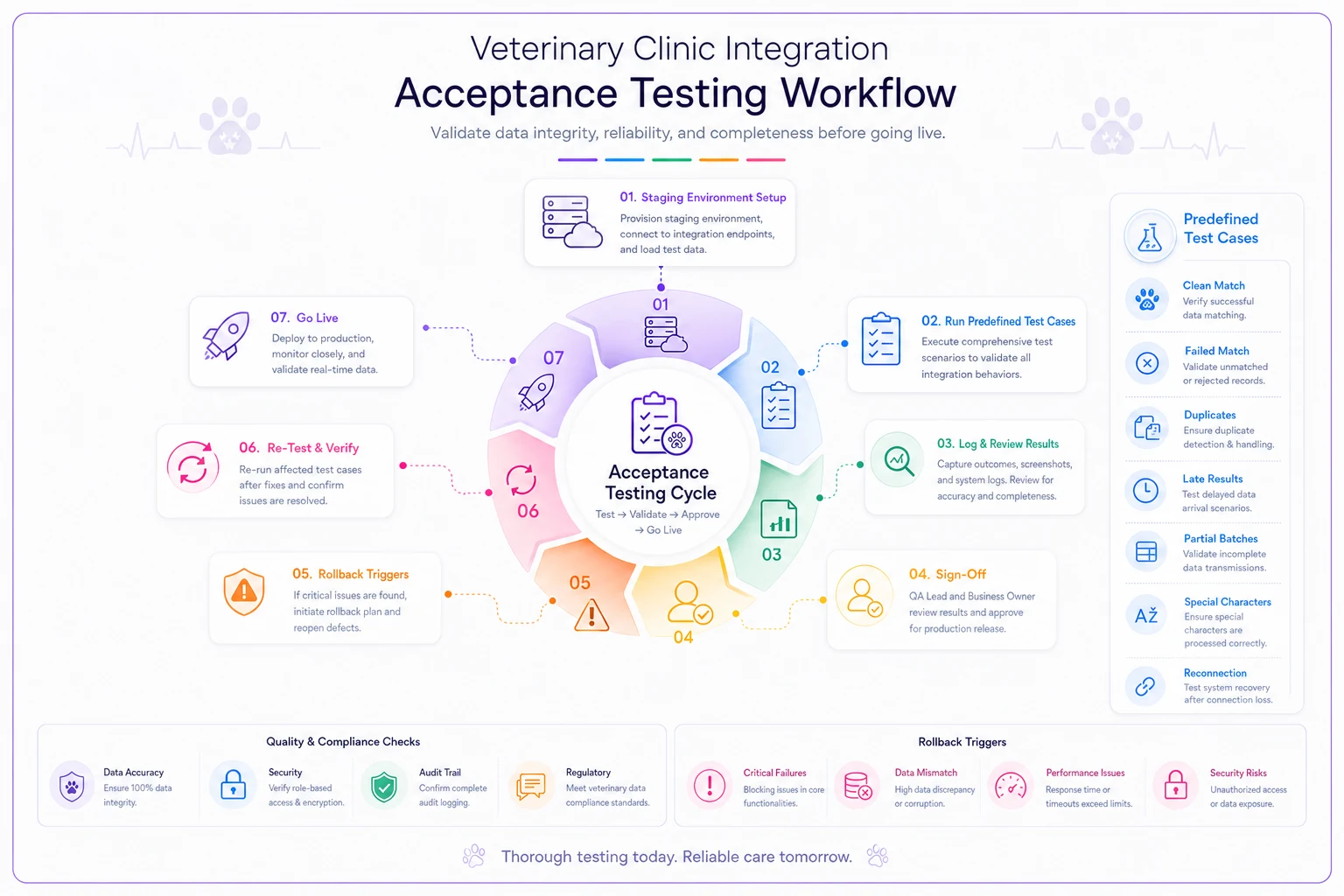
Use this workflow to make testing repeatable, documented, and auditable so you can point to the exact steps that proved an integration worked.
Rollback criteria: knowing when to pull the plug
Every integration change needs a pre-agreed answer to one question: at what point do we revert?
Clinics get this wrong by deciding in the moment, usually under pressure, usually optimistically. The payment integration is dropping 3% of transactions, but reverting feels like a bigger disruption, so everyone agrees to "watch it." Three days later you've lost track of which charges posted and which didn't, and the cleanup takes a week.
-
Revert if more than X% of records fail to sync in the first hour.
-
Revert if any charge-related data is lost (zero tolerance — financial data gets no grace period).
-
Revert if matching errors exceed a set threshold.
-
Revert if the failure can't be diagnosed within a defined window.
The decision to roll back should be made by data hitting a threshold, not by someone's gut read in the middle of a stressful morning. When you've pre-committed to "revert if charge data is lost, no exceptions," you remove the emotional negotiation that keeps broken systems limping along.
And rollback has to actually be possible. Before you deploy, confirm you can revert — that the old configuration still exists, that the vendor supports it, and that reverting won't itself lose data. A rollback plan you can't execute is just a wish.
Vendor change windows: controlling when things change
Vendors update on their schedule, not yours. But you have more control over the timing than most clinics exercise.
-
Negotiate change notification into the relationship. You want advance notice of any breaking change — ideally a week, minimum a few days.
-
Define your own change windows. Updates to connected systems happen during low-traffic periods — early mornings on slow days, not Monday at 8 a.m. If a vendor controls their own deploy timing, push to align it with your window.
-
Never stack changes. Don't let a PIMS update and a lab update land the same week. When two systems change simultaneously and something breaks, you can't isolate which change caused it.
-
Freeze during high-stakes periods. No integration changes right before a known busy stretch or during year-end reconciliation.
Clinics tend to treat vendor changes as weather — something that happens to them. The ones that stay stable treat changes as events they schedule and gate. The end-to-end imaging workflow challenges around DICOM handling and sign-off SLAs get dramatically worse when imaging vendor changes land unannounced during a busy diagnostic week. Controlling the change window is half the battle.
The integration-health cadence: catching silent failures on a schedule
This is the piece almost nobody does, and it's the one that prevents the slow bleed.
Because integration failures are often silent, you can't rely on noticing them. You have to go looking on a schedule. An integration-health cadence is a recurring check — weekly, monthly, quarterly — where someone verifies that each connection is actually doing what it's supposed to.
Weekly (15 minutes):
-
Spot-check that recent lab results and imaging studies matched to the correct records
-
Confirm payment posting reconciles against the processor
-
Review any error queues or failed-sync logs
Monthly (1 hour):
-
Run the full count
records sent vs. records received for each integration
-
Check for the silent 5% — records that should have synced but didn't
-
Review authentication expiry dates coming up in the next 90 days
-
Confirm the RACI is current (people leave, roles shift)
Quarterly (half a day):
-
Re-run the acceptance test suite against each critical integration
-
Review vendor change logs for the quarter
-
Audit the integration inventory — did someone connect a new system nobody documented?
The number that matters most in the monthly review is the reconciliation gap: records entered into one system versus records that landed correctly in the other. In healthy integrations, that gap is near zero. When it starts creeping — even a few percent — you've caught a silent failure before it compounds into a month of lost data.
Most clinics discover their integration gaps during financial reconciliation, which means they discover them 30 days late, after the trail has gone cold. Moving that check upstream — a weekly spot-check and a monthly full count — turns a painful forensic cleanup into a five-minute fix.
When this level of governance makes sense (and when it's overkill)
Not every clinic needs all of this, and pretending otherwise just creates process theater.
When full governance makes sense:
-
You're running six or more connected systems
-
Multiple doctors and no single person touches every transaction
-
Money flows through an integration (payments, billing, pharmacy)
-
You're multi-site, where a silent failure replicates across locations
When a lighter version is fine:
-
Solo or two-doctor clinic with two or three integrations
-
The owner still personally touches most of the data flow
-
No critical financial data moves automatically between systems
A solo clinic doesn't need a quarterly acceptance-test audit. It needs the RACI (even if it's one name in every box), the API contract checklist before connecting anything new, and a monthly ten-minute reconciliation check. Start there and add structure as you add systems.
Who should not try to build this all at once: a clinic in the middle of a PIMS migration, or one that just added three integrations this quarter. Stabilize what you have, then layer in governance. Trying to govern a system that's still actively changing is like trying to map a river during a flood.
A real scenario
A three-doctor small-animal practice added an online booking system that synced appointments to their PIMS and triggered reminder messages. The first few weeks looked fine.
Then the reconciliation gap showed up. Roughly 4–6% of online bookings weren't creating matching records in the PIMS — specifically, bookings from new clients or clients whose names included an apostrophe. Those appointments existed in the booking tool but never generated a reminder, and the front desk had no idea they were coming. The clinic was quietly losing somewhere around 8–12 appointments a month to no-shows that were really sync failures, plus the staff time spent untangling double-bookings when a client called to confirm an appointment the PIMS had never seen.
Nobody had defined an owner, so the problem bounced between "the booking company" and "our PIMS" for about six weeks. Once they assigned an accountable owner (the practice manager), ran a basic acceptance test suite, and added a weekly reconciliation check comparing bookings-in to records-created, they found the encoding bug, got the vendor to fix it, and closed the gap. The recovered appointments worked out to somewhere in the $2k–$4k per month range, but the bigger win was the front desk stopped getting ambushed by appointments they'd never seen.
The failure wasn't exotic. It was a special-character encoding bug — the kind of thing a single acceptance test case would have caught on day one. It ran for six weeks because of governance, not technology: no owner, no test, no scheduled check.
Pulling it together
Integration governance isn't a project you finish. It's a cadence you maintain.
The clinics that stay stable as they grow aren't the ones with the fanciest systems — they're the ones who decided early that someone owns each connection, that nothing connects without a contract checklist, that changes get tested and gated, and that silent failures get hunted on a schedule. Build it in the order your clinic actually needs it: ownership first, contracts before connecting, tests before trusting, and a health cadence that catches quiet failures while they're still small.
The systems in your clinic are only as reliable as the handshakes between them, and those handshakes are invisible until they break. The whole point of veterinary integration governance is to make the invisible visible — to put a human, a test, and a scheduled check behind every connection so the slow bleed never gets a chance to start.
Ready to elevate your clinic’s efficiency?
Join 500+ veterinary clinics using Veterinaryly to save time, reduce administrative overhead, and improve patient care.