



Most clinics don't have a staffing problem. They have a forecasting problem that shows up looking like a staffing problem.
The symptom is familiar: you're short a technician on a Tuesday, overstaffed on a Thursday, your best DVM is quietly burning out, and every month payroll creeps up without a clear reason. Owners usually respond by hiring. Then six months later they're back in the same spot, except now with a bigger wage bill and the same uneven days.
What's actually broken is that the pieces of workforce planning — demand, roles, flex capacity, and pay — are being managed as four separate decisions driven by four different gut instincts. When they aren't connected, every one of them drifts. This article is about treating them as a single connected model, and what changes when your clinic grows past the point where one person can hold the whole schedule in their head.
Why the four pieces drift apart
Think of workforce capacity as a chain: demand forecast → role mix needed to meet that demand → float capacity to absorb variation → pay bands that keep the whole thing affordable and retainable. Each link feeds the next. Break one, and the strain shows up somewhere downstream, usually somewhere that looks completely unrelated.
A typical example: a clinic forecasts demand informally — "we're busy, we need people." They hire based on who's available, not which competency they're actually short on. The new hire can't run anesthesia solo yet, so the experienced techs still carry the hard cases. Overtime climbs. The owner raises pay to stop people from leaving, but does it reactively and unevenly — now two techs doing the same work are $4–5/hour apart with no documented reason. Resentment builds. Someone quits. Demand hasn't changed, but capacity just dropped, and you're back at the start.
No single decision was crazy. The failure was that none of them talked to each other.
Start with demand, but forecast the right unit
Appointment count is the wrong forecasting unit, and it quietly ruins capacity math. Two clinics can book the same 32 appointments in a day and have completely different staffing needs depending on case mix. A day heavy on recheck exams and nail trims burns far less skilled-labor capacity than a day with three dental procedures, two sick visits that convert to diagnostics, and a surgery block.
Never miss a pet’s appointment again.
Veterinaryly helps you schedule, confirm, and manage every appointment and patient record effortlessly.
- Centralized appointment & patient management
- Automated client reminders
- Staff scheduling & task tracking
No credit card required
| Appointment type | Avg DVM minutes | Avg tech minutes | Capacity load (relative) |
|---|---|---|---|
| Wellness / vaccine | 10–12 | 15 | 1.0 |
| Sick visit (no diagnostics) | 18–20 | 20 | 1.6 |
| Sick visit → diagnostics | 20 | 40–50 | 2.4 |
| Dental (non-extraction) | 15 | 90+ | 3.5 |
| Surgery block | varies | 120+ | 4.0+ |
| Recheck / tech appointment | 0–5 | 15 | 0.6 |
Now your forecast becomes: not "we expect 30 appointments Tuesday" but "we expect roughly 42 load-units Tuesday, with a heavy afternoon." That number maps directly onto how many people — and which skill levels — you actually need on the floor.
Clinics that forecast by raw appointment count chronically understaff their high-mix days and overstaff the light ones, then blame staff for the inconsistency. The inconsistency was baked into the forecast.
Competency ladders: the link everyone skips
This is the piece most clinics never formalize, and it's the hinge the whole system turns on. A "technician" is not a unit of capacity. A tech who can place an IV catheter, monitor anesthesia, run in-house bloodwork, and triage a walk-in is maybe 2–3x the capacity of one who can't do any of those things unsupervised.
If you don't track competency explicitly, your capacity math is built on a fiction. You think you have five techs of capacity. You actually have two who can run the hard stuff and three who need supervision — which means your real skilled-capacity number is far lower than headcount suggests, and it collapses the moment one of those two calls in sick.
A competency ladder makes skilled capacity visible. It doesn't need to be elaborate. The useful version has three things:
-
Defined levels per role (e.g., Tech I, II, III, lead) with concrete sign-off skills at each level — not vibes, actual checkable competencies
-
A current map of who sits where, so you can see your real skilled-capacity depth at a glance
-
A progression path so people know what moving up requires and roughly how long it takes
This connects directly to how you develop and keep people. If your ladder shows you're thin on anesthesia-qualified techs, that's not a hiring problem — it's a training-priority problem, and it's cheaper to solve by advancing existing staff. The clinics that get this right treat the competency map as a capacity-planning document, not just an HR formality. It ties straight into a structured recruitment and retention system, because the ladder is the retention mechanism — people stay when progression is visible and fair.
One mistake worth naming: promoting someone to fill a gap without the sign-offs behind it. You make someone a Tech III because you're desperate. They're now paid and scheduled like a III, but can't actually carry III-level work. Your capacity math inflates, error rates climb, and your senior techs quietly absorb the gap — and quietly resent it.
Float pools: capacity for the variation you can't schedule away
Even a solid forecast is still a forecast. Some Tuesdays blow up. A float pool — cross-trained staff, PRN employees, or a shared bench across sites — is how you absorb variance without carrying expensive permanent overstaffing on every shift.
The math is a comparison between two costs:
-
Permanent overstaffing — carrying enough fixed headcount to cover your busy days means paying for idle capacity on the light ones.
-
Undercapacity — overtime, rushed appointments, longer wait times, staff burnout, and the slow-bleed turnover that follows.
A float pool sits between them. You staff your fixed roster to roughly your median demand day, not your peak, and flex the difference with float capacity. Instead of paying full-time wages for peak-day coverage that's idle more than half the time, you pay float capacity only when the load actually shows up.
Where this breaks: float only works if your floaters are genuinely cross-competent. A "float" who can only do wellness visits doesn't help you on the day your surgery block explodes. This is exactly why the competency ladder has to exist before the float pool makes sense — your float capacity is only as flexible as your cross-training. The two are joined at the hip.
Multi-site clinics have a structural advantage here. A shared float bench across locations smooths variance that a single site can't. If one location is slammed and another is light, float movement rebalances both — but only if you've built the operating discipline to coordinate it, which is a whole separate governance question in a multi-site operating model.
Pay-band design: the link that keeps the rest from unraveling
You can have a good forecast, a clean competency ladder, and a flexible float pool, and still watch it fall apart if pay is set reactively. Pay bands are what make the competency ladder mean something and what keep retention from turning into a bidding war.
A pay band ties compensation to competency level, not to who negotiated hardest or threatened to leave most recently. Each ladder level gets a range — a floor, a midpoint, a ceiling. Movement within the band reflects experience and performance; movement between bands requires the competency sign-offs. The discipline is in refusing to pay someone at a level they haven't earned, and refusing to let two people at the same level drift $5/hour apart with no documented reason.
When pay bands are missing, the failure is slow. Someone gets a competing offer, you match it off-cycle, now they're out of line with a peer doing identical work. That peer finds out — and they always find out — and either leaves or demands a match. You match. Your wage structure becomes a patchwork with no logic, your labor cost has climbed without any corresponding capacity gain, and new hires arrive confused about where they stand. Pay compression sets in. That's a turnover engine, not a retention strategy.
When tight pay bands are the wrong call
Rigid bands aren't always right. In a genuinely thin labor market — a rural clinic that can't find a qualified anesthesia tech within an hour's drive — holding the band firm can mean going unstaffed, which is worse. The fix isn't to abandon bands; it's to make the exception explicit and documented ("market premium, this role, reviewed quarterly") rather than letting it quietly become the new unlabeled normal. The danger is never the exception itself. It's the undocumented exception that nobody remembers the reason for two years later.
Decision thresholds: when to hire, train, float, or hold
Linking all four pieces gives you rules instead of reactions. When demand, competency, float, and pay sit in one model, you can set thresholds that tell you which lever to pull.
A workable set of thresholds:
-
Overtime running above ~8–10% of total hours for 3+ consecutive weeks → structural undercapacity, not a bad week. Time to add fixed headcount or deepen the float pool.
-
Skilled-capacity depth of 1 at any critical competency (only one person can run anesthesia, dental radiographs, etc.) → a training priority, immediately, regardless of overall headcount. Single points of failure are the most expensive gap you can carry.
-
Forecasted load exceeds fixed-roster capacity on fewer than ~2 days per week → flex with float, don't hire. Permanent headcount for occasional peaks is how wage bills balloon.
-
Float utilization consistently above ~70% → your "flex" has become baseline demand. The forecast has shifted. Convert that float capacity to a fixed role.
-
Turnover in a role above ~20% annually → check pay-band integrity and progression clarity before you touch anything else. It's usually one of those two.
These thresholds only work if the underlying data is clean — which is where most clinics actually stall. You can't apply a rule about "overtime above 10%" if nobody can pull overtime-by-role in under an hour. This is where connecting scheduling to the capacity model matters, and why moving off reactive, gut-feel rostering toward a capacity-based scheduling system is usually the first practical step — it's the layer that makes every threshold above measurable instead of theoretical.
The diagram below maps thresholds to actions so you can see which lever to pull.
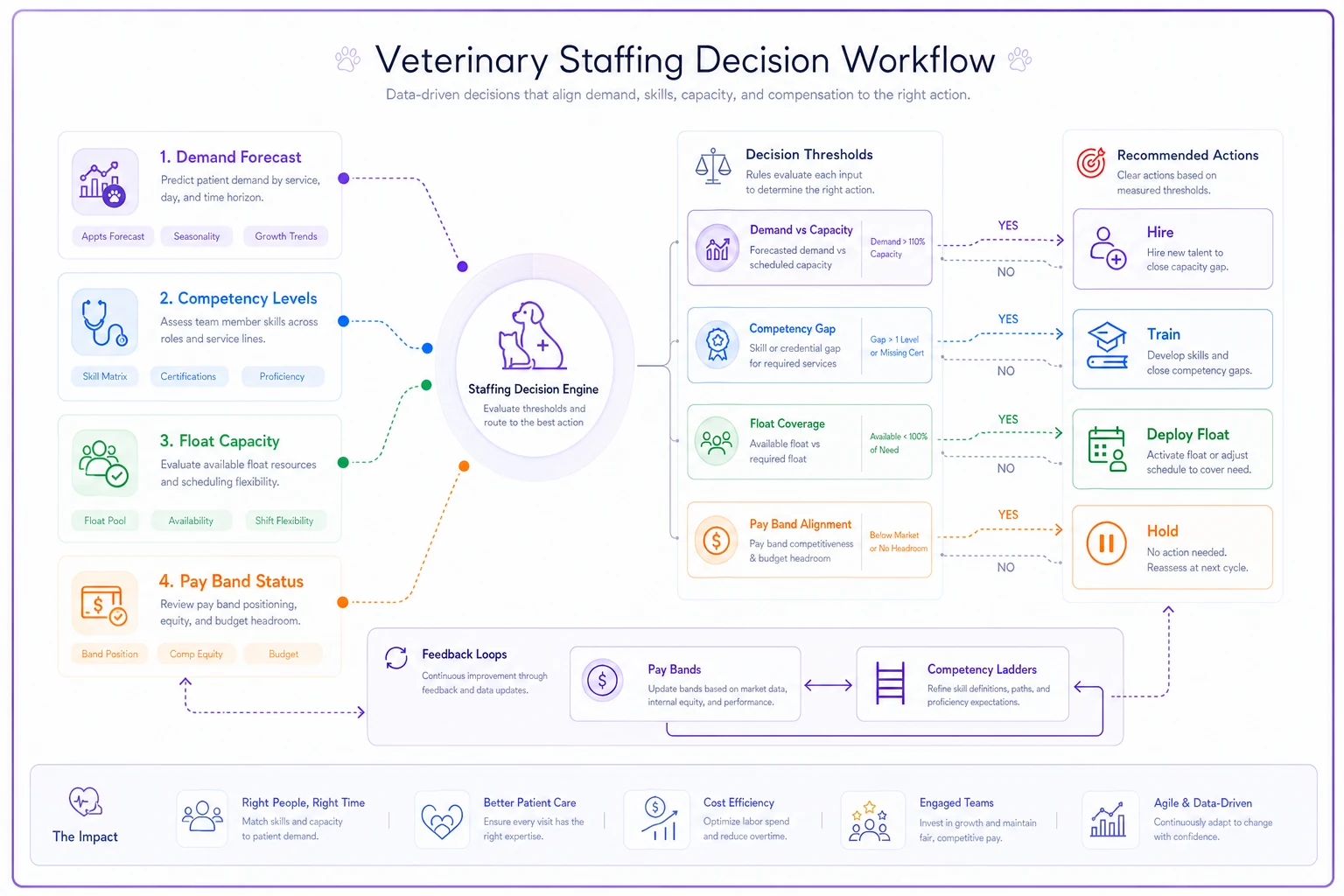
Use the flow to align thresholds with operational levers and make the decision process repeatable.
A real scenario
A two-DVM suburban small-animal clinic, growing, running roughly 320–360 appointments a month. Payroll kept rising — overtime was eating somewhere around $3k–$4k a month — and two of their four techs were clearly fried. The obvious read: hire another tech.
When they actually mapped it, the picture looked different. Raw appointment counts were manageable. The problem was that high-mix days — dentals stacked with surgery and walk-ins — kept landing on the two most senior techs, while the two junior techs hired the previous year had never been formally cross-trained on anesthesia monitoring or in-house diagnostics. Skilled-capacity depth was effectively two, not four. And pay had drifted: one junior tech was earning nearly as much as a senior one after an off-cycle match, with no sign-offs to justify it.
They didn't add a new hire. They built a three-level competency ladder, put the two junior techs on a defined progression plan to close the anesthesia and diagnostics gap over about a quarter, re-sequenced the schedule so high-load days were spread across skill levels instead of dumped on two people, and corrected the pay drift on the next review cycle rather than off-cycle.
Within three to four months, overtime dropped by more than half — down to roughly $1k–$1,500 monthly. The senior techs stopped carrying every hard case alone. Nobody quit. And the clinic absorbed continued growth without the full-time salary it had been about to commit to. The "staffing shortage" was a competency-mapping and pay-drift problem the whole time.
What changes as you grow
At one site with a tight team, an owner can hold all four pieces in their head. The forecast is intuition, the competency map is "I know what everyone can do," the float pool is "I'll just call someone," and pay is loosely remembered. It works — until it doesn't. Usually somewhere around the second DVM and the eighth or tenth staff member, when no single person can track all of it anymore.
That's the threshold where informal planning starts costing real money. The forecast gets wrong more often. The competency map lives in one person's memory and breaks the day they're out. Pay drifts because there's no documented structure. Float becomes frantic phone calls. Every failure point in this article tends to surface at roughly the same growth stage, because they were always connected — the growth just exposed it.
The clinics that scale cleanly externalize the model before they're forced to: demand forecast in labor-weighted units, a written competency ladder tied to pay bands, defined float capacity, and threshold rules that say which lever to pull when. That's not bureaucracy for its own sake. It's the difference between a workforce you plan and one that just happens to you — and that difference compounds every month you keep growing.
Ready to elevate your clinic’s efficiency?
Join 500+ veterinary clinics using Veterinaryly to save time, reduce administrative overhead, and improve patient care.